Showing posts with label Martyn "Bomber" Bradbury. Show all posts

Friday, 8 December 2017

Trump Recognises Jerusalem: The Zionist End-Game Begins.

There Can be Only One: No matter how eloquently the partisans of a Jewish homeland reassured their Arab neighbours that they had nothing to fear from a future State of Israel, the brute logic of Zionism argued against the longevity of any such attempt at cultural and religious cohabitation. Sooner or later, the sheer impossibility of the two communities, Jewish and Arab, rubbing along together in peaceful coexistence would become apparent. And when that happened, one of those communities would have to go.

“APOCALYPSE IN THE VALLEY OF ARMAGEDDON”. The Daily Blog editor, Martyn Bradbury, certainly displays a gift for evocative language! On the subject of President Donald Trump’s recognition of Jerusalem as Israel’s capital, however, I believe Martyn’s evocation of the apocalypse is premature. Trump’s decision is less a sign that Armageddon is imminent, and more a signal that the Zionists’ end-game is about to begin.

By announcing the United States recognition of Jerusalem as Israel’s capital, Trump has sent two very important messages to the extreme Zionist elements in Israeli society. The first message is brutally simple: the so-called “two-state solution” to the Israeli-Palestinian conflict is dead. The second, to the government of Benjamin Netanyahu, is that, as the political logic of the two-state solution’s demise is followed to its inevitable and brutal conclusion, the United States has got Israel’s back. Not just at the UN Security Council, but everywhere Israel needs American support.

The political logic of the two-state solution’s demise is inextricably bound up with the relentless colonisation of the West Bank by extreme Zionist “settlers”. Essentially, the so-called “settlements” were planted on the West Bank in order to render the formation of a viable Palestinian state impossible. The larger those settlements grow, the tighter the hands of Israeli politicians are bound. The political cost of dismantling the settlements has risen so high that no sensible Israeli any longer believes that a Palestinian state is achievable.

This leaves the Israeli authorities with two options. They can either continue to act as an army of occupation on the West Bank of the Jordan River: controlling every aspect of the Palestinian people’s lives, while Zionist settlements metastasise into every corner of Palestine’s shrinking body. Or, they could simply transform the West Bank into a Palestinian-Free Zone.

This latter option has lain dormant in Zionism from its very inception. No matter how eloquently the partisans of a Jewish homeland reassured their Arab neighbours that they had nothing to fear from a future State of Israel, the brute logic of Zionism argued against the longevity of any such attempt at cultural and religious cohabitation. Sooner or later, the sheer impossibility of the two communities, Jewish and Arab, rubbing along together in peaceful coexistence would become apparent. And when that happened, one of those communities would have to go.

Ethnically cleansing the West Bank would, of course, be a gross violation of international law. It would constitute a crime against humanity on a scale not seen since the break-up of the former Yugoslavia, the Rwandan genocide and, more recently, the expulsion of the Rohingya people from Myanmar.

Protected by Donald Trump and the American veto in the UN Security Council, however, Israel is unlikely to much care what the world thinks or does. When all is said and done, isn’t its fifty-year occupation of the West Bank a blatant contravention of international law? And, haven’t Israel’s repeated incursions into Lebanon, and its brutal bombing of the civilian population of Gaza, occasioned many crimes against humanity?

If a decision to expel the Palestinians from the West Bank is taken by the Israeli authorities, it would undoubtedly provoke fury in the Arab world. So great is Israel’s military power, however, that launching any kind of meaningful retaliation against such forced expulsions would risk a potentially devastating Israeli counter-strike.

Some of the most extreme Zionists might even welcome an Arab attack. What better justification for levelling the Al-Aqsa Mosque and laying the foundation-stone for the Third Temple?

Certainly, the rebuilding of “Solomon’s Temple” and the expansion of the State of Israel to the full extent of its biblical boundaries would be welcomed by the tens-of-thousands of so-called “Christian-Zionists” (and fervent Trump supporters) living in the United States. In their eyes, such developments would constitute proof-positive that the “End Times” had well and truly begun.

“Apocalypse in the Valley of Armageddon” would only be the beginning.


This essay was originally posted on The Daily Blog of Friday, 8 December 2017

Wednesday, 5 October 2016

Sleepy Hobbits? Or, Something Worse?

At The Sign Of The Green Dragon: Have we really become “Sleepy Hobbits”? Or, something worse? The Scouring Of The Shire is, arguably, the most important chapter in J.R.R. Tolkien's Lord of the Rings trilogy. Far more than his thrilling depiction of the battles between Wizards, Orcs and Men, it shows how evil is born out of, and fed by, the fear and greed of ordinary, outwardly decent, individuals - even the Hobbits of the Shire.
 
ARE WE “SLEEPY HOBBITS” – or something worse? Certainly, it doesn’t sound very sinister. Martyn “Bomber” Bradbury’s description of the New Zealand electorate seems a lot more like gentle chiding than a full-blown assault. Kiwis are upbraided for their general failure to respond appropriately to the increasingly alarming news reaching their ears. Comparing them to the complacent patrons of Hobbiton’s Green Dragon, Martyn chastises New Zealanders for being much more interested in listening to gossip than hearing news.
 
Martyn’s characterisation acquires greater force, however, if his audience’s only reference point is Peter Jackson’s film version of Tolkien’s Lord of the Rings trilogy. Apparently, growing concerns about the project’s burgeoning length required Jackson to leave out what is, in many respects, the most powerful chapter of the entire trilogy – The Scouring of the Shire.
 
It is only when Frodo, Merry, Pippin and Sam return home that the universal impact of Sauron’s bid for absolute power strikes them. With a rising sense of outrage, and horror, they see that their beloved Shire has been transformed into what Tolkien clearly wants his readers to recognise as an industrial wasteland. Worse still, the Hobbits themselves are in the process of being industrialised. The sturdy peasants and artisans of the trilogy’s opening chapters, along with their aristocratic masters, are on the point of being turned into proletarians. They have been driven from their hobbit-holes and herded into barracks. Trees have been cut down. The old flour mill belches black smoke.
 
Not everyone, however, believes this to be a bad thing.
 
“This country wants waking up and setting to rights … and Sharkey’s going to do it; and make it hard, if you drive him to it. You need a bigger Boss. And you’ll get one before the year is out if there’s any more trouble. Then you’ll learn a thing or two, you little rat folk.”
 
Even some hobbits have succumbed to the new order. Ted Sandyman, the miller, scoffs at Sam’s anguish at the Shire’s obliterated beauty:
 
“Don’t ‘ee like it, Sam? … But you always was soft. I thought you’d gone off in one o’ them ships you used to prattle about, sailing, sailing. What d’you come back for? We’ve work to do in the Shire now.”
 
Given the way Jackson behaved when his “independent contractors” made a bid for better wages and conditions, it is, perhaps, unsurprising that he decided to keep The Scouring of the Shire out of his movie.
 
Tolkien makes it clear that tyranny warrants only one response from those it oppresses: rebellion and revolt. Led by the four veterans of the War of the Ring, the Hobbits rise up against “Sharkey”, the new “Boss”, and overthrow his new order. More importantly, they follow the disease to its source – the Wizard Saruman, whose magic, corrupted by Sauron, has wrought so much havoc, even in the Shire.
 
It is only in Jackson’s movie that the Hobbits (with the obvious exceptions of Bilbo, Frodo, Merry, Pippin and Sam) are portrayed as sleepy and complacent. The film version, similarly, misrepresents the Shire itself. According to Jackson, it is a happy (if utterly powerless) Utopia from which brave souls, very occasionally, venture out, but into which nothing untoward – excepting, briefly, Sauron’s Black Riders – ever venture in.
 
Tolkien’s fantasy is much more realistic. His Shire is not overthrown by rampaging Orcs, but by the fear and greed of its own inhabitants. As the steadfast Farmer Cotton explains to Frodo:
 
“It all began with Pimple, as we call him … and it began as soon as you’d gone off, Mr Frodo. He’d funny ideas, had Pimple. Seems he wanted to own everything himself, and then order other folk about. It soon came out that he already did own a sight more than was good for him; and he was always grabbing more, though where he got the money was a mystery: mills and malt-houses and inns, and farms, and leaf-plantations. He’d already bought Sandyman’s mill before he came to Bag End, seemingly.”
 
If that doesn’t remind New Zealanders of the fate of their own beautiful country, then Martyn’s right, we really have become “Sleepy Hobbits”! Or, maybe, something even worse. Could it be that we, too, have fallen victim to our own Pimples, our own Ted Sandymans? That far too many of us have allowed ourselves to be ordered around by the Shirrifs? The Boss? By Sharkey?
 
We must hope not. Because in our own case – in our own Shire – we cannot rely upon four returning heroes to put things right. “Raising the Shire” is something we will have to do on our own. Forging our own swords. Stringing our own bows. Summoning our own neighbours. Only when we have fashioned our own horns and bugles will we, like Tolkien’s Hobbits in revolt, be able to send their clarion blasts echoing across New Zealand’s fields, towns and cities:
 
Awake! Awake! Fear, Fire, Foes! Awake!
Fire, Foes! Awake!
 
This essay was originally posted on The Daily Blog of Tuesday, 4 October 2016.

Sunday, 28 February 2016

Hey, Bomber! Inter-generational War Is Not the Answer To Auckland’s Problems.

Open Season On Baby Boomers: The highly topical second episode of the multi-media talk-show Waatea Fifth Estate covered the controversy surrounding housing intensification and the Auckland Unitary Plan. The otherwise excellent show was marred only by the casting of the Baby Boom Generation as the guilty party. Ageism can no more supply a progressive answer to Auckland's housing problems than racism or sexism.
 
NO, NO, NO, BOMBER!* This ageism has got to stop – now. You wouldn’t permit anyone writing for The Daily Blog to discriminate against people on the grounds of race, gender or sexuality. So what, in the name of Progressive Politics, are you hoping to achieve by blaming everyone born between 1946 and 1965 for Auckland’s housing crisis?
 
The Baby Boom generation didn’t choose their parents, Comrade! Any more than a black man chooses his ethnicity, or a woman chooses to be born female. Scapegoating people on the basis of their date-of-birth makes no more sense than scapegoating them because of their genetic make-up, or because their sex chromosomes are XX and not XY.
 
I’m genuinely affronted by all this Baby-Boomer-bashing, old friend. And if you want to know why, then I’d invite you to sit down and watch Episode 2 of Waatea Fifth Estate, and every time the word “Baby-Boomer” or “Boomer” is used, to mentally over-dub the word “Jew”.
 
Can you imagine the firestorm of criticism that would erupt if Jews were accused of preventing young Kiwis getting into their first home? Or if Jews were accused of taking all the good things that were on offer in the 1960s and 70s, and then denying them deliberately to succeeding generations?
 
Any broadcaster disseminating such ideas would immediately fall foul of both the Race Relations Act and the Human Rights Act. Because it is a criminal offence to incite racial hatred, and/or, to discriminate against one’s fellow citizens on the basis of their ethnicity or religious belief.
 
And while we’re on the subject of the Human Rights Act (1993) perhaps it would be helpful to point out that Section 21 of the legislation includes, among a long list of “prohibited grounds of discrimination”, the ground of “age”.
 
Also worth considering is the prohibition contained in the Fourth Geneva Convention against the imposition of collective punishment. Article 33 clearly states that: “No persons may be punished for an offense he or she has not personally committed. Collective penalties and likewise all measures of intimidation or of terrorism are prohibited.”
 
Progressive people are rightly outraged when the Israeli authorities inflict massive material and human damage on Palestinian communities in retaliation for the hostile actions of a few Hamas fighters. I would, therefore, like to hear the explanation for why we shouldn’t be just a teeny-wee bit upset when an entire generation of human-beings is blamed for societal ills they did not create and which a great many of them – myself included – wholeheartedly deplore.
 
Because, to be honest, Bomber, your eagerness, in Episode 2 of W5E, to see the planting of Generation X and Y settlements in the Baby Boomer occupied territories of Auckland’s leafy suburbs would have done the average West Bank Israeli settler-developer, and his IDF-protected construction teams, proud.
 
Forgive me, Comrade, but fomenting inter-generational warfare (which, ultimately, entails turning children against their parents or grandparents) is not, and can never be, a progressive cause. Indeed, it strikes at the most primal forms of human solidarity, and at the most essential drivers of human co-operation. Worst of all, Bomber, it misdirects the legitimate rage of those denied the social goods their parents were able to enjoy away from the social class which bears the actual responsibility for their destruction.
 
Just ask yourself, Bomber: Was it the Maori New Zealanders born between 1946 and 1965 who deliberately destroyed their own employment opportunities? Are they the ones responsible for gutting their rural communities? Did they set out to create urban breeding grounds for crime, domestic violence and drug abuse? And was it the Pasifika Baby Boomers who deliberately ran down their local schools and health services? Are they the ones responsible for the decay of social housing in New Zealand? Did Pakeha Boomers demand the destruction of their own unions? Must they be held responsible for the political marginalisation of the entire working class? And did all of these groups really conspire to thwart the aspirations of their own children and grandchildren?
 
Those responsible for the hollowed-out shell that is 21st Century New Zealand society are Baby Boomers only in the sense that they are also human-beings. They changed this country for the worse, not out of some mysterious generational impulse precipitated by listening to the Beatles or eating Eskimo Pies, but because it was in their interests to destroy the social-democratic beliefs and institutions that had so successfully limited their ability to enrich themselves, and which, if left in place, would have further undermined their political and cultural power.
 
The truly outrageous aspect of Auckland’s housing crisis is how effectively Auckland’s citizens have been excluded from playing any role in fixing it. The Auckland Super City is democratic in name only. It’s true purpose is to create opportunities for property developers (and all of the other businesses their activities sustain) to go on making profits. The power of Auckland’s ruling class will not be broken by setting one short-changed generation against another, but by creating a movement in which old and young join forces to determine what needs to be done, and out of whose pockets the money to pay for it should be taken.
 
* “Bomber” is the nom de guerre of Martyn Bradbury, Editor of The Daily Blog. Martyn and the author, Chris Trotter, have been friends and comrades since the mid-1990s.
 
This essay was originally posted on The Daily Blog of Saturday, 27 February 2016.

Wednesday, 22 April 2015

Upbraided, But Not Undone: John Key Will Survive "Tailgate".

Child's Play: Tugging a girl’s pony-tail – what male hasn’t? Not many, it’s true, but most of them were under twelve years-of-age – and almost none were their country's prime minister!
 
IN AMERICAN JOURNALISM there’s an expression: “The story was too good to check!” And every journalist knows what it means. A story so compelling; so freighted with significance; so certain to sell newspapers (or generate page-views) that you don’t want to go through the usual processes of verification – in case it turns out to be untrue.
 
You can imagine, then, how Martyn “Bomber” Bradbury felt when he heard the story about the Prime Minister and the pony-tail. A journalist can work in the industry for forty years and stumble onto something like this maybe once or twice – if he or she is lucky.
 
There’s a temptation to rush such a story into print, or post it immediately on the web, but in the age of Dirty Politics that is the last thing you should do. A story as big as this one could be a VRWC set-up: a complete fabrication designed to entrap the unwary blogger and explode his credibility forever. The watchword in such circumstances is always: caution.
 
And Bomber was as good as his watchword. He checked and double-checked. He sought advice. He pondered the consequences of getting it wrong. But in the end, he did what all journalists do. Having checked the story, he checked his gut. Did he trust his informant? Did her story ring true? If the answer to both of those questions was “Yes.”, then he had to publish. And publish he did.
 
No one now can say that Bomber’s trust was misplaced. Barely an hour up on The Daily Blog and the pony-tailed waitress’s story was being read by thousands. Twitter thrummed with comments and questions. Other blogs linked to it. And by mid-day the mainstream news media’s reporters had forced a clearly spooked Prime Minister to get off his plane at LA International Airport and deliver a public admission and apology to the young woman he’d repeatedly pestered in a Parnell café.
 
Even before his admission and apology, however, John Key’s friends and allies were leaping to his defence. The PM was only being playful, they insisted. It wasn’t as if he’d touched her breasts or backside. Tugging a girl’s pony-tail – what male hasn’t? (Not many, it’s true, but most of them were under twelve years-of-age!) There was nothing sexual in it. For God’s sake – the man’s wife was present! Seriously, who could object to a little friendly fun?
 
Well, the young woman did – as was her right – and she let him know by shooting him a filthy look. Did he stop? No he didn’t. She tried to avoid him. He crept up behind her. She told her boss, who told the PM. He kept on tugging. Finally, exasperated, the waitress summoned up all her courage (and if you are a young woman, and the man pulling your pony-tail is the Prime Minister, a great deal of courage is required) and told him to his face to cut it out. Even then, the prime-ministerial banter and teasing continued. Finally, someone – his wife Bronagh, one of his security detail, a neighbour who dines at the same café – managed to convince him that his behaviour was unwanted, unacceptable and must cease. He returned to the café, bearing two bottles of his own wine as a peace-offering. Turns out it was too little, too late.
 
Too Little, Too Late: John Key's peace offering - two bottles of "JK" wine.
 
Will the PM’s prompt admission and apology put this story to bed as swiftly as his spin-doctors are clearly hoping? Probably. By chance, the story broke when the PM was out of the country, en route to the 100th anniversary of the Gallipoli landings. That sombre event will, in all likelihood banish “tailgate” from the nation’s front-pages.
 
But, it makes you wonder.
 
According to Bomber’s informant, the hair-pulling antics of the PM began in September of 2014, during the election campaign. So let me leave you with this little thought experiment. Had the man doing the pony-tail pulling not been John Key, but the Leader of the Opposition, David Cunliffe, and the story had broken before election day (let us say, for the sake of argument, on the Whale Oil blog) how do you think the mainstream news media would have responded? Would David Cunliffe have been permitted to get away with an admission and an apology? Would his political opponents have conceded that he was guilty only of a little playfulness, a little friendly fun?
 
Of course not! Every honest New Zealander knows that if it had been David Cunliffe who’d repeatedly pulled a waitress's pony-tail, and been found out, then the story could only have ended one way – with his resignation.
 
What does it say about John Key and his relationship with both the news media and the wider New Zealand electorate that, public admission and apology delivered, he will almost certainly walk away from this scot free?
 
This essay was posted on The Daily Blog and Bowalley Road of Wednesday, 22 April 2015.

Tuesday, 24 June 2014

"Give Them Hell, David!"

Trust The People: Labour Leader, David Cunliffe, needs to grasp the difficult truth that the news media has written him off and is refusing to carry his messages fairly. He must now find the courage to go around them, addressing himself directly to that one incorruptible source of democratic power – the people themselves.

HARRY WAS A GONER. Nothing could save him. All the polls said so – the pundits too. He may have risen to the job by accident, they opined, but his dismissal would be deliberate. Harry was going to lose. You could bet on it. Everybody agreed.
 
Except Harry S. Truman, the thirty-third President of the United States. At the 1948 Democratic Party Convention Truman rounded on what he called the “do-nothing [Republican Party controlled] Congress”. Not only would he defeat his opponents, avowed the plucky little Missourian, but he’d “make these Republicans like it”.
 
Truman decided to take the Democratic Party’s progressive platform to the American voters directly – by train – on what would become his famous, 35,000 kilometre, “Whistle-Stop Tour”. The train would roll into a small American town, Truman would deliver a rousing speech, and then, after a few words with local reporters, the train would move on to its next stop.
 
During one of these tub-thumping speeches a man in the crowd cried out: “Give ‘em hell, Harry!” To which Truman replied. “I don’t give them hell, I just tell them the truth – and they think it’s hell!”
 
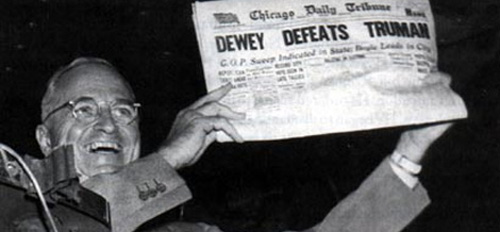
The 1948 presidential election was notable not simply for the vigour of Truman’s campaigning but for the fact that practically all the opinion polls pointed to a decisive Republican victory. So convinced were the “experts”, that one newspaper, The Chicago Daily Tribune, actually called the election for Truman’s rival, Thomas Dewey, on its front page.
 
In one of the most famous photographs of American political history, the real victor, Truman, triumphantly holds the Tribune aloft. It’s “Dewey Defeats Truman” headline reversed by the only poll that ever truly matters.
 

Bad Call: The Chicago Daily Tribune speaks too soon. President Harry S Truman celebrates winning the only poll that matters. 
 
Only after the election did the pollsters realise that their sampling methodology was connecting them exclusively to Americans wealthy enough to own a telephone. Overwhelmingly, they had been questioning Republican voters.
 
Harry Truman’s come-from-behind 1948 victory offers an important strategic lesson to the beleaguered leader of the New Zealand Labour Party. At the heart of the lesson is one very simple precept: trust the people.
 
And how is trust established? By meeting the people face-to-face. By letting the magic of the stump – the raw energy that arcs between speaker and audience – do its work. By grasping the difficult truth that if the news media has written you off and is refusing to carry your messages fairly, then you must find the courage to go around them, addressing yourself directly to that one incorruptible source of democratic power – the voters themselves.
 
Of course the “experts” will sigh and tell David Cunliffe that this is 2014 – not 1948 – and that times have changed. And, of course, ‘times’ have. But the fundamentals of politics have not.
 
Strategically, Mr Cunliffe has locked himself into a political process which, at the end of every week, is leaving him weaker, not stronger. Political journalists have already stamped the word “Loser” on his forehead and are treating him accordingly. As a communications strategy, relying on the news media to transmit Labour’s policy ideas to the voters has failed. It’s time for a new one.
 
If Mr Cunliffe was to take a leaf out of Harry Truman’s playbook he would organise and publicise a nationwide “whistle-stop” tour. Starting out softly in the halls of small-town New Zealand and building slowly to a resounding crescendo in the major centres’ town halls.
 
And, because this is 2014, every meeting, small and large, should be broadcast live on the Internet (brickbats, bouquets and hecklers included) and uploaded to YouTube the following day.
 
Can’t be done? Actually, it can. In July last year I watched young Martyn Bradbury and his anti-GCSB team fill the Mt Albert War Memorial Hall with 500 people. And then, three weeks later, pack the Auckland Town Hall with more than three times that number. On both occasions the meetings were broadcast live, to thousands more, on the Internet.
  
It Can be Done: Anti-GCSB Amendment Bill organisers fill the Auckland Town Hall, 19 August 2013.
 
Mr Cunliffe boasts that his Labour Party has doubled its membership in the space of a year. Let him prove it by making sure every one of the “whistle-stops” on his nationwide tour is Standing Room Only.
 
And what message should Mr Cunliffe deliver to these audiences? The same message he delivered to the audiences that elected him Labour Leader last year. The message that lifted Labour to 37 percent in the polls.
 
Or, as business columnist, Fran O’Sullivan, advised Cunliffe:
 
“Put aside the ‘Gotcha’ politics that both you and John Key have been indulging in. Instead, get out and sell Labour's defining policies – something which you are exceptionally skilled at when you take a disciplined approach.”
 
Stand and deliver Mr Cunliffe. Take Labour’s “defining policies” directly to the people who need them most. Tell the truth, David – and make National like it. Give 'em hell!
 
A version of this essay was originally published in The Press of Tuesday, 24 June 2014.

Tuesday, 1 April 2014

Protest Futile In The Absence Of Consensus Politics

Who's Listening? Protests remain effective only while the political and economic consensus that governments should respond to their citizens' grievances persists. New Zealand's neoliberal revolution of the 1980s and 90s overturned that consensus. All that protests do now is convince neoliberal politicians that their policies are producing the intended effects.

RELIABLE ESTIMATES of the size of the weekend protests against the Trans-Pacific Partnership Agreement (TPPA) put the number of participants at a modest 2,500. Martyn Bradbury, colourful editor of The Daily Blog, speaking to more than 1,000 “It’s Our Future” protesters in Auckland, said:
 
“I think that it really shows that economic sovereignty issues are actually quite central to New Zealanders’ concept about who they are and how they see themselves and losing that kind of sovereignty is a major concern — it’s no longer just a fringe issue.”
 
Bradbury later described the nationwide protest effort as “an incredible turnout for the esoteric intricacies of free trade deals”.
 
Placed alongside the great protests of the past, a nationwide turnout of 2,500 in defence of New Zealand’s “economic sovereignty” is indeed “incredible” – but perhaps not in the way Martyn meant!
 
But even if the “It’s Our Future” protests against the TPPA had reached the 50,000 benchmark figure established by Greenpeace’s highly effective protest against mining in national parks, it is highly debatable whether it would have been sufficient to make this government reconsider it iron-clad commitment to free trade.
 
The presence of large numbers of protesters on the streets no longer seems to give governments pause. Evidence of widespread public dissent long ago ceased to be politically decisive because policy-makers are no longer driven by the need to preserve a broad political consensus. Opposition is generally anticipated by today’s politicians, and provided it does not come from those economic and social actors deemed critical to their re-election, it is also generally ignored.
 
One has only to think of the hundreds-of-thousands of “indignacios” (indignant ones) who poured onto the streets of Spain during the worst months of the Global Financial Crisis. Or, recall the grim street-battles between police and protesters outside the Greek parliament in Athens as that impoverished country’s legislators voted to accept the European Union’s rescue package – along with the vicious austerity measures that constituted its political price.
 
What was it, then, that made the maintenance of a broad political consensus so important in the past and why is that no longer the case?
 
In the three decades following World War II – a period sometimes referred to as “The Age of Consensus” – the maintenance of social peace and prosperity remained the No. 1 political objective of both the centre-left and the centre-right. The “historic compromise” between capital and labour (big business and the trade unions) which had given birth to the Welfare State required both sides to restrain their radical extremes and cleave to the middle way. With memories of the Great Depression and the War still fresh in the minds of most citizens, any other course of action would have been most unwise.
 
Throughout this period, any manifestation of widespread social and/or political dissent was, accordingly, regarded as a direct threat to the prevailing bipartisan consensus. Prime-ministers and Leaders of the Opposition, alike, responded quickly (and often favourably) to the protesters’ demands.
 
The socially levelling effects of consensus politics could not, however, endure beyond the point where they began to undermine the power and persuasiveness of capitalism itself. The extraordinary success of Margaret Thatcher and Ronald Reagan is largely explained by their willingness to challenge the core elements of the Age of Consensus by attacking the unions, abandoning progressive taxation and reducing the responsiveness of the state. The neoliberal revolution which Thatcher and Reagan unleashed was thus predicated on the assumption that if the minority who mattered in capitalist society were to go on mattering, then the majority was going to have to learn to be disappointed.
 
Hence the dwindling impact and effectiveness of protest. Far from spurring Governments to reconsider their policies, mass protests actually provided them with evidence that the contested policies were correct. The 300,000 workers who protested against the National Government’s Employment Contracts Bill during the first fortnight of April 1991, far from constituting proof of the Bill’s inequity, merely confirmed for the Right the urgent necessity of its passage.
 
But if protest no longer works how are we to explain Greenpeace’s success? Or, for that matter – Ukraine’s?
 
In the former case it was not Greenpeace’s mobilisation efforts alone that made the difference. Tens of thousands of National Party members and voters had directly communicated their outrage to National’s MPs through letters, e-mails and phone-calls. These were the government’s core supporters in rebellion. They counted.
 
The protesters who overthrew the Ukrainian Government possessed an advantage that all the protesters described above lacked: the covert support of the armed forces. They knew that violence against the police would not be answered by violence from the army. What happened in Kiev’s Independence Square wasn’t a protest – it was a coup d’état by crowd.
 
Strip the state of its armed protection and mass protest rapidly escalates into full-scale revolt.
 
This essay was originally published in The Press of Tuesday, 1 April 2014.

Wednesday, 12 October 2011

Defusing The Bomber

Defused: Martyn "Bomber" Bradbury's exclusion from Radio New Zealand's Afternoons with Jim Mora's "The Panel" was unfair to the man and embarrassing for public radio, but it was also, in the intimate little country New Zealand has always been, utterly predictable.

I WAS A LITTLE SURPRISED, and a lot impressed, when the production team behind Radio New Zealand – National’s Afternoons with Jim Mora invited Martyn “Bomber” Bradbury on to “The Panel”. Surprised: because Bomber’s style is about as far away from the decorous National Radio tradition as it’s possible to get. Impressed: because it confirmed Afternoons’ determination to remain at the cutting-edge of public service radio in New Zealand.

Since the demise of Radio New Zealand’s commercial arm in the 1990s, and the Fifth Labour Government’s craven refusal to honour its promise to establish a publicly-owned, commercial-free, nationwide youth network, Radio New Zealand – National  has drifted, like a piece of pre-Rogernomics cultural flotsam, in hostile neo-liberal seas.

For nearly two decades the public network has struggled to re-invent itself – with limited success. How could it be otherwise, when the funding increases required for genuine experimentation were consistently withheld by Radio New Zealand’s political masters.

To be utterly dependent on non-hypothecated state funding cannot help but foster an institutional culture of acute self-awareness. Radio New Zealand’s broadcasters have become experts at sensing where the invisible political trip-wires had been laid – and how to avoid them.

“The Panel” – a sort of radio adaptation of TV3’s much-loved The Ralston Group – brought its staff and their guests about as close to those trip-wires as Radio New Zealand’s bosses were prepared to go. And, like The Ralston Group, “The Panel’s” survival depended on its guests fully understanding and respecting the show’s parameters.

I well remember TV3’s Head of News & Current Affairs, Rod Pedersen, telling Ralston’s guests (most of whom were experienced journalists) that he trusted them, as professionals, to know the difference between fair comment and defamation, and thus to keep the network out of the courts. To my knowledge, no one ever let him down.

The producers of Afternoons weren’t as explicit as Rod Pedersen, and yet it was always pretty clear to me that the “culture” of Radio New Zealand was very different indeed from the culture of Newstalk-ZB, Radio Live, and commercial radio in general. Though it ended up as a sort of Ralston-Group-without-pictures, it was originally conceived as a radio version of the BBC’s delightful show Grumpy Old Men – a witty and wistful programme by and for ageing “Baby-Boomers”. You could be many things on Afternoons – but strident wasn’t one of them.

I well remember the day I was ambushed on-air by a bitter and even more than normally vituperative Mike Moore. The former Labour leader really laid into me, landing verbal blow after verbal blow until, becoming very angry, I began to fight back – stridently. Immediately, I felt the vice-like grip of my fellow panellist, Richard Griffin, on my wrist. He shook his head emphatically, as if to say: “don’t go there, stay calm”. Meanwhile, the programme’s amiable host, Jim Mora, very adroitly and professionally, began defusing the confrontation.

This was the institutional culture that Bomber – a natural broadcasting talent honed at stations like BfM and Channel Z – was striding into: pre-written “Soapbox” diatribe gripped tightly in his hand, and that enormous, Gen-X, anti-Baby-Boomer chip he carries around balanced precariously on his shoulder. Talk about inviting Hamas to a bar-mitzvah! This was one gutsy call.

Bomber’s bombastic bloviations swept through Radio New Zealand’s studios – and into the middle-class parlours of the nation – like a noisome radical fart. And, presumably, that was the point. Why else bring Bomber onto “The Panel” unless you genuinely intended to get up the Afternoons audience’s nose? Unless, in the words of Theodore Roszak, you wanted your listeners to experience “an invasion of centaurs”? (Or, in this case, centaur?)

But what about the tripwires? Well, that’s why I was so surprised, impressed, and – yes – even delighted. Because Bomber, host of the high-rating (for Stratos) Citizen A show, and no-holds-barred poster on the Tumeke blog, was gloriously oblivious to any and all of the political tripwires lacing through Radio New Zealand’s corridors. And that could only mean, by inviting him on to Afternoons, one of the network’s highest-rating shows (and one of the highest-rating in the whole country) Radio New Zealand was ready to push out the boundaries of public radio – hard.

Too hard, it would seem.

Perhaps the Radio New Zealand producers were just so used to stepping carefully over all those political tripwires they simply assumed every other broadcaster was too. But there are all kinds of tripwires in broadcasting. In commercial radio they’re laid by the advertisers – via the Sales & Marketing Department – and the shock-jocks ignore them at their peril. In student radio, I imagine the ultimate sin is a terminal lack of “cool”.

As Bomber’s commentaries nudged the stridency levels higher and higher, and Afternoon’s Baby-Boomer audience grew weary of the Bradbury blame-game, the programme was dragged further and further away from its comfort-zone. Sooner or later, Radio New Zealand was bound to say: “Nup. That’s it. We’ve gone too far out on this particular limb.”

The moment came last Thursday afternoon. Bomber took aim at the Prime Minister and squeezed-off a sustained burst of heavy-calibre fire. It was no better or worse than a dozen other well-aimed political fusillades he’d unleashed over the past few months. But, it was one too many.

What happened? I don’t know – and I haven’t been able to find out. Did RNZ Board Chairman, Richard Griffin, put the vice-like metaphorical squeeze on CEO Peter Cavanagh’s wrist? I doubt it. The most likely explanation is that, quite suddenly, and without the clear warning he was entitled to and should have been given, Bomber crossed the invisible line from “gutsy call” to “major liability” – and the Bomber-disposal squad went into action.

Unfair to Bomber? Yes. Bad for the programme? Possibly. Deeply embarrassing for Radio New Zealand? Definitely. But in a society so small; so politically and professionally intimate; and so utterly dependent on invisible lines and unspoken rules as New Zealand, it was also very, very predictable.

This posting is exclusive to the Bowalley Road blogsite.

Thursday, 10 February 2011

Sorry Bomber (Some Thoughts On Martyn "Bomber" Bradbury's Call For A New Left Party)

Revolutions aren't made on television, Bomber, they're made on the street. And have you met the people who live on that street!

ONE’S FELLOW CITIZENS can be a terrible disappointment, Bomber. You will discover this the moment you cross the Rubicon from political observer to political participant. "The People", God bless ‘em, especially when encountered individually, are not always hewn from that heroic material so beloved by 18th and 19th Century revolutionaries.

Standing on their doorsteps, Bomber, it’s easy to become profoundly disillusioned with the human-beings whose votes decide your country’s future. Regardless of their location in the social hierarchy, and irrespective of their role in the processes of production, individuals all-too-frequently behave in ways utterly at odds with their objective self-interest. Parliamentary campaigners for the Left will regale you with stories of anti-feminist women, racist Maori, pro-capitalist proletarians and anti-welfare beneficiaries.

"There better be wisdom in crowds," grumbles the weary candidate following a particularly gruelling canvassing drive, "because there’s bugger-all in the average voter!"

Even worse than the voters with no conception of their own self-interest, are the voters who just don’t care. If you can get past the vicious dog chained-up in their front yard, and make your presence known over the blare of their massive sound system, your party-political spiel elicits nothing more than a bemused shake of the head.

"Not interested, mate", they’ll drawl, shutting the door firmly in your face. If their mailbox wasn’t already stuffed-full of junk mail, you’d leave them a pamphlet – or slip your card under the door. But that low growl, emanating from the Hound of the Baskervilles straining against his chain just a few metres to your right, suggests that it might be wiser to move on to the next house in the street.

As often as not – the neighbours are even worse.

But, of course, if you’re really serious about forming a New Left Party, Bomber, you’ll soon be experiencing all these things first hand. And don’t for a minute think there’s some way of avoiding the bruising experience of face-to-face canvassing – cos there ain’t.

The people you’re planning on drawing into the electoral process: the state-house tenants struggling to raise a family on two minimum wages; the young Maori solo-mum trying to keep it together on the DPB; the sickness beneficiary doped up to the eye-balls on lithium (because this country doesn’t really run to a decent mental health system); none of these folk read Tumeke, Bomber, or Bowalley Road, or The Standard, or Kiwipolitico. They don’t read newspapers either, or watch Citizen A. They just might pick up snatches of talk-back radio, or catch the odd TV-news bulletin – but I wouldn’t count on it.

So, to win them over you’ll have to knock on their front doors, introduce yourself, and attempt to engage them in political discussion. Which won’t happen, because while you’re launching into your spiel, they’ll be asking themselves: "What does this prick want from me? What the fuck is he talking about?"

Standing in front of them, Bomber, you’ll come across as so completely alien: so far removed from their bleak, narrow, hard-scrabble and often violent world; that you might as well have beamed down from another planet.

The barriers to effective political communication: functional illiteracy; cultural impoverishment; sheer exhaustion: each of these factors, on their own, Bomber, is enough to prevent the anomistic underclass from receiving your message. And if – as is likely – the person you’re addressing is of a different ethnicity, then your communication difficulties will be radically compounded.

So, if the underclass is politically inaccessible to the Left (which is, I’m afraid, the brutal message of the Mana by-election) then what about the working-class? Well, I’ve got news for you, Bomber, and, as Jim Anderton is fond of adding: "It’s all bad."

In fact, you should have a chat with Jim about winning and holding the support of working-class voters. Because you know what, Bomber? He was the only member of the NewLabour Party and the Alliance who ever really mastered the art.

Why? Because Jim never, ever, ever, by the slightest word or deed, gave the voters of Sydenham/Wigram reason to suppose that he considered himself, or his political and moral values, to be better than their own. In this, he remains their true representative. Like so many of them, he takes a conservative stance on abortion and illicit drug-use. But, also like them, he is prepared to embrace radical economic solutions to entrenched social problems.

It’s all about respect, Bomber. The giving of it, and the receiving of it. Respect – and respectability – lie at the heart of Anglo-Celtic working-class culture. Jim Anderton gets that. It’s why Labour could never reclaim Sydenham/Wigram from him. No matter how jarring some of their opinions on issues relating to race, gender and sexuality might be, Jim Anderton would never disrespect the people whose votes he was soliciting. He’d never call them "rednecks".

Can you say the same, Bomber? Not really.

Which leaves you politically situated slap-bang in the middle of the only political market which the "post-modern" Left has truly made its own: young(ish), well-educated, middle-income and upper-middle-income, Pakeha voters. And that market, as I’m sure you need no reminding, Bomber, is now the happy hunting-ground of both the Labour and the Green parties.

What I would say to you, Bomber, (in case you do need reminding) is that in order to win the votes of more than the ever-dwindling band of political activists who draw their ideological inspiration from the left-wing philosophers and politicians of the 19th and early-20th centuries, a New Left Party would have to offer the voters of Auckland Central, Wellington Central, Port Hills and Dunedin North more-or-less the same policies as Phil Goff and Russel Norman.

That’s the problem with the voting public, Bomber. They will insist on ignoring the Left's advice! I like the way Bertold Brecht put it in his famous poem "The Solution", written after the East German workers’ revolt of June, 1953.

After the uprising of the 17th June
The Secretary of the Writers’ Union
Had leaflets distributed on the Stalinallee
Stating that the people
Had forfeited the confidence of the government
And could win it back only
By redoubled efforts. Would it not be easier
In that case for the government
To dissolve the people
And elect another?

When you work out how to do that, Bomber, please let me know.