Chris Trotter has spent most of his adult life either engaging in or writing about politics. He was the founding editor of The New Zealand Political Review (1992-2005) and in 2007 authored No Left Turn, a political history of New Zealand. Living in Auckland with his wife and daughter, Chris describes himself as an “Old New Zealander” – i.e. someone who remembers what the country was like before Rogernomics. He has created this blog as an archive for his published work and an outlet for his more elegiac musings. It takes its name from Bowalley Road, which runs past the North Otago farm where he spent the first nine years of his life. Enjoy.
The blogosphere tends to be a very noisy, and all-too-often a very abusive, place. I intend Bowalley Road to be a much quieter, and certainly a more respectful, place. So, if you wish your comments to survive the moderation process, you will have to follow the Bowalley Road Rules. These are based on two very simple principles: Courtesy and Respect. Comments which are defamatory, vituperative, snide or hurtful will be removed, and the commentators responsible permanently banned. Anonymous comments will not be published. Real names are preferred. If this is not possible, however, commentators are asked to use a consistent pseudonym. Comments which are thoughtful, witty, creative and stimulating will be most welcome, becoming a permanent part of the Bowalley Road discourse. However, I do add this warning. If the blog seems in danger of being over-run by the usual far-Right suspects, I reserve the right to simply disable the Comments function, and will keep it that way until the perpetrators find somewhere more appropriate to vent their collective spleen.
Excitement And Pride: The reason why normally kind and respectful people are capable of such appalling violence, the single factor that explains every pogrom, every lynching, in history: the absence of consequences. The knowledge that if you do terrible things, then nothing will happen to you. The realisation that those in authority do not care if you do them. Hell, they want you to do them!
WHEN THE SETTLERS from Har-Bracha approached the security checkpoint the Israeli Defence Force soldiers waved them through. That wasn’t supposed to happen. Not when the West Bank of the Jordan was a bubbling cauldron of hate and violence. The idea of allowing Israelis from the Jewish settlements to enter Palestinian territory should have been as unthinkable as allowing Palestinians to pass in the opposite direction. But, the soldiers – like everybody else in Israel – knew that, only the day before, two brothers from Har-Bracha had been killed by a Palestinian gunman. It was payback time. Ignoring their orders, knowing full well what was likely to happen, the soldiers opened the gates and let the settlers pass. Within the hour, the nearby Palestinian village of Zaatara was ablaze.
The forces of law and order do not exist in a social vacuum. They are members of their communities, citizens of their nation, and just as likely to get caught up in the ebb and flow of public emotion as everybody else. They’re not supposed to. In theory, they are expected to remain aloof from the tidal tug of popular passions: impartial upholders of the law; keepers of the peace.
In theory.
When the white police officers and/or sheriff’s deputies whose presence in the rigorously segregated black communities of the Jim Crow South suddenly disappeared from the streets, everybody knew that trouble was on the way. The unheralded withdrawal of these racially charged armies of occupation could only mean one thing. That, for the next few hours, law and order would take a terrifying leave of absence.
The photographic images that have come down to us from this America of a century ago are hard to look at. Not only on account of the “strange fruit” hanging from the poplar trees on the outskirts of town. More difficult to stomach, or even to comprehend, than the charred bodies are the lynch-mobs that gathered to witness and celebrate the victims’ agonising demise.
Men and women, resplendent in their boater hats and summer frocks, look directly at the camera, their faces alive with a chilling mixture of excitement and pride. There is no shame here, no guilt. Would they have brought their children with them to observe the spectacle if they believed they were doing wrong? They wanted their kids to understand that this was something that simply had to be done every once and a while – to keep the community safe.
The local newspapers would recount these lynchings in enthusiastic prose. The dastardly deeds that sparked the community’s righteous anger. The apprehension of the perpetrator by the aroused populace, and his inevitable demise. The grim warning left hanging where those most in need of its terrifying message could not fail to receive it.
Such blatant abrogations of the rule of law – be they in the Deep South of a century ago, last month on the West Bank of the River Jordan, or last weekend in Auckland’s Albert Park – are able to occur for one reason, and one reason only, because those participating in them do so in the confident belief that they are doing “the right thing”. Because the government, the news media, and even the forces of law and order have all conspired – wittingly or unwittingly – to convey the impression that the extra-legal enforcement of “the right thing” will incur no penalty.
Eye witness accounts of the attack upon Kellie-Jay Keen-Minshull in Albert Park describe how the frenzy of the protesters suddenly increased when they realised that the Police were not going to interfere in their righteous punishment of the “Nazi-adjacent”, “anti-trans activist”.
And that’s the reason why normally kind and respectful people are capable of such appalling violence, the single factor that explains every pogrom, every lynching, in history: the absence of consequences. The knowledge that if you do these terrible things, then nothing will happen to you. The realisation that those in authority do not care if you do them. Hell, they want you to do them!
Considering that when the mob came, proudly bearing their threatening banners and placards, and the Police stood by and did nothing – not even when elderly people were being punched, kicked, thrown to the ground and begging the Police to assist them – it is a small miracle that “Posie Parker” escaped with her life.
This essay was originally published in The Otago Daily Times and The Greymouth Star of Friday, 31 March 2023.
Death And The Marchers: What the so-called “Freedom & Rights Coalition” would be wise to factor into their calculations is how quickly the public’s tolerance will evaporate if its followers move beyond the energetic expression of their grievances towards violence and/or the massive disruption of daily life. At that point the forbearance of the state will cease, and the protection of life and property will begin.
PROTESTERS CALLING for the overthrow of the Government should take a deep breath and consider their strategic situation. According to the Ministry of Health’s own polling, the hardcore anti-vaxxers represent – at best – five percent of the population. Even assuming that that many again are in some degree supportive of the protesters’ aims and objectives, that would still leave them confronting the remaining 90 percent of the population – who are not.
Now, it is very easy to forget this grim arithmetic when you are in the middle of a crowd of 5,000 people, surrounded by flags and placards, and breathing in the exhaust fumes of 100 large motorcycles. In such circumstances, the protester’s mind is filled with intoxicating feelings of invincibility. That any force could successfully turn “We, the People” around seems impossible.
It is, however, an enormous mistake for protesters (let alone insurrectionists) to interpret the fact that nobody has so far attempted to stop them, as proof that they cannot be stopped. What they may see as weakness on the part of a corrupt and cowardly government, will be seen by many more as evidence of a Government doing its utmost to facilitate a tiny fraction of the population’s right to express themselves politically. For most New Zealanders this will be taken as proof of their country’s deep commitment to democratic principles.
What the so-called “Freedom & Rights Coalition” would be wise to factor into their calculations is how quickly the public’s tolerance will evaporate if its followers move beyond the energetic expression of their grievances towards violence and/or the massive disruption of daily life. At that point the forbearance of the state will cease, and the protection of life and property will begin.
The Freedom & Rights Coalition will then find itself caught up in a process of relentless escalation that it cannot win. If its followers use their fists and their boots against their fellow citizens, then the Police will don riot gear and equip themselves with pepper-spray, tasers, tear-gas and rubber bullets. If the insurrectionists then decide it is time to arm themselves with knives and firearms, the Government will call upon the armed forces to “aid the civil power” and the rebels will find themselves confronting highly trained military personnel armed with machine-guns and artillery. Anyone foolish enough to put themselves at the mercy of artillery will not be given a lot of time to regret their mistake.
This process of escalation will not be restricted to the armament deployed. Faced with violence and disruption on such a scale, it is highly likely that the Government will resort to measures not seen in this country for nearly 90 years.
Not the least of these will be the swearing-in of “Special Constables”. The last time this happened was in the immediate aftermath of the 1932 Queen Street Riot. Waikato cockies, many of them on horseback, were enrolled to ensure that the unemployed remained off the streets – by any means deemed appropriate.
Twenty years earlier there had been a similar mobilisation of conservative citizens. In the Great Strike of 1913, the Prime Minister of the day, William Massey, had unleashed hundreds of Special Constables against the militant unionists affiliated to the “Red” Federation of Labour. More than a few of these “Red Feds” were unabashed revolutionaries who, like the Freedom & Rights Coalition, believed in the right of the citizenry to overthrow a tyrannical government. “Massey’s Cossacks” reminded them, none too gently, of the resources available to a state which still commands overwhelming popular support.
Interestingly, during the Waterfront Lockout of 1951 the National Government considered, but then rejected, the use of Special Constables. The trade union militants were vastly outnumbered, not only by “ordinary Kiwis”, but even by the moderate unionists affiliated to the Not-So-Red Federation of Labour. Prime Minister Sid Holland’s notorious “Emergency Regulations” were more than enough to bring the Watersiders to heel.
The contemporary equivalent of those Emergency Regulations would, of course, be a Government decision to order a temporary shutdown of the Internet, giving the Police and the rest of the national security apparatus the opportunity to round-up what was left of the insurrection.
Most New Zealanders would likely consider it entirely fitting: if the shutting-down of social media – the prime generator of anti-vaccination militancy – turned out to be its ultimate cure.
This essay was originally published in The Otago Daily Times and The Greymouth Star of Friday, 12 November 2021.
Something's Gone Wrong: The thing that’s gone wrong with the progressive movement's bloody ships is that we’ve allowed ourselves to be persuaded that protest’s only value is as a means of expressing our purely personal discontent with the status quo. This is, of course, bullshit. The purpose of protest is to apply pressure in order to achieve change. To force the wielders of effective political power into making a favourable response.
ABOUT THE TIME the second of Britain’s battle cruisers
exploded, Vice-Admiral Beatty famously remarked: “There seems to be something
wrong with our bloody ships today.” Trying to make sense of the political
passivity of New Zealanders in the twenty-first century, I am often minded of
Beatty’s words at the Battle of Jutland. Throughout the vicious class warfare
of the past 35 years there does, indeed, seem to be something “wrong” with the
progressive movement’s bloody ships!
God knows, it’s not as if there’s been a shortage of issues
for people to mobilise against! Low wages; unaffordable housing; the appalling
treatment of beneficiaries and state house tenants; the collapse of our mental
health service; neoliberalism’s subjugation of the universities: the list is a
long one.
The roll-call of resistance is, however, depressingly short.
After 1991, protest activity on the streets fell away quite sharply.
Campus-based protests against rising tuition fees flared in the early 1990s
only to fade away almost completely by the turn of the century.
Environmental causes could still draw middle-class New
Zealanders onto the streets in large numbers, however. The biggest of these
protests: the anti-GE marches and the 50,000-strong Auckland protest against
mining in national parks; were even able to persuade the government of the day
to take action.
The most calamitous decline in popular resistance, however,
occurred in the New Zealand working-class. Strike action, the most reliable
measure of the willingness of working people to stand up and defend their
interests, fell away almost completely. Prior to the passage of the Employment
Contracts Act in 1991, the number of strikes recorded in a single year plummeted
from dozens to single figures. So punitive was the new industrial relations law
that neither the unions’ paid officials, nor their members, were willing to
test it.
That had not been the case in the period between the
introduction of the Employment Contracts Bill in 1990 and the legislation being
signed into law in May 1991. In April 1991 an estimated 100,000 workers marched
against the Bill and mass rallies attended by thousands of rank-and-file
unionists voted in favour of a general strike to “Kill the Bill”.
The blank refusal of the leaders of the largest unions to
countenance a general strike struck the labour movement a mortal blow from
which it has never recovered. Since 1991 the Council of Trade Unions and its
affiliates have never been able to muster more than 5,000 unionists in one
place. Workers had been ready to fight in 1991 but their so-called “leaders”
had not.
The 2012 Ports of Auckland dispute, led by the late Helen
Kelly, offered a glimpse of what working people might achieve if given half a
chance – and courageous leadership. So, too, did Matt McCarten’s “Unite” union
of low-paid security guards and fast-food workers. Sadly, these proved to be
the exceptions – not the rule.
Then there were the great “one-offs”: protests that surged
and exploded into genuine demonstrations of “people power” only to be sucked
into the swamp of parliamentary politics and drowned.
The first of these was the hugely impressive 2004 hikoi
against the controversial Foreshore and Seabed legislation. After setting forth
from the Far North, the hikoi grew in strength until it arrived in the capital
numbering somewhere between 15,000 and 25,000 protesters. The Maori Party was born
out of this impressive mobilisation of New Zealand’s indigenous people. Sadly,
the huge hopes invested in the party ended up producing only the most meagre of
political dividends.
The second big one-off protest was the February 2016
demonstration against the Trans-Pacific Partnership Agreement. It wasn’t just
the number of protesters (somewhere between 30,000 and 50,000) but their palpable
anger and energy that startled the political class. Alas, as happened with the
hikoi, the anti-TPPA movement allowed itself to be skilfully finessed by the
parliamentary opposition. The Labour Party, in particular, encouraged the
protesters to believe that, once elected, it would keep New Zealand out of the
TPPA’s trans-national corporate clutches.
The energy and anger of February 2016 soon dissipated and
could not be reactivated when, 20 months later, the new Labour-NZF-Government
proudly attached its signature to something called the “Comprehensive and
Progressive Trans-Pacific Partnership”.
At the Battle of Jutland, the thing that was wrong with
Beatty’s “bloody ships” was that the necessary precautions against enemy shells
penetrating the battle cruisers’ magazines had not been taken. In effect, it
was Beatty’s negligent approach to safety that sank his ships.
What, then, has gone wrong with New Zealand’s progressive
ships?
In the simplest possible terms, the link between protest and
political action has been broken.
For most of the post-war period, widespread protest activity
almost always brought forth an answering political response. People marched and
petitioned to “Save Manapouri!” – and Manapouri was saved. Thousands protested
New Zealand’s involvement in the Vietnam War – and NZ troops were withdrawn.
For 56 days in 1981 the country was convulsed by the Springbok Tour – NZ’s
sporting contact with Apartheid South Africa ceased. Most importantly, workers
went on strike to improve their pay and conditions – and their pay and
conditions were improved. Direct action worked.
It was one of the core objectives of the neoliberal
counter-revolution that this relationship between popular agitation and the
democratic political process be destroyed. Most especially in matters relating
to the economy. The idea that ordinary people might influence the way in which
wealth was created and distributed had to be discouraged.
The thing that’s gone wrong with our bloody ships is that
we’ve allowed ourselves to be persuaded that protest’s only value is as a means
of expressing our purely personal discontent with the status quo. This is, of
course, bullshit. The purpose of protest is to apply pressure in order to
achieve change. To force the wielders of effective political power into making
a favourable response.
If those with the power refuse to respond to our protests,
then the correct reaction is not to give up and go quiet. It is to protest
louder and harder and longer until the powers-that-be give up – and give in.
This essay was
originally posted on The Daily Blog
of Thursday, 14 June 2018.
A Change Is Gonna Come: The militant solidarity and bi-cultural unity on display in the anti-TPPA protests has delivered to the neoliberal elite a symbolic message which they would be wise to heed. They have grown accustomed to dominating this country’s political discourse as effortlessly as they dominate its economy. They are not used to being contradicted by people they dismiss, contemptuously, as “losers”. But as Bob Dylan reminds us: "the losers of now may be later to win – when the times they are a-changing."
TAKEN SEPARATELY, a series of unusual incidents may not
amount to much. Taken together, however, they can suggest that, politically,
something important is happening. Specifically, that the long-quiescent New Zealand
population (the people upbraided by top left-wing blogger, Martyn Bradbury, as
“sleepy hobbits”) are beginning to bestir themselves.
Consider the following straws in the wind.
Straw No. 1: As last Thursday’s massive anti-TPPA march
swung sharply left at the bottom of Auckland’s Queen Street and headed back
towards Sky City, construction workers began punching through the white plastic
of their “petticoated” building sites and urging-on the marchers with
clenched-fist salutes.
Straw No. 2: Seasoned activists insist that the huge
demonstration was the first Pakeha-organised political protest to be led down
Queen Street by a Maori Kapa Haka group. (Some claiming that these toa (warriors) were members of the same
group who’d earlier refused to provide a Maori welcome to the TPPA’s
signatories.)
Straw No. 3: John Key was booed when he turned up to the
Auckland Nines on Waitangi Day.
It’s this latter event that will have stung the Prime
Minister most painfully. His easy, apolitical rapport with sports-mad Kiwis has
been one of his greatest electoral strengths. That a major political issue was
able, finally, to penetrate the feel-good force-field that has for many years
kept our sports stadia politics-free-zones must have given him genuine pause.
It may not have been the whole crowd, but it was a large enough section of it
to warrant the journalists present filing a story. And that, as Mr Key well
knows, is all it takes.
The mass participation of Maori in last Thursday’s protest
activities is also a highly significant development. New Zealand has seen big
Maori protests before: the Seabed and Foreshore hikoi of 2004 being the most impressive. Separate Maori
contingents, like the Patu squad of
Springbok Tour fame, have also featured in Pakeha dominated protest movements.
The 4 February demonstration was different. Last Thursday’s
was a genuine bi-cultural protest (the first of any size that the writer has
witnessed) in which thousands of Maori bearing fern fronds, and Pakeha carrying
placards, marched side-by-side; English and Te
Reo mingled seamlessly; and where scores of New Zealand Ensigns flew
proudly alongside an equal number of fluttering Tino Rangatiratanga flags.
This is a politically explosive combination: at whose heart
lies the frightening realisation that more and more Pakeha New Zealanders are
losing control of their future. For Maori, that is, of course, a far from new
revelation. As Marama Fox, Co-Leader of the Maori Party, told the Anti-TPPA
rally held at the Auckland Town Hall on 26 January: “Welcome to our world!”
For 176 years the rulers of New Zealand have lived in fear
of this alliance. Captain Hobson’s 1840 declaration “now we are one people”
notwithstanding, the intention of New Zealand’s British colonisers has always
been to separate not only the Maori from their land, but to keep forever
separate the interests of colonised and colonisers. The Powers-That-Be may have
paid lip-service to the ideal of bi-culturalism by linking together the
interests of the Pakeha and Maori ruling elites. But the very idea of non-elite
Maori and Pakeha making common cause in defence of their common interests, and
their common homeland, has always been culturally and politically terrifying.
The fear inspired in the political class by the clearly
bi-cultural quality of the 4 February demonstration was expressed, at least
initially, in the scornful depiction of the protesters as ignorant dupes of the
usual “commie” suspects. What those making fun of New Zealanders very real, if
ill-expressed, anxieties about the TPPA simply ignored was the fact that in
democratic societies most citizens take their cues from trusted cultural and/or
political leaders, by whose deeper understanding of complex issues they are
more than happy to be guided.
Only a few days ago, it was to Labour voters’ trust in Helen
Clark that the TPPA’s promoters were appealing, in an obvious attempt to
convince them that Andrew Little’s opposition to the agreement was mistaken.
When, however, it became clear that Centre-Left voters put more faith in Jane
Kelsey’s assessment of the TPPA than Helen Clark’s, its promoters immediately
began mocking them. The very idea that ordinary people’s views might be taken
seriously was treated as a joke.
Which brings us back to those construction workers’ fists
breaking through the plastic.
In that arresting image of militant solidarity there is a
symbolic message to which the neoliberal elite would be wise to pay heed. They
have grown accustomed to dominating this country’s political discourse as
effortlessly as they dominate its economy. They are not used to being
contradicted by people they dismiss, contemptuously, as “losers”.
But as Bob Dylan reminds us: the losers of today may be
tomorrow’s winners – when the times they are a-changing.
This essay was
originally published in The Press of Tuesday,
9 February 2016.
March in February! The TPPA is inimical to New Zealand’s national sovereignty, and poses a deadly threat to its democratic institutions So, march tomorrow/today as if your independence and your freedom depends on it – because they do.
WHAT I WOULD GIVE to get a look at the Government’s polling
data on the Trans-Pacific Partnership Agreement (TPPA). Coming out of the
summer holiday torpor, my best guess was that the public, generally speaking,
was pretty relaxed about the agreement. But everything the Government and its
allies have done since early January suggests that the opposite is true: that
the numbers reported in TV3/Reid Research poll of 20 November 2015 have not
budged, and that a clear majority of New Zealanders remain opposed to the
agreement.
Since then, the anti-TPPA forces have worked tirelessly to
analyse the 5,000 page document and to marshal their arguments against
ratification. In the weeks following the 5 November 2015 release of the TPPA
text, a raft of expert, peer-reviewed research papers (available at https://tpplegal.wordpress.com/)
were written and released. These have made a considerably greater impact on the
news media than the rather perfunctory National Interest Analysis, thrown
together by New Zealand’s team of TPPA negotiators, and released by the
Ministry of Foreign Affairs and Trade (MFAT) on 25 January 2016.
The expert paper entitled “The Economics of the TPPA”,
jointly written by University of Auckland economics professor, Tim Hazledine,
Dr Geoff Bertram, Rod Oram and Barry Coates, impressed even the NZ Herald’s
senior business writer, Brian Fallow. The rising level of vitriol deployed by
the National Party’s best ideological skirmisher, Matthew Hooton, and echoed
shrilly in the columns of the Herald’s Fran O’Sullivan, indicates
strongly how disadvantaged in the propaganda stakes the pro-TPPA forces now
feel themselves to be.
The greatest blow struck against the TPPA, however, was
delivered by the Labour Party. On Tuesday, 26 January, from their New Year
caucus retreat in the Wairarapa, Labour MPs dispatched their Finance
Spokesperson, Grant Robertson, to Auckland. There, he informed the first of the
four main centre town-hall meetings organised by the anti-TPPA group, It’s Our
Future, that Labour would NOT be supporting the agreement.
The full impact of Labour’s rejection was blunted by Leader,
Andrew Little’s, maladroit handling of the TPPA’s two strongest caucus
supporters, Phil Goff and David Shearer. Within days, however, the grim fact
that the cosy, 30-year-old, bi-partisan consensus on Free Trade had ended,
began to sink in.
The TPPA had turned out to be a bridge too far – even for
the NZ Labour Party. This was not a free trade agreement in the mould of the
China-NZ FTA. It was, in the words of the veteran New Zealand diplomat,
Terrence O’Brien: “an economic policy integration agreement”. And the intent of
such documents is, indisputably, to limit the sovereignty of nation states. As
Professor Tim Hazledine explained in a Herald op-ed article of 3
February 2016:
“The fundamental idea or ideology behind the TPP is that
national governments cannot be trusted to act independently on many issues, because
they will inevitably succumb to local vested interests. Only the cleansing
discipline of untrammelled global free-market forces will deliver efficient
outcomes.”
By “local vested interests” the free-marketeers are, of
course, referring to the citizens of the nations concerned. That is why the
opponents of the TPPA talk about the agreement threatening democracy itself.
Exactly how far this message: that the TPPA is inimical to
New Zealand’s national sovereignty, and poses a deadly threat to its democratic
institutions; has entered public consciousness is what the Government, MFAT,
the “intelligence community”, the Police, the NZ-US Council, the National
Party, and the mainstream news media have no doubt been working like blazes to
find out.
Because all of them know that if a substantial portion of
the New Zealand population – maybe even a majority – can be convinced that the
anti-TPPA message is true, and if that conviction can be given political force
by the Labour, Green and NZ First parties, then a great deal more than the
future of the TPPA is at stake. If protecting our national sovereignty and
defending our democracy become the battle-cries of the 2017 General Election,
then the entire neoliberal project will be threatened.
So, march tomorrow/today as if your independence and your
freedom depends on it – because they do.
This essay was
originally posted on The Daily Blog
of Wednesday, 3 February 2016.
The Perfect Backdrop: Why didn't John Key's government secure a distant, easily defended venue - like the exclusive Millbrook Resort pictured here - for the signing ceremony of the Trans-Pacific Partnership Agreement? The choice of Sky City Casino, in the heart of Auckland City, is seen by many as a deliberate provocation to the TPPA's opponents.
IT WAS BARELY SIX MONTHS since the airliners had crashed
into the Twin Towers. In strict secrecy, the intelligence chiefs of the five
major English-speaking countries had flown into Queenstown for a series of discreet
discussions on the global terrorist threat. From the airport they were driven
to Millbrook Resort, a five-star accommodation and leisure complex located
about 15 kilometres from the town. The chiefs came with their own close
protection personnel who operated alongside New Zealand’s Diplomatic Protection
police officers. In case Osama Bin Laden’s reach had extended even as far as
Queenstown, a special hostage rescue team was kept in readiness throughout.
The “Five Eyes” intelligence colloquium of March 2002 would
have passed entirely unnoticed had a sharp-eyed individual not recognised
Robert F. Mueller, the newly appointed Director of the US Federal Bureau of
Investigation, stepping off an unmarked Gulfstream 5 aircraft at Queenstown
Airport. (As the French saboteurs of the Rainbow
Warrior discovered back in 1985, we Kiwis don’t miss much!)
The question that is exercising many New Zealanders minds,
14 years later, is why our Government has decided against staging the signing
ceremony of the Trans-Pacific Partnership Agreement (TPPA) at a venue like the
Millbrook Resort. Hundreds of miles from the country’s main population centres,
and easily defended, it would have provided a breathtakingly beautiful backdrop
to what the Government clearly considers the most important trade treaty New
Zealand has ever helped to negotiate. A remarkable agreement, signed in the
shadow of the Remarkables. What could be better than that!
Or more enjoyable for the trade representatives from the
twelve countries – including the United States and Japan – who are party to the
TPPA? It was, after all, the Millbrook Resort which played host to President
Bill Clinton when he visited New Zealand in 1999. The President was as fulsome
in his praise of its hospitality as his senior spooks were, no doubt,
appreciative of its discretion three years later. Why, then, has Mr Key
rejected the option that promised his esteemed guests an enjoyable and
trouble-free signing ceremony? Why has he decided that the ceremony will,
instead, be held at the Sky City Casino in Auckland?
The cynics among us have hailed the choice of a casino as
the ideal venue for the signing ceremony. If you’re intent on making a wager as
large and potentially catastrophic as the TPPA – where better than a gambling den!
Also, as possibly the best domestic example of what can happen when
transnational corporations and politicians adopt a common view of the future,
the Sky City Casino (and Conference Centre!) has revealed the shape of things
to come in the TPPA’s corporate-friendly Pacific.
But, for those of us who expect our Government to keep the
peace and maintain law and order, the choice of Sky City as the signing
ceremony venue has raised a number of very disturbing questions.
The casino is situated in the heart of downtown Auckland –
the city that, just a few months ago, turned out between 10,000 and 15,000
anti-TPPA protesters. Feeling against the agreement is still running high, and
the Prime Minister’s decision to effectively rub his opponent’s noses in the Government’s
victory has done nothing to calm the situation. Many Aucklanders are now openly
speculating that Mr Key would not be too upset if the inevitable mass protests
against the signing of the TPPA turned into a riot.
Police confirmation that “public order training” – riot
control – has been underway for some time in anticipation of increased “civic
unrest” arising out of the signing decision has been received by opponents of
the TPPA as ultimate proof of the Government’s bad faith.
Their mistrust is understandable given the Government’s
initial flat-out denial that it was hosting the TPPA signing in New Zealand on
4 February. There is also considerable bad feeling about the proximity of the
signing ceremony to Waitangi Day. Fear of the loss of national sovereignty is
the prime motivator of opposition to the TPPA. To organise the signing of the
agreement, in a casino, just 48 hours before the day that celebrates the birth
of the nation, must surely rank as one of this Prime Minister’s most provocative
acts.
It is also alarmingly at odds with the style of political
leadership he has demonstrated to date. Mr Key, like the prime minister with
whom he is most frequently compared, Sir Keith Holyoake, is considered a
consensus-seeker – not a polariser and provocateur. For that we must turn to
Sir Robert Muldoon – the last National Party leader to court riot and disorder
for narrow electoral advantage.
Such cynicism was, perhaps, forgivable in a political leader
staring down the barrel of imminent defeat, but John Key’s love affair with the
electorate continues unabated.
Nothing good can come from this decision, Prime Minister.
Please, go to Millbrook.
This essay was
originally published in The Press of Tuesday,
26 January 2016.
More Than "The Usual Suspects", Mr Groser: Once a demonstration swells beyond “the usual left-wing suspects” to include the sort of ordinary Kiwis who turned out in their thousands on Saturday, 15 August 2015, a wise government will begin to ask itself some very serious questions about the wisdom of proceeding with the policy under attack. John Key's best political option, now, is to walk away from the TPPA.
ON SATURDAY, upwards of 30,000 New Zealanders protested
against the Trans-Pacific Partnership Agreement (TPPA). From the tiny village
of Kohukohu in the Hokianga, where 50 people marched, to Auckland, where Queen
Street was filled from top to bottom with, at the very least 15,000 protesters,
New Zealanders from all walks of life expressed their opposition to the
proposed agreement.
When confronted with the protest numbers, Trade Minister, Tim
Groser, who, only a fortnight ago, branded his opponents “breathless children”,
was quick to reach for more insults. Many of those marching, he claimed, had
been “misled” by the TPPA’s opponents: people he’d earlier dismissed as
“politically irrelevant”.
Well, in the light of Saturday’s turnout around the country,
that’s a judgement he may wish to reconsider.
Sustained protest activity in New Zealand, after peaking
during the Springbok Tour demonstrations of 1981, has fallen away steadily over
subsequent decades. Occasional spikes, such as the massive protests mounted
against the Employment Contracts Bill in April 1991, or the 50,000-strong
Auckland march against mining in New Zealand’s national parks on 1 May 2010,
have not been able to disguise the seemingly inexorable demise of public
protest as an effective political tactic.
One of the obvious reasons for abandoning the street as a
venue for effective politics is that, over the course of the past 30 years,
increasingly derisory turnouts have only tended to alert politicians to the
weakness of the organisers’ causes. A memorable article (later turned into a
poster) from the anti-Vietnam War era posed the question: “Suppose they gave a
war – and nobody came?” The temptation for government politicians to paraphrase
that question in relation to protest demonstrations must have been very great!
Not that many of the governments of the past 30 years have
been at all responsive to political pressures from below. Indeed, making a
virtue out of refusing to be swayed by public opinion is a distinguishing
characteristic of neoliberal governments the world over. As the newly-elected,
left-leaning Greek government was curtly informed by the technocratic masters
of the Eurozone earlier this year: “Elections change nothing.” That the 99
Percent must be prevented from voting themselves a better life at the expense
of the 1 Percent, is a neoliberal article of faith. Keeping ignorant
electorates well away from complex, technical exercises – like the negotiation
of free trade agreements – is, similarly, regarded as axiomatic.
Dismissing the anti-TPPA protests as “politically
irrelevant” is, therefore, the most natural top-of-the-head reaction for a
confirmed neoliberal politician like Mr Groser. Unfortunately, for him and his
government, however, the anti-TPPA movement is growing, not dwindling. Moreover, thanks to the extraordinary
communicative power of the Internet, generally, and of social media, in particular,
protesters are not only extremely well-informed, but also supremely
well-equipped to increase the circulation of anti-TPPA propaganda
exponentially.
On 7 March, this year, The
Press estimated 1,000 Christchurch protesters had turned out for the “It’s
Our Future” coalition’s nationwide, anti-TPPA, day of action. Five months on,
and the numbers have increased four-fold, with the Stuff website estimating Saturday’s turnout at 4,000 demonstrators.
Since the first of the “It’s Our Future” days of action, held in November 2014,
the overall number of people participating has surged from 10,000 to 30,000. Mr
Groser and his colleagues need to understand that, for the first time in a long
time, they are confronted with a street-based, nationwide, protest movement
that is growing larger – not smaller. When 50 people turn out in Kohukohu
(Population: 150) “politically irrelevant” is not the right call.
Once a demonstration swells beyond “the usual left-wing
suspects” to include the sort of ordinary Kiwis who turned out in their
thousands on Saturday, a wise government will begin to ask itself some very
serious questions about the wisdom of proceeding with the policy under attack.
That is exactly what the Prime Minister, John Key, and his Cabinet did following
the huge anti-mining demonstration of May-day 2010. On that occasion, and to
their credit, Mr Key and his government walked away from what was, clearly, an
unacceptable policy. They would be very wise to do the same in relation to the
Trans-Pacific Partnership.
If they refuse to be advised by the electorate on this
issue: if, like good neoliberals, they reject the very idea of the people
having a say on matters fundamental to their economic well-being; and, without
letting New Zealanders to know what is in it, sign the TPPA – thenthings will change.
Sign the TPPA, and the mood of rising frustration with the
National-led Government – so evident on the streets over the weekend – will
become one of outright fury. This will only intensify once the content of the
TPPA becomes known, and people discover what sort of agreement their leaders
have signed.
Not just a bad deal, Mr Groser, but your government’s death
warrant.
This essay was
originally published in The Press of Tuesday,
18 August 2015.
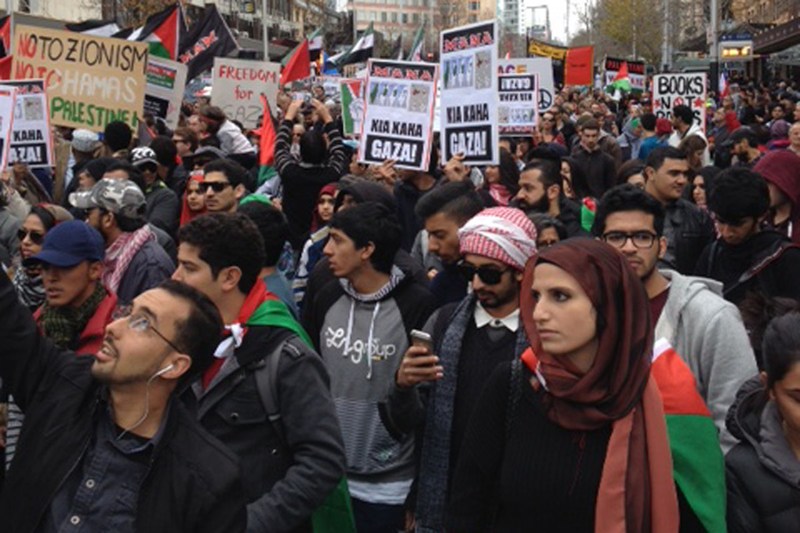
The Changing Face Of Protest: In marked contrast to the theologically- and ideologically-driven protest movements of the 1960s, 70s and 80s, contemporary protest, like this demonstration against the latest Israeli assault on Gaza, tends to be led by those whose stake in the identified violation of individual and/or collective identity is perceived to be the greatest. Photograph by GPJA.
PROTESTS against Israel’s latest invasion of Gaza are
gathering momentum. In Auckland the rallies and marches of the last two
Saturdays have drawn thousands to Aotea Square and Queen Street. Hundreds more
have marched in Wellington. More action is planned. The protest organisers are
now vowing to rally and march every Saturday until the Israeli Defence Force
ceases its assault upon the beleaguered Palestinian enclave.
Viewed from an historical perspective these protests would appear,
at least superficially, to conform to the templates laid down by the protest
movements of the 1960s, 70s and 80s. Like the current movement in support of
the Palestinian people, the movements against sporting contacts with Apartheid
South Africa, nuclear weapons, and the war in Vietnam grew out of New
Zealanders’ conscientious objection to conflicts flaring far beyond their
country’s shores.
The prime movers of these earlier protests were drawn,
overwhelmingly, from the churches, the trade unions and the universities. For
the most part their motivation was straightforward moral revulsion. The
Sharpeville Massacre of 1960; the nuclear war-gamers’ apocalyptic doctrine of
Mutual Assured Destruction; the technology-driven carnage being visited upon
the Vietnamese; all of these horrors stirred into action the muscular Christian
ideals which, ever since the days of the Church Missionary Society, have played
such an influential role in shaping New Zealand society.
Inevitably there was an element of smug condescension in
these demonstrations of Christian charity. In the warm glow of the post-war
boom many New Zealanders believed their little country came about as close to
social perfection as it was possible to get in an imperfect world. With its
“exemplary” race relations, its cradle-to-grave welfare state and its
convenient amnesia concerning the nation’s disgraceful colonial conduct in
Samoa, “progressive” New Zealand felt entirely justified in protesting against
the rest of the world’s moral delinquency. How could “God’s Own Country” do
less?
Playing the part of yeast in all this liberal Christian
white-bread were the tiny communist parties. To the worthy moralism of the
churches these Marxist missionaries added the sharp-edged arguments of
socialist anti-imperialism. Though they were careful never to say so directly, implicit
in their criticism of New Zealand’s diplomatic and military allegiances was the
clear suggestion that we had taken up our position on the wrong side – not just
of the Cold War but of History itself.
Wielding influence out of all proportion to their numbers,
the communists would have been even more persuasive if their loyalties had not
been divided between the gospels of Lenin, Mao and Leon Trotsky. The intensity
of the struggles waged by the Communist Party of New Zealand (Beijing) against
the Socialist Unity Party (Moscow) and by the Workers Communist League (Mao)
against the Socialist Action League (Trotsky) rivalled that directed against
the running-dogs of Capitalism themselves!
But regardless of whether the deities they worshipped were
religious or secular, the leaders of New Zealand’s protest movements shared a
common assumption that their respective doctrines were universally applicable.
Black or White, Male or Female – everyone was welcome in God’s Kingdom/the
Proletarian Paradise. What united human-beings was more important than what
divided them.
It was only after the most convulsive protests in New
Zealand history: the Springbok Tour Protests of 1981; that these universalist
assumptions began to be challenged. Maori demanded to know what middle-class
Pakehas could possibly know about racial and colonial oppression. Women
wondered how men who preached racial equality could be so blind to inequality
between the sexes. Gays struggled to make the straight world understand how
oppressive a universal definition of sexuality could be.
The things that divided human-beings were important too. The
new left-wing catechism now held that people define themselves less by the
qualities they share with everybody else than by the attributes peculiar to
themselves and those similarly identified: gender; ethnicity; sexuality;
nationality; religion.
In this, the age of identity politics, protest activity
operates according to a very different set of rules. The idea that New
Zealanders per se might launch a
series of nationwide protests inspired simply by Israel’s abrogation of
universal moral values would quickly be challenged by persons and groups representative
of the people most directly involved. In the case of Gaza and in descending
order: by Palestinians; fellow Arabs and Muslims; people similarly victimised
by imperialist oppression; and only then by “ordinary” New Zealanders – who
must, of course, acknowledge the leadership and political objectives of those
at the summit of the identity hierarchy.
And so the anti-Israeli protesters chant “Palestine will be
free – from the river to the sea!” And no one who expects to be invited back
dreams of asking: “Free in what way? Do you mean two free and independent
states living side-by-side in peace? Or, do you mean that from the River Jordan
to the Mediterranean, Palestine will be free of Jews?”
Because there’s a big difference.
This essay was
originally published in The Press of Tuesday,
29 July 2014.
There's Something Happening Here: The Labour victories of 1972 and 1984 were preceded by massive upsurges in extra-parliamentary civil engagement. By 1999, however, the neoliberal counter-revolution had reduced politics to a contest between political parties - the two largest of which were steadily becoming ideologically indistinguishable. (Photo by JOHN MILLER)
A DECISIVE FACTOR in New Zealand’s left-wing electoral
victories has been the upsurge in progressive civil engagement which preceded
them. In its turn, this increased politicisation has lifted the level of
electoral participation. In circumstances of heightened civil engagement the
ordinary citizen experiences a growing feeling of politics being “in the air”
and the act of casting a vote is more easily presented as “making a
difference”. At length, even the politically disengaged begin to take an
interest, and since political disengagement is disproportionately associated
with the young, the poor and the socially marginalised, it is hardly surprising
that an up-tick in participation from these groups can make a crucial
difference to the electoral efficacy of the overall “Left Vote”.
Let’s flesh out this proposition by examining the three
periods immediately preceding the decisive Labour victories of 1972, 1984 and
1999.
1972
Having only narrowly lost the 1969 General Election
(National: 605,960 votes or 45.2 percent, Labour: 592,055 votes or 44.2
percent) Labour was confident that the very small swing required to change the
government in 1972 could be achieved.
This confidence was boosted by the widespread public
perception that “the times they were a-changing”. Young people – especially the
tens-of-thousands who were yearly taking advantage of New Zealand’s “free”
tertiary education system – were making their political presence felt on the
nation’s streets in protest demonstrations of unprecedented size and impact.
The 1971 “mobilisations” against the Vietnam War featured
simultaneous demonstrations in the university cities of Auckland, Wellington,
Christchurch, Dunedin, Hamilton and Palmerston North. The combined turnout of
these protest marches represented roughly 1 in 4 of the country’s university
students. They were joined by thousands more progressive New Zealanders from
the churches and the trade unions. On Friday, 30 April 1971, more than 30,000
citizens participated in anti-war protests across New Zealand.
The trade unions themselves were increasingly by-passing the
now discredited Arbitration Court and deploying the strike weapon against their
employers. Acute labour shortages left employers with little option but to
settle and wages rose accordingly. Working-class New Zealanders’ political
confidence grew by leaps and bounds. The Federation of Labour’s conservative
National Executive struggled to keep pace with the jaunty aspirations of the
unions’ rank-and-file.
In 1970, 264,907 people (10 percent of the country’s
population!) signed the “Save Manapouri” petition – imprinting the issue of
environmentalism on to the nation’s political consciousness for the first time.
This potent example of “post scarcity politics” was followed by the creation of
the Values Party. In 1972 this plucky political arriviste, chock-full of visionary inspiration, so spooked the
Labour Party that their full-page election advertisements featured a graphic of
the New Zealand environment (including a forest-destroying deer) safely bottled
up in, of all things, an Agee preserving jar!
By the time the election rolled around, politics wasn’t just
“in the air” – it was filling the
air. The 1969 turnout had been a very respectable 88.94 percent and crucially
for Labour that number – three percentage points higher than the turnout in
1966 – held firm in 1972. This time, however, the Norman Kirk led Opposition
won 677,669 votes or 48.4 percent, and National 581,422 votes or 41.5 percent.
The massive upsurge in civil engagement described above had challenged the
complacency of the old and politicised the young. Labour’s winning slogan:
“It’s time for a change” was resoundingly endorsed.
1984
The three years separating 1981 from 1984 saw the huge
outpouring of progressive energy occasioned by the Springbok Tour channelled
into a series of long-term hegemonic projects that have yet to end.
Labour’s easy victory in 1984 provided belated confirmation
of its plurality of the popular vote in 1981. Only the exigencies of the
First-Past-the-Post electoral system allowed Rob Muldoon’s National Party to
cling onto power in that tumultuous year. In 1981 the final count gave “Rob’s
Mob” 698,508 or 38.77 percent of the popular vote compared to Labour’s 702,630
votes or 39.01 percent.(Social Credit,
which claimed an extraordinary 20.6 percent of the popular vote, was “rewarded”
with just 2 seats!)
The turnout in 1981, at 91.4 percent, was even higher than
1969 and 1972. The near record number reflected the extraordinary
politicisation of the country which the Tour had effected. That it failed to
secure Muldoon’s defeat saw progressive politics bifurcate into the largely
extra-parliamentary “New Social Movements” (Feminism, Anti-Racism, Gay Rights,
Pacifism and Environmentalism) and the more traditional, class-based movements
(trade unionism and the working-class political parties). There was, of course,
a lively intercourse between the two which saw the Federation of Labour endorse
the Working Women’s Charter and the Labour Party establish its enormously
influential Women’s Council.
The 1981-84 period also marked the high point of the “New
Cold War” and its answering response – the movement for a Nuclear-Free New
Zealand. The extent to which this movement permeated the New Zealand population
is extraordinary – as evidenced by the succession of county, borough and city
councils (representing two-thirds of the population) which declared themselves
nuclear-free between 1980 and 1984.
Finally, there was the creation of the unemployed workers’
rights movement. Astonishingly, at least to younger politicos, this movement
was state-subsidised. Unemployed Rights Centres received grants not only from
the trade unions but also from government agencies, and their full-time staff
were paid courtesy of government work schemes. For the first time since the
1930s, the poorest and most marginalised citizens had a voice. (Interestingly,
the Fourth Labour Government moved very quickly to eliminate this kind of state support
for advocacy groups.)
The Left's mobilisation of New Zealand’s most marginalised
citizens almost certainly explains the truly extraordinary turnout for the 1984 General
Election. At 93.7 percent it holds the record for the greatest percentage of
registered voters ever to have participated in a general election. Labour was
swept to power in what should have been an undiluted triumph for the Left. The
full explanation for why it very quickly turned into something else must wait
for another occasion.
1999
The Neoliberal Counter-Revolution which remade New Zealand
in the years that followed 1984 reached its zenith in 1991 with Bill Birch’s
long-prepared Employment Contracts Act and Ruth Richardson’s savage “Mother of
All Budgets”. Had both been answered as they should have been, with a General
Strike from the unions and mass demonstrations by the unemployed and
beneficiaries, the following decade could have been one of unprecedented and
radical politicisation culminating in the eventual election of a government
committed to rolling back neoliberalism in
toto. Tragically, the 1990s turned out to be anything but.
On 18 April 1991, state-sector union
bosses (actively encouraged by the officers of the Council of Trade Unions) voted down the General Strike motion advanced by the private sector unions –
thereby condemning hundreds of thousands of wage workers to the steady
erosion of their workplace rights and the relentless deunionisation of their
industries.
And because the unions did not rise, the sympathetic effect
of a general strike upon the other groups under attack from Jim Bolger’s
National Government never eventuated. The natural alliance of wage workers and
beneficiaries which had already begun to take shape as tens-of-thousands took
to the streets in late-March and early-April 1991 was brutally aborted by the
CTU’s failure to effectively resist the Employment Contracts Bill.
The inevitable and entirely predictable result of this
strategic failure on the part of the New Zealand labour movement was a steady
decline in the turnout of registered voters at general elections. Twenty-seven
years after that record 93.7 percent turnout in 1984, the number of registered
voters participating had slumped to just 74.2 percent – the lowest turnout
recorded since the advent of universal suffrage in 1893.
There were, of course, a succession of bold and extremely
sincere opponents of the neoliberal counter-revolution – the most effective
being those heroic champions of the MMP cause who, by securing a narrow victory
for proportional representation in the referendum of 1993, successfully
resisted the corporate sector’s well-funded campaign to preserve the manifestly
unfair FPP system.
But not even MMP could undo the terrific damage inflicted
upon New Zealand’s political system by the Fourth Labour Government’s
abandonment of social democracy in favour of neoliberalism in the 1980s. This
fundamental political derangement not only split the Labour Party but, by
driving National sharply to the right, inspired its more moderate elements to
form NZ First. Subsequent to Labour’s ideological apostasy, all politics in New
Zealand has been about how best to navigate around the black hole where the
centre-left used to be.
The NewLabour Party, which soon became the Alliance, was the
best effort to rebuild an electorally viable alternative on the Left. By 1996,
however, its relentless struggle against what remained of the Labour Party had
severely shaken the electorate’s faith in the entire Left’s ability to govern.
It is for this reason that the first MMP coalition government was the one
formed between National and NZ First.
Turnout for that first MMP election, at 88.3 percent, was
the highest since 1984, and between them National and NZ First secured 47.2
percent – more than enough with the votes of the avowedly neoliberal ACT Party
to form a government.
Racked by internal strife and the insuperable contradictions
inherent in any attempt to merge the neoliberal and conservative ideologies
into a single project, the National-NZ First Coalition Government was soon
reduced to an incoherent collection of rabid ideologues and disreputable
turncoats. Seizing the moment Labour and the Alliance announced their intention
to govern together in a loose coalition and the scene was set for a “left-wing”
victory in 1999.
But the Labour-Alliance victory (augmented by the electoral
success of the Green Party which had left the Alliance in 1997) bore almost no
resemblance to the victories of 1972 and 1984. Yes, there had been some protest
activity – mostly centred around tertiary student fees and, to a lesser extent,
environmental issues – but it paled in comparison to the mass actions of 1971
and 1981. Overwhelmingly, politics had become a matter for organised parties.
The extra-parliamentary impetus which an effective trade union movement, peace
and environmental activism, and the struggle against Apartheid had given to Left
politics as a whole in the 1970s and 80s was absent.
The 1999 turnout, at 84.1 percent, represented not a rise
but a falling away in political enthusiasm. Bluntly, Helen Clark became Prime
Minister because she was not Jenny Shipley. And when Big Business complained
about the radicalism of her Alliance partner she was quick to reassure the
bosses that socialist measures would pass only over her dead body.
2014
As the General Election of 2014 approaches, the signs of any
sort of upsurge in civil engagement are few and far between. Certainly, the
kinds of mass protest and the forcing on to the agenda of wholly new political
issues and priorities which were the precursors of the great electoral
transitions of the 70s and 80s are almost entirely absent. A dreadful inertia
pervades the body politic: an unwillingness to be moved by any cause or even
any outrage. It is hard to believe, looking back at the conscience-driven civil
eruptions of our recent history, that we are the same people.
The National Prime Minister, John Key, recently told Radio
New Zealand’s Morning Report that
when Labour was last in power, National voted for two-thirds of its legislative
programme, and that since he’s been Prime Minister, Labour has voted for
two-thirds of his. It was an extremely shrewd statement, because the only New
Zealanders who could possibly object to such a cosy arrangement are those who
desperately need politics to be about difference. And the only way to secure
the success of transformative politics is for the young, the poor and the
socially marginalised to, once again, become engaged in the processes of
change.
The very thing that, currently, they are either unable, or
unwilling, to do.
This essay was
originally posted on The Daily Blog
of Tuesday, 8 July 2014.
Who's Listening? Protests remain effective only while the political and economic consensus that governments should respond to their citizens' grievances persists. New Zealand's neoliberal revolution of the 1980s and 90s overturned that consensus. All that protests do now is convince neoliberal politicians that their policies are producing the intended effects.
RELIABLE ESTIMATES of the size of the weekend protests
against the Trans-Pacific Partnership Agreement (TPPA) put the number of
participants at a modest 2,500. Martyn Bradbury, colourful editor of The Daily Blog, speaking to more than
1,000 “It’s Our Future” protesters in Auckland, said:
“I think
that it really shows that economic sovereignty issues are actually quite
central to New Zealanders’ concept about who they are and how they see
themselves and losing that kind of sovereignty is a major concern — it’s no
longer just a fringe issue.”
Bradbury
later described the nationwide protest effort as “an incredible turnout for the
esoteric intricacies of free trade deals”.
Placed
alongside the great protests of the past, a nationwide turnout of 2,500 in
defence of New Zealand’s “economic sovereignty” is indeed “incredible” – but
perhaps not in the way Martyn meant!
But even if
the “It’s Our Future” protests against the TPPA had reached the 50,000 benchmark
figure established by Greenpeace’s highly effective protest against mining in
national parks, it is highly debatable whether it would have been sufficient to
make this government reconsider it iron-clad commitment to free trade.
The
presence of large numbers of protesters on the streets no longer seems to give
governments pause. Evidence of widespread public dissent long ago ceased to be
politically decisive because policy-makers are no longer driven by the need to
preserve a broad political consensus. Opposition is generally anticipated by
today’s politicians, and provided it does not come from those economic and
social actors deemed critical to their re-election, it is also generally
ignored.
One has
only to think of the hundreds-of-thousands of “indignacios” (indignant ones) who poured onto the streets of Spain
during the worst months of the Global Financial Crisis. Or, recall the grim
street-battles between police and protesters outside the Greek parliament in
Athens as that impoverished country’s legislators voted to accept the European
Union’s rescue package – along with the vicious austerity measures that
constituted its political price.
What was
it, then, that made the maintenance of a broad political consensus so important
in the past and why is that no longer the case?
In the
three decades following World War II – a period sometimes referred to as “The
Age of Consensus” – the maintenance of social peace and prosperity remained the
No. 1 political objective of both the centre-left and the centre-right. The “historic compromise” between
capital and labour (big
business and the trade unions) which had given birth to the Welfare State
required both sides to restrain their radical extremes and cleave to the middle
way. With memories of the Great Depression and the War still fresh in the minds
of most citizens, any other course of action would have been most unwise.
Throughout
this period, any manifestation of widespread social and/or political dissent
was, accordingly, regarded as a direct threat to the prevailing bipartisan
consensus. Prime-ministers and Leaders of the Opposition, alike, responded
quickly (and often favourably) to the protesters’ demands.
The
socially levelling effects of consensus politics could not, however, endure
beyond the point where they began to undermine the power and persuasiveness of
capitalism itself. The extraordinary success of Margaret Thatcher and Ronald
Reagan is largely explained by their willingness to challenge the core elements
of the Age of Consensus by attacking the unions, abandoning progressive
taxation and reducing the responsiveness of the state. The neoliberal
revolution which Thatcher and Reagan unleashed was thus predicated on the
assumption that if the minority who mattered in capitalist society were to go
on mattering, then the majority was going to have to learn to be disappointed.
Hence the
dwindling impact and effectiveness of protest. Far from spurring Governments to
reconsider their policies, mass protests actually provided them with evidence that
the contested policies were correct. The 300,000 workers who protested against
the National Government’s Employment Contracts Bill during the first fortnight
of April 1991, far from constituting proof of the Bill’s inequity, merely
confirmed for the Right the urgent necessity of its passage.
But if
protest no longer works how are we to explain Greenpeace’s success? Or, for
that matter – Ukraine’s?
In the
former case it was not Greenpeace’s mobilisation efforts alone that made the difference. Tens
of thousands of National Party members and voters had directly communicated
their outrage to National’s MPs through letters, e-mails and phone-calls. These
were the government’s core supporters in rebellion. They counted.
The protesters
who overthrew the Ukrainian Government possessed an advantage that all the
protesters described above lacked: the covert support of the armed forces. They
knew that violence against the police would not be answered by violence from
the army. What happened in Kiev’s Independence Square wasn’t a protest – it was
a coup d’état by crowd.
Strip the
state of its armed protection and mass protest rapidly escalates into
full-scale revolt.
This essay was originally published in The Press of Tuesday, 1 April 2014.
David and Goliath Struggle: Critics of Greenpeace have condemned its latest protest against deep sea oil drilling as folly. But, in a world made miserable by the “wisdom” of our neoliberal masters, “folly” may be exactly what people are looking for.
BE CAREFUL what you wish for, Prime Minister. If the New
Zealand electorate has shifted as far to the left as the polls show the British
and American electorates shifting, a Labour Party committed to re-nationalising
the partially-privatised energy SOEs and Air New Zealand may not be as
unpopular as you think. By the same token, Mr Cunliffe: “Profligate Communist!”
may not be the insult you assume it to be.
Across the world, but especially in the developed world,
there is a growing sense of enough being enough. Enough inequality. Enough
unemployment. Enough insecurity. Enough retrenchment. Enough austerity. Enough
of swallowing the lie that all of these things are as immutable as the seasons.
Unalterable. Just the way it is.
“Enough of that!” People are saying. “What was made by Man
can be changed by Man.”
Enough is enough.
It’s been slow to arrive in New Zealand. Nearly three
decades of bipartisan agreement on the essentials of neoliberal economic policy
have seen to that. A whole generation has grown up believing that this is as
good as it gets. That the Reserve Bank Act, the Public Finance Act, the State
Sector Act and the Employment Contracts/Relations Act – like the stone tablets
Moses brought down from Mt Sinai – are laws written by God.
But the problem with raising up a massive, all-embracing,
hegemonic structure is that, eventually, it has to deliver. People will
tolerate a slow start – especially if the system being replaced held sway for a
long time and embedded its values deep in the national psyche. At some point,
however, the new system has got to work. And by “work” the average person means
“work for everyone – not just a privileged few”.
Thirty years has been more than enough time for the
neoliberal system to have proved its worth. That it has delivered the world we
live in today argues pretty decisively against it being much more than a
mechanism for making the rich richer and the rest of us wretched.
The newspapers and the electronic media may tell us that
things are not as bad as they seem, and that, really, our government’s
“common-sense” policies are working splendidly; but their spin is counter-spun
by our lived experience. The content of our day-to-day lives is constantly
constructing a powerful “counter-hegemony”. We “just know” that things are not
getting better.
And, knowing this, we are constantly bemused, amazed and
(more recently) aggrieved that the political parties purporting to offer a
challenge to the status-quo do not seem to be aware of it. Or, even if they are
aware of it, remain steadfastly unwilling to embrace the sort of policies that
might do something about it.
Mr Cunliffe’s unwillingness to be labelled a “Profligate
Communist” reveals the power that neoliberalism still wields over New Zealand’s
political class. Every editor, every political journalist and commentator in
the country would declare his unequivocal pledge to renationalise the energy
SOEs utter folly – and the Leader of the Labour Party has balked at the
prospect.
But, in a world made miserable by the “wisdom” of our
neoliberal masters, “folly” may be exactly what people are looking for in a
Labour leader. The “holy folly” that inspired the Saints: that prompted Martin Luther
to nail his manifesto of protest to the cathedral door; that kept Rosa Parks in
her seat, immovable, on a Montgomery bus.
We New Zealanders have a soft spot for that sort of holy
foolishness. It’s why we cheered when Norman Kirk dispatched a frigate to
Mururoa. It’s why we applauded when hundreds of little boats sailed out to
blockade the nuclear warships of the US Navy. It’s why, deep down, and in spite
of all the sneers and jeers, we are willing Greenpeace’s little flotilla to
stay the distance and succeed.
When we see the size of the drilling vessel: the way it
dwarfs the little craft that have sailed into Anadarko’s forbidden zone to bear
witness against the reckless gamble that is deep sea oil; something in us
reaches out to them – law or no law.
“This will not stand”, whispers the voice of holy folly. And
then, loud enough to disturb his whole Government, that same voice makes a
second promise: one our Prime Minister was certain he would never hear – and
now recoils from:
“They will not stand alone.”
This essay was
originally published in The Waikato Times, The Taranaki Daily News, The
Timaru Herald, The Otago Daily Times and The Greymouth Star of Friday, 29 November 2013.
Pristine Coastline: The Government's plans to bring deep-sea oil exploration and exploitation to New Zealand's Exclusive Economic Zone threaten the unspoiled beauty of its coasts, the survival of its flora and fauna and the future of its fishing and tourism industries.
THE NORTH OTAGO COUNTRYSIDE descends in a series of broad
terraces towards the sea. So, when I was a child, the journey home was all
downhill. On the farm where I grew up, those smooth-topped hills came to an
abrupt end, dropping suddenly to the flat paddocks and meandering creeks that
ran out among the sea grass and sand dunes of Otago’s curving shoreline.
Behind our homestead, all was high hills and distant
mountains, but before it ran the ruled line of the Pacific’s far horizon. Well,
it seemed far to me, but, in reality, it was only a few miles away. Even so,
the world lay beyond it, infinitely far, and every night I’d fall asleep to the
steady rhythm of the breakers whose soft whispers I could never quite decipher.
Fifty years later, those breakers' messages are suddenly
intelligible: full of warning and fears for the future. Because, if Prime
Minister Key and his gung-ho Energy Minister, Simon Bridges, get their way,
then the unsullied line of the Pacific will be defiled.
Rising between the horizon and the shore, gas stacks flaring
in the wind like the banners of a feudal host, will be oil platforms. And
everything I cherished as a child: the rush-lined creeks; the orange and white
pebble beaches; the fishing grounds; the circling gulls; the little estuaries
and wide river mouths; will be one accident away from destruction.
Of course,
Mr Bridges will tell me exactly what he told the 600 oil prospectors and their
enablers gathered at the Advantage New Zealand Conference in Auckland on
Monday, that: “New
Zealand has a world-class regulatory system that ensures the safety of its
people and its environment, alongside greater resource development.”
I wish
that was true. I wish that before any company was permitted to lower their
drilling equipment more than a thousand metres to the bottom of the sea they
had to have all the necessary salvage equipment ready and waiting, just hours
away, in the event of something going wrong.
Because
things do go wrong with deep sea oil wells. And Robert P. Daniels, Senior Vice
President, International and Deepwater Exploration, Anadarko Petroleum
Corporation, a guest speaker at the Advantage New Zealand Conference, could’ve
told Mr Bridges all about them.
Because
the Anadarko Petroleum Corporation was there when something very serious went
wrong on a deep sea oil platform. Anadarko owned 25 percent of the Deepwater Horizon when it exploded,
killing eleven men, and unleashing, more than a mile below, the first of the
780,000 cubic metres of crude oil that devastated the unprotected Gulf of
Mexico.
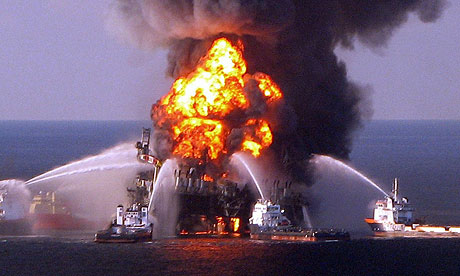
Disaster On The High Seas: The Deepwater Horizon tragedy took 87 days to contain - and that was in the Gulf of Mexico where salvage equipment was close by. A similar oil spill would take many more months to contain if it happened off the New Zealand coast.
It took 87
days to finally cap that oil gusher – and that was when the necessary (and
eye-wateringly expensive) equipment required for the job was located only a few
days sailing time from the scene of the disaster.
If
something akin to the Deepwater Horizon
disaster happened here in New Zealand, that equipment would take not days, but
months, to arrive. While it was being assembled an environmental catastrophe
beyond the imagination of most New Zealanders would be destroying our flora and
fauna, fouling our coastline, and inflicting damage on our fishing and tourist
industries that only decades could repair.
None of
this information appears in Mr Bridges’ speech to the oil explorers. What he
did say, after listing the vast strips of New Zealand’s Exclusive Economic Zone
which the National Government has opened for exploration, was this:
“Many of
you have actively engaged with the Government on the review of the Crown
Minerals Act, the introduction of environmental legislation into the Exclusive
Economic Zone and on new health and safety regulations for petroleum
operations.
“I thank
you for your tireless efforts to help make our laws and regulations
world-class.”
In other
words, Mr Bridges thanks the oil exploration companies for “actively engaging”
in the task of drawing up the legislation intended to regulate the behaviour of
… the oil exploration companies.
Included
among the regulatory provisions of this “world-class” legislation are Mr
Bridges’ clauses permitting the armed forces to be used against New Zealand
citizens challenging the oil exploration companies. Any repetition of the
actions that drove Petrobras out of the Raukumara Basin will see protesters
facing massive fines and serious jail time.
Our
country faces a sudden downhill journey – but we are not going home.
This essay was originally published in The Waikato Times, The Taranaki Daily News, The Timaru Herald, The Otago Daily Times and The
Greymouth Star of Friday, 3 May 2013.