
Showing posts with label Deepwater Horizon Disaster. Show all posts

Friday, 3 May 2013

Deep Waters And Broken Horizons

Pristine Coastline: The Government's plans to bring deep-sea oil exploration and exploitation to New Zealand's Exclusive Economic Zone threaten the unspoiled beauty of its coasts, the survival of its flora and fauna and the future of its fishing and tourism industries.
 
THE NORTH OTAGO COUNTRYSIDE descends in a series of broad terraces towards the sea. So, when I was a child, the journey home was all downhill. On the farm where I grew up, those smooth-topped hills came to an abrupt end, dropping suddenly to the flat paddocks and meandering creeks that ran out among the sea grass and sand dunes of Otago’s curving shoreline. 

Behind our homestead, all was high hills and distant mountains, but before it ran the ruled line of the Pacific’s far horizon. Well, it seemed far to me, but, in reality, it was only a few miles away. Even so, the world lay beyond it, infinitely far, and every night I’d fall asleep to the steady rhythm of the breakers whose soft whispers I could never quite decipher.
 
Fifty years later, those breakers' messages are suddenly intelligible: full of warning and fears for the future. Because, if Prime Minister Key and his gung-ho Energy Minister, Simon Bridges, get their way, then the unsullied line of the Pacific will be defiled. 

Rising between the horizon and the shore, gas stacks flaring in the wind like the banners of a feudal host, will be oil platforms. And everything I cherished as a child: the rush-lined creeks; the orange and white pebble beaches; the fishing grounds; the circling gulls; the little estuaries and wide river mouths; will be one accident away from destruction.
 
Of course, Mr Bridges will tell me exactly what he told the 600 oil prospectors and their enablers gathered at the Advantage New Zealand Conference in Auckland on Monday, that: “New Zealand has a world-class regulatory system that ensures the safety of its people and its environment, alongside greater resource development.”
 
I wish that was true. I wish that before any company was permitted to lower their drilling equipment more than a thousand metres to the bottom of the sea they had to have all the necessary salvage equipment ready and waiting, just hours away, in the event of something going wrong.
 
Because things do go wrong with deep sea oil wells. And Robert P. Daniels, Senior Vice President, International and Deepwater Exploration, Anadarko Petroleum Corporation, a guest speaker at the Advantage New Zealand Conference, could’ve told Mr Bridges all about them.
 
Because the Anadarko Petroleum Corporation was there when something very serious went wrong on a deep sea oil platform. Anadarko owned 25 percent of the Deepwater Horizon when it exploded, killing eleven men, and unleashing, more than a mile below, the first of the 780,000 cubic metres of crude oil that devastated the unprotected Gulf of Mexico.
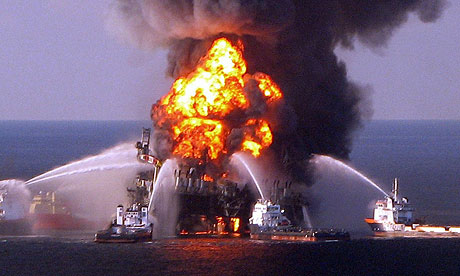
 
Disaster On The High Seas: The Deepwater Horizon tragedy took 87 days to contain - and that was in the Gulf of Mexico where salvage equipment was close by. A similar oil spill would take many more months to contain if it happened off the New Zealand coast.
 
It took 87 days to finally cap that oil gusher – and that was when the necessary (and eye-wateringly expensive) equipment required for the job was located only a few days sailing time from the scene of the disaster.
 
If something akin to the Deepwater Horizon disaster happened here in New Zealand, that equipment would take not days, but months, to arrive. While it was being assembled an environmental catastrophe beyond the imagination of most New Zealanders would be destroying our flora and fauna, fouling our coastline, and inflicting damage on our fishing and tourist industries that only decades could repair.
 
None of this information appears in Mr Bridges’ speech to the oil explorers. What he did say, after listing the vast strips of New Zealand’s Exclusive Economic Zone which the National Government has opened for exploration, was this:
 
“Many of you have actively engaged with the Government on the review of the Crown Minerals Act, the introduction of environmental legislation into the Exclusive Economic Zone and on new health and safety regulations for petroleum operations.
 
“I thank you for your tireless efforts to help make our laws and regulations world-class.”
 
In other words, Mr Bridges thanks the oil exploration companies for “actively engaging” in the task of drawing up the legislation intended to regulate the behaviour of … the oil exploration companies.
 
Included among the regulatory provisions of this “world-class” legislation are Mr Bridges’ clauses permitting the armed forces to be used against New Zealand citizens challenging the oil exploration companies. Any repetition of the actions that drove Petrobras out of the Raukumara Basin will see protesters facing massive fines and serious jail time.
 
Our country faces a sudden downhill journey – but we are not going home.
 
This essay was originally published in The Waikato Times, The Taranaki Daily News, The Timaru Herald, The Otago Daily Times and The Greymouth Star of Friday, 3 May 2013.

Tuesday, 2 April 2013

The Paradox Of The Free Market

Non-Market Player: A Greenpeace protester position's himself in the path of the Orient Explorer as part of the ultimately successful campaign to drive deep-sea oil prospector, Petrobras, out of the Raukumara Basin. The National Government now proposes to make such protests illegal. It is the great paradox of "free" markets that they require an ever-stronger state to keep them functioning.

AT THE HEART of the so-called “free market” is a puzzling paradox.
 
Around the world, the justification for implementing free market policies was said to be the damaging effects of state intervention on economic performance. In his inaugural address, that arch free-marketeer, President Ronald Reagan, warned his fellow Americans that “Government isn’t the solution … Government is the problem.”
 
For prosperity to be guaranteed, argued the free marketeers, the power of the state must be curtailed, and its interfering hands forcefully removed from the economic levers.
 
The paradox of the free market lies in the political implications of those two words: “curtailed” and “forcefully”.
 
To prevent non-market players from intervening in the economic life of society and increase the scope and freedom of market forces, the power of the state must not, under any circumstances, be “curtailed”. Quite the opposite, in fact: to protect the operations of the free market, the capacity of the State to act “forcefully” must be increased.
 
The latest proof of the free-market paradox comes in the form of an announcement from Energy and Resources Minister, Simon Bridges.
 
In his media statement of 31 March, Mr Bridges states:
 
“The Government is proposing stronger measures to protect offshore petroleum and minerals activity from unlawful interference”.
 
In a Supplementary Order Paper to the Crown Minerals (Permitting and Crown Land) Bill the Cabinet has provided for a firming up of the protection available to “lawful offshore petroleum and minerals activity”. The SOP, to be tabled in Parliament, also gives new enforcement powers to police and defence force personnel.
 
Explaining the Government’s decision, Mr Bridges points to recent attempts to “seriously disrupt lawful mining and related activities”. Such actions, says the Minister, “impose significant costs on companies carrying out legitimate activities under permits, and present very serious health hazards and safety risks”.
 
Those “recent activities” no doubt refer to the successful 2012 campaign by Greenpeace and a local Maori organisation, Te Whanau a Apanui, to disrupt and dissuade the giant, state-owned Brazilian energy company, Petrobras, from continuing its deep-sea oil prospecting in the Raukumara Basin off East Cape.
 
The most effective protest action of the Greenpeace/ Te Whanau a Apanui Campaign involved a small flotilla of seven boats sailing into Petrobras’s prospecting zone and taking up positions around its large survey vessel, the Orient Explorer.
 
When a local Maori fisherman, Elvis Teddy, steered his own vessel, the San Pietro, across the Orient Explorer’s path, dropping buoys and long-lines, the National-led Government authorised the Police and New Zealand Defence Force naval units to move in and arrest him.
 
Powerful Combination: Elvis Teddy's San Pietro sails towards its confrontation with the Orient Explorer. The pairing of Greenpeace and Te Whanau a Apanui proved to be a winning political formula in the campaign against deep-sea oil prospecting off East Cape.
 
To the Government’s dismay, the charges against Mr Teddy were later dropped. The Court declined jurisdiction because the protest action took place outside New Zealand’s twelve nautical miles territorial limit.
 
Earlier this year, on 13 January, Petrobras announced it was pulling out of New Zealand.
 
Minister Bridges “stronger measures” are designed to prevent any further protest interventions along the lines of those developed by Greenpeace/ Te Whanau A Apanui.
 
“The changes address a gap in the current legislation. They provide an effective deterrent, and readily workable operational powers, to act against unlawful interference with legitimate exploration and production activities.” Mr Bridges stated.
 
Future protest groups face jail sentences and massive fines if they violate a “notified minimum non-interference distance” of up to 500 metres.
 
What just happened here?
 
The National-led Government is keen to develop energy potential of the Raukumara Basin. Accordingly, it invites large multinational energy companies to acquire the necessary permits and begin prospecting.
 
Greenpeace, in alliance with Te Whanau a Apanui, oppose deep-sea oil drilling as an unacceptable threat to both the kai moana of local whanau and hapu, and the acutely vulnerable deep sea environment. They point to the devastating Deepwater Horizon disaster which spilled billions of litres of crude oil into the Gulf of Mexico.
 
Now, consider the State’s role in this classic stand-off.
 
From the outset it has given preference to market over non-market interests. In spite of the fact that New Zealand lacks both the technology and the financial resources to adequately respond to a deep-sea drilling malfunction on the scale of the Deepwater Horizon spill, it promotes and facilitates deep-sea prospecting in the Raukumara Basin.
 
Thwarted by the Court’s refusal to punish the behaviour of the protest flotilla, the National-led Government sets about equipping the State with new, quite draconian, powers to protect any future oil-prospecting multinational corporations from the physical obstruction (and attendant publicity) of Greenpeace’s “Stop Deep Sea Oil” protest campaign.
 
It will soon be perfectly lawful to deploy the New Zealand armed forces to protect and defend not the victims of war or natural disaster, but vast, privately-owned corporations whose profit-seeking activities threaten both the New Zealand environment and economy.
 
Whose freedom is the Government protecting here? The market’s, or our own?
 
This essay was originally published in The Press of Tuesday, 2 April 2013.

Wednesday, 19 October 2011

Drill, Baby, Drill!

Foreseeable Crisis: The mile-deep disaster that overtook the Deepwater Horizon oil-rig in the Gulf of Mexico had massive technological assistance within a day's sailing of the catastrophe. Even so, it took BP several months to bring the massive ecological crisis under control. Given the authorities' obvious logistical difficulties in dealing with the comparatively small oil-spill from the Rena, is deep-sea oil exploration really the best answer to New Zealand's energy deficit?

“DRILL, BABY, DRILL!” It’s the battle-cry of the believers in “business as usual”. Sarah Palin’s infamous injunction is also the Populist Right’s translation of former American Vice-President, Dick Cheney’s, much more ominous observation that: “The American way of life is non-negotiable.”

What did the Vice-President mean? In brutally simple terms, Mr Cheney’s words meant that nothing should be allowed to come between Americans and the supply of cheap fossil fuel that underpins the USA’s extraordinary wealth.

“Drill, baby, drill!”, also sums up the National-led Government’s policy on fossil fuels. The Rena may be leaking heavy fuel-oil into the Bay of Plenty, but the Government’s plans for promoting deep-sea oil exploration within New Zealand’s exclusive economic zone (EEZ) have yet to be put on hold. Indeed, the Greens and Labour have been chastised for even suggesting such a moratorium, and thereby giving the relevant authorities time to absorb the causes, consequences and lessons of Rena’s grounding.

Why the gung-ho attitude? Why is the Government so determined to proceed in the face of so much evidence suggesting the need for extreme caution? The enormous difficulties already encountered in off-loading just 1,700 tonnes of fuel-oil from a coastal container ship pale into insignificance when compared to the ecological tragedy which unfolded in the Gulf of Mexico between April and July of 2010.

That disaster took place within a day’s sailing of the USA and Mexico, two of the world’s largest energy producers and refiners. So, help was close at hand. A similar deep-sea drilling accident occurring off the coast of New Zealand: a country at the end of the world’s sea-lanes; thousands of miles, and weeks of sailing, away from international assistance; would swiftly dwarf the Deepwater Horizon catastrophe.

Simple common-sense suggests that even the most rudimentary of cost-benefit analyses would flag deep-sea exploration in New Zealand’s EEZ as, at best, marginal, and, at worst, grossly irresponsible.

Of course, the same could’ve been said (and was) about the radical deregulation of our coastal shipping industry. Allowing so-called “flag of convenience” vessels (crewed not by the best, but by the cheapest officers available) to supplant New Zealand flagged and crewed vessels, made a Rena-style accident all-but-inevitable. The Maritime Union of New Zealand warned successive governments over and over again about the risks. Nobody listened.

So, what is it? How is this refusal to recognise simple common sense, and heed the warnings of experts, to be explained?

The answer is frighteningly simple. Politicians like Sarah Palin, Dick Cheney, Gerry Brownlee and Hekia Parata (Mr Brownlee’s stand-in as Energy Minister) are all in a state of denial.

Even though a succession of reputable international agencies (the latest being the IMF) have warned the world’s governments that the moment of peak oil production occurred five years ago, and that the chances of the current and future global demand for oil being met by the discovery and exploitation of new deep-sea fields are extremely low (the world needs to locate the equivalent of four Saudi Arabia’s to meet the looming shortfall of cheap oil supplies) the politicians just go on denying that any of this alarming information is true.

Given New Zealand’s acute vulnerability to price and supply shocks, our political leaders’ refusal to face the facts is, perhaps, understandable. The best evidence available suggests that this country’s domestic fossil fuel reserves will be largely exhausted by 2020. That will leave our automobile-dependent society and economy dangerously exposed to the vagaries of international supply and demand.

Try these numbers for size.

The current price of “Brent Crude” is between $US100-$US120 per barrel. The NZ Treasury forecasts that in 2015 our exchange rate with the US dollar will be 0.60$US/$NZ. Assuming that by 2015 the declining global supply of oil has pushed the price of Brent Crude to $US200 per barrel, means New Zealand would need to find an additional $10.5 billion, annually, to pay its net fuel import bill. (Compare this with the total cost to Government of rebuilding Christchurch, estimated by Treasury to be $8 billion.)

The economic consequences of such a massive increase in the price of oil are easily imagined: falling GDP, rising inflation, declining real income, decreased consumer spending, increased unemployment, recession.

And so the cry of “drill, baby, drill!” goes up. Because it’s easier to imagine some lucky offshore prospector uncovering another North Sea oil and gas field than it is to imagine how any government might even broach, let alone manage, the winding-back of our fossil-fuel-based civilisation.

It’s all too hard. Just as it was too hard to resist the deregulation of our coastal shipping industry – and so keep our beaches and wildlife free from stinking, toxic sludge.

Fifty years from now, when the foreign ships no longer call, may our grand-children laugh where we now weep – and wonder at our folly.

This essay was originally published in The Press of Tuesday, 18 October 2011.