

Pristine Coastline: The Government's plans to bring deep-sea oil exploration and exploitation to New Zealand's Exclusive Economic Zone threaten the unspoiled beauty of its coasts, the survival of its flora and fauna and the future of its fishing and tourism industries.
THE NORTH OTAGO COUNTRYSIDE descends in a series of broad
terraces towards the sea. So, when I was a child, the journey home was all
downhill. On the farm where I grew up, those smooth-topped hills came to an
abrupt end, dropping suddenly to the flat paddocks and meandering creeks that
ran out among the sea grass and sand dunes of Otago’s curving shoreline.
Behind our homestead, all was high hills and distant
mountains, but before it ran the ruled line of the Pacific’s far horizon. Well,
it seemed far to me, but, in reality, it was only a few miles away. Even so,
the world lay beyond it, infinitely far, and every night I’d fall asleep to the
steady rhythm of the breakers whose soft whispers I could never quite decipher.
Fifty years later, those breakers' messages are suddenly
intelligible: full of warning and fears for the future. Because, if Prime
Minister Key and his gung-ho Energy Minister, Simon Bridges, get their way,
then the unsullied line of the Pacific will be defiled.
Rising between the horizon and the shore, gas stacks flaring
in the wind like the banners of a feudal host, will be oil platforms. And
everything I cherished as a child: the rush-lined creeks; the orange and white
pebble beaches; the fishing grounds; the circling gulls; the little estuaries
and wide river mouths; will be one accident away from destruction.
Of course,
Mr Bridges will tell me exactly what he told the 600 oil prospectors and their
enablers gathered at the Advantage New Zealand Conference in Auckland on
Monday, that: “New
Zealand has a world-class regulatory system that ensures the safety of its
people and its environment, alongside greater resource development.”
I wish
that was true. I wish that before any company was permitted to lower their
drilling equipment more than a thousand metres to the bottom of the sea they
had to have all the necessary salvage equipment ready and waiting, just hours
away, in the event of something going wrong.
Because
things do go wrong with deep sea oil wells. And Robert P. Daniels, Senior Vice
President, International and Deepwater Exploration, Anadarko Petroleum
Corporation, a guest speaker at the Advantage New Zealand Conference, could’ve
told Mr Bridges all about them.
Because
the Anadarko Petroleum Corporation was there when something very serious went
wrong on a deep sea oil platform. Anadarko owned 25 percent of the Deepwater Horizon when it exploded,
killing eleven men, and unleashing, more than a mile below, the first of the
780,000 cubic metres of crude oil that devastated the unprotected Gulf of
Mexico.
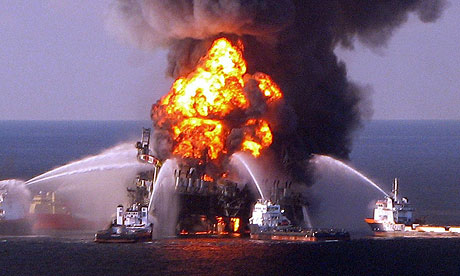
Disaster On The High Seas: The Deepwater Horizon tragedy took 87 days to contain - and that was in the Gulf of Mexico where salvage equipment was close by. A similar oil spill would take many more months to contain if it happened off the New Zealand coast.
It took 87
days to finally cap that oil gusher – and that was when the necessary (and
eye-wateringly expensive) equipment required for the job was located only a few
days sailing time from the scene of the disaster.
If
something akin to the Deepwater Horizon
disaster happened here in New Zealand, that equipment would take not days, but
months, to arrive. While it was being assembled an environmental catastrophe
beyond the imagination of most New Zealanders would be destroying our flora and
fauna, fouling our coastline, and inflicting damage on our fishing and tourist
industries that only decades could repair.
None of
this information appears in Mr Bridges’ speech to the oil explorers. What he
did say, after listing the vast strips of New Zealand’s Exclusive Economic Zone
which the National Government has opened for exploration, was this:
“Many of
you have actively engaged with the Government on the review of the Crown
Minerals Act, the introduction of environmental legislation into the Exclusive
Economic Zone and on new health and safety regulations for petroleum
operations.
“I thank
you for your tireless efforts to help make our laws and regulations
world-class.”
In other
words, Mr Bridges thanks the oil exploration companies for “actively engaging”
in the task of drawing up the legislation intended to regulate the behaviour of
… the oil exploration companies.
Included
among the regulatory provisions of this “world-class” legislation are Mr
Bridges’ clauses permitting the armed forces to be used against New Zealand
citizens challenging the oil exploration companies. Any repetition of the
actions that drove Petrobras out of the Raukumara Basin will see protesters
facing massive fines and serious jail time.
Our
country faces a sudden downhill journey – but we are not going home.
This essay was originally published in The Waikato Times, The Taranaki Daily News, The Timaru Herald, The Otago Daily Times and The
Greymouth Star of Friday, 3 May 2013.

