
Showing posts with label Bucha Massacre. Show all posts

Friday, 15 April 2022

Where Is The Peace Movement?

Casus Belli: The bodies in the street, the terrible revelations of rape and torture: these only make matters worse. Our instinctive response, when confronted with such images is not to calmly contemplate the best means of extricating all concerned from the horrors of war, but to punish those responsible for such atrocities.

WHY HAS THE RUSSO-UKRAINIAN WAR not generated a global movement for, at the very least, an immediate cessation of hostilities? The aggressor, Russia, possesses nuclear weapons, and has issued thinly-veiled threats that it is prepared to use them if any other power attempts to interfere in its “military operation” in Ukraine. The slightest miscalculation, therefore, could trigger an all-out nuclear exchange – and the end of civilisation as we know it. In such precarious circumstances, mobilising global support for a peaceful resolution to the conflict seems like a good idea. So, why isn’t it happening? Where is the peace movement?

Before attempting an answer to that question, it is worth casting our minds back to the first quarter of 2003. The United States and the United Kingdom were engaged in obvious preparations for a full-scale military invasion of Iraq. All over the world people were gathering in huge demonstrations to oppose the US/UK plans. Over a million protesters flooded the streets of the UK’s largest cities in what was, almost certainly, the largest political protest in the nation’s history. Vast crowds similarly thronged the streets of American cities. In France, Italy and Germany it was the same. Time magazine described the global peace movement as the other great power on the planet.

All to no avail. Like the Russian Federation, the United States was not about to be dissuaded from doing what it believed it had to do. That it would go to war without the sanction of the UN Security Council, and on the basis of intelligence claims that most independent experts dismissed as spurious, was not about to slow the administration of George W Bush down. Peace movement or no peace movement, the invasion would go ahead as planned.

The demonstrable futility of the international protest movement against the Iraq War offers a pretty solid explanation for the absence of a global pacifist response to the Russo-Ukrainian War. Among those coming of age in the first quarter of the Twenty-First Century, it may simply be understood that if a major power is resolved to attack another country, no amount of chanting and placard-waving will stop it. Didn’t the UK Prime Minister Tony Blair’s spin-doctors respond to media taunts that there were a million citizens on out on the streets, by referencing the tens-of-millions who weren’t?

The other obvious lesson to be drawn from the global protests against the US/UK invasion of Iraq is that they would never have happened (or, at least, not on anything like the same scale) had their organisers not been living in democracies. If the Russian Federation showed the same respect for fundamental human rights as the United States, it is possible that a million or more Russians would have turned out to protest the invasion of Ukraine. What the world actually witnessed on the streets of Moscow and St Petersburg was the brutal suppression of every attempt at protest by the thuggish Russian police.

It is these images of suppression and violence that bring us to the heart of the matter. People around the world rose up against the prospect of the invasion of Iraq in part because they believed that the two nations responsible, the USA and the UK, were still, in some hallowed and undefiled place, receptive to the moral case for peace. All the evidence may have pointed in the opposite direction, but, in their heart-of-hearts, the historical friends and allies of the United States and the United Kingdom wanted to – needed to – believe that they were better than the murderous bullies Bush and Blair had turned them into.

Very few people believe that some hallowed and undefiled place exists in the dark monstrosity that is the Russian state. There are no democratic orchards in Russia. The fruits of freedom and justice do not grow there. The conditions are too harsh. Even when the tree of liberty is smuggled in and persuaded to bloom, which is seldom, the flowers fade for lack of warmth. Russia is a hard, cold country, and difficult to love, even if you’ve a mind to. But no people on earth knows more about suffering – and how to share it.

And we are suffering, but not in a way that does Russia any good. Our suffering is vicarious, inspired by the pain and heroism of the Ukrainian people. How else are the people of the West supposed to feel when they are presented with the image of a Ukrainian father, now a soldier, fighting back tears as his wife and son are borne away from him on a westbound train to safety, clutching in his hands his little boy’s toy ambulance – all that is left to him? Are we supposed to be filled with an urge to make peace? Or, are we already part of the war?

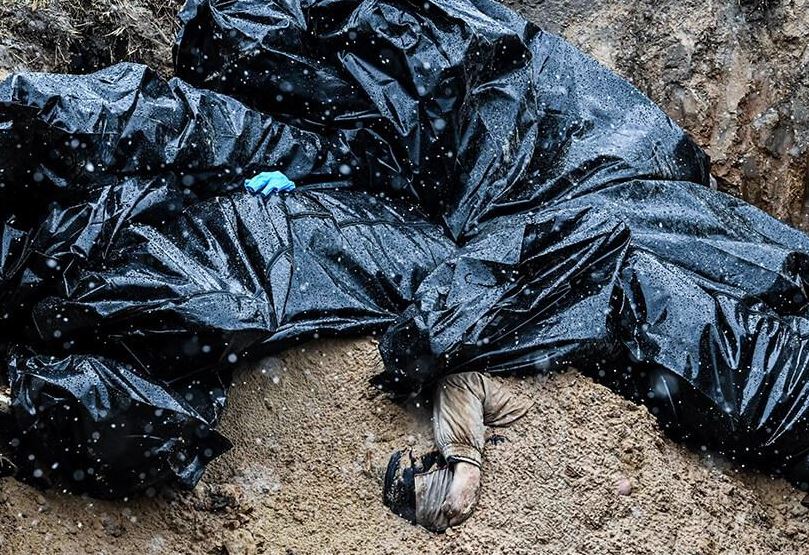
The bodies in the street, the terrible revelations of rape and torture: these only make matters worse. Our instinctive response, when confronted with such images is not to calmly contemplate the best means of extricating all concerned from the horrors of war, but to punish those responsible for such atrocities. Perhaps that’s what they’re intended to do. Perhaps, as the Russians insist, they are fake news. But while such images are all the world is seeing, there will be no global peace movement.

And if there is worse to come: if the wounded Russian Bear tears the Ukraine to pieces; and if the world is bombarded with ever more tragic and terrifying images of Ukraine in extremis; then it will not be a global peace movement that emerges, but a global war movement. Channeling the wild bellicosity of the masses celebrating the outbreak of the First World War, the people of the West, heedless of the nuclear danger, will cry: “Do your worst, Russia – and we will do ours!”


This essay was originally posted on The Daily Blog of Friday, 15 April 2022.

Friday, 8 April 2022

Bloody Anniversaries.

My Lai, Vietnam, 16 March 1968: That was the day two companies of United States infantry descended on what the Americans called “Pinkville” and began killing civilians. The Vietnamese inhabitants of the village, between 300 and 500 of whom would be dead by nightfall, called it My Lai.

WHY, IN THE MIDST of an horrific war between Russia and Ukraine, did we let the anniversary pass? With talk of atrocities and war crimes filling the airwaves, how could we have overlooked the events of 16 March 1968?

That was the day two companies of United States infantry descended on what the Americans called “Pinkville” and began killing civilians. The Vietnamese inhabitants of the village, between 300 and 500 of whom would be dead by nightfall, called it My Lai.

The My Lai Massacre, as the wanton butchery and rape of unarmed men, women and children came to be known, was notable for two extraordinary interventions.

The first occurred on the day of the killings, when Warrant Officer Hugh Thompson and his helicopter crew, witnessing the mass murder taking place just a few hundred feet below them, landed their aircraft close to a group of My Lai villagers cowering in a bunker and organised their safe evacuation, making it clear to the American soldiers menacing them, that he and his men were prepared to use their aircraft’s heavy machine gun to keep the villagers safe.

Returning to base, Thompson told his commanding officer: “It’s mass murder out there. They’re rounding them up and herding them in ditches and then just shooting them.”

The other extraordinary intervention came two years later when the President of the United States, Richard Nixon, intervened to have the only individual convicted for his role in the My Lai Massacre, Lieutenant William Calley Jnr, released from the military jail where he was being held pending his appeal and placed under house arrest. Sentenced to life imprisonment on 22 counts of murder, Calley ended up spending only three-and-a-half years in custody.

In 1971, patriotic Americans could sing along to Terry Nelson’s “Battle Hymn of Lt Calley” – a tribute to the man considered a hero by many of his countrymen. By contrast, Warrant Officer Thompson and his crew were denounced by the then Chairman of the House Armed Services Committee, Mendel Rivers, as “traitors”.

In war, frightened and disillusioned young men are capable of the most atrocious behaviour, especially if encouraged to do so by those placed in command over them. At the outbreak of World War I, for example, German conscripts were ordered to engage in acts of Schrecklichkeit – frightfulness – as a means of deterring civilians from attempting to resist their advance. Thousands of men, women and children died.

In the final days of the First World War, when it was clear that all was lost, and with the Allies advancing rapidly towards the German frontier, there were instances of the retreating German soldiers murdering as many of the inhabitants of the villages and towns they were abandoning as they could find - seemingly out of a combination of petulance and spite. Schrecklichkeit indeed!

The images we have all had to confront this week from the Ukrainian town of Bucha are reminiscent of the scenes that confronted Australian and New Zealand troops in Flanders at the end of 1918.

Our Prime Minister quite rightly described the killing of unarmed Ukrainian civilians by Russian conscripts as “beyond reprehensible”. United States President, Joe Biden, went further, calling the man responsible, President Vladimir Putin, a “war criminal”. National’s foreign affairs spokesperson, Gerry Brownlee, has called for the expulsion of the Russian ambassador.

This latter demand would be easier to endorse if Mr Brownlee had made a similar call when the United States, the United Kingdom and Australia unleashed their “shock and awe” attacks on Iraq in March 2003. Then, too, there were confronting images of a capital city lit up by the explosions of cruise missiles; heart-wrenching scenes of civilians killed as they cowered in bunkers.

That was also an illegal war, launched without UN sanction, against a nation that had not attacked its invaders. The siege, bombardment (with phosphorous shells) and eventual occupation of the Iraqi city of Fallujah certainly bears comparison with the Russian armed forces’ siege and bombardment of the Ukrainian port city of Mariupol.

Why then did Mr Brownlee fail to call for the expulsion of the American ambassador, President Bush’s mouthpiece in Wellington?

No part of humanity, no nation on Earth, carries a “Get Out of Jail Free” card that the Devil will honour.

Every date on the calendar commemorates a crime against humanity.


This essay was originally published in The Otago Daily Times and The Greymouth Star of Friday, 8 April 2022.

Thursday, 7 April 2022

Forgetting To Remember: News Coverage of the Russo-Ukrainian War.

Six O'Clock Stories: The journalism to which we are nightly subjected is not intended to supply information, it is intended to be affective – that is to say it is aimed almost exclusively at arousing our feelings.

WATCHING THE NEWS coverage of the Russo-Ukrainian War is a struggle. The entire Western news media, our own included, have hurled themselves into the fray on the side of “the brave Ukrainians”. There is nothing in the news coverage that encourages us to contrast and compare the events we are witnessing now, with remarkably similar events a great many of us have witnessed in the recent past. There’s nothing that encourages detachment, reflection or the exercise of sober judgement. As the war unfolds, our news bulletins have come to resemble George Orwell’s “Five Minute Hate” from Nineteen Eighty-Four.

The thing to bear in mind as you watch the news coverage is that it is the product of a whole team of journalists and technicians. They are the people who decide what is shown and how it is edited. They are the people who write the autocue script for the news anchor/s to read in front of the cameras.

What you are watching is a carefully constructed narrative which, in its essentials, does not change from broadcast to broadcast. We are supplied with a cast of heroes and villains to cheer on and condemn. An occasional nod in the direction of fairness and balance may be inserted, but any serious challenge to the dominant narrative will be contradicted more or less immediately. Nothing is permitted to blunt the emotional impact of the coverage. The journalism to which we are nightly subjected is not intended to supply information, it is intended to be affective – that is to say it is aimed almost exclusively at arousing our feelings.

Pause here and think about that for a minute or two. At war with Ukraine is a nation in possession of more nuclear devices than any other nation on the planet. With each passing day the Western news media’s portrayal of the President of the Russian Federation, Vladimir Putin, grows increasingly lurid. He has become a devil-like caricature: someone who is clearly either mad or bad – probably both.

The people responsible for our nightly news bulletins do nothing to dispel this characterisation, indeed, they reinforce it. No one anywhere appears to have asked themselves: “Is it wise to go on demonising Vladimir Putin? Is it prudent to promote the imposition of an ever-increasing number of crippling sanctions upon Putin, his supporters and the Russian people? If he truly is as mad and bad as the Western media is suggesting, might such tactics not cause him to lash out with his nuclear weapons?

Take, for example, the massacre of civilians at Bucha. Right across the West, Putin is being branded a war criminal, and calls are growing for him to be put on trial in the manner of Goering and Hess at the end of World War II.

Except that nobody knows what happened in Bucha – apart from the fact that many civilians lost their lives. There has been no independent investigation; no collection of evidence and eye-witness testimony, no patient piecing together of a timeline. The forensic work simply hasn’t been done.

The world simply does not know if the killings were the result of a deliberate policy, formulated by Russian commanders, at the behest of Putin; or, whether they were the awful consequence of terrified and panicky conscript soldiers who had seen dozens of their comrades killed and wounded as their armoured column was blown to pieces by the Ukrainian armed forces – fellow Slavs who, they’d been assured, were their friends and compatriots.

Inasmuch as he ordered the invasion of Ukraine, Putin is culpable. Without his order, the terrible events of the past few weeks would not have happened. In that sense, the Russian President does indeed have blood on his hands. But to hold him guilty of a war crime: without evidence, without witnesses, without a trial; isn’t that asking for trouble?

What incentive is the West giving Putin to negotiate a peace settlement? What is it doing to reduce the chances of the Russian Bear, backed into a corner, lashing out with his thermos-nuclear claws?

Moreover, as John Minto so rightly points out in his latest post, if Putin is a war criminal, then so are the men who launched the illegal invasion of Iraq in 2003. As anyone who has watched the disgusting video, released to the world by Chelsea Manning and Julian Assange, of the crew of an American Apache attack-helicopter opening fire on a group of unarmed Iraqi civilians and journalists in Baghdad, on July 12, 2007, surely understands, there are no “goody” countries and “baddy” countries. The United States is no less guilty than the Russian Federation of plotting and waging “aggressive war” on a fellow member of the United Nations.

But, as John writes:

There were no sanctions against the US, UK and Australia, there were no US soldiers, military leaders or politicians held to account. There were no arms sent to help the Iraqis facing overwhelming odds in their fight against the US and its allies. There were no moves to charge George Bush (US President), Tony Blair (UK Prime Minister) or John Howard (Australian Prime Minister) for war crimes before the International Criminal Court. 

[In fact, the USA refuses to accept the jurisdiction of the International Criminal Court! – C.T.]

As our nightly news bulletins are put together over the course of the day there is scant evidence that anybody on the “team” is raising these sorts of objections, or demanding at least some effort be made to place what is happening in Ukraine in its historical context. While it is true that many younger journalists would only have been children in 2003, that is certainly not true of their senior colleagues. As experienced journalists they should all have vivid memories of the Iraq War and its many crimes.

What that means is that, in putting together their coverage of the Russo-Ukrainian War, New Zealand broadcasters and publishers are either unconsciously, or deliberately, suppressing all recollection of the events that have shaped the last thirty years.

One almost hopes they are doing so deliberately: that, at least, would suggest they believe in something – no matter how bereft it might be of historical understanding and/or moral purpose. The alternative explanation: that the past has simply dropped out of their day-to-day consciousness, and that they receive the Ukraine “story” ready-made from “sources” they see no need to interrogate or challenge; is much, much scarier.

It was the Czech novelist, Milan Kundera, who said it best:

The struggle of man against power is the struggle of memory against forgetting.


This essay was originally posted on The Daily Blog of Thursday, 7 April 2022.