Showing posts with label Ukraine. Show all posts

Monday, 6 June 2022

Summer Is Coming.

A Sun-Hardened Road To Victory: The point of maximum danger will come if/when a day arrives when the Russian forces in Ukraine lose all offensive capability and begin to fall back under Ukrainian pressure. That moment is likely to come when the state-of-the-art weaponry currently being dispatched from the United States is effectively deployed on the battlefields of Ukraine. Weapons with the power to shut down the massive artillery barrages Russian military commanders rely upon to take their objectives.

THE AMERICANS are doubling down on their commitment to keep the Ukrainian armed forces in the field against the Russians. The Biden Administration’s decision to dispatch another billion-dollars-worth of state-of-the-art artillery to Kiev has been met with fury in Moscow. The rage of Putin and his mouthpieces is understandable. Washington is giving the Ukrainians the weapons they need to keep the devastating Russian self-propelled guns out of range of the Donbass cities Moscow must take to secure anything remotely resembling victory.

What do the Americans know about Russia’s present military situation that makes them willing to incur Putin’s wrath in this way? The Russian President has warned the United States and its Nato allies repeatedly that the supply of weapons capable of fundamentally altering the strategic balance of its “Special Military Operation” in Ukraine will produce unimaginable consequences. By this, Putin is clearly alluding to the Russian Federation’s nuclear capability. “Give Ukraine too much help,” he is saying, “and I’ll use my nukes.”

That’s a big bluff to call.

To find out why Biden and his Defence and National Security advisors may be willing to call Putin’s bluff, we have to go all the way back to January and February of this year. From the wealth of detail relating to Russia’s offensive plans for Ukraine – subsequently borne out by the facts of the Russian invasion – it is clear that there had been a massive breach of Russian military security. Somehow, the Americans were reading Russia’s political and military leaders’ mail.

Obviously Putin, himself a counter-intelligence specialist, took steps to close up the breach. Senior figures in the political and military hierarchy started blipping off Russian screens.

Job done?

Apparently not.

It is highly doubtful that the Americans would feel confident enough to call Putin’s nuclear bluff if they did not have it on very good authority, from those in a position to do so, that any move toward the tactical or strategic use of nuclear weapons by the Russian President will result in his immediate deposition.

This could mean something thoroughly cinematic – like a patriotic bodyguard drawing his pistol, shooting Putin and his advisers dead, crying “Long Live Russia!” and then turning the weapon on himself. Alternatively, it could involve the commanders of Russia’s Strategic Rocket Forces sending an H-Bomb tipped missile hurtling into Putin’s supposedly blast-proof nuclear bunker. (Spoiler Alert: There’s no such thing.) Or, it could amount to senior officers in the know quietly communicating Putin’s location to the Americans in sufficient time for them to carry out the deposition themselves.

Certainly, there can be little doubt in the minds of senior Russian commanders that the Americans know pretty much exactly where they are at any given moment of the day or night. The sheer number of Russian commanders killed by sniper-fire or drone-strikes since 24 February makes that terrifyingly clear. They will also know that if Putin is insane enough to actually order a tactical nuclear strike, the American response will be a massive, decapitating, counter-strike that will leave Russia leaderless and rudderless. Precisely because Russian nuclear-war-fighting doctrine devolves launch authority, in extremis, to battlefield commanders, the Americans will make damn sure that there are no battlefield commanders left alive.

In the context of this discussion it is important to remember that when the world was literally on the brink of Nuclear Armageddon in October 1962, it was the good sense and humanitarian instincts of the political commissar aboard a Soviet nuclear-armed submarine under attack from US Navy-launched depth-charges, off Cuba, who persuaded the vessel’s commanders not to respond with its nuclear torpedoes. By refusing to put his key in the unlocking mechanism, he saved himself, the crew, and the whole world from nuclear annihilation.

There is absolutely no reason to suppose that Russian patriots have become so extreme that, rather than depose a delusional and potentially genocidal president, they would see the whole of Mother Russia – along with the rest of the planet – reduced to a radioactive ash-heap. Nor is it fanciful to suppose that Russia’s most intelligent and capable citizens have not long since realised that their country has no viable future as an independent nation if it persists in the folly of attempting to “Make Russia Great Again” by force of arms. The only questions that matter now are: How many of those intelligent and capable citizens are there in the upper echelons of the Russian armed forces? And: How many of them have a working back-channel to the US Joint Chiefs of Staff?

The point of maximum danger will come if/when a day arrives when the Russian forces in Ukraine lose all offensive capability and begin to fall back under Ukrainian pressure. That moment is likely to come when the state-of-the-art weaponry currently being dispatched from the United States is effectively deployed on the battlefields of Ukraine. Weapons with the power to shut down the massive artillery barrages Russian military commanders rely upon to take their objectives.

In the hugely popular television series, Game of Thrones, the stark warning that “Winter is coming” struck fear into the hearts of all the peoples of Westeros. Along the bitterly contested battle-lines of the Russo-Ukrainian War, the warning that should strike fear into the Russians’ hearts is the seasonal opposite of the Game of Thrones. Not the bitter snows of winter, but the sun-hardened fields of the Ukrainian plains, across which the Blue and Yellow Walkers can move with deadly speed.

What stark warning should Putin fear?

“Summer is coming.”


This essay was originally posted on The Daily Blog of Friday, 3 June 2022.

Friday, 15 April 2022

Where Is The Peace Movement?

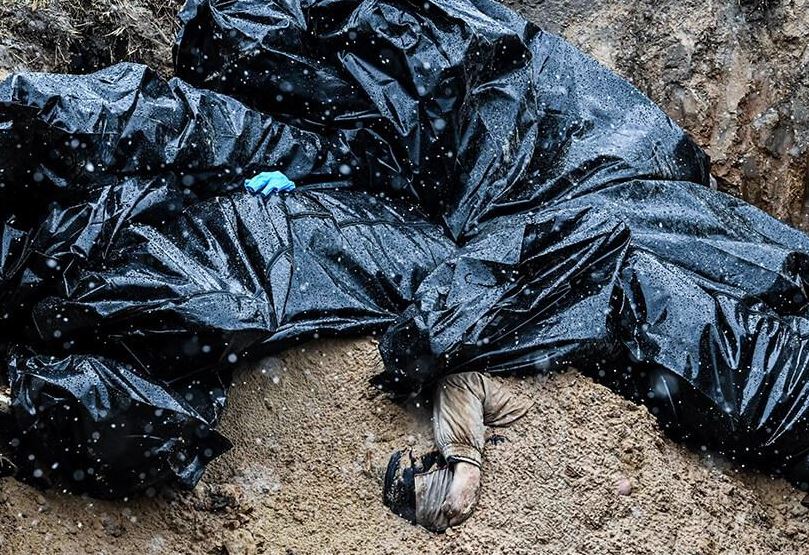
Casus Belli: The bodies in the street, the terrible revelations of rape and torture: these only make matters worse. Our instinctive response, when confronted with such images is not to calmly contemplate the best means of extricating all concerned from the horrors of war, but to punish those responsible for such atrocities.

WHY HAS THE RUSSO-UKRAINIAN WAR not generated a global movement for, at the very least, an immediate cessation of hostilities? The aggressor, Russia, possesses nuclear weapons, and has issued thinly-veiled threats that it is prepared to use them if any other power attempts to interfere in its “military operation” in Ukraine. The slightest miscalculation, therefore, could trigger an all-out nuclear exchange – and the end of civilisation as we know it. In such precarious circumstances, mobilising global support for a peaceful resolution to the conflict seems like a good idea. So, why isn’t it happening? Where is the peace movement?

Before attempting an answer to that question, it is worth casting our minds back to the first quarter of 2003. The United States and the United Kingdom were engaged in obvious preparations for a full-scale military invasion of Iraq. All over the world people were gathering in huge demonstrations to oppose the US/UK plans. Over a million protesters flooded the streets of the UK’s largest cities in what was, almost certainly, the largest political protest in the nation’s history. Vast crowds similarly thronged the streets of American cities. In France, Italy and Germany it was the same. Time magazine described the global peace movement as the other great power on the planet.

All to no avail. Like the Russian Federation, the United States was not about to be dissuaded from doing what it believed it had to do. That it would go to war without the sanction of the UN Security Council, and on the basis of intelligence claims that most independent experts dismissed as spurious, was not about to slow the administration of George W Bush down. Peace movement or no peace movement, the invasion would go ahead as planned.

The demonstrable futility of the international protest movement against the Iraq War offers a pretty solid explanation for the absence of a global pacifist response to the Russo-Ukrainian War. Among those coming of age in the first quarter of the Twenty-First Century, it may simply be understood that if a major power is resolved to attack another country, no amount of chanting and placard-waving will stop it. Didn’t the UK Prime Minister Tony Blair’s spin-doctors respond to media taunts that there were a million citizens on out on the streets, by referencing the tens-of-millions who weren’t?

The other obvious lesson to be drawn from the global protests against the US/UK invasion of Iraq is that they would never have happened (or, at least, not on anything like the same scale) had their organisers not been living in democracies. If the Russian Federation showed the same respect for fundamental human rights as the United States, it is possible that a million or more Russians would have turned out to protest the invasion of Ukraine. What the world actually witnessed on the streets of Moscow and St Petersburg was the brutal suppression of every attempt at protest by the thuggish Russian police.

It is these images of suppression and violence that bring us to the heart of the matter. People around the world rose up against the prospect of the invasion of Iraq in part because they believed that the two nations responsible, the USA and the UK, were still, in some hallowed and undefiled place, receptive to the moral case for peace. All the evidence may have pointed in the opposite direction, but, in their heart-of-hearts, the historical friends and allies of the United States and the United Kingdom wanted to – needed to – believe that they were better than the murderous bullies Bush and Blair had turned them into.

Very few people believe that some hallowed and undefiled place exists in the dark monstrosity that is the Russian state. There are no democratic orchards in Russia. The fruits of freedom and justice do not grow there. The conditions are too harsh. Even when the tree of liberty is smuggled in and persuaded to bloom, which is seldom, the flowers fade for lack of warmth. Russia is a hard, cold country, and difficult to love, even if you’ve a mind to. But no people on earth knows more about suffering – and how to share it.

And we are suffering, but not in a way that does Russia any good. Our suffering is vicarious, inspired by the pain and heroism of the Ukrainian people. How else are the people of the West supposed to feel when they are presented with the image of a Ukrainian father, now a soldier, fighting back tears as his wife and son are borne away from him on a westbound train to safety, clutching in his hands his little boy’s toy ambulance – all that is left to him? Are we supposed to be filled with an urge to make peace? Or, are we already part of the war?

The bodies in the street, the terrible revelations of rape and torture: these only make matters worse. Our instinctive response, when confronted with such images is not to calmly contemplate the best means of extricating all concerned from the horrors of war, but to punish those responsible for such atrocities. Perhaps that’s what they’re intended to do. Perhaps, as the Russians insist, they are fake news. But while such images are all the world is seeing, there will be no global peace movement.

And if there is worse to come: if the wounded Russian Bear tears the Ukraine to pieces; and if the world is bombarded with ever more tragic and terrifying images of Ukraine in extremis; then it will not be a global peace movement that emerges, but a global war movement. Channeling the wild bellicosity of the masses celebrating the outbreak of the First World War, the people of the West, heedless of the nuclear danger, will cry: “Do your worst, Russia – and we will do ours!”


This essay was originally posted on The Daily Blog of Friday, 15 April 2022.

Monday, 28 February 2022

Russia Invades Ukraine: A Crime – And A Mistake.

Be Careful What You Wish For: Putin has conjured into being the very strategic nightmare he spent the last 20 years attempting to forestall. His actions have given all the nations of Western and Eastern Europe a terrifying reminder of the wisdom of banding together against the Russian Bear.

I’M WHAT’S KNOWN, on the Left, as a “Tankie”. That is to say I am not a reflexive opponent of the Russian regime. In the Georgian border regions; in Syria; and until 24 February 2022, in the Ukraine; I have, by and large, been sympathetic to the aims and objectives of the Russian Federation. More specifically, right up until this past week, I have had a sneaking admiration for the way in which President Vladimir Putin, in spite of finding himself in some extremely difficult positions, has nevertheless managed to checkmate his Western opponents.

But that’s all over now. It’s one thing to silence with tanks and artillery the Washington-inspired braggadocio of Georgia’s opportunistic leader. Or, to throw Russia’s military support behind the least worst protagonist in the Syrian civil war. But, to order a full-scale invasion on Ukraine? That’s not Chess, that’s Draughts – and not even very good Draughts. Putin has over-reached himself – quite possibly fatally.

It is difficult to understand why Putin couldn’t understand just how much ground he had made, diplomatically, by staging large-scale military manoeuvres on the Ukrainian border. The increasingly hysterical shrieks and yells emerging from Washington and NATO Headquarters in Brussels were achieving nothing useful for the West – apart from validating Putin’s critiques of NATO’s expansionist doctrine. As prediction after prediction of a Russian invasion of Ukraine proved inexact, Moscow gave every indication of being grimly amused. The Russian talent for irony and sarcasm was on full display.

Even better, the hysterical reactions of Washington and Brussels, were prompting the appearance of some no doubt very satisfying (to Moscow) cracks in the NATO alliance. To the evident delight of the Russian foreign ministry, Germany and France (both of which are guilty of invading Russia in the past, and then paying a terrible price for their aggression) took up their roles as guarantors of the Minsk Accords. For the price of an extended round of annual manoeuvres, the Russian Federation, and its Belarussian ally, were on the verge of reaping a bountiful diplomatic harvest.

So, what went wrong? How was the Kremlin’s master Chess-player suddenly robbed of both his strategic and his tactical senses?

In the harsh light of Russia’s invasion of the Ukraine, during which so many of the predictions and descriptions of the Russian armed forces’ battle-plans have been proved correct, it is surely reasonable to speculate that the Americans may have cracked the Russian military codes, giving them full access to all of the Kremlin’s strategic and tactical conversations. Or, they may have a highly-placed spy on the inside who is relaying to them the same information. They may even have both.

For Putin, a political leader schooled in the security services of the old Soviet Union, the revelation of such a catastrophic security breach would be devastating. The paranoid style of politics that pervaded the old KGB would have been intensified in Putin, the former KGB officer, to the point where he may simply have stopped thinking clearly.

If the debilitating revelation that Russia’s national security had been fundamentally compromised was further aggravated by serious disinformation concerning the character and intentions of the Ukrainian Government, then Putin’s descent into an enraged and murderous paranoia is readily explained.

Whatever happened, it was clear, several days out from the invasion, that something in Moscow had changed. RT, the Federation’s worldwide propaganda arm (now unavailable on New Zealand’s Sky Network, it’s former host) seemed to flounder as it struggled to come to grips with the Kremlin’s rapidly darkening tone.

Up until Putin’s rambling history lecture of 22 February, immediately followed by the recognition of the Donetsk and Luhansk breakaway republics, it had seemed as though RT’s leading lights were perfecting their scornful one-liners for the day Russia’s military forces on the Ukrainian border proved NATO wrong by simply turning around and returning to barracks.

Certainly, that was the outcome for which Putin’s government had been preparing the Russian people over the preceding weeks and months – and, it must be said, it was also the outcome the Ukrainians were expecting. Very few people on either side of the border wanted, or were prepared for, a full-scale invasion. The very fact that spontaneous anti-war rallies erupted all over the Russian Federation bears testimony to the shock and dismay provoked by Putin’s aggression against his fellow Slavs.

It is instructive to contrast Putin’s total failure to prepare his people for a full-scale invasion of Ukraine with the many months George W. Bush spent convincing the American people that his equally illegal invasion of Iraq was both militarily necessary and morally justified.

One is reminded of the decidedly unenthusiastic reception given to the Wehrmacht’s tanks as they rolled through the streets of Berlin in the early stages of the so-called “Munich Crisis” of September 1938. The German people did not want war with Britain and France, which is why they cheered to the echo the peacemaker, Neville Chamberlain, as he made his way through the streets of Munich – much to the disgust of the Fuhrer, who most emphatically did want war with Czechoslovakia.

It is worth contemplating the historical lessons of the Munich Crisis in relation to the crisis currently unfolding in Ukraine. Had Chamberlain, backed by France and Italy, not signed over the largely German-speaking Sudetenland to Adolf Hitler and, instead, warned him that Czechoslovakia would not be abandoned, then it is highly likely that Hitler’s generals (who were quite unconvinced that Germany could win such a war) would have deposed him in a military coup d’état. Had that happened, it is entirely possible that the Second World War could have been avoided.

The Russian Federation’s possession of nuclear weapons rules out any overt military response on the part of NATO, but the harshness of the economic sanctions regime it has imposed is bound to give Putin’s generals and oligarchs pause.

Nothing is more expensive than full-scale war. While, geographically, Russia may be a vast country, economically it is smaller than Italy. Far from heralding the restoration of Russian greatness, a drawn-out war against Ukrainian resistance fighters (supported and supplied by a ferociously united West) coupled with the debilitating economic and political effects of swingeing sanctions (not to mention the financial and human costs of a prolonged occupation) can only weaken the Russian Federation profoundly.

Even from the perspective of hard-line Russian nationalists, Putin’s wild gambit makes no sense. Indeed, those of a Machiavellian disposition among the Russian elites may come to the conclusion that some of Putin’s more rational geopolitical objectives stand a much greater chance of being achieved if Putin is no longer on the scene. Amidst the palpable and near universal relief which a change of regime in Moscow, followed by the withdrawal of all Russian forces from Ukraine, would undoubtedly bring, a comprehensive revision of European security arrangements might end up being welcomed – by all sides.

As matters now stand, however, Putin has conjured into being the very strategic nightmare he spent the last 20 years attempting to forestall. His actions have given all the nations of Western and Eastern Europe a terrifying reminder of the wisdom of banding together against the Russian Bear.

Ironically, the Ukrainians Putin dismissed as “drug addicts and neo-Nazis” stand revealed as heroes and patriots: men and women willing to lay down their lives for their country. Certainly, President Volodymyr Zelensky has demonstrated communication skills even more impressive than those of our own Jacinda Ardern. His social-media broadcast from the heart of besieged Kyiv was nothing short of inspirational. No one, now, is interested in accusations of undue Washington influence, widespread corruption, and neo-Nazi militias.

Russia’s “tankie” support in the West was based on Putin’s moral, political and military jiu-jitsu: his hitherto impressive knack for using the weight and power of his Western antagonists against them; and his skill at exposing the crass hypocrisy of those powers who have never hesitated to commit the very same sins they are forever attributing to Russia.

But, there is nothing clever about Putin’s invasion of the Ukraine. It will achieve nothing but massive material destruction and untold human suffering. Even worse, from the perspective of the unfortunate Russian people, Putin’s invasion has provided an ex post facto justification for their enemies’ most predatory designs .

As the deeply cynical, but nonetheless brilliant, French statesman, Charles Maurice Talleyrand (1754-1838) said of Napoleon’s ill-judged decision to abduct and execute the politically unfortunate Duke d’Enghien:

“This is worse than a crime, it’s a mistake.”


This essay was originally posted on the Interest.co.nz website on Monday, 28 February 2022.

Friday, 25 February 2022

The West Will Ignore Putin’s Weary Anger At Its Peril.

Out Of Patience: Putin’s weary anger said it all. The Ukraine and Russia are one. The West cannot have her. If NATO is determined to fight, then Russia will fight back. And, if Russia falls, she will not fall alone.

ON CHRISTMAS EVE 1991, Germany and Austria, without warning or consultation, recognised the independence of Slovenia and Croatia.

Six months earlier, on 25 June 1991, these hitherto constituent republics of the Federal Republic of Yugoslavia had declared themselves independent states. Naturally, the Yugoslav Government objected in the strongest terms and sent its army north. NATO’s Secretary-General, the former British Foreign Secretary, Lord Carrington, attempted to negotiate a peaceful settlement.

Sufficient progress was being made for the Yugoslav Government to order the army’s tanks back to their bases. Its consternation, when the newly re-united Germany recognised the breakaway republics’ independence, and Austria partially mobilised its armed forces along the Slovenian border, is readily imagined. The Americans, the EU, and the United Nations were equally non-plussed.

Yugoslavia may have been crumbling, but the unilateral recognition of Slovenian and Croatian independence by Germany and Austria undoubtedly hastened its disintegration. The tragic consequences: civil war, murderous ethnic cleansing, NATO’s assault on Serbia (the largest of the Yugoslav successor states) cost tens-of-thousands of innocent lives.

Were Germany and Austria punished for their deliberate fracturing of another European state? Did the United States, the EU and NATO impose a devastating regime of sanctions upon them? Were massive supplies of weapons shipped to Yugoslavia in an attempt to keep its fragile constitutional architecture standing? Was the German Chancellor, Helmut Kohl, vilified across the Western news media as another Adolf Hitler? Did his neighbours manoeuvre hostile battle-groups along his country’s borders?

Of course not. Indeed, it is highly unlikely than more than one in ten of the people reading this post will even remember Germany’s and Austria’s flagrant breach of international law – or care.

Those belonging to the realist school of international diplomacy may have raised an eyebrow at the two German-speaking nation’s uncharacteristic departure from international diplomatic norms, but they didn’t engage in hysterical name-calling or fill the airwaves with dire predictions of European war. (Even if the more perspicacious among them, remembering the fraught history of the Balkan states, foresaw only bad things flowing from Germany’s and Austria’s rash decisions.)

It was clear to everyone that the Yugoslavia forged by Marshall Tito in the white heat of the Second World War and, while he lived, a remarkably successful experiment in multi-ethnic, multi-cultural, and socialist co-operation, was unravelling at an alarming rate. Old crimes were being remembered, vengeful ghosts were rising from the killing fields of the German occupation. Few international scholars, and even fewer experienced diplomats, were surprised that Catholic Slovenia and Croatia wanted out, or that they fell gratefully into the nearest pair of outstretched arms.

The contrast with the present hysterical condemnation of Russia’s recognition of the breakaway republics of Donetsk and Luhansk could hardly be clearer. There is precious little evidence of hard-headed realism in the West’s diplomacy, only inchoate rage at Russia’s stubborn refusal to become the vassal of a declining American super-power and its dangerous kennel of NATO attack-dogs.

Vladimir Putin was absolutely correct to describe the break-up of the Soviet Union as a geopolitical catastrophe. The Russians had done the world an enormous favour in taking responsibility for the cutthroat nations of Eastern Europe and the Baltic littoral.

Few people in the West now recall how many of these states allied themselves with Nazi Germany during World War II. But the Russians have not forgotten whose soldiers were positioned on the flanks of Stalingrad as von Paulus’s Sixth Army closed in for the kill. Nor have they forgotten how eagerly the Latvians, Lithuanians, Estonians and, yes, the Ukrainians, helped the Einsatzgruppen murder two million of their Jewish neighbours.

Setting these bloodlands free was always a risky proposition.

Not that the NATO Alliance had many thoughts to spare for the recent history of Eastern Europe. As the Soviet Union fell apart and the elites of its constituent republics seized the moment to make their fortunes, the Americans and their European vassals could only look on in awe at the world of rich geopolitical pickings opening up before their eyes.

The wildest dreams of Western geopoliticians, dating all the way back to the end of the First World War, could now be realised. Georgia, the Caucasus, Moldova, Belarus, and the geopolitical jewel in the crown, Ukraine: all of them were up for grabs – daggers pointed directly at the heart of Mother Russia. “Come one, come all!” cried Washington and Brussels – “NATO’s door is always open!”

Poor, deluded Mikhail Gorbachev: how could he possibly have been so innocent as to take on trust George H. W. Bush’s pledge that NATO would not advance “one inch” beyond the River Elbe? Had the combat boot been on the other foot, would the Soviet Union have given such a pledge? Or, if it did, would it have felt bound to honour it?

Some have laughed at Putin’s rambling history lesson of 22 February, preliminary to his signing of the documents recognising the breakaway Donbass republics. He was not, however, joking. His criticism of Lenin and the Bolsheviks was entirely serious.

As good socialists they were determined to honour the principles of national self-determination. Putin’s argument is that by doing so they made the later disintegration of the Union of Soviet Socialist Republics a great deal easier than it should have been. Had the Bolsheviks treated Ukraine and the other constituent republics in the same way as the Tsarist regime: beloved provinces of one great, indissoluble nation – Russia – then the almost casual agreement of August 1991 to break up the Soviet Union might have been averted.

But, we are where we are. Like a baited bear, the Russian Federation has watched through small, black eyes as NATO’s attack-dogs crept closer and closer. Unlike the doomed creatures chained by neck and ankle in the bear-pits of yesteryear, however, the Russian Bear is constrained only by how many of these slavering curs it is willing to kill, and how.

Putin’s weary anger said it all. The Ukraine and Russia are one. The West cannot have her. If NATO is determined to fight, then Russia will fight back. And, if Russia falls, she will not fall alone.


This essay was originally posted on The Daily Blog of Thursday, 24 February 2022.

Bear-Baiting.

Unchained: It is certainly fine sport, this high-stakes game of bear-baiting. Ukraine’s dog goes in first, hackles raised, teeth bared. Close behind sidle NATO’s new members – Poland, Romania, Bulgaria and the Baltic States – jaws slavering, US-supplied fangs gleaming. While all around them, wild and eager, the newshounds of the Western media bark and bark and bark. Only France and Germany hang back. They’ve baited this bear before and know from bitter experience how sharp are its teeth, how dangerous its claws.

THE THING TO REMEMBER about bear-baiting is that, like “reality” television, there is very little about it that is real. This cruel spectacle, enjoyed by English kings and commoners alike for nearly 800 years, always weighted the odds heavily against the bear. Had they not, there would have been no one to bet on but the bear. Mastiffs and Bulldogs are fearsome beasts, but neither of them could last five minutes in a fair fight with an angry bear.

The bear simply had to be handicapped. Accordingly, the baiters took care to chain the bear by the leg, or the neck, to an iron stake driven into the middle of the bear-pit. They were also careful to set more than one dog against the bear. Sometimes, to be absolutely certain that the dogs had a fighting chance, the baiters would pull the bear’s canine teeth and pare-back his lethal claws.

Thus was the uncertainty of the encounter heightened, and the range of outcomes upon which to place a wager multiplied. How many dogs would the bear be able to kill or maim before he was brought low? How long could the chained and defanged creature hold out? One hour? Two?

King Henry VIII enjoyed the sport so much he had a bear-pit constructed at his Whitehall palace. It is not recorded how much the sovereign won or lost betting against the bears.

Sad to say, sovereign powers are still engaged in bear-baiting. The bear in question may be the symbolic representative of Russia, but the principle is the same. De-fang it by stripping away all the territories you can trick or bribe into abandoning their homeland. Pare back its claws by means of economic sabotage and diplomatic chicanery. Chain it unfairly behind indefensible borders. And then send in your dogs.

And were there ever dogs so vicious as the dogs of the West? The dogs of NATO? Poor Mikhail Gorbachev: bedazzled by dreams of a democratic and de-militarised Eastern Europe; intoxicated by the idea of a free and mutually supportive association of nation states stretching all the way from the North Sea to the Pacific Ocean; he foolishly neglected to get in writing President George H. W. Bush’s guarantee that NATO would not advance “one inch” beyond the River Elbe.

How could he have forgotten the old Russian proverb that no less a person than Ronald Reagan had quoted to him (in passable Russian) Doveryay, no proveryay: “Trust, but verify.”

Ah, but those NATO dogs are cunning fellows. Thirty-two years after Bush and his Secretary of State, James Baker, gave their word to Gorbachev, they snarl at the Russian bear: “Where’s your proof that NATO ever offered such a guarantee? You have no proof. You lie!”

The Western Media, a dog whose teeth are every bit as sharp as NATO’s, gleefully inserts the word “contested” whenever the Russian President, Vladimir Putin, repeats Gorbachev’s claim.

In this baiting game, however, no dog is more gangrel, greedy or vicious than the puppet-regime purporting to represent the people of the Ukraine. Installed by the Americans in 2014, after their armed gangs of self-avowed fascists had driven the elected government from power, Kyiv’s humble servants have kept a very useful small-war smouldering on Russia’s border for 8 years. Their signature on the Minsk Protocol as worthless as all their subsequent protestations of peace and goodwill.

It is certainly fine sport, this high-stakes game of bear-baiting. Ukraine’s dog goes in first, hackles raised, teeth bared. Close behind sidle NATO’s new members – Poland, Romania, Bulgaria and the Baltic States – jaws slavering, US-supplied fangs gleaming. While all around them, wild and eager, the newshounds of the Western media bark and bark and bark. Only France and Germany hang back. They’ve baited this bear before and know from bitter experience how sharp are its teeth, how dangerous its claws.

But, what is this? What has happened to the chain that the baiters were at such pains to reassure the gamblers remained firmly fastened around the bear’s neck? And surely those claws are much longer than they should be? Dear God! That Ukrainian dog has ventured much too close – can someone not pull him back beyond the reach of those powerful arms?

We have wagered everything on NATO’s dogs. How could we have missed the Russian bear’s nuclear teeth?


This essay was originally published in The Otago Daily Times and The Greymouth Star of Friday, 25 February 2022.

Tuesday, 10 February 2015

Gone With The Nuclear Wind?

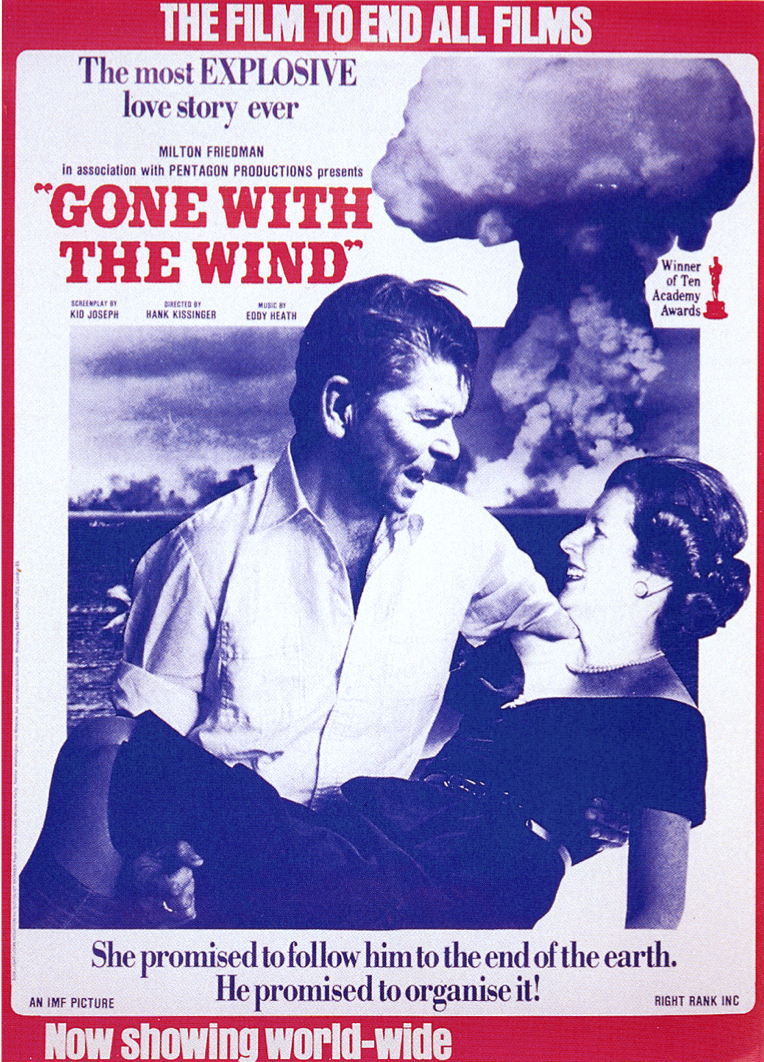
Tomorrow Might Not Be Another Day: The poster which swept the pre-Internet world in the anti-nuclear 80s. Those born in the post-Cold War period have little idea of how pervasive was the fear of nuclear annihilation. Those weapons have not gone away. Vladimir Putin's reassertion of his country's geopolitical interests may yet reacquaint the world with the fears of the 1980s. The Russian bear still has nuclear teeth.
 
IT WAS ONE of the most famous posters of the anti-nuclear 80s. Parodying the 1939 movie poster promoting Gone With The Wind, the 1980s version depicted Ronald Reagan in the role of Rhett Butler, and Margaret Thatcher as Scarlet O’Hara. Instead of rescuing his heroine from the wreckage of a burning Atlanta, Reagan carried Thatcher from the fallout of an ominous mushroom cloud. The anti-nuclear poster’s tag-line read: “She promised to follow him to the end of the earth. He promised to organise it.”
 
Black humour? Undoubtedly. But the worldwide popularity of the poster in those pre-Internet days speaks volumes about the existential fears of ordinary people everywhere that their leaders were impelling them towards a nuclear Armageddon.
 
These globally experienced fears were given specific expression in New Zealand by the nationwide movement to have the country declared nuclear-free. Distracted by the upheavals of the Springbok Tour for most of 1981, the Nuclear-Free New Zealand Movement only began gathering serious political momentum in 1982. By 1984, however, there were very few cities and towns in New Zealand that had not declared themselves nuclear-free. The incoming Labour Government, elected in July 1984, had little option but to go with the flow. Among its rank-and-file members (all 85,000 of them!) anti-nuclear sentiment was as intense as it was immovable.
 
It is difficult for New Zealanders who did not live through the early-1980s to appreciate just how tense the stand-off between the USA and the Soviet Union had become.
 
President Reagan and Prime Minister Thatcher were both implacable cold warriors. Indeed, when asked by a youthful aide to sum up his position on the Cold War, President Reagan breezily replied: “Well, I think we should win it.”
 
Soviet leaders, by contrast, came and went with almost comical speed. Between the death of Leonid Brezhnev in 1982 and the accession of the Soviet Union’s last leader, Mikhail Gorbachev, in 1985, the world welcomed and farewelled in quick succession Yuri Andropov and Konstantin Chernenko.
 
Meanwhile, as the Soviets were casting about frantically for a leader capable of lasting longer than eighteen months in office, Nato forged ahead with its plans to install nuclear-tipped Cruise missiles – a first-strike weapon – along the length of the Iron Curtain. Not surprisingly, the vast nuclear arsenals of the opposing superpowers were on a hair-trigger.
 
To New Zealanders born after 1991, the year the Soviet Union quietly blipped-off History’s screen, the mutual and assured destruction (MAD!) strategies of the Cold War era are mostly experienced as the more-or-less harmless echoes from a far-off, but very-far-from-harmless, historical era.
 
Today’s 24-year-olds may be intellectually aware that substantial stockpiles of nuclear weapons still exist in the United States and the Russian Federation, but the oppressive sense of their parents’ generation, that the slightest political miscalculation (or even a flock of errant geese!) might trigger the utter destruction of human civilisation, has, mercifully, faded from memory.
 
Global Warming, the existential threat du jour, may prove to be equally devastating, but its effects will be experienced over decades – not in the micro-seconds of a nuclear detonation.
 
Meanwhile, as the Millennials battle to prevent runaway global warming, another, all-too-literal battle rages between the forces of the Nato-supported Ukrainian government and the Russian-backed militias of Ukraine’s breakaway eastern provinces. Reported only fitfully in the Western news media, this conflict now threatens to escalate into a general European war. As former Swedish Prime Minister, Carl Bildt, told the Frankfurter Allgemeine Zeitung on Sunday.
 
“Unfortunately, war with Russia is conceivable. We are definitely living through one of the more dangerous historical phases, especially if you view the situation from a European perspective […] What makes the situation so explosive is that there is also great uncertainty about global power relations.”
 
The global uncertainty Mr Bildt speaks of is being fuelled by statements issuing from the United States Vice President, Joe Biden, reaffirming the Obama Administration’s determination to “allow Ukraine to defend herself”. By which the Americans mean – be given access to the heavy weapons necessary to drive back the pro-Russian separatists.
 
The German Chancellor, Angela Merkel, has reacted sharply to the Vice President’s statement, declaring that she could not “imagine any situation in which improved equipment for the Ukrainian army leads to President Putin being so impressed that he believes he will lose militarily.”
 
Only now is the European Union beginning to grasp its reckless folly in allowing anti-Russian extremists within Nato to connive in the fascist-supported overthrow of Ukraine’s democratically-elected President, Victor Yanukovych, in February 2014. Only now, having spent the last 12 months baiting the Russian bear, have the Europeans, the Americans, and the rest of us, belatedly remembered that the Russian bear has nuclear teeth.
 
The Nato powers promise to follow the fascist-backed Ukrainian regime to the end of the earth. Vladimir Putin offers to organise it.
 
This essay was originally published in The Press of Tuesday, 10 February 2015.

Tuesday, 16 December 2014

Sitting On Our Hands

"We Nailed It!" New Zealand's representative to the United Nations, Jim McClay, takes a moment as his country's election to the UN Security Council is announced. Prime Minister Key told reporters that New Zealand got there on the strength of its reputation for being "someone that stands up for what's right". Why then did we, just a few weeks later, refuse to support a resolution condemning neo-Nazism?
 
NEW ZEALANDERS experienced a justifiable surge of national pride when their country was elected to the United Nations Security Council. New Zealand’s UN ambassador (and former Deputy Prime Minister) Jim McClay buried his face in his hands with heartfelt relief. Our foreign minister, Murray McCully, exclaimed “We nailed it!”
 
Speaking outside his Parnell residence, a clearly delighted Prime Minister told reporters that: “It’s a very good result. There’s a lot of responsibility over the next two years. I think it will be quite a challenging time to be on the Security Council. There are some very big issues – as we see in the Middle East at the moment – and it will be a demanding time for New Zealand.
 
Commenting on the outstanding success of the Ministry of Foreign Affairs and Trade’s six-year-long campaign, Mr Key observed: “We put on display the credentials of New Zealand. Which is seen as an honest broker. Someone who stands up for what’s right.”
 
That’s certainly how most Kiwis regard their country. From the very beginnings of the United Nations, New Zealand has stood up for the rights of smaller countries. We made ourselves their champion in the unsuccessful fight to locate the international organisation’s ultimate authority in the General Assembly.
 
In the aftermath of the most destructive war in human history, New Zealand’s Prime Minister, Peter Fraser, argued passionately (but unavailingly) against vesting veto power in the five permanent members of the UN Security Council. He had more success in ensuring that economic and social rights were included alongside civil and political rights in the UN’s Universal Declaration of Human Rights.
 
Why then did New Zealand, the “honest broker”; the country which always “stands up for what’s right”; fail to support a resolution sponsored by the Russian Federation condemning the “glorification of Nazism” and declaring the “inadmissibility of certain practices that contribute to fuelling contemporary forms of racism, racial discrimination, xenophobia and related intolerance”?
 
If ever there was a “no brainer” for New Zealand diplomacy – this was it. Who on earth, apart from the extremist political hoodlums it identifies, could fail to support such a resolution?
 
Well, apparently, we could. When the Russian Federation’s resolution was put to the General Assembly’s Social, Humanitarian and Cultural Affairs Committee on 26 November 2014, New Zealand, along with 56 other UN members, abstained. Included among the abstainers were every member of the European Union (EU). Not even Germany, Nazism’s birthplace and the nation state responsible for the most horrific manifestations of race hatred in human history, was prepared to join the 120 other UN members who voted in favour of the resolution.
 
Only three UN members could be found among neither the supporters nor the abstainers. Canada, Ukraine and the United States of America had voted against the resolution.
 
Why? What could possibly persuade the democratic nations of Europe, North America and Australasia to refrain from declaring their alarm at “the spread in many parts of the world of various extremist political parties, movements and groups, including neo-Nazis and skinhead groups, as well as similar extremist ideological movements”? Or, for that matter, from expressing deep concern at “all recent manifestations of violence and terrorism incited by violent nationalism, racism, xenophobia and related intolerance”?
 
Beating The Tin Drum: Members of the Patriot of the Ukraine party marching to the beat of a neo-Nazi revival in Eastern Europe that New Zealand refuses to condemn.
 
The answer, of course, is to be found in the well-documented involvement of the US State Department and the governments of the EU in the February 2014 overthrow, by armed neo-Nazi demonstrators, of the democratically-elected government of Ukraine. That both the USA and the EU were prepared to recognise, for the first time since World War II, a European government which included openly fascist and neo-Nazi politicians, rendered support for the Russian Federation’s resolution diplomatically implausible.
 
Accordingly, the Western democracies argued strongly that supporting the Russian Federation’s resolution would be tantamount to endorsing the latter’s annexation of Crimea, and ignoring its ongoing military and economic support for the breakaway Russian-speaking provinces of Eastern Ukraine.
 
Utter foolishness.
 
President Vladimir Putin’s Russia is prey to the very same fascistic and neo-Nazi forces that its UN anti-racist resolution condemns. The uncomplicated endorsement of its content would, therefore, have allowed the democratic countries to serve notice on both the Russian Federation and Ukraine that violent racist xenophobia remains totally unacceptable to the United Nations’ membership.
 
Sadly, the United States refused to tolerate even implied criticism of its hard-won Ukrainian protectorate. Canada cravenly concurred. And the EU, rather than alienate the Americans, abstained.
 
As an “honest broker” who “always stands up for what’s right”, New Zealand was gifted an early opportunity to show the 145 UN members who voted for her that their support had not been misplaced. Reminding the world of Nazism’s 20 million Russian victims, and reconfirming its unalterably evil nature would, surely, have done more for international understanding – and our reputation – than sitting on our hands?
 
This essay was originally published by The Press of Tuesday, 16 December 2014.

Monday, 8 September 2014

Putin - The Grand Master


I FOUND THIS little gem on Cameron Slater's Whaleoil blogsite (yes, yes, I know, but it's actually a really interesting place to visit!) and I just had to re-post it on Bowalley Road.
 
This posting is exclusive to the Bowalley Road blogsite.

By Other Means: Bringing Down A Government, Or Keeping One In Power, No Longer Requires Tanks.

Coup D'état By Crowd: With the appeal to naked force no longer acceptable in a post-Cold War world, the United States and its allies were forced to develop new, less objectionable means of removing their enemies from power. Paradoxically, democracy became the only plausible means of preserving the global dictatorship of the United States' neoliberal ideology. Or, at least, it looked like democracy.

TOPPLING GOVERNMENTS in the twenty-first century, or installing them, is no longer the business of soldiers. It used to be, back in the days of the Cold War. Just think of Chile in 1973, or Argentina in 1976. Back then nobody much cared about the optics. So there were tanks on the streets. So a few thousand people “disappeared”. So what? They were commies. Nobody cared. Good riddance!
 
With the fall of the Berlin Wall, however, and the dissolution of the Soviet Union, things changed. Lacking the Cold War justification of “resisting attempted subjugation by armed minorities or by outside pressures” the United States and its allies were forced to develop a new way of making sure that their friends continued to acquire and/or retain power, while their enemies – unaccountably – suffered one set-back after another.
 
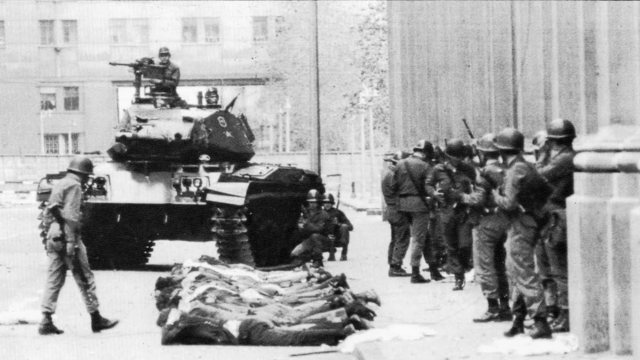
The Old Way Of Dealing With America's Enemies: Tanks roll through the streets of Santiago, Chile, 11 September 1973.
 
The first step was to make sure that even if their friends failed the political consequences would be minimal. There were to be no more elections like the Chilean election of 1970, in which the victory of Salvador Allende’s Popular Unity coalition resulted in the introduction of genuine left-wing policies. The imposition around the world of the neoliberal “Washington Consensus” (which began with the arrival of the “Chicago Boys” in post-coup Chile) meant that even nominally “left-wing” parties could be relied upon to refrain from introducing measures calculated to inhibit or restrict the free operation of market forces.
 
The second step was to devise a whole new repertoire of non-military methods for bringing a government down. Essentially this involved using the core freedoms enshrined in all democratic states: freedom of speech; freedom of the press; and the freedom to assemble peacefully for a redress of grievances; not to advance democracy but to create a simulacrum of it. What appeared to the world to be a spontaneous uprising of the people against a corrupt and dictatorial regime, would, in fact, be the culmination of months, even years, of careful planning by teams of operatives (spies?) inserted into the target country by the United States and its allies.
 
The classic examples of this new technique of “coup d’état by crowd” were the so-called “colour revolutions” that brought down the democratically elected governments of Serbia, Georgia and Ukraine. (In the case of the latter, twice!) The Americans spent millions of dollars in these countries establishing political organisations, founding newspapers, setting up radio and television stations, and creating websites – all of which were then used to recruit thousands of perfectly genuine followers (usually young, middle-class university students) who would then be led onto the streets to confront the government.
 
These ostensibly peaceful protests were almost always carefully stage-managed to ensure that the authorities, goaded to breaking-point by a tiny, well-trained and well-paid “hard-core” fraction of the crowd, would over-react and start beating the protesters indiscriminately. Graphic examples of this state violence would then be broadcast around the world (often via social media) and, inevitably, the size of the protests would grow and the demands of the protesters would escalate.
 
The critical demand of these “people’s movements” would be the holding of new elections. This was especially so when the “revolution’s” precipitating event was an election whose result was disputed (as in Serbia in 2000). One of the key methods employed to make the claims of a “stolen” election plausible was the publication of bogus opinion polls. The government’s enemies – both foreign and domestic – would fabricate polls showing massive disapproval of the governing party and correspondingly massive support for its challengers. When the ballot boxes disgorged a radically different result the immediate response of the government’s enemies was that the election had been “stolen”. Gravely concerned, the US, UK and European Union would immediately lend their voices to the call for fresh elections.
 
The New Way: Kiev, Ukraine, January 2014.
 
Sometimes, of course, these tactics spooked the government under attack into doing the subversives’ work for them. Informed by his own (and the Russian’s) intelligence agencies that the US was active behind the scenes, building and funding his liberal opposition, the Serbian strongman, Slobodan Milosevic, panicked and stole the election for real. Perfect!
 
Interestingly, the process works just as well in reverse.
 
If there’s a government the powers that be, domestically and/or internationally, wish to keep in office, then exactly the same funds will be lavished on exactly the same hidden persuaders. Social media will be skilfully and extensively employed, not to attack the incumbent government, but to undermine and smear its political opponents. Opinion polls will consistently demonstrate the government’s overwhelming popularity. Sympathetic journalists will disparage any suggestion of widespread popular discontent with the status quo. Political activists and parties evincing just a little too much passion and/or promising just a little too much in the way of genuine, as opposed to purely cosmetic, reforms will suddenly find all manner of things going wrong. They’ll hear strange clicking sounds on their landlines. Their computers may be hacked or stolen. The controls of their leader’s car may suddenly malfunction, sending him tumbling down a bank.
 
And nary a tank in sight.
 
This essay was originally posted on The Daily Blog of Friday, 5 September 2014.

Tuesday, 22 July 2014

Who Shot Down MH17?

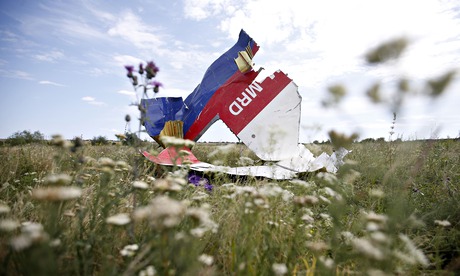
Killing Fields: The tragedy of Malaysian Airlines Flight MH17 is amplified by the Western news medias' refusal to either contextualise the airliner's destruction, or provide its global audience with any explanation other than Russian guilt and perfidy. As if historical events have no historical causes.

WHO SHOT DOWN MH17? While there is currently insufficient evidence to declare “Pro-Russian Separatists” guilty beyond reasonable doubt, the balance of probability strongly suggests that Russian-speaking militiamen were indeed responsible for blowing Malaysian Airlines Flight MH17 out of the sky.
 
Unfortunately, this is the point at which our shock and outrage at the destruction of nearly 300 innocent civilian lives causes our thought processes to stop.
 
For those who grew up during the Cold War, that single word, “Russian”, is enough. Of course “the Russians” are responsible. The Russians are always responsible.
 
For younger New Zealanders, “Russia” means “Putin”. He’s the dead-eyed, bare-chested, gay-bashing gargoyle who threw Pussy Riot and Greenpeace into prison. The President whose gun-toting, balaclava-wearing Spetsnaz stole Crimea from Ukraine. Of course Putin did it!
 
It is vitally important, however, to keep on thinking about the fate of MH17.
 
Is it really credible to suppose that either the armed supporters of the self-proclaimed Peoples Republic of Donetsk (PRD) or their military advisers from just across the border in the Russian Federation, deliberately targeted a civilian airliner? What motive could the PRD and its principal ally possibly have for bringing down upon their own heads the righteous wrath of the entire international community?
 
Isn’t it much more likely that the poorly-trained, fearful (and hence trigger-happy) operators of a surface-to-air missile battery mistook MH17 for a military transport plane belonging to the Ukrainian Air Force and treated it as a legitimate military target? It is certainly true that in the days immediately preceding the MH17 tragedy a PRD missile had brought down just such an aircraft flying above Donetsk at 21,000 feet.
 
And why were the armed forces of the PRD launching surface-to-air missiles at the Ukrainian Air Force in the first place? Could it be because the Ukrainian armed forces have, for several weeks, been bombing and shelling the rebel towns and cities of eastern Ukraine? Hundreds of civilians have been killed in these attacks. Something which the rest of the world, its eyes on the World Cup, failed to register.
 
Nor was the Western news media – whose blanket coverage of the MH17 tragedy is currently drawing the eyes of the world to the body-strewn fields of Donetsk – at all disposed to alert its global audience to the pain and suffering inflicted upon people the Ukrainian Government still insists upon calling its own citizens. Then again, considering the role the Western media played in bringing that government into being, its unwillingness to report the Ukrainian army’s butchery in cities like Slavyansk is understandable.
 
Cast your mind back to January of this year; to the deadly riots in the heart of the Ukrainian capital, Kiev. Supported by both the United States and the European Union, the rioters (many of them outright fascists) were targeting the democratically-elected government of Victor Yanukovich. The ultimate success of their “revolution” was hailed by Western media as yet another victory for “freedom”. It was not perceived so in Ukraine’s Russian-speaking eastern provinces. The presence of fascists in the new government brought back bitter memories of the Second World War, when Ukrainian nationalists had fought alongside the Nazi invaders.
 
Context is everything in tragedies like the downing of Flight MH17.
 
Would it have happened if the cease-fire negotiated by President Vladimir Putin and the German Chancellor, Angela Merkel, had been renewed by the Ukrainian Government?
 
Had the Ukrainian Air Force not been engaged in bombing “Russian Separatist Terrorists” and their civilian compatriots, would the operators of that rogue surface-to-air missile battery have been so quick to mistakenly identify a civilian airliner as a military transport plane?
 
If the Americans and the Europeans were not so eager to extend NATO’s reach to the very borders of the Russian Federation, would the latter’s intelligence officers and special forces now be moving back and forth across Ukraine’s borders with such deadly purpose?
 
And had the Ukrainian constitution not been shredded in Kiev’s Independence Square, and had President Yanukovich been allowed to serve out his term and stand for re-election in May, would there now even be a self-proclaimed People’s Republic of Donetsk – with airspace to defend?
 
Context is everything.
 
The victims of the USS Vincennes' surface-to-air missile strike which brought down an Iranian civilian airliner in July 1988. All 290 passengers were killed.
 
In July 1988, when Captain Will Rogers III of the USS Vincennes, fearing that his vessel was under attack from an Iranian fighter-aircraft, ordered the launch of the surface-to-air missile which sent Iran Air Flight 655 plummeting out of the sky, killing all of its 290 passengers, we in the West were remarkably restrained in our response.
 
In the fog of war, our editorialists opined, terrible things happen. Captain Rogers was responding to a perceived threat. He was, after all, operating in a war zone.
 
We grieve for the passengers of MH17 and their loved ones. Those responsible must be held accountable for their deaths.
 
All of those responsible.
 
This essay was originally published in The Press of Tuesday, 22 July 2014.

Friday, 16 May 2014

Should Journalists Have To Declare Their Ideological Predispositions?

Helpful Hint: Nobody reading my own newspaper columns has ever had to waste any time working out from which side of the political divide I draw my inspiration. Would we be better or worse off if all journalists' work was so clearly identified?
 
IF YOU’RE READING this column you know already that it’s coming to you “From the Left”. You are, therefore, free to absorb its contents with a rare foreknowledge of its author’s ideological predispositions.
 
But how often can you say as much? How many of the stories, columns and feature articles published every day carry such a useful consumer warning? And how easy is it, Dear Reader, in the absence of such a warning, to discern how those stories, columns and feature articles have been put together and why?
 
Because, make no mistake, everything you read, watch and listen to, every newspaper article, television programme and radio broadcast, has been carefully constructed by an individual, or individuals, working consciously, or unconsciously, from well-established ideological predispositions.
 
The information a journalist decides to include in a story is very often less important than the information he or she decides to leave out. Indeed, this is almost always the case. Because in any “newsworthy” event there will always be many more details and contributory causes than a journalist’s employers could ever possess either the time or the space to relate.
 
A few mornings ago, for example, I listened to a correspondent reporting on the referenda on regional autonomy that had just taken place in Ukraine’s eastern provinces. His report concentrated on irregularities in the way the referenda were conducted. He then linked these irregularities to statements from European Union and United States officials in which the “Russian-backed separatists’” referenda were angrily condemned as “illegal”.
 
Another journalist, reporting from the same country, might just as easily have started her report by reiterating the illegal status of the government in Kiev. She could have pointed to the presence of the overtly fascist political formations within the Western-backed regime and linked this to the determination of ethnic Russians and Russian-speakers to protect themselves by voting in hastily organised referenda for regional autonomy. After all, these so-called “separatists” are living in territory which had, up until 1922, been part of Russia-proper.

Hero Or Villain? It depends on which facts journalists choose to put into their stories about the crisis in Ukraine, and which they decide to leave out.
 
What made the media outlet I was listening to choose the first report over the second? Both are constructed out of facts which, thanks to Google and Wikipedia, are readily checkable. And yet, the Ukraine which emerges from the way these facts are either included or excluded differs wildly. In the first report the referenda symbolise illegal Russian-backed separatism. In the second, the referenda represent East Ukraine’s determination to protect itself from Western-backed fascists in Kiev. In the end, it probably came down to the news editor’s ideological predispositions.
 
Or, alternatively, the news editor made a rational assessment of the way his bosses would react to his broadcasting the second report, and opted for the first. Such self-censorship is extremely common, reflecting the fact that individuals are not the only things with ideological predispositions – institutions have them too. And if you would discover the political direction of an institution’s bias, just find out who pays the bills.
 
In the light of the recent report on political bias released by Television New Zealand, the question of a journalist’s ideological predispositions has acquired an unusual moral salience.

Shane Taurima: Conflict of interest?
 
Mr Shane Taurima was forced to resign from his job at TVNZ because he allegedly failed to adequately separate his political ambitions from his statutory obligations, as a public broadcaster, to be politically neutral and only broadcast news and current affairs that is fair and balanced. TVNZ plans to avoid any future suggestion of political partiality by requiring its news and current affairs staff to declare and relinquish any existing ties and/or affiliations to political parties.
 
But, surely, this can only be regarded as a mixed blessing? At least an open declaration by all TVNZ journalists of their ideological predispositions would allow viewers to judge their output with a greater understanding of what kinds of facts they are more likely to put into, and leave out of, their stories. Just like the readers of this column, TVNZ’s viewers would then be able to calculate an appropriate political discount.
 
The Law may require our public broadcaster to be fair and balanced, but the Law can’t be there to witness what goes into or gets left out of everything we see.
 
Would we not be better served if all journalists were required to identify themselves as coming “From the Left’ or “From the Right”?
 
This essay was originally published in The Waikato Times, The Taranaki Daily News, The Timaru Herald, The Otago Daily Times and The Greymouth Star of Friday, 16 May 2014.

Friday, 7 March 2014

Parcels Of Rogues

All The King's Men: Redcoats await the onslaught of Bonnie Prince Charlie's clansmen, 1745. The future of Scotland has never been a casual matter for England - just as the future of the Ukraine has never been a casual matter for Russia.
 
IT’S OVER 300 YEARS since a “parcel of rogues” signed away Scotland’s status as an independent nation. The Act of Union of 1707 created the “united” kingdom of “Great Britain”. Two crowns are one crown too many, said the English, and the Scots were “persuaded” to agree.
 
According to the distinguished British historian, Simon Schama: “What began as a hostile merger, would end in a full partnership in the most powerful going concern in the world ... it was one of the most astonishing transformations in European history.”
 
 “[H]ostile merger”? Why were the English so determined to put an end to Scottish independence?
 
To understand England’s motives we need look no further than the situation currently unfolding in the Crimea and Ukraine. When you share a border with a nation unnervingly sympathetic to powers than wish you no good, “independence” can very quickly become a dirty word.
 
In 1707 the Catholic monarchy of France was still offering sanctuary to the descendants of James Stuart, the deposed king of England and Scotland. While Scottish independence persisted there was always a risk that England would wake up one morning and find King James VIII of Scotland, backed by French bayonets, camped along its northern border.
 
England was willing to spend a lot of money to dispel that strategic nightmare.
 
As Robbie Burns so succinctly put it:
 
We were bought and sold
For English gold
Such a parcel of rogues in a nation
 
And, when English gold was no longer enough, England was more than willing to spill Scottish blood. In 1715, and again, most famously, in 1745, when James Stuart’s grandson, “Bonnie Prince Charlie”, raised the clans against its German-speaking Hanoverian king, George II, England’s answer was swift and brutal. Scotland had been bought fair and square – and, By God! She was going to stay bought!
 
It’s highly likely the President of the Russian Federation, Vladimir Putin, experienced very similar feelings as he watched the government of bought-and-paid-for Viktor Yanukovych cut a disgraceful deal with, and then run from, the far-right nationalist protesters occupying Kiev’s Independence Square. If Ukrainian “independence” meant waking up one morning to find the European Union, backed by NATO bayonets, camped along his southern border, then, from President Putin’s perspective, the word “independence” needed some … redefinition.
 
The rag-tag regime installed by the Kiev protesters may not like President Putin’s idea of Ukrainian independence, but they can hardly have been surprised by it. Russia was born in the Ukraine. The ancient cities of Novgorod and Kiev providing the economic and administrative hubs around which the Russia state took form. Ukrainian independence – at least in its post-Soviet guise – is an accident of history.
 
The more thoughtful sort of American (which unfortunately excludes nearly all of its political leaders) understands the essential fragility of Ukrainian “independence” very well. Here’s how the leading US strategic forecasting agency, Stratfor, sums up the situation:
 
“Ukraine is as important to Russian national security as Scotland is to England or Texas is to the United States. In the hands of an enemy, these places would pose an existential threat to all three countries … And given that, the future of Ukraine is never a casual matter for them.”

"Russia has only two friends in the world - its army and its navy."
 
Just as the future of Scotland can never be a casual matter for England.
 
Or the future of the entire Western Hemisphere can ever be a casual matter for the United States.
 
It was President James Monroe who, in 1823, gave voice to the strategic doctrine that would forever after bear his name. Addressing Europe’s imperial powers on behalf of the American people, Monroe declared:
 
“[W]e should consider any attempt on their part to extend their system to any portion of this hemisphere as dangerous to our peace and safety.”
 
In May 1962, it was the Monroe Doctrine which underpinned the Kennedy Administration’s demand that the Russians remove their nuclear missiles from Cuba. In the 1980s, with much less justification, President Ronald Reagan invoked it against the Sandinista government of Nicaragua.
 
The United States friends and allies maintained a respectful silence as it went about securing its “near abroad”. The Russian Federation, by all appearances, has not been so fortunate.
 
“Russia has only two friends in the world,” said Tsar Alexander III, “its army and its navy.”
 
If history is any guide – two is all she needs.
 
This essay was originally published in The Waikato Times, The Taranaki Daily News, The Timaru Herald, The Otago Daily Times and The Greymouth Star of Friday, 7 March 2014.

Sunday, 2 March 2014

Coup d'état By Crowd

Same Scene, Different Flag: No, it's not Kiev's Independence Square. This "revolutionary" crowd gathered in the Georgian capital of Tbilisi in 2003. Another of the so-called "Colour Revolutions", Georgia's "Rose Revolution" unfolded in a manner remarkably similar to the overthrow the Serbian government in 2000. The same elements were also present in the "Orange Revolution" which convulsed Kiev a year later in 2004 - and again, in 2014.
 
WHAT HAVE WE JUST SEEN? A revolution? It certainly looked like one. There were crowds, vast crowds, singing patriotic songs in Kiev’s Independence Square, their collective breath rising up like smoke in the freezing winter air. There were Riot Police, too, naturally. Hundreds of them – looking for all the world like Roman Legionaries lost in time and space. There were even barricades – just like in Les Miserables.
 
And did we hear the Ukrainian people sing? You bet we did!
 
At least, that is what we thought we heard – and saw.
 
We have such short memories now. Last year is already so last year. Expecting us to remember what happened 14 years ago, in Serbia, would be completely unreasonable. You might as well ask us to remember what happened a thousand years ago in Serbia.
 
It’s useful, this collective historical amnesia. Not to us, but to the sort of people who stage-manage revolutions. If you’re that sort of person, a fully-functioning historical memory is an extremely dangerous thing.
 
A fully-functioning historical memory would instantly recall what happened in Serbia in 2000: the vast crowds; the riot police; the barricades; the fall of the dictator; the flowering of democracy. It would also remember what happened in Georgia three years later: the vast crowds; the riot police; the barricades; the fall of the dictator; the flowering of democracy. Heck! It would remember what happened in Ukraine itself, just ten years ago: the vast crowds; the riot police; the barricades; the fall of the dictator; the flowering of democracy.
 
If you’re noticing a pattern here – well done! And, if you were wondering what to call it, try “coup d’état by crowd”.
 
Blows against the state were once delivered with a mailed fist. In the Cold War period the iconography of “regime change” was very different from what we have just witnessed in Ukraine.
 
A fully-functioning historical memory would recall vividly the day General Pinochet unleashed the Chilean military against the democratic socialist government of Salvador Allende. On 11 September 1973 the world looked on helplessly as Skyhawk jets bombed the Presidential Palace, tanks rumbled through the streets of Santiago and the national football stadium filled up with bruised and broken political detainees.
 
It wasn’t pretty, but Uncle Sam recalled the Soviet tanks that had rumbled through the streets of Prague just five years earlier and laid claim to a rough-and-ready moral equivalence. “When it’s up against a regime like that,” argued Uncle Sam, “only dictatorship can save democracy.”
 
Regime Change Cold War-style: When only dictatorship could save democracy, the USA was happy to see its enemies deposed by military force. Chile, 1973.
 
But, after the fall of the Berlin Wall and the collapse of the Soviet Union, the old excuses no longer washed. At what Francis Fukuyama dubbed “the end of history” all the great geo-political conundrums were resolvable only by free-market capitalism and liberal democracy. If Uncle Sam wanted regimes to change in Christian lands he’d have to come up with a solution that left a lot less mess than strike aircraft, tanks and mass executions. (In the Islamic world, effecting regime change is still a blood sport.)
 
Enter the “Colour Revolutions” of 2000-2005: regime changes utilising methods that fell somewhere between a soft and a hard application of American power.
 
But, like the proverbial iceberg, “revolutions” of the sort we have just witnessed in Ukraine hide much, much more than they ever let us see.
 
Long before the first student protester’s boot hits the streets of the targeted capital, Uncle Sam has been busy for months. He’s seeded the media with sympathetic journalists; bought and paid for reliable polling agencies; stuffed sympathetic NGO’s bank accounts with cash; and “advised” the armed forces high command (most of them trained in the US) to keep the Government’s troops in their barracks.
 
Only then do the protest leaders, fresh from their “civil resistance” training programmes, fully equipped with state-of-the-art IT and communications equipment and chaperoned by the best and the brightest the CIA can spare, step out to accomplish the fall of the dictator and the flowering of democracy.
 
This essay was originally published in The Dominion Post, The Waikato Times, The Taranaki Daily News, The Timaru Herald, The Otago Daily Times and The Greymouth Star of Friday, 28 February 2014.