

Same Scene, Different Flag: No, it's not Kiev's Independence Square. This "revolutionary" crowd gathered in the Georgian capital of Tbilisi in 2003. Another of the so-called "Colour Revolutions", Georgia's "Rose Revolution" unfolded in a manner remarkably similar to the overthrow the Serbian government in 2000. The same elements were also present in the "Orange Revolution" which convulsed Kiev a year later in 2004 - and again, in 2014.
WHAT HAVE WE JUST SEEN? A revolution? It certainly looked
like one. There were crowds, vast crowds, singing patriotic songs in Kiev’s
Independence Square, their collective breath rising up like smoke in the
freezing winter air. There were Riot Police, too, naturally. Hundreds of them –
looking for all the world like Roman Legionaries lost in time and space. There
were even barricades – just like in Les
Miserables.
And did we hear the Ukrainian people sing? You bet we did!
At least, that is what we thought we heard – and saw.
We have such short memories now. Last year is already so last year. Expecting us to remember what
happened 14 years ago, in Serbia, would be completely unreasonable. You might
as well ask us to remember what happened a thousand years ago in Serbia.
It’s useful, this collective historical amnesia. Not to us,
but to the sort of people who stage-manage revolutions. If you’re that sort of
person, a fully-functioning historical memory is an extremely dangerous thing.
A fully-functioning historical memory would instantly recall
what happened in Serbia in 2000: the vast crowds; the riot police; the
barricades; the fall of the dictator; the flowering of democracy. It would also
remember what happened in Georgia three years later: the vast crowds; the riot
police; the barricades; the fall of the dictator; the flowering of democracy.
Heck! It would remember what happened in Ukraine itself, just ten years ago:
the vast crowds; the riot police; the barricades; the fall of the dictator; the
flowering of democracy.
If you’re noticing a pattern here – well done! And, if you
were wondering what to call it, try “coup d’état by crowd”.
Blows against the state were once delivered with a mailed
fist. In the Cold War period the iconography of “regime change” was very
different from what we have just witnessed in Ukraine.
A fully-functioning historical memory would recall vividly
the day General Pinochet unleashed the Chilean military against the democratic
socialist government of Salvador Allende. On 11 September 1973 the world looked
on helplessly as Skyhawk jets bombed the Presidential Palace, tanks rumbled
through the streets of Santiago and the national football stadium filled up
with bruised and broken political detainees.
It wasn’t pretty, but Uncle Sam recalled the Soviet tanks
that had rumbled through the streets of Prague just five years earlier and laid
claim to a rough-and-ready moral equivalence. “When it’s up against a regime
like that,” argued Uncle Sam, “only dictatorship can save democracy.”
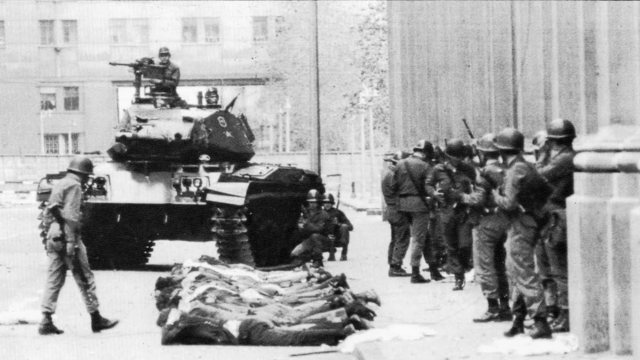
Regime Change Cold War-style: When only dictatorship could save democracy, the USA was happy to see its enemies deposed by military force. Chile, 1973.
But, after the fall of the Berlin Wall and the collapse of
the Soviet Union, the old excuses no longer washed. At what Francis Fukuyama
dubbed “the end of history” all the great geo-political conundrums were
resolvable only by free-market capitalism and liberal democracy. If Uncle Sam
wanted regimes to change in Christian lands he’d have to come up with a
solution that left a lot less mess than strike aircraft, tanks and mass
executions. (In the Islamic world, effecting regime change is still a blood
sport.)
Enter the “Colour Revolutions” of 2000-2005: regime changes
utilising methods that fell somewhere between a soft and a hard application of
American power.
But, like the proverbial iceberg, “revolutions” of the sort
we have just witnessed in Ukraine hide much, much more than they ever let us
see.
Long before the first student protester’s boot hits the
streets of the targeted capital, Uncle Sam has been busy for months. He’s
seeded the media with sympathetic journalists; bought and paid for reliable
polling agencies; stuffed sympathetic NGO’s bank accounts with cash; and
“advised” the armed forces high command (most of them trained in the US) to
keep the Government’s troops in their barracks.
Only then do the protest leaders, fresh from their “civil
resistance” training programmes, fully equipped with state-of-the-art IT and
communications equipment and chaperoned by the best and the brightest the CIA
can spare, step out to accomplish the
fall of the dictator and the
flowering of democracy.
This essay was
originally published in The Dominion Post, The Waikato Times, The
Taranaki Daily News, The Timaru
Herald, The Otago Daily Times and The Greymouth Star of Friday, 28 February 2014.
