
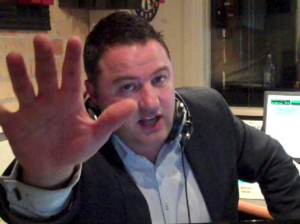
Tweet Surrender: Paradoxically, Duncan Garner's use of Twitter to announce a move against the leadership of David Shearer may, by alerting his supporters, have caused its organisers to hastily abort whatever it was they were trying to achieve. Or, the former TV3 political editor may simply have been played.
DUNCAN GARNER has been roundly criticised this week for
falsely predicting the imminent resignation of Labour leader, David Shearer.
Comparisons have been drawn between Mr Garner’s infamous “tweet” and the media
tactics used to bring down the Australian Labor Prime Minister, Julia Gillard.
Questions are now being raised about the ethics of journalists and commentators
becoming players in a game they’re only supposed to watch.
All of which is the purest humbug. Politicians and journalists
have always lived out of each other’s pockets. This is because politics isn’t
just about the use of power; it’s also about how the use of power is explained
and justified.
The truly effective politician leaves as little of that task to journalists
as possible. There wasn’t a lot more that a journalist could have added to
Abraham Lincoln’s Gettysburg Address, or Winston Churchill’s “Finest Hour”
speech. Nor could Kiwi scribes much improve upon David Lange’s crushing
dismissal of Sir Robert Muldoon’s interventionism: “You can’t run a country
like a Polish shipyard!”
Not all politicians are, however, blessed with such
memorable rhetorical skills. For those who struggle to explain and/or justify
their political actions, a measure of journalistic assistance is usually required.
We have learned to call these people “spin doctors”. It’s an
evocative title, recalling those legendary spin bowlers who could turn a
cricket ball in whatever direction they pleased. The reality, however, is that
nearly all spin doctors have, at one time or another, been senior political
journalists.
As such, they have a fairly shrewd idea of who it is among
their former colleagues that should be called in for an interview – and who
should be kept as far away from their bosses as possible. As skilled
journalists they can also spot the weaknesses and strengths in the stories that
are written about their employers.
Tony Blair’s formidable spin doctor, Alastair Campbell,
certainly wasn’t shy about letting errant journalists know exactly what he
thought of their work – and them.
The environment in which politicians and journalists move
is, therefore, one of both familiarity and contempt. Only the very best
performers, on either side, have no need for the back-scratching of the other.
Stories are leaked. Rumours are started. Judgements are made
– or encouraged. Politicians and journalists constantly use each other – not
only to build themselves up, but also to tear down their colleagues (who are
more often than not their competitors and rivals).
Which brings us back to Mr Garner and his tweet.
Labour MPs have accused Mr Garner of “making up” his story
about a coup being underway against Mr Shearer. But only a moment’s thought is
required to expose this accusation for the nonsense it is.
Mr Garner has confirmed that his informant was a member of
the Labour Party Caucus. Presumably, he or she was someone who had vouchsafed
information to Mr Garner in the past – information which had proved to be
reliable.
The maelstrom of criticism into which Mr Garner has been unceremoniously
pitched, since his predictions of last Thursday night were proved wrong,
provides the strongest argument as to why he would not have tweeted without
feeling extremely confident about the rumour’s veracity. (Just to make sure,
however, he sought and received confirmation from a second Labour Party source.)
That Mr Garner was given what the Americans call “a
bum steer” should tell him (and us) that the atmosphere in Labour’s Caucus is
becoming increasingly toxic. And, as Julia Gillard would no doubt confirm, such
a poisoned political environment makes rumours of an imminent leadership spill both
inevitable and believable.
So, why did Mr Garner’s coup rumour fail to stack up? Let’s
go through the explanatory options.
1) Some sort of leadership coup was on, but Mr Garner’s
tweet alerted Mr Shearer’s supporters and the organisers were forced to abort.
(Despairing Labour MPs may simply have been gathering sufficient signatures to
persuade their leader to go gracefully and preserve the party from a
debilitating civil war.)
2) No coup was imminent, but Mr Garner’s source considered
it vital that Mr Shearer be forced to endure yet another destabilising round of
media speculation concerning the viability of his leadership. (So vital that
they were willing to abuse and lose Mr Garner’s trust.)
3) For reasons of their own, Mr Shearer’s backers decided to
undermine Mr Garner’s journalistic credibility by deliberately misinforming him
that a coup was underway.
Each of these explanations offers a slightly different take
on the dire state of affairs within the Labour Caucus. Underlying all of them,
however, is the undeniable fact of a leader (and the faction backing that
leader) under extraordinary and unremitting pressure.
Mr Garner’s prediction may have failed to materialise, but
it did, at least, remind us of Bismarck’s famous quip: “Never believe anything
in politics until it has been officially denied.”
This essay was
originally published in The Press of Tuesday,
16 July 2013.
