Showing posts with label George W. Bush. Show all posts

Monday, 27 March 2023

Too Big To Punish.

Too Strong For The Law’s Web: But, if the USA is too big to punish, why isn’t the Russian Federation? Russia’s economy may be roughly the size of Italy’s, but it’s nuclear arsenal is more than capable of laying human civilisation to waste. Threatening to arrest Vladimir Putin - especially when the Russian Federation and the rest of the United Nations are recalling George W. Bush’s illegal invasion of Iraq twenty years ago – is an astonishingly provocative act.

I AM CONSTANTLY ASTONISHED at how blithely unconscious the West is of its own transgressions. That the International Criminal Court (ICC) could announce its decision to issue a warrant for the arrest of Vladimir Putin a mere three days ahead of the twentieth anniversary of the United States’, the United Kingdom’s, Australia’s and Poland’s illegal invasion of Iraq on 20 March 2003 shows just how morally comatose the West has become.

Twenty years ago, President George Bush, Prime Minister Tony Blair, Prime Minister John Howard and the Polish premier, Leszek Miller, ordered a massive airborne attack and an all-out armoured assault upon a nation that was at peace with its neighbours and, which had made no aggressive moves against any of the nations whose armed forces were pouring across its borders. Unsurprisingly, a large number of the world’s nations condemned the invasion of Iraq as a breach of the UN Charter and international law. Millions of people around the world, with considerable justification, branded Bush, Blair, Howard and Miller war criminals. Certainly, the invasion they authorised led directly to the deaths of hundreds of thousands of innocent human-beings.

So, why didn’t the ICC, which had come into formal existence on the 1 July 2002, issue warrants for the arrest of Bush, Blair, Howard and Miller? Were they not guilty of war crimes and crimes against humanity? Had they not involved themselves in what the prosecutors at the Nuremburg Trials called “the crime of crimes” – the planning, preparation and waging of aggressive war? The crime for which the surviving Nazi leaders were hanged in 1946.

From the grim perspective of the world of realpolitik, the reason why the ICC decided not to prosecute the four aggressors is obvious: the United States is simply “too big to punish”. Not only did the USA refuse to recognise the jurisdiction of the ICC over United States citizens, but every diplomat and jurist worthy of the name understood that any attempt to arrest George W. Bush would provoke a reaction of truly biblical proportions.

But, if the USA is too big to punish, why isn’t the Russian Federation? Russia’s economy may be roughly the size of Italy’s, but it’s nuclear arsenal is more than capable of laying human civilisation to waste. Threatening to arrest Putin - especially when the Russian Federation and the rest of the United Nations are recalling the illegal invasion of Iraq twenty years ago – is an astonishingly provocative act.

Now, some of those reading these words will object that they are nothing more than an egregious example of “whataboutism”. If Putin stands accused of illegally deporting thousands of Ukrainian children to Russia, then he should be put on trial for his actions – not let off because Bush, Blair, Howard and Miller were not held accountable for theirs. Crying “What about Iraq?!” is an irrelevant question – it has no bearing on the case against Putin.

Except, of course, it does. The application of justice must not only be even-handed, it must be seen to be even-handed. If the public had witnessed the child of a rich and powerful family engaging in clearly dangerous and illegal activity, and then seen the Police refuse to bring charges against him because his family was simply too rich and too powerful, they would be disgusted. And if they then saw the child of a poor and powerless family brought to trial for exactly the same offences, they would be outraged. Prosecuting the poor, but not the rich, child would, quite rightly, be regarded as a travesty of justice. What’s more, the court responsible would be utterly discredited in the eyes of all fair-minded people.

Two-and-a-half thousand years ago, a Scythian prince named Anacharsis had this to say about Ancient Athens’ celebrated legal code: “Written laws are like spiders’ webs; they will catch, it is true, the weak and poor, but would be torn in pieces by the rich and powerful.”

The USA has proved the truth of Anacharsis’ observation by simply overawing the ICC’s timid prosecutors. Twenty years on from its failure to hold the invaders of Iraq to account, however, the ICC clearly believes that the Russian President is too weak to tear its legal web in pieces.

But who would be the person who arrests Putin? Or the country that tries to hold him?


This essay was originally published in The Otago Daily Times and The Greymouth Star of Friday, 24 March 2023.

Wednesday, 29 September 2021

It Was Twenty Years Ago: "Infinite Justice".

A Promise Of Justice? I can hear you! I can hear you! The rest of the world hears you! And the people - and the people who knocked these buildings down will hear all of us soon!
-
President George W. Bush, 14 September 2001.

WHEN AN EVENT as large and resonant as the terror attacks of 11 September imprint themselves on the memories of millions, journalism is momentarily rendered speechless. The sheer enormity of the destruction of the World Trade Centre exposed what has been called “a poverty of eloquence” on the part of those whose job it was to describe reality.

Not only were the wordsmiths lost for words, but they were also bereft of explanations. Nowhere was this more evident than on the American television networks, where stunned anchor-people struggled, in real time, to interpret what their fellow citizens, with mounting horror and disbelief, were witnessing through a hundred million television sets.

The only people who seemed equal to the task of putting words to the images were politicians. Almost instantaneously, the US political and security establishment found the phrases that have subsequently come to frame the issue.

The terrorist attacks were described as the opening salvo of a global war between Good and Evil, a war which the United States would prosecute with the utmost severity - no matter what the cost. Those responsible for this outrage, and any who gave them shelter or support, would be pursued to the very ends of the earth. Within days, this cosmic struggle had a code-name: it was called “Infinite Justice”.

But now journalism is beginning to respond to the Bush Administration’s rhetoric. Upon the unreflective surface of the mainstream media monolith, hairline cracks of doubt and disagreement are appearing. Above the patriotic clamour for vengeance, dissenting voices are beginning to be heard.

Sometimes they come from the most unlikely sources. Stephen Schwartz writing in the right-wing weekly magazine, The Spectator, points an accusing finger not simply at Osama bin Laden, but also at the fanatical Islamic sect known as the Wahhabis (of which bin Laden is a follower). “Not all Muslims are suicide bombers,” observes Schwartz, “but all suicide bombers are Wahhabis.”

Founded in the 18th Century by the Arabian cleric Ibn Abdul Wahhab, the sect’s teachings were taken up by the founder of the kingdom of Saudi Arabia – Ibn Saud – who cleverly exploited its austere puritanism in his World War I struggle against what he regarded (encouraged by T.E. Lawrence – “Lawrence of Arabia”) as the decadence of his Turkish overlords.

As Schwartz notes, Wahhabism remains the official creed of the Saudi royal family: “One major question is never asked in American discussions of Arab terrorism: what is the role of Saudi Arabia? The question cannot be asked because American companies depend too much on the continued flow of Saudi oil, while American politicians have become too cosy with the Saudi rulers.”

Just how cosy, is revealed by John Mecklin, a US investigative reporter formerly based in Houston, Texas. Back in the late 1980s, Mecklin was running down leads on the connections between prominent Texans and the Bank of Credit and Commerce International – an institution later implicated in money laundering, arms dealing and, tangentially, in the Iran-Contra ‘arms-for-hostages’ scandal that rocked the Reagan White House.

One of the key figures at the Texas end of Mecklin’s BCCI investigation was businessman James R. Bath. Among Mr Bath’s clients were a number of wealthy Saudi Arabians – including one Salim bin Laden, heir to a vast construction fortune and half-brother to Osama. According to a Time magazine report, James Bath also had a 5% stake in two limited partnerships, Arbusto 79 and Arbusto 80, both controlled by his old Air National Guard buddy, George - eldest son of a former CIA Chief. (Arbusto is Spanish for ‘bush’.)

That son is now President of the United States – and the mortal foe of Osama bin Laden.

Infinite justice indeed.


This essay was originally published in The Dominion of Friday, 28 September 2001.

Tuesday, 9 August 2016

Is Trump Preparing To Substitute Bullets For Ballots?

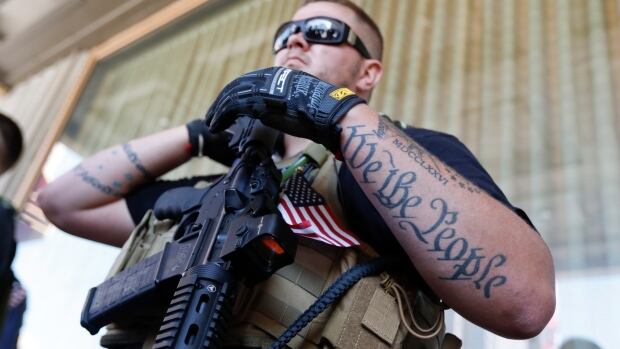
The Constitution In Arms: Alarmed at the steady decline in Trump's poll-ratings, extreme elements of the American Far-Right have begun warning his supporters that the forthcoming Presidential Election will be "rigged" to prevent their candidate from taking office. Already the Republican Party's most notorious political saboteur, Roger Stone, is using words like "bloodbath". Not one to miss his cue, Trump's stump speeches now include repeated references to a "rigged" or "stolen" election.

AS TRUMP’S NUMBERS slump, and Hillary’s surge, the worst elements of the American Right are mobilising in his defence. The Republican Party’s most notorious political saboteur, Roger Stone, is urging Trump to prepare his followers for a “rigged” election. And Trump is listening. To the alarm of election observers and commentators of every political stripe, Trump has taken to dropping the “R” word into his recent stump speeches.
 
“November 8th, we’d better be careful, because that election is going to be rigged,” he told American television viewers on Monday, 1 August, “and I hope the Republicans are watching closely, or it’s going to be taken away from us.”
 
Fears are growing in the Democratic camp that the prospect of losing to Hillary fills Trump with such terror that, rather than concede defeat, he will not shy away from doing irreparable damage to America’s 240-year-old system of representative democracy.
 
Roger Stone, who has a portrait of Richard Nixon tattooed on his back, is nothing if not explicit. In an interview with Alex Jones (a far-right extremist broadcaster and conspiracy theorist) he issued a chilling warning to Trump’s opponents:
 
“Well you have to let them know in advance that you’re not going to stand for it. That if there’s any solid evidence of election irregularities you’re prepared to challenge her swearing in and create a constitutional crisis.”
 
Or something much worse. According to the BBC’s Anthony Zurcher:
 
“In a podcast last week, long-time Trump advisor Roger Stone said that if the election results in November don’t match opinion polls, the Republican nominee should challenge the validity of the election and warned that the unrest could end in a “bloodbath”. “If there’s voter fraud, this election will be illegitimate,” he said. “The election of the winner will be illegitimate, we will have a constitutional crisis, widespread civil disobedience, and the government will no longer be the government.”
 
Roger Stone - Republican Party Fixer.
 
Threats of a similar nature were made in the lead-up to the Republican Convention. Even if, back then, they were directed at the leadership of the Republican Party itself! Historically-speaking, such overt references to political violence are alien to the presidential election process. At the state and local level of American government, however, “election irregularities” are commonplace.
 
Stone’s reference to “voter fraud” is telling. For nearly a decade Republican-controlled state legislatures have been passing legislation specifically designed to make it harder for voters more likely than not to support the Democratic Party to both register to – and cast – their vote. The standard political justification for these so-called “voter suppression” laws is the alleged incidence of fraudulent voting. Expert examination of such claims has pronounced them groundless. Proven examples of voter fraud in the United States are extremely rare.
 
The strongly contested presidential election of 2000 is, however, proof that, even at the presidential level, things can go very badly wrong with the election process. The irregularities surrounding the Florida vote were legion – including strong prima facie evidence of Bush family involvement (in 2000, George W. Bush’s brother, Jeb, was the Florida Governor) in a comprehensive plan to suppress the participation of the state’s African-American voters.
 
A more reckless and less patriotic Democratic Party presidential candidate than Al Gore might have done considerably more to prevent the 2000 election being stolen from him. His party had, after all, won the popular vote by a comfortable margin, and election day exit polls had shown him ahead (albeit narrowly) in Florida. Rather than call his followers into the streets, however, Gore allowed the US Supreme Court to determine the outcome of the election. By the narrowest of margins, the Court voted to declare Bush the winner.
 
Can Donald trump be relied upon to go quietly if the election is won narrowly (or even decisively) by Hillary Clinton? Or will he goad the losing side of the most heavily-armed citizenry on earth into substituting their bullets for their ballots?
 
This essay was originally posted on The Daily Blog of 9 August 2016.

Wednesday, 25 November 2015

Dictatorship Or Chaos? The Only Choice Left In The Middle East.

A Room Full Of Spiders: Shia militiamen training in Iraq. Living with dictators is never easy, but if events in the Middle East since 2003 have taught us anything, it’s that living without them is impossible. The curtailment of civil liberties that characterises dictatorial regimes has often been considered an acceptable trade-off for the peace and stability they bring with them. People living in these circumstances know that the alternative to dictatorship isn’t democracy – it’s chaos.
 
“SADDAM WAS A FAT BLACK SPIDER high up in the corner of the room. You knew where he was, and kept as far away from him as possible.” As a description of Saddam Hussein’s Baathist regime, the metaphor was memorable enough, but what the young Iraqi woman said next was unforgettable. “Now that Saddam has gone the room is full of spiders. You can’t watch them all, and you can’t keep out of their way.”
 
Living with dictators is never easy, but if events in the Middle East since 2003 have taught us anything, it’s that living without them is impossible. There’s a simple reason for this. The conditions that give rise to dictatorship are generally so appalling that the curtailment of civil liberties that inevitably follows their establishment is considered an acceptable trade-off for the peace and stability they bring with them. People living in these circumstances know that the alternative to dictatorship isn’t democracy – it’s chaos.
 
Let us give the West the benefit of the doubt and say that its leaders failed to grasp this obvious truth. Let us assume that when Tony Blair declared Saddam a monster, and insisted the world would be a better place without him, he was being sincere. Let us accord the same honour to President George W. Bush, and assume that he, too, was speaking sincerely when he told the US Congress, in his 2007 State of the Union address: “The great question of our day is whether America will help men and women in the Middle East to build free societies and share in the rights of all humanity.” Where does it leave us?
 
It leaves us contemplating a number of brutal truths. The first, and the most brutal, being that, even allowing for Blair and Bush harbouring only the best of intentions, the answer to “the great question of our day” is that America and her allies cannot build free societies in the Middle East. And that the men and women living there will not be sharing the political rights of Westerners any time soon.
 
That being the case, the West’s choice is no longer between dictatorship and democracy; it is between dictatorship and chaos. And, given that chaos is the only thing the West’s intervention in the Middle East has created, there is really only one positive choice to be made, and that is to back those military/political leaders with the best chance of maintaining, and/or restoring, peace and stability.
 
In terms of the present security crises precipitated by the Islamic State, and the deadly chaos of Syria’s civil war (out of which the Islamic State emerged) this can only mean recognising what the Russian President, Vladimir Putin, has understood from the very beginning; that the best hope of peace and stability in Syria, and eradicating Islamic State, resides with the Baathist government of President Bashar al-Assad.
 
It is what Emile Simpson, former British Army officer and author of War From the Ground-Up: Twenty-First Century Combat as Politics, is calling the “cold realism” of the  West’s diplomatic and military future. Writing for the conservative American magazine, Foreign Policy, Simpson predicts:
 
“The post-Paris war on terror will affirm the West’s commitment to fighting radical Islamic terrorism, but, in the process, it will reject the idiom of revolutionary, moralizing democratic change inherited from President Bush. Syria was the end of the line for that approach. This new phase will assume that terrorists are nonstate actors, and will take the view that if you have an international system built around strong sovereign states — no matter how brutal or unconcerned with human rights — life becomes much harder for nonstate armed groups, including terrorists. This is simply a reflection of the new realities we face, not a celebration of that shift.”
 
Democrats will stand aghast at this unapologetic re-emergence of Nineteenth Century realpolitik. They would, however, be wise to curb their outrage. The Baathist regimes of Saddam Hussein and the Assad family were, indisputably, ruthlessly oppressive in the context of political rights. When viewed from the perspective of the economic and social rights these secular Baathist regimes delivered, however, the picture changes. Modern systems of public education and health opened up the prospect of a more prosperous life for both men and women. Large-scale state interventions generated both jobs and, by Middle Eastern standards, prosperity. Most important, in both Iraq and Syria, the Baathists kept Islamic fanaticism under tight control.
 
All of which raises the worrying question: Was it really dictatorship that the West was determined to eradicate from the Middle East – including Egypt, Saudi Arabia and the Gulf States? Or was it Baathism? Were the men behind Blair and Bush actually betting that their long-term interests would be better served by “a room full of spiders?”
 
If so, then they lost the bet.
 
This essay was originally published in The Press of Tuesday, 24 November 2015.

Friday, 4 May 2012

Executive Ethics

Mind The Gap: According to our Prime Minister: "There's quite a wide definition of ethics." To which we can only reply: "And it's getting wider!"

RON SUSKIND is a Pulitzer Prize-winning American journalist, best known for his reporting of the Global War on Terror (GWOT). It was while covering GWOT for The Wall Street Journal that Mr Suskind first encountered the ethics of self-created reality.

All wars do violence to human sensibilities, but the war which began on 11 September 2001 was destined to set new benchmarks. Dark practices such as torture, collective punishment, and extra-judicial killings: extreme sanctions which, from the moment of its birth, the United States had proudly and emphatically renounced; suddenly became accepted elements of American state-craft. In order to live with these acts (for which no ethical justifications are available) American military, diplomatic and bureaucratic personnel were forced to devise a whole new way of looking at and explaining the world.

Ron Suskind was the first to report it.

“In the summer of 2002,”, he recalls, “after I had written an article in Esquire that the White House didn’t like about Bush’s former communications director, Karen Hughes, I had a meeting with a senior adviser to Bush. He expressed the White House’s displeasure, and then he told me something that at the time I didn’t fully comprehend – but which I now believe gets to the very heart of the Bush presidency.

“The aide said that guys like me were ‘in what we call the reality-based community,’ which he defined as people who ‘believe that solutions emerge from your judicious study of discernible reality.’ I nodded and murmured something about enlightenment principles and empiricism. He cut me off. ‘That’s not the way the world really works anymore,’ he continued. ‘We’re an empire now, and when we act, we create our own reality. And while you’re studying that reality – judiciously, as you will – we’ll act again, creating other new realities, which you can study too, and that’s how things will sort out. We’re history’s actors  . . . and you, all of you, will be left to just study what we do’.”

It is difficult to overstate the importance of this reported conversation. Not only because its content spoke to the very dark heart of the Bush presidency, but also because it constituted much of the “discernible reality” of contemporary politics – including our own.

In essence, what the Bush Administration official was saying to Mr Suskind was that the exercise of raw executive power, by virtue of its self-evident effects, removes any need for ethical justification. If the United States invades Iraq, then that is the reality the world must face. Questions about its ethics are simply irrelevant. As the 9/11 hijackers demonstrated: if the deed is big enough, it explains and vindicates itself.

Our ethical structures are simply too fragile to contain, or judge, such acts. Like the spider’s web which ensnares small creatures, but whose fragile threads are powerless to hinder larger prey, the “reality-based community” can only “judiciously” report and study – but never stop – what the “Empire” does. As President Richard Nixon notoriously observed to David Frost: “Well, when the President does it, that means that it is not illegal.” Or, in the language of the Roman Emperors: Necessitas non habet legem: Necessity knows no law.

Fish, it is said, rot from the head down. If the most powerful men and women in the most powerful nation on earth were now free to embrace torture and murder with impunity, then how likely was it that those occupying the next steps of the social hierarchy would repudiate these new, self-justifying, realities of executive power? If the President of the United States could now condemn an American citizen to death without trial, what was there to prevent Wall Street looting the American treasury? Or fat Germans beggaring emaciated Greeks?

And, if the exercise of naked power now requires no justification, should we local representatives of the “reality-based community” really be surprised to learn that the rights of film technicians and actors can be cancelled at the urging of an accommodating prime minister? Or that, by building a convention centre, a casino owner can secure a revision of the gambling laws? Or that an “anonymously” funded politician can ride off, Scot-free, into the political badlands on the ass that is New Zealand’s local electoral law?

No. Not when, as our own self-created little emperor says: “There’s quite a wide definition of ethics.”

This essay was originally published by The Otago Daily Times, The Waikato Times, The Taranaki Daily News, The Timaru Herald and The Greymouth Star of Friday, 4 May 2012.

Thursday, 6 August 2009

Backroom Boy

Re-framing the new political environment: Murray McCully, like his fellow neo-conservative, Dick Cheney, knows that the best deals are done when nobody is looking.

IT’S A CHILLING image. In the foreground we see the face of the former US President, George W. Bush, wearing that wide-eyed, open-mouthed, slightly goofy expression so beloved by the world’s caricaturists. Behind Bush, his features ever-so-slightly out-of-focus, hunches Vice-president Dick Cheney. While the President looks towards the camera, the Vice-president’s eyes remain fixed, proprietarily, upon his boss. Points of light reflect off his steel-rimmed glasses. His mouth is forming into just the faintest hint of a smirk.

Small wonder TIME magazine chose this photograph to illustrate their special report on "The Final Days of Bush & Cheney". A thousand words could hardly match its deeply creepy depiction of the relationship between Cheney and his hapless Texan protégé.

Has a New Zealand photographer to captured a similar "moment" between our own Prime Minister, John Key, and his Foreign Minister, Murray McCully? It wouldn’t require much effort, because there is definitely something in McCully’s political relationship with Key that recalls the sorcerer’s apprentice aspects of the Cheney-Bush combination.

Perhaps it’s the boyish and disarmingly ingenuous demeanour of the New Zealand Prime Minister that makes one think of Bush, or the talent both men possess for inflicting grievous bodily harm upon the English language. More seriously, it could be the uneasy feeling one gets when watching the public performances of Bush and Key that their grasp of public policy is only as strong as their last verbal briefing. In this respect, the sharpness of the contrast between Key and his predecessor, Helen Clark, is only exceeded by that of the man who succeeded Bush, Barack Obama.

The parallels are also there between Cheney and McCully.

In terms of the recent political histories of their respective nations, both men have been around forever. Cheney (like his close ally, the former Defence Secretary, Donald Rumsfeld) began his career in the days of Richard Nixon (1968-74). He was elected to the House of Representatives five times during the Reagan era, and, before becoming George W, Bush’s running-mate in 2000, served in George Bush Snr’s administration (1988-1992) as Secretary of Defence.

McCully was first elected to Parliament 22 years ago, in 1987, but his career as a National Party insider stretches all the way back to 1973 when, at the age of 20, he was elected President of the Young Nationals. Those 36 years in the trenches have fashioned McCully into the ultimate political insider. Few within his party (perhaps Michelle Boag?) could match the intricacy or extent of his political networks, or challenge his encyclopaedic knowledge of who did what to whom, when, and why. It is taken as an article of faith in National Party circles that, since 1987, no leadership coup has proceeded without McCully’s blessing.

All of which suggests that Key is in McCully’s political debt, and is, therefore, bound to take the MP for East Coast Bays’ ideas on both domestic and foreign policy extremely seriously. TIME magazine writes of Cheney that: "Both by habit and by design, he cultivated a relationship that suited Bush’s view of their roles: the President as the ‘decider’ and Cheney as the éminence grise who counselled him. In reality, by wiring the bureaucracy and being the last person Bush spoke with on many key decisions, Cheney became [as his biographer Barton Gellman put it] a ‘sounding board for advice he originated himself’." It’s a description that could, with only a small amount of editing, be used to describe McCully’s relationship with Key.

McCully’s influence over National’s conduct of domestic policy is more apparent in the present Government’s evolving "tone", than in any specific policy.

It should not be forgotten that, as National’s Communications Director in the late-1970s, McCully observed at close hand the crudely authoritarian and deeply divisive style of Sir Robert Muldoon, and how effective it was at driving wedges into Labour’s traditional support-base. That the raw meat of "Laura Norder" and beneficiary-bashing has become the staple diet of Labour’s disillusioned deserters, is in no small measure attributable to McCully’s strategic insight.

McCully understands, in a way that Key almost certainly does not, the critical importance of keeping the deep-seated social resentments of the New Zealand working-class bubbling merrily away. Certainly, MSD Minister Paula Bennett’s release of the income details of two politically active domestic purposes beneficiaries recalls the very worst excesses of Muldoon’s right-wing populism.

McCully’s influence is, however, most pronounced in matters relating to diplomacy, trade and defence. It is in these fields that the impact of the neo-conservative ideology he shares with Cheney is clearest.

The Foreign Affairs portfolio, McCully’s reward for giving Key the nod, allows him to pursue (well away from the prying eyes of the news media) his long-held objective of restoring New Zealand to its proper place in the Anglo-Saxon fold. His impatience with the diplomacy of grand moral gestures – epitomised by Kirk’s despatch of a frigate to the French nuclear testing-ground at Mururoa Atoll; Lange’s Nuclear-free legislation; and Clark’s refusal to join the invasion of Iraq – underpins his determination to re-couple New Zealand to the train of its traditional allies.

Working in Cheney-like secrecy with the Defence Minister, Wayne Mapp, and Trade Minister, Tim Groser, McCully has spent the last nine months radically reorienting New Zealand diplomacy. The days of New Zealand lecturing the world from a lofty ethical perch, held together by the diplomatic equivalent of No. 8 Wire, are over. Foreign policy under McCully is guided by the more conservative thinkers of Canberra, Washington and London – just as it was in the days of Sir Keith Holyoake and Muldoon.

Almost without them noticing, McCully has enlisted New Zealanders as eager participants in the War on Terror; foot-draggers in the campaign against climate change; and mini-imperialists in the economic re-conquest of the South Pacific.

McCully is also pressing Key to send the SAS back to Afghanistan in a combat role. If the blood of Kiwi soldiers is the price New Zealand must pay to convince her erstwhile allies that she is once again ready to play her part as the fifth finger of the Anglo-Saxon "fist", then he will not demur.

Like Cheney, McCully is perfectly content to let his protégé claim personal ownership of "advice he originated himself". Thirty-six years of political skulduggery have taught this backroom boy that the best deals are done when no one’s looking.

This essay was originally published in The Independent of Thursday, 6 August 2009.