
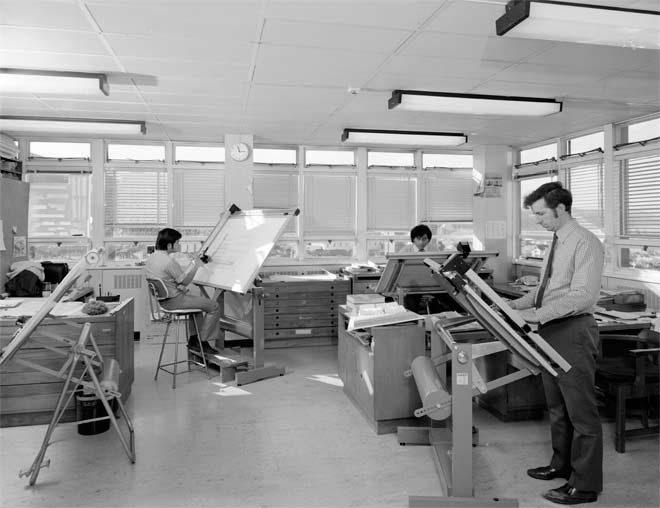
Architects Of The Public Good: Government architects, along with engineers, scientists, tradespeople and thousands of other workers, were employed by the Ministry of Works - the state-owned planning and construction agency that built so much of New Zealand's infrastructure. In a country plagued by earthquakes and facing the consequences of global warming, isn't it time for MoW 2.0?
ONCE AGAIN, New Zealanders are confronted with the raw and
unconquerable power of the tectonic forces beneath their feet. Although the
rebuilding of Christchurch remains a real and present priority; the nation’s
eyes have been drawn inevitably to the earthquake-ravaged landscape of the
Kaikoura Coast.
The civil-engineering challenges of this latest disaster are
daunting. Reconstructing an urban landscape is one thing. But shifting whole
mountainsides of rock and clay? That is something else again! Restoring State
Highway One and the coastal railway linking Christchurch with Picton will be
the work not of weeks, or even months, but years.
Our political leaders, prompted by the conventional wisdom
of the past thirty years, will undoubtedly look to the private sector for
salvation. As the initial damage surveys are completed, civil servants will be
tasked with drawing up job specifications and seeking expressions of interest
from domestic and foreign construction firms. Every bid received will have been
carefully calculated to deliver a healthy financial return to the tenderer’s
shareholders – not New Zealand’s citizens.
Is this truly the most sensible way to proceed? Wouldn’t New
Zealand’s long-term interests be better served by the creation of a large,
permanent and state-owned construction organisation? The arguments in favour of
establishing a twenty-first century version of the twentieth century’s Ministry
of Works are compelling.
The first and most obvious advantage of having a large,
permanent and state-owned construction force is the ease of its rapid
mobilisation. Organised along the lines of the United States Army Corps of
Engineers (one of the largest publicly-owned engineering, design, and
construction management agencies in the world) this new Ministry of Works –
let’s call it MoW 2.0 – would be able to swing into action at a moment’s
notice.
In much the same way as the NZ Defence Force was able to
send the HMNZS Canterbury and a
convoy of army trucks to the aid of Kaikoura, the MoW 2.0 would be able to move
engineers, construction workers and heavy earth-moving machinery to where they
were most needed.
Such a force would not only be available to deal with the
earthquakes to which New Zealand is so prone, but also to remediate the damage
caused by the extreme weather events that are already a disturbing feature of
global warming. Violent storms, massive floods, inundating tides and eroding shorelines
will become the “new normal” as the planet heats up. MoW 2.0 would take on the
lion’s share of repairing the nation’s beleaguered infrastructure and play a
leading role in the design and construction of new climate-change protection
schemes.
MoW 2.0 could also play an important role in managing the
New Zealand labour market. As a major employer of unskilled and semi-skilled
workers it would soak up a large number of citizens who would otherwise be
unemployed. Remedial education and on-the-job training would be an important
part of MoW 2.0’s remit and would constitute an ongoing contribution to the
public good.
Within just a few years, MoW 2.0 would be passing out
highly-trained and experienced engineers, architects, scientists and
tradespeople to take up new positions in the private sector. A massive public
subsidy? Yes. But no different from the huge public subsidisation of the
medical profession which we accept quite happily every time we are treated by a
young doctor working in our local public hospital.
Not all of those inducted into MoW 2.0 would move out into
the private sector, however. Many would make the defence, restoration and
construction of New Zealand’s public infrastructure their life-long career. In
time, MoW 2.0 would build up a formidable body of highly-qualified and
highly-creative professionals, dedicated not only to the resolution of present
problems, but also to the anticipation of new ones.
An historical precedent for this is clearly discernible in
the original Ministry of Works, whose planners, in the final years of the First
Labour Government, produced a comprehensive blueprint for the growth and
development of Auckland. This extraordinary plan anticipated practically all of
the problems which are currently taxing the Auckland Council. Everything: from
urban intensification to light-rail connectivity; comprehensive public
amenities to pedestrian precincts and cycleways; was foreseen and provided for
as long ago as 1946!
And this is, arguably, the most compelling reason of all for
establishing a large, permanent and state-owned construction organisation.
Unconstrained by the private sector’s need to be constantly in search of better
contracts and bigger profits, it would be able to construct a “big picture’ of
New Zealand’s vulnerabilities and needs.
Against the blind, overwhelmingly destructive forces of
nature, MoW 2.0 would oppose the imagination and foresight of intelligent
human-beings. In sharp contrast to the short-termism of free-market capitalism,
it would look over the horizon to the outlines of a more appropriately
resourced and better prepared New Zealand.
A country awaiting only the earthquake of progressive
political change.
This essay was
originally published in The Press of Tuesday,
22 November 2016.
