Showing posts with label Greek Austerity Referendum. Show all posts

Friday, 10 July 2015

Yanis Varoufakis: A Hero Worthy Of His Heritage.

Dropping The Pilot: The classical character of Varoufakis’s departure as Greece’s Finance Minister was made even more poignant by the fact that his own personal defeat was announced amidst the echoing tumult of a victory that he, more than anyone, had secured for his people.
 
“WE OF THE LEFT know how to act collectively with no care for the privileges of office.” How long has it been since a left-wing leader talked like that? Yanis Varoufakis may have used a blogpost to announce his resignation to the world, but the sentiments he expressed were straight out of Homer. Like the hero of an ancient Greek legend, he showed that he understood both the duty he was bound to fulfil, and that he embraced it with a glad heart.
 
The classical character of Varoufakis’s departure as Greece’s Finance Minister was made even more poignant by the fact that his own personal defeat was announced amidst the echoing tumult of a victory that he, more than anyone, had secured for his people.
 
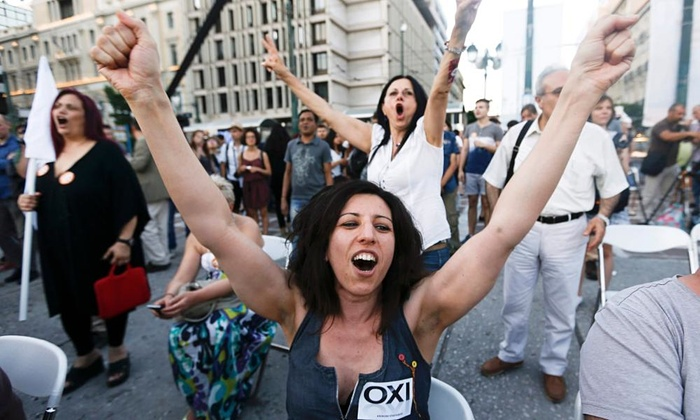
Across the whole of Greece, from Thrace in the north to Crete in the south, the Greek people had delivered a resounding “Oxi!” (No!) to the European Union’s demands for never-ending austerity.
 
Beneath a frenzy of flailing flags, in Athens’ Syntagma Square, tens-of-thousands of supporters of the Syriza Party-led coalition government shouted their defiance of the hated “Troika” (the European Commission, the European Central Bank and the International Monetary Fund). But, even as the Oxi voters celebrated, Prime Minister Alexis Tsipras was delivering the “Eurogroup’s” lethal ultimatum to his Finance Minister.
 
In Varoufakis’s own words: “Soon after the announcement of the referendum results, I was made aware of a certain preference by some Eurogroup participants, and assorted ‘partners’, for my… ‘absence’ from its meetings; an idea that the Prime Minister judged to be potentially helpful to him in reaching an agreement. For this reason I am leaving the Ministry of Finance today.”
 
If, as Troy burned, King Agamemnon had asked Odysseus to appease its tutelary deities by falling on his sword, the shock of injustice and ingratitude could hardly have been greater. But Varoufakis did not demur. “I consider it my duty to help Alexis Tsipras exploit, as he sees fit, the capital that the Greek people granted us through yesterday’s referendum.”
 
And yet, even as he abandoned his portfolio for the back-benches, Varoufakis could not resist one final, parting shot at the European hierarchs who, in their petulant fury, had demanded his political head.
 
“And I shall wear the creditors’ loathing with pride.”
 
This undisguised contempt for both the intellect and the character of Greece’s European creditors was, almost certainly, Varoufakis’s hamartia (in Classical Greek literary tradition, the fatal character flaw that causes the hero’s downfall). The son of a wealthy Greek industrialist, Varoufakis was never for a moment overawed by the European Union’s political bureaucrats and bureaucratic politicians. That he was, himself, an accomplished academic economist and author merely heightened his conviction that he had nothing to fear, and even less to learn, from the Eurogroup’s “participants and assorted partners”.
 
That Varoufakis’s professional analysis of Greece’s economic position was correct (as confirmed by at least two Nobel laureates – Stiglitz and Krugman – and, more recently, by the IMF itself) only made him more insufferable to the likes of Germany’s 72-year-old Finance Minister, Wolfgang Schauble. The hard-working German ant did not appreciate being lectured at by some upstart Greek grasshopper with a PhD – and no neckties.
 
Varoufakis’s sartorial insouciance was, of course, as carefully calculated as his economic analyses. His leather jackets and brightly coloured shirts (all-too-often unaccompanied by the required necktie) signalled his determination to carry just a little Mediterranean sunshine and machismo into the grey, staid and deeply conventional world of European finance. That these ageing Teutons in their dark suits and sensible ties felt upstaged by Varoufakis’s big fat Greek virility was as obvious as it was disruptive. A rock star at a Rotary meeting could not have been more out of place.
 
But disruption and non-conformity were essential ingredients of the Varoufakis shtick. What better way to demonstrate his radical new approach to doing business with the “suits” than by refusing to turn up in one? In a world increasingly informed by images rather than words, Varoufakis was signalling that Neoliberalism is not the only game in town: that economic alternatives do exist.
 
His people got the message. And even if he is not there to deliver it in person, Varoufakis’s vision of a better world will continue to dazzle the eyes of the “gods” who demanded this Greek hero’s sacrifice.
 
This essay was originally published in The Waikato Times, The Taranaki Daily News, The Timaru Herald, The Otago Daily Times and The Greymouth Star of Friday, 10 July 2015.

Tuesday, 7 July 2015

The Power of No: The Greeks Expose Neoliberalism's Anti-Democratic Agenda.

No! The decision of the Greek people has shown us that Neoliberalism can be challenged. Whether it can be beaten will require more than the bravery of a single nation. To defeat the neoliberals’ greed and cruelty, not just Greece but the whole world will have to find the courage to say: “No!”
 
THE UNFOLDING CRISIS in Greece has stripped Neoliberalism of its protective disguise and the world is recoiling from its ugliness. In normal circumstances the true purposes of the world’s neoliberal elites are masked by their use of opaque economic jargon. In the case of Greece, however, the social science of economics has been turned against them by some of its most impressive exponents. Nobel laureates Joseph Stiglitz and Paul Krugman have told the world that what is being done to Greece has nothing to do with economics, and everything to do with politics. A whole country is being driven to the wall in a desperate bid to destroy its left-wing government. Neoliberalism simply cannot allow the Greek Prime Minister’s, Alexis Tsipras’s, powerful lessons in democracy to go unpunished. If his Syriza Party is allowed to defeat austerity in Greece, what is there to prevent Podemos from defeating it in Spain? Or Sinn Fein in Ireland?
 
Hence the ugliness. Deprived of credible economic arguments for insisting that the Greek government persist with an austerity programme that has already shrunk Greece’s GDP by 25 percent and kept upwards of 60 percent of her young people out of the paid work force, the EU’s neoliberal elites – particularly the German holders of the neoliberal franchise – have been forced to resort to outright lies and childish insults.
 
Germany’s 72-year-old Finance Minister, Wolfgang Schauble, has clearly been unable to cope with his 54-year-old Greek counterpart, Yanis Varoufakis. Everything about the free-wheeling Greek economics professor offends the unyielding German ideologue. Varoufakis has been unsparing in his criticism of Germany’s inability to grasp the necessity for Greek debt relief (which even the IMF now acknowledges). It’s an act of insubordination which Schauble and his colleagues are resolutely determined to punish. So unchallenged has neoliberalism’s ideological hegemony been since the collapse of Soviet-style socialism that it finds itself unable to adequately respond to Varoufakis’s neo-Keynesian populist critiques. Their greatest fear is that, like the little boy in the Hans Christian Andersen fairy tale, the Greek Finance Minister will draw the world’s attention to the fact that the neoliberal German Emperor is wearing no clothes.
 
With Schauble and his neoliberal colleagues forced on to the defensive by the combined diplomatic and intellectual onslaught of Tsipras and Varoufakis, mobilisation orders were swiftly issued to neoliberalism’s reserve units located in the global news media. These latter lost no time in launching vicious attacks against the Syriza leadership – especially Varoufakis – and redoubled their blatantly racist denigration of the Greek people as a whole. This latter tactic had been in operation ever since Greece’s creditors had forced successive Greek governments into slashing the living standards of their own people. Cast as indolent Mediterranean grasshoppers (so unlike the hard-working Teutonic ants, whose borrowed Euros they had fecklessly frittered away) the Greek victims of neoliberal extremism were told that they had no one to blame but themselves.
 
Even at a distance of 17,000 kilometres from Athens, New Zealand’s neoliberal journalists and commentators have been working hard to maintain the two central arguments for neoliberalism’s assault on Greece. That the Syriza Government’s position is economically untenable; and that, in any case, the Greek people had it coming and richly deserve everything they have got. To pull this off they have had to studiously ignore the highly critical contributions of leading economists, while attempting to preserve the fiction that Greece has no alternative except to swallow still more of the austerity poison.
 
The most disturbing aspect of the mainstream news media’s adherence to the neoliberal line has been its willingness to go along with ethnic defamation. Just substitute the word “Maori” for “Greeks” in these neoliberal tirades and the full racist character of the attacks becomes clear. Newspapers and networks that would never allow contributors to get away with calling Maori lazy, good-for-nothing, ne’er-do-wells with no one to blame for their poverty but themselves, were quite happy to have it said of the Greeks.
 
It was, however, Tsipras’s decision to put the question of whether or not to persist with the EU’s austerity programme to a referendum that stripped away the last vestiges of Neoliberalism’s technocratic disguise. Now they were required to openly disparage not just Syriza, not just the Greek people, but democracy itself. In extremis, the neoliberals had no choice but to demonstrate, in a fashion that people who value democratic principles could not miss, that the interests of those who are both empowered and enriched by their control of the markets; and the interests of the people whose lives are cheapened and constrained by the operations of those same markets; have always been, and are still, on a collision course.
 
The decision of the Greek people has shown us that Neoliberalism can be challenged. Whether it can be beaten will require more than the bravery of a single nation. To defeat the neoliberals’ greed and cruelty, not just Greece but the whole world will have to find the courage to say: “No!”
 
This essay was originally posted on The Daily Blog of Monday, 6 July 2015.

Monday, 6 July 2015

Democracy Triumphs - Long Live Greece!

 
The Greek Interior Ministry's official projection of the Referendum Result has just been released:
 
Yes: 39 %
No: 61%
 
 
This posting is exclusive to the Bowalley Road blogsite.