

Defending The Heartland: Russian volunteers bar the eastward road to a US-installed Ukrainian government determined to derange the strategic equilibrium of Eastern Europe - even at the risk of igniting World War III.
IN THE CAPITAL CITIES of Europe, diplomats are sharing the
following, rather grim, joke: It seems
that Washington, having missed out on the beginning of World Wars I and II, is
determined to be in right at the start of World War III.
No one in the European Union is laughing very loudly. The
flames of war are already lighting-up Europe’s eastern horizon, and a fire in
your neighbour’s house, if not extinguished quickly, can all-too-easily set
your own ablaze.
Beneath the joke’s mildly anti-American punch-line lie a
host of barely acknowledged European fears. For almost half-a-century after the
end of World War II the nations of Europe were effectively relieved of the
responsibility for formulating their own foreign policies. To the east, the
nations of the Warsaw Pact followed Moscow’s lead. In the West the members of
Nato allowed themselves to be guided by Washington.
With the fall of the Berlin Wall in 1989, and the collapse
of the USSR two years later, that all changed. The collapse of the Soviet Empire
allowed a huge power vacuum to develop between the eastern border of the newly
re-united Germany and the western border of a Russian Federation shorn of
territories formerly regarded as integral and indispensable to the Russian
State.
Diplomacy, like nature, abhors a vacuum. The West was thus
presented with some very difficult – but crucially important – choices. Would
the United States and her European allies take advantage of Russia’s temporary
weakness and extend Nato’s reach hundreds of kilometres to the east. Or, would
they acknowledge the historical justification for Russia’s demand that a
buffer-zone of friendly and largely demilitarised states be erected between
itself and the military might of the Nato powers? After all, the last time a large
Western European state decided to move eastwards, 20 million Russian citizens
lost their lives.
In spite of giving the last Soviet leader, Mikhail
Gorbachev, his word that the Nato powers would not attempt to extend the
alliance all the way to Russia’s new borders, the US President, George H.W.
Bush, and his successors, attempted to do exactly that.
Their strategy was almost exactly the same as the one which
had been urged on the Big Three victors of World War I, Great Britain, France
and the USA, by the British envoy to Southern Russia in 1919, the
geopolitician, Sir Halford Mackinder.
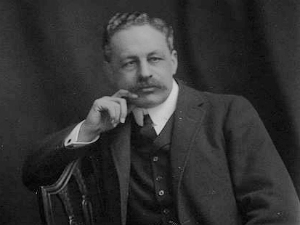
Sir Halford Mackinder: The father of geopolitics.
To keep the revolutionary Russian government weak, he
argued, it would be necessary to construct a “cordon sanitaire” of
Western-oriented regimes out of bits of the now defunct Austro-Hungarian,
German and Russian Empires. Crucially, among the territories to be included in
Mackinder’s list of westward-oriented buffer-states were Georgia, Byelorussia
and the Ukraine.
According to Mackinder’s own “Heartland” theory, whichever
great power, or combination of great powers, ended up acquiring these
territories – especially the Ukraine – would soon be in a position to rule the
world. This was because the possession of these territories would open the way
to the strategic heart of what he called “The World Island” – the
geographically contiguous Eurasian and African land-masses.
Mackinder’s infamous geopolitical formula: “Who rules East Europe commands the Heartland; Who
rules the Heartland commands the World Island; Who rules the World Island
commands the World”; was to inspire not only Adolf Hitler, but an alarming
number of American geostrategic thinkers throughout the Cold War.
Geopolitics For Beginners: Frank Kapra's Why We Fight - a motivational series of films produced for American servicemen during World War II - leans heavily (and without attribution) on Mackinder's geopolitical theories. That they were seized upon by German nationalists in the 1920s and 30s rendered Mackinder's ideas unfit for polite public discussion. (But not for Cold War strategy sessions!) The relevant section begins about 4 minutes in.
These same
geostrategic thinkers, confronted with the unexpected collapse of the Soviet
Union, immediately sought to apply Mackinder’s formula. The US and its Nato allies were urged to take control of East
Europe as quickly as possible.
What was
surprising was that the West European states, freed from the threat of Moscow’s
armoured divisions, were unwilling
to assert a more independent course. In spite of seeing the ruin all previous
attempts to apply Mackinder’s geopolitical formulae had wrought upon Europe,
her leaders made no attempt to restrain their American counterparts.
Perhaps those
European leaders would have tried harder, had they known that Russia’s rising
political star, Vladimir Putin, and his sinister coterie of foreign policy and
military advisers, were every bit as enthusiastic in their admiration for Sir Halford Mackinder’s theories as their hawkish
American adversaries. The West is not going to be permitted to rule East Europe
on their watch. Not while Russia still commands nuclear weaponry.
Contemplating the
outbreak of World War III is no joke.
This essay was originally published in The Waikato Times, The Taranaki Daily News, The
Timaru Herald, The Otago Daily Times and The Greymouth Star of Friday, February 27, 2015.
