Showing posts with label Islam. Show all posts

Friday, 21 February 2020

China Immune To The Infection Of Democracy.

The Democracy Virus: China’s authoritarian political system enables a level of social surveillance and control that liberal democratic societies cannot match. The Chinese Government makes full use of the latest digital technology to both punish – and reward – its citizens. The plans it formulates cannot be challenged, or hindered. Where else could a million human-beings be “re-educated” into sullen obedience? Where else can whole cultures be rendered invisible? (ABC Image)

“A MINOR RELIGIOUS INFECTION”, no statement captures more succinctly China’s problem with world – or the world’s problem with China. The words themselves appear in a leaked document setting forth in grim detail the reasons for the detention of 300 Uighurs and other Muslims in China’s benighted Xinjiang province. Other justifications for incarcerating an estimated one million Uighurs in China’s very own “Vocational and Educational” archipelago include: “used to wear a long beard”; and, “used to wear a veil”. Tellingly, not even the past tense can save you in Xinjiang.

Does the Chinese Communist Party leadership in Beijing understand how poorly the idea that religious belief constitutes a form of “infection” is likely to be received by the overwhelming majority of human-beings belonging to one or the other of the world’s great faith communities? Reading these words in the context of China’s ongoing struggle against the COVID-19 viral epidemic is certain to amplify global displeasure.

When people of faith around the world discover that the Chinese authorities regard the guiding principles of Buddhism, Christianity and Islam as dangerous diseases, whose followers must be isolated from the uninfected population, restored to ideological health, and only then released; they will be dumbfounded. But, not for long. This news will generate rage and resentment on a scale no rational political regime would willingly countenance.

And yet, the Chinese Government remains adamant that its Uighur policy is not only fully justified, but also politically effective. It will not hear a word spoken against its Xinjiang strategy – or, at least, not by those whose opinions it is in a position to monitor – and contain. That this refusal to respond to world opinion might threaten such cherished Chinese initiatives as One Belt, One Road, does not appear to have occurred to those in charge of the Uighur policy. Nor has the mounting evidence of attitudes towards China hardening, all across the world, been sufficient to prompt a regime change of heart.

What is it, exactly, that Beijing fears? What is of more concern to them than the world’s increasingly negative opinion of the Chinese Government? The answer is brutally simple: what the Chinese Government fears most; and certainly much more than global public opinion; is losing control.

China has witnessed the extraordinary derangement of American politics which was set in motion by the 9/11 terrorist attacks. Accordingly, it is determined to dry up the waters of religious extremism in which terrorist organisations like Al Qaida and ISIS floated.

They have also observed, in the EU countries and Britain, the dangerous socio-political pressures produced by mass immigration, along with the divisive multicultural policies it generates. In the People’s Republic, it is the Han Chinese who migrate en masse to the territories of their nation’s ethnic minorities – not the other way around. Cultural homogeneity is both the short and long term objective of the Chinese Government. China’s future is envisaged as monocultural, not multicultural. It is national unity that the Chinese Communist Party seeks – not cultural diversity.

These goals, like the Party’s militant and uncompromising atheism, sit uncomfortably with the expectations of Western elites. It was, for many years, their fond expectation that free trade and free-markets would set up the conditions in which China’s transition to liberal democracy became inevitable. Few now believe that such a transition is imminent. The Chinese looked on grimly as the former Soviet Union was stripped and humiliated by the West. If these were the consequences of embracing liberal democracy, then the West could keep it.

In truth, the Chinese Communist Party has made a high-stakes historical wager. It’s betting everything China has achieved since 1949 that liberal democratic excess will undermine the social, political and cultural cohesion of Western Capitalism long before it overturns “Socialism with Chinese Characteristics”.

This is not as risky a wager as Westerners might think. China’s authoritarian political system enables a level of social surveillance and control that liberal democratic societies cannot match. The Chinese Government makes full use of the latest digital technology to both punish – and reward – its citizens. The plans it formulates cannot be challenged, or hindered. Where else could a million human-beings be “re-educated” into sullen obedience? Where else can whole cultures be rendered invisible?

Yes, all these policies put China off-side with the rest of the world. The thing is: China doesn’t care.

This essay was originally published in The Otago Daily Times and The Greymouth Star of Friday, 21 February 2020.

Saturday, 28 December 2019

Christmas 2019: Still Salivating At Jingle-Bells.

The Season of Good Sales: “What does it matter?”, sneer the atheists and secularists. “The whole silly story never happened.” It matters because the still-cherished principles of secular humanism may be traced all the way back to the Roman Empire of 2,000 years ago, when ordinary human-beings gathered to hear and repeat the words of a carpenter’s son.  It matters, also, because, to paraphrase Robert Harris, writing in his latest, terrifying, novel The Second Sleep: when morality loses its power, power loses its morality.

WHAT HAVE WE just celebrated? Christmas? A holy festival? Or a bacchanalian celebration of conspicuous consumption designed, built and delivered to a palace or a hovel near you by Global Capitalism PLC? I think we all know the answer to that. What hurts the most is that we fall for it every single year. Proof, if proof is required, that Pavlov’s dogs weren’t the only animals conditioned to salivate whenever the jingle-bell rings.

Consider the fact that Christmas is celebrated in just about every mall on the face of the planet. They’re doing it in Shanghai, Tokyo, Singapore and Bangkok. The only part of the world where you might struggle (and, quite possibly, incur some risk) to find Christmas displays and commercial enticements is in the Muslim world.

Now, why is that? The answer is simple. Because Muslims still believe. Islam remains a living and, for the most part, uncorrupted faith. It is still illegal in Muslim countries to practice “usury” – lending out money at interest.

The same was once true of Christendom. Indeed, one could argue that the forward march of capitalism was only finally secured in the British Isles in 1854 with the passage of “An Act To Repeal The Laws Relating To Usury”. The commercial imperative has long since laid low the ancient claims of religion in the Christian West. In the Muslim world, however, the good fight against Mammon goes on.

It would be an interesting exercise to quiz a thousand young people chosen at random from the countries where neoliberal capitalism reigns joyful and triumphant, and ask them to locate the events of Christ’s birth in the broader New Testament narrative.

Would a majority still be able to accurately re-tell the story? Mary’s pregnancy; the journey of Mary and Joseph to Bethlehem; the birth of the infant Jesus in a stable; the shepherds in the fields; the Angelic Host’s proclamation of peace and goodwill toward men; the journey and arrival of the Magi; King Herod’s massacre of the innocents; Mary, Joseph and the infant Jesus’ flight into Egypt. How many would attempt to place Santa Claus somewhere in the Christmas Story? It’s probably best not to know!

Astonishingly, not even our senior Christian clerics seem to be able to tell the Christmas story correctly. In the NZ Herald of Saturday 21 December 2019, one of them wrote (on behalf of all the major denominations) that: “Jesus, God’s son, was born amongst the animals. He grew up in a family that experienced poverty. He spent the first years of his life as a refugee, eventually fleeing for his life from a wicked dictatorship.”

Ummm. No. He didn’t. Joseph was a carpenter and, like blacksmiths, carpenters in the ancient world were not to be counted among the poor. Jesus had a comfortable upbringing. Nor did the Christ spend the first years of his life as a refugee. Yes, the New Testament has him fleeing to Egypt, but his return to Galilee was not long delayed on account of King Herod’s sudden and mysterious demise. So, quite where this “eventually fleeing for his life from a wicked dictatorship” comes from is anybody’s guess. The Gospel According to Golriz Ghahraman perhaps?

“What does it matter?”, sneer the atheists and secularists. “The whole silly story never happened. The gospels were thrown together several decades after the alleged birth, life and death of Jesus of Nazareth – if such a person can truthfully be said to have existed at all!”

It matters because the still-cherished principles of secular humanism, which continue to inspire the multitude of moral arbiters who police social media, come with provenance papers tracing them all the way back to a peculiar collection of Jews and Gentiles living and writing in the Roman Empire of 2,000 years ago. Ordinary human-beings who gathered to hear and repeat the words of a carpenter’s son: the Galilean rabbi, Yeshua Ben-Joseph. Words that still constitute the core of the what remains the world’s largest religious faith –  Christianity.

It matters, also, because, to paraphrase Robert Harris, writing in his latest, terrifying, novel The Second Sleep: when morality loses its power, power loses its morality.

Meaning that, with every passing Christmas, the stuff we’re conditioned to buy will amount to less: and the Carpenter’s story we no longer remember will count for so much more.

This essay was originally published in The Otago Daily Times and The Greymouth Star of Friday, 27 December 2019.

Friday, 20 April 2018

Britain's Interests Nowhere Near The Moral High Ground.

And Never The Twain Shall Meet: Britain’s spoils from the First World War were many, but its greatest prize was indisputably the vast territories formerly controlled by the Ottoman Empire (whose territory we invaded on 25 April 1915). Between them, Britain and her principal wartime ally, France, carved up the Middle East as if it was an oil-soaked Christmas pudding.

IN JUST A FEW DAYS tens-of-thousands of New Zealanders will gather to commemorate the 102nd anniversary of the ANZAC landings. All the usual bromides about heroism, sacrifice, freedom and democracy will be trotted-out. Young people, who are featuring more and more in contemporary Anzac Day ceremonies, will construct their public remarks on the foundational assumption that, in 1915, New Zealand stood on the moral high ground. (By which they mean alongside Great Britain). It does not do to question this assumption. April 25 is this country’s Day of the Dead – and the Dead must be respected.

Let us, therefore, leave the Dead and examine the empire for which they died. Because the lines of British force and British interests that intersected at Gallipoli on 25 April 1915 were not broken there. They survived all that fruitless killing, growing stronger and more extensive as the war wore on. So much so that, by 1919, when most of the peace treaties were signed and sealed, the British Empire controlled considerably more of the earth’s land surface than it had when the conflict began. (As did New Zealand, which found itself in possession of the former German colony of Samoa.)

Britain’s spoils of war were many, but its greatest prize was indisputably the vast territories formerly controlled by the Ottoman Empire (whose territory we invaded on 25 April 1915). Between them, Britain and her principal wartime ally, France, carved up the Middle East as if it was an oil-soaked Christmas pudding.

Nations that are still, more than a century later, providing the world with its blackest headlines: Palestine (now Israel) Iraq, Syria, Saudi Arabia; were all cradled in the intersecting lines of British force and British interests. Young protesters may have waved placards decrying the exchange of young blood for oil during the first Gulf War of 1991 but, rest assured, the idea – if not the slogan – is much, much older than that!

Not that all the people of the region were content to live their lives enmeshed in the lines of British force and British interests. Many of them rose in rebellion against the British Empire – just as T.E. Lawrence, “Lawrence of Arabia”, had encouraged them to do against the Ottoman Empire during the Great War.

In 1920, anxious to conserve British blood and treasure while putting down these Arab revolts, the then British Secretary of State for War, Winston Churchill, recommended that the RAF deploy chemical weapons – mustard gas in particular. Gas, he insisted, was bound to inspire “a lively terror” in the rebel-held territories.

Not that Great Britain restricted itself to terrorising the Arab peoples. In “Arabia” they were only too happy to secure a kingdom for the House of Saud. In a bewildering series of alliances forged and friendships betrayed, the British armed Abdulaziz al Saud and his fanatical Wahhabist militia and allowed them to take control of most of the Arabian Peninsula, including the holy Muslim cities of Mecca and Medina. When the Wahhabists attempted to spread their fundamentalist version of Islam beyond Abdulaziz’s new realm, he had their leaders mown down with British-supplied machine-guns.

It was the beginning of a long and fruitful relationship between Great Britain and the Muslim world. In India the lines of British force and British interests were deliberately drawn between the Muslim and Hindu communities. While the British Raj endured, the purpose of these “divide and rule” tactics remained purely political. Only in 1947, as British rule was coming to an end, did they become geographical. It was the Foreign and Colonial Office that partitioned India and created the Muslim state of Pakistan.

Saudi Arabia, Pakistan, Wahhabism: for the past 70 years these have been the nurseries for all manner of Islamic religious fanaticism and jihadi terrorism. Saudi Arabia gave us Osama Bin Laden, and Pakistan, when it wasn’t busy organising and supplying the Taliban, gave him shelter. And through it all, though increasingly difficult to discern clearly, the lines of British force and British interests have continued to run. Which countries are counted among the biggest importers of British military equipment? Saudi Arabia and Pakistan.

The invasion we celebrate every year on 25 April continues to cast a very long shadow. Wherever Britain and the Anzacs were standing on that day, it was nowhere even remotely near the moral high ground.

This essay was originally published in The Waikato Times, The Taranaki Daily News, The Timaru Herald, The Otago Daily Times and The Greymouth Star of Friday, 20 April 2018.

Saturday, 18 June 2016

God’s Bigots: The Religious Origins Of Homophobia.

Owen Jones Takes Offence: Dismayed at British Sky Television's handling of the Orlando Massacre, left-wing author and LGBTI activist, Owen Jones, gets ready to disengage from the live media review in which he is participating. Owen's viewpoint, that Orlando should be seen purely and simply as a homophobic atrocity, not an Islamic terrorist attack, while understandable, is, nevertheless, an oversimplification.
 
OWEN JONES: democratic socialist, LGBTI activist and Guardian journalist: takes homophobia seriously. So seriously, that earlier this week he pulled off his microphone and stormed out of Britain’s Sky News studio in protest at the network’s treatment of the Orlando massacre.
 
To Jones, what happened in Orlando was very simple: more than a hundred people had been killed or wounded by a gun-wielding assailant because they were gay. Before it was anything else, Jones declared, Orlando was a homophobic atrocity – the worst since the Second World War. Alleged connections with ISIS; the assailant’s religious beliefs; these were secondary to the killer’s primary motivation, which was, according to Jones, the violent erasure of LGBTI identity.
 
Watching the video, it is easy to see why Jones became so irate. There is an unmistakeable tone of correction in the presenter’s voice when he emphasises the victims’ humanity over their sexuality. It was almost as if he felt unable to identify with the dead and wounded until they had been redefined into persons for whom he could legitimately grieve. Not queers, but “human-beings”.
 
Jones had been invited into the Sky studio to discuss the way the news media had presented the tragedy. This was, of course, why Jones was so angry. The dominant theme of the British and American coverage was that Orlando represented yet another Islamic terrorist assault upon the “freedoms” and “tolerance” of the enlightened and democratic West. The homophobia which drove Omar Mateen to gun down the LGBTI patrons of the Pulse nightclub was thus elided in favour of a more comfortable narrative: “They [ISIS, Radical Islam] hate us [The West] because of our freedom.”
 
What must also be acknowledged, however, is that Jones’ determination to keep the focus squarely on Mateen’s homophobic motivation, itself begs the question of what made Mateen a homophobe in the first place? In this regard, Jones’ determination to dismiss the killer’s religious beliefs – along with his declared allegiance to ISIS – as matters irrelevant to his homophobic actions, is, almost certainly, misguided.
 
If we reject the proposition that homophobia is genetically predetermined, then we must accept it as a socially constructed phenomenon. In the simplest terms: homophobes are not born, they are made.
 
And if homophobia is a social construction, then we must acknowledge the important roles played by powerful societal institutions – including organised religion – in its creation. The Abrahamic religions: Judaism, Christianity and Islam; all of them militantly monotheistic and aggressively patriarchal; have always dealt harshly with homosexuality and lesbianism. Those found guilty of such “abominations” were to be put to death.
 
It is only in the course of the last half-century that Western statute law has ceased to offer powerful secular reinforcement to these religious strictures. Meanwhile, in the overwhelming majority of Islamic countries, homosexual conduct continues to rank as a capital offence. Even where more liberal and permissive penal codes now prevail, the legacy of organised religion’s condemnation of homosexuality is a strong one. In a great many parts of the supposedly “tolerant” West, anti-homosexual prejudice – homophobia – continues to lurk just below the surface.
 
How disturbing the apprehension of this intolerance must be for those whose sexual orientation is other than heterosexual. In communities where homophobic antagonism is construed by family and friends, employers and workmates, as obedience to the will of God, the situation for LGBTI individuals is much, much worse. Constantly being made aware of one’s “otherness”, while not being able to either acknowledge it, or escape it, can only generate the most acute psychological stress.
 
Was Omar Mateen gay? Quite possibly. Patrons of the Pulse nightclub remember him, but only as a loner, someone who held himself aloof from the club’s easy-going conviviality. His first wife remembers him as an angry man, from whose violent behaviour she had ultimately to be rescued by her family. Looking at his many brooding selfies, the world will remember Mateen as someone determined to present his best possible face to the world.
 
And that could never be his gay face. Was this the crucial negation which fuelled his anger and twisted his perceptions? When he saw two men kissing in a Miami street, did he envy their freedom or resent it? Unlike him, they appeared to fear neither God’s punishment, nor their families’ rejection. How had they done it? How had they moved beyond sin, beyond shame? He could not be such a person. He would not be such a person. He would ask God to make him a different person – a righteous person. He would wage a jihad against his own desires.
 
In the end, did he despair of ever defeating those desires? Is that when he began to fantasise about martyring himself in the holy war against Western corruption? In the online communities of Islamic fundamentalism he would have found plenty of encouragement. Paradise awaited those who fell in the battle against the sinners; the unbelievers; the enemies of God.
 
The operator who took Mateen’s 911 call, just minutes before he unleashed hell at the Pulse nightclub, described him as sounding “calm”. In his final moments, before a hail of Police bullets cut him down, witnesses similarly recalled his calm, untroubled demeanour.
 
These descriptions do not conform with Owen Jones’ characterisation of the killer as some sort of enraged, frothing-at-the-mouth, homophobic thug. It does, however, sound remarkably similar to the descriptions of the early Christian martyrs as they waited to be torn to pieces in the amphitheatres of Ancient Rome.
 
It is what religion does to people: it transforms their world.
 
For the early Christian martyrs, the evil arrayed against them was not a barrier, but a portal, to the presence of God. For the contemporary soldiers of Islam, dutifully slaying God’s enemies, Paradise awaits.
 
On that terrible Sunday morning, where did the broken human vessel that was Omar Mateen believe himself to be standing? At the gates of heaven? In God’s favour? Or, was the Pulse nightclub simply the place where he killed himself – forty-nine times?
 
This essay was posted on The Daily Blog and Bowalley Road on Saturday, 18 June 2016.

Thursday, 24 December 2015

The Carpenter And The Merchant - A Tale For Christmas 2015.

“A trader? No. Carpentry was my trade – although, some said I did better as a fisherman. As to what brings me south: that is easy. I came looking for a merchant: a merchant with a message. I have a great interest in messages.”
 
THEY ARRIVED amidst the snorting of camels and the loud shouting of orders. The Carpenter watched the caravan unload. The sun-shimmer on the dust-clouds kicked up by the dark-robed men made him squint. Where was he – this merchant, this messenger, about whom the Carpenter had heard so much? He took another sip of the strong red Arabian wine in his cup, and waited.
 
The Merchant took in the dimensions of the inn and calculated roughly how much of his animals’ burdens he was likely to leave behind. But, first things first. He needed to wash the desert from his face and feet and hands. The prospect of a cool jug of water was almost as refreshing as the water itself. Yes, he would introduce himself to the inn-keeper, perform his ablutions, and then join that fellow he’d spotted as he crossed the threshold – the one sipping wine in the shade. The one whose glance had stopped him in his tracks.
 
“Peace be with you, my friend”, said the Merchant, placing his hand lightly upon his chest by way of greeting.
 
“And with you also”, replied the Carpenter, gesturing towards the stool opposite. “You have travelled far and your beasts are heavy laden, it is good to give them rest and take shelter from the relentless sun.”
 
“True words, my friend,” the Merchant replied, “even if they are garnished with the accents of the distant north. You are a Galilean?”
 
The Carpenter smiled and nodded slowly. “Yes. A long time ago. I was a Galilean.”
 
“What brings you so far south? Are you a trader?”
 
“A trader? No. Carpentry was my trade – although, some said I did better as a fisherman. As to what brings me south: that is easy. I came looking for a merchant: a merchant with a message. I have a great interest in messages.”
 
Though the sun was at its zenith, and the landscape all around buckled and wavered in its heat, the Merchant felt a chill run through him – as though a sword, sheathed in ice, had suddenly been driven into his heart.
 
“Who are you, Carpenter?” The Merchant’s voice withered to a whisper. “There is something in your eyes that I have seen before. Are you one of His messengers?”
 
The Carpenter laughed, broke an unleavened loaf and refilled his cup. “Won’t you join me? Whoever makes this wine surely knows his business!”
 
“Thank you, no”, said the Merchant, struggling to regain his composure, “I do not drink wine.”
 
“No? A pity. But then I hear your message is an austere one. Can you reduce it to a single word?”
 
“Indeed, I can, Carpenter, and that word would be “Submit!”.
 
“Submit? Submission? Surrender? This is your message? This is what you believe the One True God demands of his children?”
 
“No, of course not. The One True God is all Love and Mercy. Submission is what I, the One True God’s chosen messenger, demand of men. The human race is not fit to choose, it is too proud, too lustful and too greedy to be left to make its own way to the One True God. If men are not shown a clear path, then they will stray. If I ask them to obey, it is only fair that I leave them the clearest set of instructions.”
 
“Instructions?” The Carpenter took a thoughtful sip of wine and smiled, as if remembering an old joke. “Yes, I tried that once, standing on a hill in Galilee. They were simple instructions – or so I thought at the time. They didn’t take.”
 
“But, that’s just it! What use is there in a rule that is not enforced? If men prove unwilling to follow the path, then we must shepherd them with the sword!”
 
“The sword you say? I had a friend who tried to defend the work of the One True God with a sword. I will say to you, Merchant, what I said to him: ‘Put your sword back into its place. For all who take the sword will perish by the sword’.
 
Wonder and terror vied for control of the Merchant’s features. With a wild cry, he fell to his knees.
 
When he looked up the Carpenter was gone. On the table, scrawled in wine as red as blood, the Merchant found a single word.
 
“Love.”
 
This short story was originally published in The Waikato Times, The Taranaki Daily News, The Timaru Herald, The Otago Daily Times and The Greymouth Star of Thursday, 24 December 2015.

Friday, 13 February 2015

Give War A Chance

Mars Takes The Field: The role warfare has played throughout history in reconciling the irreconcilable and solving the insoluble is beyond dispute. Sometimes, if peace is not in prospect, it pays to give war a chance.
 
THE RUBBLE in Europe and Asia was still smoking when representatives from 51 nations assembled in the undamaged United States city of San Francisco in June of 1945. Calling themselves the “United Nations”, they there inscribed their collective determination, “to save succeeding generations from the scourge of war, which twice in our lifetime has brought untold sorrow to mankind”.
 
Surveying the corpse-strewn landscape which separates us from those hopeful signatories of ‘45, you’d have to say that Peace has failed. Over the past 70 years, barely a day has passed without the scourge of war bringing untold sorrow to at least one unfortunate member of the family of nations somewhere in the world.
 
That the existence of the United Nations has spared us all a third global conflict is less a testimony to the wisdom and forbearance of a chastened humanity, than it is to the certainty that, being waged with nuclear weapons, World War III would’ve had no victors and no survivors.
 
And yet, in spite of the UN’s consistent failure to save succeeding generations from its effects, War continues to be both rejected and condemned as an instrument for the advancement of national policy. Though member states of the United Nations have regularly unleashed war upon their fellow UN members for precisely that purpose, the pious hopes enshrined in the UN Charter remain the official expression of what is – and is not – acceptable international conduct.
 
Is humanity well-served by this extraordinary hypocrisy?
 
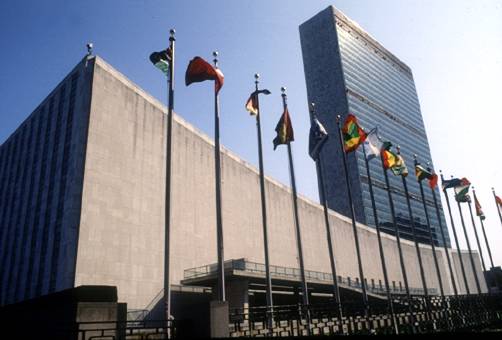
Extraordinary Hypocrisy: The United Nations headquarter in New York City.
 
When a prominent politician from the United States, the nation which, in complete contravention of the UN Charter, launched a full-scale military invasion of Iraq, shamelessly castigates the Russian President, Vladimir Putin, for “violating Ukraine’s national sovereignty”, one struggles to muster any kind of respect for the existing international system.
 
Indeed, one wonders (heretically) whether the world might not be better off if the number of nation states belonging to the United Nations (currently 193) was significantly reduced. With the benefit of hindsight, isn’t it at least arguable that the much-vaunted principle of “national self-determination”, far from making the world a more peaceful place, has actually increased the incidence of organised violence?
 
In a similar vein, wouldn’t it be a lot easier to respond to global crises, such as anthropogenic global warming, if humanity was aggregated into larger, rather than smaller, political units? If it’s possible to construct banks and corporations that are “too big to fail”, might it not also be possible to create states that are “too big to lose”?
 
And where nations are embroiled in bitter conflict, as in the Middle East, shouldn’t it be acknowledged, honestly, by nations outside the region, that war may be the only effective means of re-arranging the pieces on the board?
 
Even more heretically, should we not ask whether nation states are even the most sensible solution to conflicts whose origins lie not in ethnicity or geography but in matters of religious doctrine?
 
Certainly, it is the view of James Traub, from the Centre for International Co-Operation, that what we are witnessing in the Middle East is not a “clash of civilisations”, but clashes within a civilisation. The war, argues Traub, is “not between ‘us’ and ‘them’ but inside the Islamic world.”
 
Would the planet be better or worse off if the outcome of this war inside the Islamic world was the emergence of a political entity roughly akin to the open, tolerant and inclusive Abassid Caliphate that once stretched all the way from Baghdad, in what is now Iraq, to Tunisia? Such an outcome would have less to do with redrawing national boundaries than it would with redefining the way Muslims express their religion.
 
The rules governing the relationships between nation states, as elaborated by we Europeans, are, in part, the product of our own civilisation’s inability to resolve religious schisms. But, whether the conflicts currently tearing the Islamic world apart can be resolved by the principles enshrined the 1648 Treaty of Westphalia, which ended the Thirty Years War between Catholics and Protestants, is highly debateable.
 
Beyond dispute, however, is the role warfare has played throughout history in reconciling the irreconcilable and solving the insoluble. Sometimes, if peace is not in prospect, it pays to give war a chance. Alexander the Great didn’t unravel the impossibly complex Gordian Knot with his fingers. He used his sword.
 
This essay was originally published in The Waikato Times, The Taranaki Daily News, The Timaru Herald, The Otago Daily Times and the Greymouth Star of Friday, 13 February 2015.

Friday, 16 January 2015

Tolerance In Arms

Asserting The Right: To say 'I am!' When all around you are saying 'You are not!', is the true definition of power. As Thomas Mann so rightly said: "Tolerance becomes a crime when applied to evil."

IT HAS BEEN a hell-week for Tolerance. Tragic events in France and unspeakable atrocities in Nigeria have tested her followers’ fidelity to the limit. The temptation to condemn; to lash out in righteous anger; has been overwhelming.
 
“What kind of people”, we ask, “can justify gunning down a roomful of grandfatherly journalists and cartoonists? Or strap a bomb to the body of a ten year old girl and send her into the middle of a crowded marketplace?”
 
In responding to such questions others demand to know what kind of people could crowd grandfathers and ten-year-old girls into “showers” and drop deadly poisonous pellets of Zyklon-B on their heads?
 
Such responses are intended to remind us that cruelty and violence are not the sole preserve of Al Qaida, Islamic State or Boko Haram jihadists. That, within living memory, highly-educated Europeans set a bench-mark for cruelty and violence that has yet to be exceeded.
 
They should also remind us that fighting for and defending Tolerance is no job for pacifists.
 
Our fathers and grandfathers did not hesitate to condemn or lash out in righteous anger against the Nazi regime. On the contrary, they made war upon it until little was left of its German birthplace except bloody piles of rubble. At Nuremburg, in the name of Humanity itself, they put Nazism on trial and hanged its guilty leaders by their necks until they were dead.
 
There are some (thankfully a small minority) who compare the Islamic religion in toto with Nazism and demand from the nations of the West the same uncompromising determination to rid the world of a malign influence that was displayed between 1939 and 1945.
 
Fortunately, Tolerance’s grip upon the vast majority of Westerners is still strong enough to reject such annihilationist solutions. Simple common-sense tells us that the murderous jihadists whose crimes have dominated the headlines for the past ten days have as much to do with Islam as the cross-burning members of the Ku Klux Klan had to do with Christianity.
 
Every bit as much. Because isn’t it true that even though only a handful of white southerners actually wore the Klan’s hoods and robes, its terrorist exploits (most of which, right up until the late 1960s, went unpunished) could only take place in a social environment that made both the moral condemnation and/or legal conviction of the perpetrators unthinkable?
 
Those southern towns were as full of churches as the cities of the Middle East are filled with mosques. The hard truth remains that the Klan was only defeated as a powerful terrorist force when the people among whom it operated were no longer willing to justify its crimes or shield its members from the claims of justice. When those churches finally stopped turning a blind eye to terrorism, and their congregations finally stopped turning up to lynchings.
 
Tolerance is a militant goddess – never to be confused with acquiescence or clever apologetics. To end the reign of the Ku Klux Klan required not only the courage and sacrifice of Dr Martin Luther King’s non-violent civil rights campaigners; not only the steadfast support of defiant African-American communities; not only the solidarity and assistance of progressive Americans from all over the USA; but also the relentless interventions of the Department of Justice and the covert operations of the FBI.
 
Tolerance rejects the racist suggestion that the Islamic peoples are incapable of responding to the moral challenge of terrorism in the same manner as White Christians in the South eventually responded to it.
 
Tolerance charges us to not only familiarise ourselves with the fundamental tenets of Islam, but also to challenge openly the ways in which the message of the Prophet has been distorted and defiled by the murderous blasphemers and heretics who dare to march beneath his banner.
 
Tolerance knows that it is only when the body of the faithful rises in revolt against the Kings and Ayatollahs, the Presidents and Generals, whose personal and profane interests are served by the dissemination of a creed that knows nothing of submission or penitence or charity, that the true voice of the Prophet will once again ring out clearly across the lands of the faithful.
 
But, most of all, Tolerance knows that her great enemy, Intolerance, only ever triumphs when ordinary, decent people confuse doing the right thing with doing nothing.
 
This essay was originally published in The Waikato Times, The Taranaki Daily News, The Timaru Herald, The Otago Daily Times and The Greymouth Star of Friday, 16 January 2015.

Tuesday, 14 October 2014

If Kobane Falls?

Under Fire: The fate of the Syrian border-town of Kobane has assumed an international significance. Its capture by the forces of the Islamic State would be a serious blow to the West's collective resolve to degrade and ultimately destroy this new and extremely dangerous radical Islamist project.
 
IF KOBANE FALLS – or should that be when Kobane falls – a number of terrible things will happen. Any Kurdish soldiers found alive in the Syrian border town will be killed. For propaganda purposes some will be beheaded, their deaths recorded, and the video clips uploaded to the Internet. Young Shi’ite women will be rounded up and sent deeper into the Islamic State (IS) where many will find themselves being offered to IS soldiers as “brides”. Any professional women (doctors, nurses, teachers, lawyers) found in Kobane will face instant execution by the Islamic State pour encourager les autres. All facilities for the secular education of women will be closed.
 
If Kobane falls – or should that be when Kobane falls – the strategic and geographical coherence of the Islamic State will be greatly enhanced and their victorious forces re-deployed to apply what is likely to prove decisive additional psychological and military pressure on Iraqi forces battling the Islamic State’s advance into Anbar province.
 
If Kobane falls – or should that be when Kobane falls – the resolve of those Western nations pledged to degrade and destroy its aggressive military potential will be further weakened. Turkey, a NATO ally of the US and UK forces already engaged in Iraq and Syria, will face furious international condemnation for refusing to deploy the overwhelming strength of its armed forces in defence of Kobane’s Kurdish defenders.
 
If Kobane falls – or should that be when Kobane falls – many people in the West will observe that if the Syrian people’s nearest neighbour is prepared to sit on its hands and watch while thousands of soldiers and civilians are slaughtered or sent into sexual slavery, then why should nations thousands of kilometres from the fighting be expected to expend blood and treasure on their rescue?
 
If Kobane falls – or should that be when Kobane falls – New Zealand’s Prime Minister, John Key, and his Cabinet will be faced with some extremely difficult decisions. They must weigh very carefully the costs and benefits of committing elements of the New Zealand Defence Force (NZDF) to the international coalition currently battling the Islamic State. If they decide upon a military commitment (most probably in the form of personnel belonging to the NZDF’s elite Special Air Service) then how long should it be for, and under what circumstances might it be curtailed? Should New Zealand remain engaged if the seemingly unstoppable advance of the Islamic State prompts the armies of Turkey and Iran to intervene? With the boundaries of the entire Middle East being re-drawn, what business would New Zealand soldiers’ boots have on any part of its disputed ground?
 
If Kobane falls – or should that be when Kobane falls – what are young Sunni Muslim men and women living in New Zealand and other Western countries likely to make of yet another Islamic State victory? Will they (as we hope) recoil in horror at the brutal battlefield behaviour of their co-religionists? Or will at least some of them attempt the ethical calculus required to determine whether the beheading of a Western aid worker is more or less reprehensible than the “collateral damage” inflicted by an American Predator drone unleashing its Hellfire missiles on a Yemeni or Waziri village? And will those same young Muslims not wonder why Saudi Arabia, in which 57 people have been beheaded in the last year alone, has not merited the same expressions of international outrage as the Islamic State?
 
If Kobane falls – or should that be when Kobane falls – wouldn’t it be a good time to ponder the reasonably obvious fact that in the eyes of many young Sunni Muslims the Islamic State is not the dwelling place of monsters, but the one location in the Muslim world where corruption is ruthlessly rooted-out; where the administration of the law is given over to ordinary people pledged to uphold and enforce the traditions of their faith; where the State is not the enemy of ordinary people but their friend, extending to them not the iron fist of tyranny but the solicitous hand recommended by the Prophet; and where, to be a woman is not to be paraded as a lump of sexual meat, but as a precious vessel to be cherished and protected. Isn’t it time we in the West asked ourselves: just how likely is it that young Muslim men and women are leaving their families and their friends, travelling thousands of miles and hazarding their freedom, their lives, their very souls – for monsters? Internationally acclaimed expert on the funding of terrorism, Loretta Napoleoni, has already asked herself this question. Her conclusion: “It’s not.”
 
The question New Zealanders should now be asking themselves is whether the fight against the Islamic State is their fight? Ethically, militarily, diplomatically and politically – what  should we do if Kobane falls?
 
Or should that be when Kobane falls?
 
This essay was originally published in The Press of Tuesday, 14 October 2014.

Sunday, 23 September 2012

Tolerating Islam

Meetings Of Minds: In the great trading cities of Baghdad, Damascus and Cairo, Islamic civilisation florished for close to 300 years. How did a culture once synonymous with tolerance and learning become so closely associated with violence and fanaticism?

THERE WAS A TIME when tolerance, compassion and the search for enlightenment were the singular virtues of Islam. When the peoples of Christendom still bent their knees to brutal mounted warriors, and the Papacy was little more than a trophy for the corrupt inheritors of Rome’s decaying grandeur, Islamic civilisation was the wonder of the world.

In the space of barely three centuries the followers of the Prophet Mohammed blended the best of the classical era’s legacy with the strict moral discipline and judicious social organisation of the Islamic faith.
 
In the Muslim Caliphate, which stretched from the Euphrates River to the Rock of Gilbraltar, Muslims, Christians and Jews co-existed in relative harmony. In return for a modest tax, the adherents of non-Islamic faiths were allowed to live in peace. In this tolerant environment scholars and craftsmen were encouraged to extend the boundaries of knowledge and technology. The resulting cultural flowering, subsidised by the immense wealth of the Caliphate’s trading centres, ushered in a golden age. Islamic merchants and traders dominated the exchange of the raw products of Europe and Africa for the finished goods of China and India.
 
Indeed, it might almost be said that the military and economic success of Islamic civilisation was the goad that drove Christendom to embark on its epic voyages of exploration, its exploitation of Africa and the Americas, and the rapid development of the mercantile and industrial expertise which ultimately permitted the peoples of Europe to dominate the planet.
 
Westerners all-too-easily forget that when Christopher Columbus set sail from Palos de la Fonterra on 3 August 1492, the Eurasian landmass was dominated by two vast super-powers: the Ottoman and Chinese empires. The kingdoms and principalities of Christendom were bit-players.
 
The beliefs and institutions we prize most highly: the essential equality and “inalienable rights” of all human-beings; the primacy of reason and the scientific method over religious faith and “primitive” superstition; our democratic system of government, within which, alone, human equality and individual liberty, especially the freedom of expression, can hope to survive; all are the product of the West’s relatively brief (300 years) sojourn as global hegemon.
 
But all around us are signs that the era of Western hegemony is waning. Islam has become the vector of its decline – and we have no one to blame but ourselves.
 
From the First Crusade of 1096-99 to the Sykes-Picot “Agreement” of 1916, Westerners have disposed of the lands of Muslim peoples with breath-taking arrogance. The latter’s singular misfortune to live on top of the world’s most productive oil fields has only whetted the West’s appetite for domination. A resource which could have led to the flowering of a new golden age of Islamic civilisation has been sequestered for the United States and its allies by a vicious congeries of kleptomaniacal kings, sultans, emirs and military strongmen – all watched over by the garrison state of Israel.
 
Are we truly surprised that the West’s history of invasion, occupation and exploitation in Muslim lands has armed the most regressive and murderous interpreters of Mohammed’s message? What chance had moderation in the face of Western imperialism? Who else but the Wahabbists, Salafists and Jihadis were likely to benefit from the depredations of the Western powers?
 
While these extremists batter at the gates of the West: pronouncing fatwas on novelists, murdering artists and, as we have seen over the past fortnight, attacking US embassies and clamouring for the head of the film-maker responsible for the risible Innocence of Muslims; the cultural confidence of the West, its adherence to Enlightenment values, has already given way. Post-imperial guilt has given birth to the pernicious cultural relativism of post-modernism, and transformed the intellectual guardians of the West’s egalitarian and libertarian traditions into militant Islam’s fifth column.
 
Within the space of twenty years, the world will likely witness the ratification of a United Nations’ international convention, sponsored by the United States and its allies, outlawing the defamation and/or scandalising of the world’s faith communities. Once adopted by national legislatures, it will be a crime to write a novel like Salman Rushdie’s The Satanic Verses, or make a film like Martin Scorsese’s The Last Temptation of Christ.
 
Let this paraphrase of W. B. Yeats’ The Second Coming be Freedom of Expression’s epitaph:
 
The best lacked all conviction, while the worst
Were full of passionate intensity.
 
This essay was originally published in The Waikato Times, The Taranaki Daily News, The Timaru Herald, The Otago Daily Times and The Greymouth Star of Friday, 21 September 2012.

Friday, 29 June 2012

Islam And Democracy

Representative Of The People: Egypt's new President, Mohammed Morsi, candidate of the Muslim Brotherhood, has been hailed as that country's first democratically elected leader. But early Islamic history manifested a strong impetus towards political representation and equality within the community of the faithful. The great hope of the so-called "Arab Spring" is that these traditions will undergo a powerful revival.

IS MOHAMMED MORSI Egypt’s first democratically elected leader? Though many journalists are insisting he merits that distinction, it’s just possible the journalists may be wrong.

Among the first peoples to be conquered by the followers of the Prophet Mohammed, Seventh Century Egyptians discovered earlier than most that membership of the community of the faithful (the Ummah) conferred radical new rights. Among the most important of these was the right to elect representatives. These upright citizens (the Shura) were, in their turn, collectively charged with determining upon whose shoulders the responsibility for leading the peoples of Islam should fall.

The chosen one, known as the Caliph, was of necessity both a religious and political leader. Islam, unlike Christianity, draws no clear distinction between the things that belong to Caesar and the things that belongs to God. The Caliphate, at least in its original form, was, therefore, a proto-democratic republic of faith, ruled over by a person in whose supreme office the powers of President and Pope were combined. It’s at least arguable that, fourteen hundred years ago, Mr Morsi had a predecessor.

Given the political traditions of the era, it is hardly surprising that the Caliphate became the prize of a succession of dynasties. Even so, the core religious-political principle of the fundamental equality of all believers made possible the dazzling and extraordinarily tolerant culture of Islam’s “Golden Age” (750-1250 AD).

The Great Mosque of Cordoba, in Spain. In the islamic Golden Age (750-1250 AD) the best scientific minds were to be found in Egypt, Syria and Iraq.

Weakened by successive Christian assaults from the West (the Crusades) the Abbasid Caliphate was finally laid low in 1258 by the Mongol armies of Genghis Khan. The West, however, had reason to be grateful that before the beautiful cities, towering mosques and celebrated universities were destroyed, most of the scientific, mathematical, medical and philosophical achievements of Islamic civilisation had already, by fair means and foul, passed into the hands of Christendom.

Though the Caliphate would rise again under the Ottoman Turks, it would never again attain the extraordinary confidence and poise of Islam’s golden age. Hugely impressive (not to mention militarily dominant) though the Ottoman Caliphate may have been, there was something missing. That vital spark which had lit the fires of creation and inquiry for so long was, for some reason, no longer being struck.

Scholars of Islamic history called that missing spark ijtihad – the spirit of independent reasoning. Today, we’d call it critical thinking. The loss of confidence which followed the slaughter and devastation of the Mongols, combined with the authoritarian military-bureaucratic culture of the Ottomans, saw ijtihad replaced by taqlid – reliance on the tested, following established practice, deferring to the teachings of those who had come before.

At the same moment that the knowledge passed to Christendom began fostering the intellectual forces that would result in the Renaissance, the Reformation and the Enlightenment, the Islamic world was beginning its slow but remorseless decline into insularity and orthodoxy.

The real question to be asked about the so-called “Arab Spring” is whether or not it signals a reaffirmation of the fundamental equality of all believers, and a rebirth of the democratic spirit of the shura? If so, then the world can hope that the spirit of independent thought, of ijtihad, will similarly be born again and the Islamic world will recapture the glories of its golden age.

But, if the revolts taking place across the Middle East end up being hijacked by the upholders of taqlid: if Mr Morsi and his Muslim Brotherhood are only interested in the re-establishment of orthodoxy and the extinguishing of freedom, then spring will become winter and the Ummah will, once again, be robbed of the summer they deserve.

As we watch these events unfold across the Islamic world, we should resist the temptation to celebrate our historical escape from the clutches of taqlid. The global financial crisis harrowing the West may not mirror the mayhem of the Mongols, but all around us there is evidence of a very similar loss of confidence and intellectual agility.

Looking at our own caliphs, are we struck by their ability to engage in independent reasoning and creative thinking? Or have they, too, fallen victim to the false promises of orthodoxy?

What now lies before the West: a golden light, or gathering darkness? In the words of the Fifteenth Century Syrian scholar, Ahmad ibn Arabshah: “If the future is hidden, yet you should guess it from the past.”

This essay was originally published in The Otago Daily Times, The Waikato Times, The Taranaki Daily News, The Timaru Herald and The Greymouth Star of Friday, 29 June 2012.