
Showing posts with label Jerry Collins. Show all posts

Tuesday, 23 June 2015

"Home Town Boy": What Jerry Collins’s Homecoming Can Teach The Left About Pasifika New Zealanders.

From Inspiration To Aspiration: Not everyone can feint and side-step like Jerry Collins, but in those moments of transcendent sporting artistry for which he will long be remembered, he has inscribed an irresistible invitation to every young Pasifika man and woman: “You, too, can be this good!”
 
IT LOOKED SPONTANEOUS, but it wasn’t. Crowds numbering in the thousands very seldom appear without a lot of behind the scenes preparation. And when Jerry Collin’s body returned to Porirua last Sunday, it seemed as if half the city had turned out to welcome their fallen rugby hero home.
 
It was the same today [17 June 2015]. Te Rauparaha Arena was filled to its 4,000-seat capacity for Collins’s funeral service. Rugby greats of both the past and the present; including Jonah Lomu and All Black Captain, Ritchie McCaw; were there to pay their respects. Porirua’s ambitious young Mayor, Nick Leggett, spoke too, but briefly. More than happy to let the huge crowd speak for itself, Leggett simply noted that Collins was “a home-town boy at heart”.
 
The rugby field was always the place where Collins spoke the loudest, but, in the extraordinary outpouring of love, grief and pride at his tragic death, he has bequeathed to those with sufficient wit to interpret it, an important message about what moves and inspires Pasifika people in New Zealand.
 
Because the thousands of Pasifika men and women, boys and girls, who have, in recent days, filled their city’s streets and stadia, are the same people European political scientists and commentators have in mind when they talk, glibly, about the “Missing Million” voters.
 
It’s not a kindly designation. Those who, though eligible to vote, decline to do so are, more often than not, dismissed as inferior citizens. Their political inertia is explained away by the deleterious effects of poverty and cultural marginalisation. They are deemed to be suitable cases for treatment; targets for education programmes; the problem children of a political system under pressure.
 
And yet, in the space of a few days, these same “inert” citizens, utilising the social institutions that still count for something in their lives: schools; church groups: rugby clubs; were able to organise a demonstration of love and pride that stunned the nation.
 
There were some who found it all vaguely de trop: the man was, after all, only a rugby player. “For God’s sake – it’s not as if he cured cancer!” For others, it was touching proof of the essential innocence of Pasifika culture. “Oh, how marvellous! Just look at those hand-made banners. He obviously meant so much to them!”
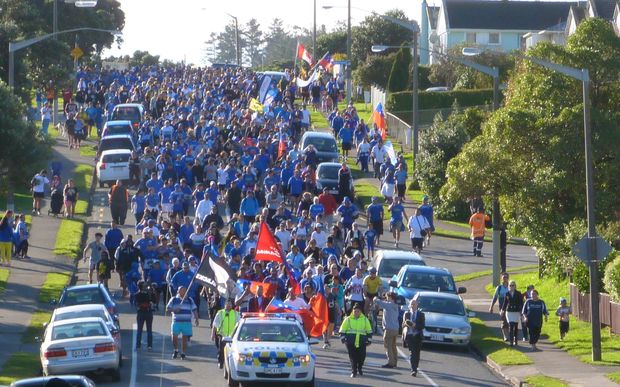
 
"Home Town Boy At Heart": Jerry Collins's homecoming was about so much more than rugby.
 
Such misjudgements only reinforce the need to more fully (and accurately!) decode the meaning of Porirua’s response to Jerry Collins’s death. Clearly, this was about so much more than rugby.
 
For all immigrant communities there are vectors of escape. For some, the primary route to participation and acceptance in the dominant culture is education. For others, it is service in the military. For a great many more, however, both here in New Zealand and around the world, sport is by far the most effective vector for escaping the constraints of subordinated immigrant societies.
 
But sport offers more than mere escape. Unlike education, which all-too-often removes the escapee from the cultural milieu in which he or she was raised, sport provides its success stories with multiple opportunities to “give something back”. This may be as simple as giving the fans superlative displays of sporting skill and flair. But it can also include mentoring up-and-coming players, coaching local or national teams, and providing that all-important “role model” for the young and aspirational.
 
Jerry Collins contributed at all these levels and was recognised as having done so by the community in which he grew up. This could only burnish his status as a local hero. Not only had he proved himself in the European world (including faraway France!) but, as he was doing so, he had remained, in Leggett’s words, “a home-town boy at heart”.
 
A son of Samoa, a son of Porirua, a son of New Zealand – living proof that to be born Pasifika is no obstacle to greatness.
 
It was for this that they turned out in their thousands to honour Jerry Collins’s homecoming. For the living proof he provided that ethnicity is not destiny; that it is a good thing to aspire to greatness; and that it is an even better thing to achieve it.
 
For left-wing European politicians this is the crucial message – though not all of them will recognize, and even fewer will welcome, it. That Pasifika people neither see themselves, nor are they happy to be treated as, victims. That, even more importantly, they do not see the exercise of the franchise as a primary, or even a particularly effective, vector of escape. The European working-class constructed a political party and used it to lever themselves out of poverty and into relative affluence. Pasifika people appear to be engaged in blazing a very different trail to the future.
 
Much of it is about community. More of it than is any longer the case with European New Zealand is about spirituality. But most of it seems to be about hope and the power of good examples. Not everyone can feint and side-step like Jerry Collins, but in those moments of transcendent sporting artistry for which he will long be remembered, he has inscribed an irresistible invitation to every young Pasifika man and woman:
 
“You, too, can be this good!”
 
This essay was originally posted on The Daily Blog of Thursday, 18 June 2015.

Thursday, 11 June 2015

Ropes of Sand: Honouring The Memory Of Peter Conway - Trade Unionist.

A New Zealander Worth Remembering: Peter Conway was a man whose efforts in the cause of social justice touched the lives of a huge number of New Zealanders; a man who will be remembered and mourned by clothing workers and shop assistants, truck drivers and storepersons. Of him, the employers’ organisation, Business New Zealand, said: “Peter was an industrial leader of the highest integrity and his passing is a sad loss to New Zealand.”
 
THIS IS HOW IT IS NOW. This is the country we’ve become. These are New Zealand’s priorities – even in the grim business of honouring the dead.
 
A man, his wife and baby daughter, travelling by car along a French highway, are reported to have veered into the path of an oncoming truck. In the ensuing collision, the man and his wife are killed and their baby seriously injured.
 
There is no other word for this bare summary of facts except tragedy. To the family and friends of the deceased is owed the sympathy of all decent and caring people.
 
Except that the victim of this tragic traffic accident was something more than just a man – he was a former member of the All Blacks – New Zealand’s world-beating rugby team. And that is why, for the past three or four days, the country’s newspapers have given this story saturation coverage. The life story of Jerry Collins, his history with both the Hurricanes provincial rugby team and the All Blacks, is related in lavish detail, with considerable empathy and undoubted pride. When his body arrives back in New Zealand, Jerry Collins funeral service will attract thousands of mourners.
 
An 80-year-old lawyer dies following a six year struggle with prostate cancer.
 
Once again, all decent people will acknowledge a life lived well, and with considerable success in the nation’s courtrooms, and express their deep regret at his passing.
 
Except this man was no ordinary lawyer, but the defender of some of New Zealand’s most notorious criminals. Sir Peter Williams QC was the barrister for Ron Jorgesson, the Bassett Road machine-gun murderer, and Terry Clark – a.k.a “Mr Asia”. He also defended Arthur Alan Thomas, the man accused of, and then ultimately pardoned for, the murders of Harvey and Jeanette Crewe. President of the Howard League for Penal Reform for 30 years, Sir Peter was an outspoken critic of the way New Zealand treated the men and women it locked up. A bon vivant and wicked raconteur, he will be remembered as one of this country’s most colourful legal practitioners.
 
We know all this because, aware of the seriousness of his illness, the nation’s newspapers had prepared fulsome obituaries to mark his passing.
 
A trade union leader loses his battle with acute depressive illness.
 
In the NZ Herald of 10/6/15 the death of Peter Conway, former Secretary of the New Zealand Council of Trade Unions – at over 300,000 strong, this country’s largest voluntary organisation – merited precisely 63 words.
 
More than 30 years devoted to improving the lives, wages and working conditions of tens-of-thousands of New Zealand workers was considered unworthy of even a photograph. The stories of how he campaigned alongside the British miners in their doomed struggle against the government of Margaret Thatcher; or, how he organised scores of young New Zealanders to travel to the socialist republic of Nicaragua in the early 1980s to pick coffee under the banner of “The Harry Holland Brigade”; neither of these warranted a mention. Nor did the fact that in his 40s he went back to university to attain a master’s degree in economics – the better to defend the interests of working people against the bosses’ apologists. That he was a fine singer and accomplished player of both the guitar and mandolin was, likewise, left out of the tiny side-bar story.
 
Peter Conway was a man whose efforts in the cause of social justice touched the lives of a huge number of New Zealanders; a man who will be remembered and mourned by clothing workers and shop assistants, truck drivers and storepersons. Of him, the employers’ organisation, Business New Zealand said: “Peter was an industrial leader of the highest integrity and his passing is a sad loss to New Zealand.” The Greens co-leader, Metiria Turei, recalled that: “As Secretary of the Council of Trade Unions, Peter could still be found running a picket line at 3 in the morning, he never shirked the hard work, and never stopped fighting for a fairer New Zealand.” And, of his friend and comrade, the former Secretary of the EPMU – now leader of the Labour Party – Andrew Little said, simply: “He was a good man and he will be held in the hearts of the labour movement.”
 
None of these tributes were considered worthy of quotation by the NZ Herald, and, to be fair, by most of the rest of the mainstream news media. Because, when all is said and done, Peter was not an All Black, nor a renowned barrister – he was a trade unionist.
 
The coverage of this fine New Zealander's death recalls to mind the following verses by James K. Baxter, which seem to have been written for just such a man as Peter Conway:
 
The man who talks to the masters of Pig Island
About the love they dread
Plaits ropes of sand, yet I was born among them
And will lie some day with their dead.
 
 
This essay was originally posted on The Daily Blog of Wednesday, 11 June 2015.