Showing posts with label Nick Leggett. Show all posts

Tuesday, 16 August 2016

Dangerous Company: Andrew Little Quarantines The Labour Right.

Dark Horse: The ambitious Napier MP, Stuart Nash, has his own impressive connections to the power elite. This is, after all, the man who financed practically the whole of his campaign for the Napier seat with a Matthew Hooton-organised fund-raising dinner at Auckland’s exclusive Northern Club. The contrast between Nash’s fund-raising skills and those of the impoverished, Little-led Labour Party is not a flattering one.
 
ANDREW LITTLE’S DECISION to ban Stuart Nash from sharing a platform with Wellington Mayoral hopeful, Nick Leggett, is instructive. First of all, it tells us that Little and his supporters are still very frightened of the Labour Right. Though by no means a majority of either the parliamentary caucus, or the party, Labour’s right wing constitutes a large enough minority to fatally injure Labour’s re-election chances if it feels so inclined. Secondly, it tells us that Little and his supporters lack the confidence to engage the likes of Leggett (or Phil Quin, or Josie Pagani) in free and open political debate.
 
Little, with a great deal of help from his chief-of-staff, Matt McCarten, has spent the last 18 months convincing caucus members of every ideological stripe that disunity is death. They point to the way the left of the party undermined the leadership of David Shearer, and how the right of the caucus repaid them by undermining the leadership of David Cunliffe. Their contention, that such behaviour simply had to stop, was supported by all those MPs who longed to escape the impotence of Opposition – i.e. every single one of them.
 
So why, given his undoubted success in dampening-down the fractious factions of both the Labour caucus and the wider party, did Little feel obliged to lower the boom so publicly on the head of Stuart Nash?
 
Clearly the campaign team behind the Labour-endorsed candidate for the Wellington Mayoralty, Justin Lester, had a hand in his decision. They are only too aware of the political clout of the people backing Leggett’s campaign, and of the sheer volume of the money that keeps rolling in for the former Porirua Mayor. They are also rattled by Leggett’s winning ways. There is more than a little of Mike Moore’s populist style in Leggett’s political demeanour (not something you can say about Justin Lester’s). Little was goaded to action by a combination of fear and spite. Not a good look.
 
Leggett’s ready access to the networks of power, influence and money, coupled with his backers’ plan to have him share a platform with Nash, would also have reminded Little and his team of the ambitious Napier MP’s own impressive connections to the power elite. This is, after all, the man who financed practically the whole of his campaign for the Napier seat with a Matthew Hooton-organised fund-raising dinner at Auckland’s exclusive Northern Club. The contrast between Nash’s fund-raising skills and those of the impoverished Labour Party is not a flattering one.
 
In such circumstances, it is easy to see how Little and his supporters might fall prey to the notion that Nash and his kind constitute a right-wing “Labour Party-in-waiting” with all manner of helpful friends in the business community, PR circles and the news media. Friends who, given the “right” line-up on Labour’s front bench will be quick to offer all kinds of helping hands.
 
The dangerously accurate sniper-fire kept up against the Little-led Labour Party by the likes of Josie Pagani and Phil Quin (key movers, along with Leggett, in a plan to form a New Zealand-based political think tank modelled on those advising the Blairite wing of the British Labour Party) can only have contributed to the siege mentality so obviously gripping the Leader of the Opposition’s office. Particularly galling for the Labour leadership is the fact that their critics, having allowed their membership of the Labour Party to lapse, are in no way subject to its discipline. As regular guests on The Nation and Q+A, they can articulate their critique of Little’s electoral strategy with impunity.
 
The only effective way to combat the undoubted influence of Leggett, Quin, Pagani (and Nash?) within the Labour Party is to confront them head-on. If it is not possible for them to counter their opponents’ “Third Way” ideology in open debate, then Little and his team must either plead guilty to being woefully ineffectual democratic socialists, or, to secretly subscribing to exactly the same strategic objectives as the Labour Right.
 
Leggett openly proclaims his conviction that: “You have to occupy the centre, and you have to appeal to a broad base of New Zealanders, and for Labour to win they’ve got to be as big as National … They’ve got to be a 40% plus party.”
 
Frankly, it’s difficult to believe that becoming “as big as National” is not also Little’s prime electoral objective. And, if that’s correct, then the real reason for his refusal to allow Nash to share a platform with Leggett is that Little does not want the left of the party to realise that the true extent of Labour’s ambition is no greater than the goal of its unreconstructed right-wing: “to occupy the centre”.
 
This essay was originally posted on The Daily Blog of Saturday, 13 August 2016.

Tuesday, 23 June 2015

"Home Town Boy": What Jerry Collins’s Homecoming Can Teach The Left About Pasifika New Zealanders.

From Inspiration To Aspiration: Not everyone can feint and side-step like Jerry Collins, but in those moments of transcendent sporting artistry for which he will long be remembered, he has inscribed an irresistible invitation to every young Pasifika man and woman: “You, too, can be this good!”
 
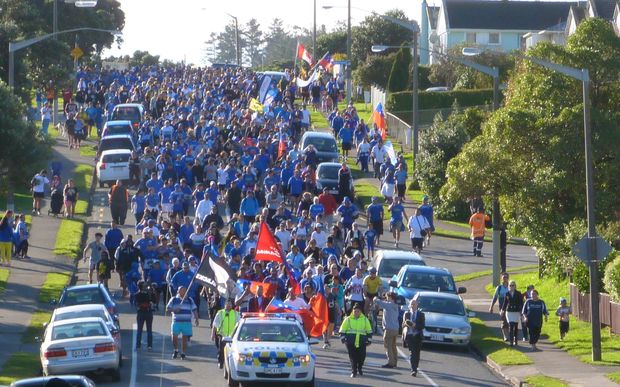
IT LOOKED SPONTANEOUS, but it wasn’t. Crowds numbering in the thousands very seldom appear without a lot of behind the scenes preparation. And when Jerry Collin’s body returned to Porirua last Sunday, it seemed as if half the city had turned out to welcome their fallen rugby hero home.
 
It was the same today [17 June 2015]. Te Rauparaha Arena was filled to its 4,000-seat capacity for Collins’s funeral service. Rugby greats of both the past and the present; including Jonah Lomu and All Black Captain, Ritchie McCaw; were there to pay their respects. Porirua’s ambitious young Mayor, Nick Leggett, spoke too, but briefly. More than happy to let the huge crowd speak for itself, Leggett simply noted that Collins was “a home-town boy at heart”.
 
The rugby field was always the place where Collins spoke the loudest, but, in the extraordinary outpouring of love, grief and pride at his tragic death, he has bequeathed to those with sufficient wit to interpret it, an important message about what moves and inspires Pasifika people in New Zealand.
 
Because the thousands of Pasifika men and women, boys and girls, who have, in recent days, filled their city’s streets and stadia, are the same people European political scientists and commentators have in mind when they talk, glibly, about the “Missing Million” voters.
 
It’s not a kindly designation. Those who, though eligible to vote, decline to do so are, more often than not, dismissed as inferior citizens. Their political inertia is explained away by the deleterious effects of poverty and cultural marginalisation. They are deemed to be suitable cases for treatment; targets for education programmes; the problem children of a political system under pressure.
 
And yet, in the space of a few days, these same “inert” citizens, utilising the social institutions that still count for something in their lives: schools; church groups: rugby clubs; were able to organise a demonstration of love and pride that stunned the nation.
 
There were some who found it all vaguely de trop: the man was, after all, only a rugby player. “For God’s sake – it’s not as if he cured cancer!” For others, it was touching proof of the essential innocence of Pasifika culture. “Oh, how marvellous! Just look at those hand-made banners. He obviously meant so much to them!”
 
"Home Town Boy At Heart": Jerry Collins's homecoming was about so much more than rugby.
 
Such misjudgements only reinforce the need to more fully (and accurately!) decode the meaning of Porirua’s response to Jerry Collins’s death. Clearly, this was about so much more than rugby.
 
For all immigrant communities there are vectors of escape. For some, the primary route to participation and acceptance in the dominant culture is education. For others, it is service in the military. For a great many more, however, both here in New Zealand and around the world, sport is by far the most effective vector for escaping the constraints of subordinated immigrant societies.
 
But sport offers more than mere escape. Unlike education, which all-too-often removes the escapee from the cultural milieu in which he or she was raised, sport provides its success stories with multiple opportunities to “give something back”. This may be as simple as giving the fans superlative displays of sporting skill and flair. But it can also include mentoring up-and-coming players, coaching local or national teams, and providing that all-important “role model” for the young and aspirational.
 
Jerry Collins contributed at all these levels and was recognised as having done so by the community in which he grew up. This could only burnish his status as a local hero. Not only had he proved himself in the European world (including faraway France!) but, as he was doing so, he had remained, in Leggett’s words, “a home-town boy at heart”.
 
A son of Samoa, a son of Porirua, a son of New Zealand – living proof that to be born Pasifika is no obstacle to greatness.
 
It was for this that they turned out in their thousands to honour Jerry Collins’s homecoming. For the living proof he provided that ethnicity is not destiny; that it is a good thing to aspire to greatness; and that it is an even better thing to achieve it.
 
For left-wing European politicians this is the crucial message – though not all of them will recognize, and even fewer will welcome, it. That Pasifika people neither see themselves, nor are they happy to be treated as, victims. That, even more importantly, they do not see the exercise of the franchise as a primary, or even a particularly effective, vector of escape. The European working-class constructed a political party and used it to lever themselves out of poverty and into relative affluence. Pasifika people appear to be engaged in blazing a very different trail to the future.
 
Much of it is about community. More of it than is any longer the case with European New Zealand is about spirituality. But most of it seems to be about hope and the power of good examples. Not everyone can feint and side-step like Jerry Collins, but in those moments of transcendent sporting artistry for which he will long be remembered, he has inscribed an irresistible invitation to every young Pasifika man and woman:
 
“You, too, can be this good!”
 
This essay was originally posted on The Daily Blog of Thursday, 18 June 2015.