Showing posts with label Seventies Pessimism. Show all posts

Monday, 30 April 2012

Seventies Nostalgia: Song From 1974

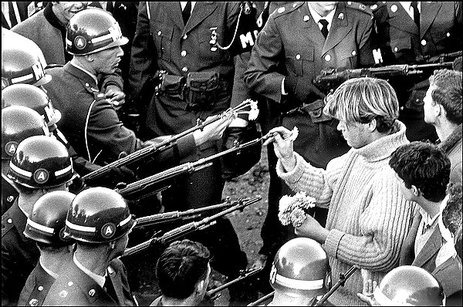
We offered arrogance the virtues of the flower

The Faithful And The True

On the streets of sublimation
Where the scholars make their home,
We came in search of bread
But they left us with a stone.
Engaged in argument of
Pointless points of view,
They offered nothing to
The Faithful and the True.

In the suburbs of the affluent,
In the gardens of the good,
We sang of love and life
But no one understood.
The sirens of the squad-cars
Were the only songs they knew.
They issued warrants for
The Faithful and the True.

In the fortresses of influence,
In the corridors of power,
We offered arrogance
The virtues of the flower.
But the judge's fatal verdict
Sent the soldiers clad in blue
To carry out the sentence on
The Faithful and the True.

On the sidewalks of oblivion,
In the ghettoes of despair,
The few of us who had survived
pretended not to care.
Just litter in the gutter
On the crowded avenue,
And no one there has time to care for
The Faithful and the True.

Chris Trotter
1974

Thursday, 26 April 2012

The Journey: A Political Memoir. Posting No. 2

In One Hand He's A Golden Coin: Before audiences of thousands, Muldoon cast himself in the role of economic saviour. To the anxious inhabitants of suburbia he promised "New Zealand the way YOU want it" - and on Saturday, 29 November 1975 "Rob's Mob" dutifully swept Bill Rowling's government from power - exactly reversing the Labour landslide of 1972.

It was supposed to be a book about the birth of the NewLabour Party, but somewhere along the way it became the story of what led me into, and out of, the old Labour Party. In hopes of providing future political studies students with a glimpse of what it was like to be a left-wing Labour activist in the days of David Lange and Roger Douglas I am publishing The Journey on Bowalley Road as a series of occasional postings. L.P. Hartley wrote: “The past is a foreign country, they do things differently there.” May these memoirs, written in 1989, serve, however poorly, as my personal passport.


Saturday, 29 November 1975


MY DRINKING COMPANIONS were all old mates from school. Barry and Peter sat with me in my parent’s spacious living room drinking beer and watching the results flash up on the television screen. Labour was being murdered before our eyes and we simply couldn’t believe it.

I stepped out into the fresh air, reeling from a combination of shock and too much beer. Barton Avenue was its usual polite self. I turned and glared at the house next door. National Party president, George Chapman, and his family were not at home that night. I knew where they were. At the National Party headquarters it was already bedlam: Champagne, cheers and kisses all round – I had seen them on TV. I turned and looked towards the house on the right. No doubt Tom Maling, Deputy-Director of the SIS, was quietly celebrating, in a manner befitting an ex-colonial officer, the demise of Bill Rowling’s administration. His friends at the United States’ embassy would be very, very pleased.

How could it have happened? Just hours before, in bright sunshine I had walked with my family to the polling booth at Brentwood School. It was my first vote. Behind the screen I stared down at the ballot paper. One by one I crossed out every name except that of Ron Bailey, Labour’s candidate for Heretaunga. A pang of guilt had run through me as I scored out the name of the Values candidate. But then I remembered Norman Kirk: the cancellation of the Springbok Tour; the HMNZS Otago on its way to Mururoa; the face of Rob Muldoon as he preached to his cheering followers in the Upper Hutt mall. I remembered the ring around the moon. It had to be Labour.

Feelings of foreboding had shadowed me ever since Kirk’s death. Some months before the Election I had attempted to write a campaign song for the Labour Party; what emerged had frightened me:

Oh you who turn your faces
From the poet and the priest,
You are lost amongst the neon
Bloated by the feast.
And the man who shouts the loudest
Is bound to win the strife,
In one hand he’s a golden coin,
The other wields a knife.

And the Sons of Cain are howling
Like wolves beneath the moon.
“Oh when will it be time?”, they cry.
Their master answers: “Soon.”

At the home of the poet Alistair Campbell, just weeks before the election, Barry and I talked with the cream of Wellington’s intelligentsia about the political future of New Zealand. Lauris Edmond, Michael Volkerling, and a host of others talked quietly and authoritatively about the unacceptability of the little man from Tamaki.

Perched high on the Paekakariki cliffs, with the surf crashing relentlessly below and a fresh breeze blowing across Cook Strait off the distant peaks of the South Island, it all seemed so plausible. Seated uncomfortably on the floor of that crowded room I listened and hoped; and hoped and listened. Trevor Edmond, who had been the principal of my old secondary school, Heretaunga College, spoke to me reassuringly: “Don’t worry Chris”, he smiled, “a man like Muldoon is far too far to the right for the majority of New Zealanders. Labour will win.” My fears had subsided.

I returned to the living room. Bill Rowling was on the screen, speaking to a scrum of journalists on the steps of his Election Night headquarters. “New Zealand will have need of Labour again”, he said quietly, “and when she does, Labour will be ready.”

With tears in my eyes I picked up Barry’s guitar and sang the final chorus of my song:

The Sons of Cain are marching,
Before the dawn they bow.
“Oh when will it be time?”, they cry.
Their master answers: “Now!”

This posting is exclusive to the Bowalley Road blogsite.

Sunday, 7 March 2010

Seventies Pessimism: (Song from 1975)

Written in the months leading up to the General Election of 1975, The Sons of Cain was an attempt to put into words my feelings of deepening dread as the mood of the country swung inexorably to the right and all the bright hopes kindled by the election of the Third Labour Government in 1972 flickered and went out. The image is taken from the scene in Fritz Lang's Metropolis where the capitalist revellers welcome in the Whore of Babylon.

The Sons of Cain

We’ve traveled from the borderlands
Where few men dare to go.
We’ve scaled the heights of innocence,
Been blinded by the snow.
And now we cast a warning
Into your crowded stream.
For smoke drifts from the altars
And the silver sabres gleam.

And the Sons of Cain are howling
Like wolves beneath the moon
"Oh, when will it be time?", they cry
Their Master answers, "Soon."


Oh you who turn your faces
From the poet and the priest.
You are lost amongst the neon,
Bloated by the feast.
And the man who shouts the loudest
Is bound to win the strife.
In one hand he’s a golden coin,
The other wields a knife.

And the Sons of Cain are howling
Like wolves beneath the moon
"Oh, when will it be time?", they cry
Their Master answers, "Soon."


We hear the wailing of the damned
Imprisoned in the cells.
And we see the slaughter of the young
Below the broken bells.
Oh you who turn your faces,
You children of the dust;
If your living proves so tedious
Then die – die if you must.

For the Sons of Cain are marching,
Before the dawn they bow.
"Oh, when will it be time?", they cry
Their Master answers, "Now!"


Chris Trotter
1975

Tuesday, 30 June 2009

Seventies Pessimism (Poem from 1978)


Winter Sonnet

Dressed all in burgundy, so roughly swathed,
What does she seek, this pilgrim of the night?
Who startles winter revelers neon-bathed,
And meeting Victory, will call him Flight.

I meet her constantly in places drunk with lies,
Our speaking purged of all uncertainty.
As doubtful lust our faith and purpose tries
We laughingly salute each other’s frailty.

What blasts my soul that I do call it love,
And ache with every vacant hour I live?
No answers do I find in Powers above,
Nor Powers below do any answers give.

She is a dream that plagues my hours so.
Yet if I could to her each night I’d go.

Chris Trotter

Tuesday, 19 May 2009

Seventies Pessimism: Polemical Poetics 1978


This poem was submitted to the Otago University student newspaper Critic in lieu of the usual candidate’s "blurb" for election to the OUSA Executive. It conveys something of the oppressive political climate then prevailing under the authoritarian and deeply polarising National Government led by Rob Muldoon. The reference to Bert Walker and Frank Gill is to the two most reactionary members of Muldoon’s cabinet.


From a Blade of Grass the Lawn-Mower Missed


I

What can possibly be said in a space such as this?

The eyes of six-and-a-half thousand
Skimming through pages laid-out by half-a-dozen.

What can possibly be said by yet another student politician
Gold-fishing in the universal yawn?
Staining these pages with bitter union coffee,
Half an eye on the clock,
What can you possibly expect me to say
Students of Otago?

That I will kindle crimson fires
In the hearts and minds of Medical Students
Dissecting flesh as cold as the Leith’s winter stream?
Set ablaze the brows of English Majors
As they struggle through yet another
Of Donne’s ‘Holy Sonnets’?
Lay to rest the ghost of Machiavelli
Gibbering glibly in the boardroom upstairs?
What can I possibly say?


II

In the midst of Muldoon’s frigid reign
All policy is corrupt.
Who would be foolish enough
To make you promises?

In the land of Bert Walker and Frank Gill
All promises are best read as threats.

Suffice to say that we find shelter here:
Freed at last from Home and School,
Not yet incarcerated in the social zoo.
I seek to serve the cerebral few
Boxed in by the dumb ignorance
Of an aging Protestant town.

My fight is with the creeping tide of lies
That flows across Cook Strait,
That oozes from every pen
Scribbling for Internal Assessment,
That dribbles from every mouth
Urging acquiescence to the eyeless men
Whose hands still drip with the blood
of Africans, Chileans, Timorese.


III

Can I possibly have said all this;
Polemical poetics on a Tuesday afternoon
Half-an-hour before the next lecture?

Can he possibly have said it!

For reading this far you have my thanks.
If my words have found faint echoes among you
Deliver come election day
Politics into the hands of poetry.


Chris Trotter
1978

Friday, 17 April 2009

The Real "Guardians".

Harold Wilson addresses a May Day rally in Hyde Park.

More evidence that the 1970s were the historical pivot upon which the fortunes of 20th Century social democracy turned. Proof, too, of just how clear-sighted and brave a social-democratic leader must be to face down the real "guardians" of the capitalist state.

By March 1976, a month before his planned resignation, Wilson knew that there were serious plots against him. He had the evidence of his own eyes and ears – the deluge of smears and gossip that had accompanied the 1974 Government: the ‘private armies’ episode; rumours of coups; a number of known tip-offs, discussed above; others we must reasonably presume we have not heard of. He had received confirmation from Oldfield and Hanley that MI5 were involved and had already sent a message via Weindenfeld to the CIA; and on the next day, 11 February, he had heard of the 1968 Cecil King ‘coup plot’ from Lord Zuckerman. At this point, Wilson was the man in the William Burroughs aphorism, the paranoid who really was the only one who knew what was going on. More, he had a problem: what could he actually do about it? The people who should investigate such things for the PM, MI5, were at the centre of the plots …..

….. Wilson embodied the radical end of the wartime social contract, which not only saw that a dynamic mixed economy demanded a producers’ alliance, but also saw that such an alliance could not succeed with an ascendant City of London. The extraordinary hatred that Wilson provoked on the British right was not irrational: Wilson was a serious threat; he knew who the 'enemy within' actually was. And they knew he knew; ‘they’ – the banker in the City with the elder brother in MI6 and a cousin in the Army – ‘they’ knew that Wilson, virtually alone among Labour leaders of his generation, had pulled aside the whisps of mystification which hid the British Establishment and seen the power of finance capital at its heart.

Excerpts from Smear! Wilson & the Secret State by Stephen Dorril & Robin Ramsay. Published in Great Britain in 1991 by Fourth Estate Limited.*

* Long out of print, I obtained my copy of this excellent piece of left-wing research courtesy of the Inverclyde Libraries, from whose collection, a large stamp rather ominously informed me, the book had been WITHDRAWN.

Seventies Pessimism (Fragment of a letter from December 1977)


LATE Thursday evening, approaching midnight, though Fergusson Drive still crowded with cars. This island never sleeps. Full moon giving the sky an unnatural brightness. Not a breath of wind.

This street on the right side of the road. Heretaunga, twenty miles out of Wellington. Old, established, oozing money and self-satisfaction. Home of businessmen industrialists and their whores, the lawyers and accountants.

Been here now for over a month. A lonely bird in a gilded cage. Miss the old town and the faces in it. Aching for A.

Writing to you now. Doesn’t do to neglect old friends. Caught up in the ego-race last year – kinda lost touch. We all make mistakes.

Your ideas are old-fashioned, definitely not hep, but sorta admirable in the burned out remains of our culture. Time for a prophet, no doubt. Someone to throw the money-changers out of the temple. Sure. But whose got that sort of magic up his sleeve these days?

We are dealing with forces beyond our comprehension.

The Lord of the Night has spread his cloak wide and the Sun itself is on the defensive. Black holes sucking the light out of the universe. The Powers of Darkness definitely on the offensive. Arab/Japanese cloak-and-dagger deals behind closed doors. Baader-Meinhoff unleashing fire and slaughter, even as they die.

Bad magic W. Powerful spells.

The Wizard must know – but what are we to do?

Back in the dark days of 1940 the witches and wizards of England met in the New Forest and raised the Cone of Power to repel the German invaders. The spell succeeded, but in casting it the Keepers of the Power destroyed themselves.

For, you see, there is no contest between Good and Evil. Evil has all the cards in his hands. To throw back the Nazis, English wizardry had to use its entire strength. Now the power of England is broken. Those that protected and fed the English flame for so long are spent, and the continent of Europe has finally retrieved her wayward islanders. Long live the EEC and German social-democracy!

You catch glimpses of it sometimes. The Plan. Unfolding itself with all the inevitably of Death, the Grim Reaper, striding heaven-high between clouds, and laughing like a thunder-storm.

On the journey North I travelled by night across the Canterbury Plains. And all along the spine of the island, flashing off the faces of the Alps, burned wildfire - leaping and flickering from mountain-top to mountain-top, shattering the darkness in glaring white bursts.

Fantastic!

Sent me back to my childhood in North Otago. Past and present running together. A living continuum.

And me, watching this awesome display, my nose pressed to the window of a Datsun 120Y. (Japanese car, Arab oil!) On my way North in the middle of the night. Heading for what is now my past. Towards this letter which will travel the path I followed backwards to you.

All linked W.

Everything.

Nothing done in isolation.

We’re all assigned our role. All play our parts.

And the Plan unfolds.

Thursday, 16 April 2009

The Guardians

Quis custodiet ipsos custodes? Who guards the guardians?


IT’S strange, the things we remember. For me, it’s the formative influence of an obscure television series, produced in 1971 by London Weekend Television for the private British broadcaster, ITV, and screened here a few years later by the NZBC. The name of the series was The Guardians.

Described by Mark Duguid of the British Film Institute as:

"A product of the new pessimism of the early 1970s, and reflecting that decade's key concerns - mass unemployment, spiralling inflation, chronic industrial unrest - The Guardians (ITV, 1971) is now largely forgotten, perhaps because relatively few viewers had the patience to see this lengthy, talky drama to its conclusion. For all its faults, however, the series is fascinating for its insights into the political ferment of its times, and for what now appears an unusual and bold attempt to present a drama of moral philosophy for a mainstream television audience."

The BFI website offers the following synopsis of the series’ plot:

"In a near-future Britain, the far-right government has declared a state of emergency and suspended elections. The Queen has fled in protest, while the defence of the state is in the hands of the Guardians, a paramilitary force with absolute power and a ruthless determination to stamp out resistance."

What made The Guardians so special for me, were the very attributes that rendered it so commercially unsuccessful. It was, indeed, very long and very "talky". More particularly, however, this "bold attempt to present a drama of moral philosophy", was a powerful study in the application of political ethics in extremis.

One scene in the drama remains forever seared into my memory.

The anti-government terrorist organisation, "Quarmby", has captured a young and idealistic member of the paramilitary "Guardians". Asked by his captors to put on record his reasons for joining the Guardians, the young man delivers a brutally eloquent speech in which he reaffirms the far-right government’s view that "democracy is a form of group suicide", and celebrates the opportunity provided by the state of emergency to force through long-delayed change – especially in relation to the environment. "At long last", he declares, "people are having to clean up their own shit!" At that moment, with the tape still running, and the young man still declaiming, one of the terrorists takes out a pistol and shoots him in the back of the head.

A couple of years ago I was invited by Sue Bradford to address a meeting of the North Shore Greens. In the Q&A session afterwards I was somehow reminded of that shocking scene from The Guardians – most likely in response to a comment about the almost insurmountable barriers to effecting urgent environmental change in a democratic political context.

With my tongue firmly lodged in my cheek, I recalled the 1970s television series and suggested that perhaps what the world needed was a force of "Green Guardians" – a paramilitary organisation comprised of "partisans of the planet"; people with sufficient coercive power to quite literally force individuals and corporations to "clean up their own shit". To my astonishment (and alarm) I saw many respectable North Shore heads nodding in agreement. One woman later rose to her feet and declared that she really liked the idea: "Green Guardians are exactly what we need!"

Green fascism? Is there a case to be made?

In the Great Britain of the early 1970s a rising sense of political unease pervaded the nation’s governing circles. Many believed the country was on the brink of ungovernability. Northern Ireland had already become an open wound, where all manner of extreme political solutions were being tested in the fight against terrorist violence. Of even greater concern to business leaders and the permanent civil service, however, was the seemingly unstoppable (at least by democratic means) power of the trade unions.

The Guardians ran from July until October 1971. In the ensuing eight years many of its plot-lines took on the appearance of prophecy. In 1973, faced with a crippling coal-miners strike, the Conservative prime minister, Edward Heath, asked the country to decide "Who governs?" – Parliament or the Unions? The answer came back: "The Unions!" People in high places began to contemplate a Guardians-style coup d’etat (Lord Louis Mountbatten was rumoured to be involved). In 1976, the Labour prime minister, Harold Wilson, resigned suddenly, amidst rumours of an MI5 plot. The decade ended with Margaret Thatcher ushering-in 11 years of extreme right-wing rule.

Desperate times had called forth desperate measures.

The NZ Greens (and green parties all over the world) are similarly convinced that what happens – or fails to happen – in the next five-to-ten years will determine the fate of civilised existence on this planet. As those years tick by, tremendous internal frustration will grow at the inability of the democratic process to address in any meaningful sense the global ecological crisis. The fear will be that by the time the effects of global warming and peak oil are serious enough to prompt a majority of the global electorate to swing its support behind green solutions, it will be much too late for them to have any effect.

Every passing election makes it increasingly clear that, with only 4-12 percent of the popular vote internationally, the greens can never be anything more than attractive window dressing for the non-ecological parties of the Left and the Right. Accordingly, the global green movement is faced with two, equally daunting, prospects. Green activists will either become disillusioned with politics altogether, and drift away into personal redemption and/or survivalism, or, they will embrace new and undemocratic means of forcing the ecological issue.

The friendly, all-things-to-all-people brand of "Green" may end up being replaced by a starker and more menacing brand, "Survive!" – a movement ready and willing to tap into the deeply embedded millenarian and apocalyptic mythos of the Judeo-Christian tradition – most probably by appropriating and/or adapting the excluding and annihilationist rhetoric of the far-right evangelical churches: "He who is not for me is against me".

With a global economic meltdown now overlaying the global ecological crisis, the number of voters willing to trade their personal freedom for collective security – democracy for survival – is only going to increase. As burgeoning rates of unemployment are echoed by rising sea-levels, and an increasing number of countries succumb to the economic equivalent of the advancing desert sands, the grimly prophetic words of The Guardians team of writers: "democracy is a form of group suicide" may come to sound more and more like political – and ethical – common sense.

This essay was originally published in The Independent of Thursday, 9 April 2009.