Showing posts with label Third Labour Government. Show all posts

Friday, 23 August 2019

Jacinda's Library

A Long Time Ago, In A Parallel Universe Far, Far Away: The political journalist scratched his head in confusion. Only then did he notice the name of the building: ‘The Jacinda Ardern Presidential Library and Public Resource Centre’. Making his way inside to the information desk, he asked the librarian for an explanation.

SOME COSMOLOGISTS SAY that ours is but one of an infinite number of universes. It’s a wild thought, because, if they exist, this infinity of parallel universes grants us an infinity of parallel lives. Whatever we can imagine ourselves doing has already been done, is happening right now, or will be done at some point in the future, in one of these alternate worlds. In this universe we may be powerless paupers, but elsewhere – in at least one of these parallel universes – we are kings.

How’s that for a comforting thought the next time you’re feeling down?

The idea that there are other worlds, adjacent to this one, is far from new. In the myths and legends of many cultures we find tales of people who left their homes on hum-drum errands, only to encounter mysterious beings who, in the twinkling of an eye, transported them to places of wonder and enchantment. When they return home, time itself seems to have been stretched and twisted. By their reckoning, their absences can only have lasted a few hours, but in the country they left behind, many years have passed. Loved ones have died, or grown old, and our baffled heroes pass, unrecognised, down streets that did not exist when they set out – only a day before.

All very Einsteinian (or should that be Schrodingerian?) but rest easy, there is a purpose to all this esoteric speculation.

Nowhere is the experience of contingency stronger than in the realm of politics. Politicians and political activists may live in this universe, but their heads and hearts are filled with the multiple worlds that could exist – if only the voters; the proletariat; the national community; were courageous enough to bring them into existence.

This multiplicity of possible worlds is often expressed in the musings of what are called “counterfactual” historians. How often have we heard someone pose the question – “What if?”

What if the Archduke Franz Ferdinand’s car had turned down another street in Sarajevo – instead of the one where his assassin, Gavrilo Princip, was eating his lunch?

What if JFK had toured Dallas in a standard – instead of an open-topped – presidential limousine?

What if Roger Douglas had been hit by a Wellington trolley-bus on his way to Parliament in 1983?

Whenever questions like these are posed, we sense the presence of alternate pasts: histories of worlds that might have been – but never were.

So now, arriving at the crux of the matter, I intend to pose a question of my own. A question which, simply by being asked, raises before us that shimmering membrane which separates the world as it is, from the world as it might be. A world that, even now, could break through the web of contingency – but only if the leaders of the Labour-NZ First-Green Government can find the courage to change course.

It has been nearly 40 years since the imaginations of New Zealanders hungry for change have been seized so forcefully by an incoming prime minister and government. The last time the thin membrane separating the parallel worlds of political reality and political aspiration shimmered so brightly was in 1972.

The difference between now and then, however, is that Norman Kirk and the Third Labour Government actually attempted that most dangerous of all political manoeuvres: the merging of “what is” with “what could be”. Kirk made a wonderful start, but like so many other political leaders who have attempted the manoeuvre, it proved too much for him. With his death, the two worlds straightaway began to disentangle themselves. On election night 1975, the once bright membrane shimmered faintly – and went dark.

At this point, I feel duty-bound to explain the enormous difference between attempting to bring into being that which has never before existed – which his immensely difficult – and allowing the ideas and practices of the past to break through into the present.

The relative ease with which this can be accomplished was demonstrated by the prime ministers and governments that followed Kirk’s. Political and economic concepts that many believed dead and buried passed effortlessly from the world of “what was” and into the world of “what is”. Once inside this world, the world of the present, these ghost concepts began to transform it. More rapidly than many believed possible “now” began to look like “then”. Mass unemployment returned. Inequality grew by leaps and bounds. Homelessness became commonplace. The streets filled with beggars. New Zealand soldiers went off to fight in other people’s wars.

The ghosts of the past are easily summoned. The angels of the future require considerably more persuasion.

What then should Jacinda and her government do?

I will answer that question with a story.

It concerns a political journalist who, in fulfilling some hum-drum errand, found himself in the company of a mysterious band of revellers who insisted that he accompany them to a marvellous party.

He awoke the next morning in a deserted mansion shaded by tall macrocarpa trees and enclosed by a tumble-down and ivy-covered wall. Pushing open the rusted front gates, he stumbled into the streets of a city that seemed greatly changed.

What has become of all the cars? He wondered. And why is the Tino Rangatiratanga flag flying above the library?

When he put these questions to a passer-by, the person looked at him strangely.

“That the flag of the Aotearoan Republic, stranger, and has been these last 25 years.”

The journalist scratched his head in confusion. Only then did he notice the name of the building: ‘The Jacinda Ardern Presidential Library and Public Resource Centre’. Making his way inside to the information desk, he asked the librarian for an explanation.

“It’s named after the Prime Minister who ushered-in the Republic back in 2022 – after the uprising.”

“Uprising? What uprising?”

The librarian shook his head in disbelief.

“What uprising? Where have you been for the past quarter-century? When Jacinda and her coalition introduced what was soon being called “The Rollback”, the neoliberals did everything they could to prevent it from happening. When a crazed junior staffer from the Treasury attempted to assassinate the Prime Minister in the Beehive Theatrette, hundreds of thousands turned out to demand the passage of her government’s reforms. The protesters, led by rangatahi, stormed Parliament and proclaimed the Bi-Cultural Republic of Aotearoa. With the neoliberals ousted, and Jacinda elected President, the real changes began. Aotearoa rapidly became a beacon for equality, freedom and ecological wisdom across the whole world.”

“And Simon Bridges?”, asked the journalist, hardly able to believe what he was hearing.

“Bridges! That rogue! Hah! He fled to Australia – still there as far as I know.”

“And Jacinda? Is she still alive?”

“Still alive! Where have you been! Jacinda Ardern is Secretary-General of the United Nations!”

Wide-eyed, the journalist, had only one more question.

“So, who’s running the country now?”

“Why, President Swarbrick, of course. She’s halfway through her second term. In two years’ time, the presidency will pass back to the Tangata Whenua. Most people are picking Pania Newton to succeed Chloe.”

The journalist, thanked the librarian and, plucking a free map of the city from the counter, headed off in what had, only the day before, been the direction of his home.

This essay was originally posted on The Daily Blog of Friday, 23 August 2019.

Thursday, 27 June 2019

That Seventies Show.

Compare And Contrast: One of the reasons so many powerful forces combined to oust the Third Labour Government was its obvious determination to move beyond progressive rhetoric and embrace progressive action. When assessing the behaviour of Prime Minister Jacinda Ardern and her team, it so often appears that they believe progressive rhetoric and progressive action to be one and the same. That to say it, is to do it. If only politics were that simple!

JACINDA ARDERN HAILS her government as the most committed to delivering progressive change since the mid-1970s. In other words, since the Third Labour Government of Norman Kirk and Bill Rowling (1972-1975). Before assessing whether or not the Prime Minister’s claim is true, it is worth considering what on earth possessed her to make it. What would make the leader of this Labour caucus – so very different from the caucus Norman Kirk presided over in the heady days following the 1972 election – so eager to assert her government’s close kinship with the Labour Party of the early 1970s?

Part of the answer must surely lie in the deep political impression which the Third Labour Government left upon those who were there at the time. Among left-leaning Baby Boomers, in particular, Norman Kirk and his government still elicit strong emotions. After twelve long years of National Party rule, its palpable political energy jolted the country awake in a way that was entirely new to a generation which had almost given up on the idea that conventional politics could usher-in genuine change.

It makes sense for Labour’s campaign strategists to associate Ardern with Kirk. The Baby Boomers are conscientious voters. If they can be persuaded to see Jacinda as the re-incarnation of “Big Norm”, then those who remember the tragic fate of his government will want to do everything they can to ensure that hers does not share it. Kirk died in office, and Labour was thrown out after a single three-year term. Over the years, many members of the Baby Boom generation have asked themselves: How might New Zealand have fared if Kirk had lived and Labour had won a second term? Encouraging these voters to hope that, somehow, re-electing Jacinda will show them, isn’t a completely stupid idea.

The other, slightly scarier, explanation is that Jacinda and those around her actually believe they are presiding over a government every bit as progressive as Kirk’s and Rowling’s. With so few of her key advisers and most trusted colleagues being old enough to have experienced the Kirk years (such people would need to have been born around, or before, 1955, making them 60+) it will be difficult for them to grasp just how radical was the political disjuncture between the New Zealand that existed before 1972, and the New Zealand that came after.

One of the reasons so many powerful forces combined to oust the Third Labour Government was its obvious determination to move beyond progressive rhetoric and embrace progressive action. When assessing the behaviour of Jacinda and her team, it so often appears that they believe progressive rhetoric and progressive action to be one and the same. That to say it, is to do it. If only politics were that simple!

If Jacinda’s coalition government really was the progressive equal of Kirk’s, then it would have behaved very differently in the 100 days following its formation. Kirk, like his counterpart across the Tasman, Gough Whitlam, wasted no time in announcing a complete withdrawal of troops from Vietnam; abolishing compulsory military training; and recognising the People’s Republic of China. These were all commitments he had made while in opposition, and he lost no time fulfilling them in government. The equivalent moves by Jacinda would have been to withdraw New Zealand from the Trans-Pacific Partnership; order an immediate halt to all oil and gas exploration; and repatriate immediately all New Zealand military personnel serving in Afghanistan and Iraq.

Jacinda’s supporters will, of course, object that two out of three ain’t bad. Except, her government’s oil and gas announcement is a post-dated cheque, not a decision with immediate effect. Similarly, with Iraq and Afghanistan. In deference to our “very, very, very good friends” New Zealand’s withdrawal has been staggered over three years. The less said about the TPPA (sorry, the CPTPPA!) the better.

And this, of course, is the fundamental difference between the Kirk/Rowling Government and Jacinda’s. Such decisions as the PM and her colleagues have made all tend toward the tentative, small steps of the preternaturally cautious. Entirely lacking is the bold, unequivocal gestures that distinguished the Third Labour Government. Kirk’s decision to send a frigate to the French nuclear testing ground at Mururoa. His cancellation of the 1973 Springbok Tour. Labour’s bold steps in public broadcasting. It’s economy-transforming superannuation scheme. Bill Rowling’s green-lighting of Matt Rata’s revolutionary Waitangi Tribunal. Kirk’s Government didn’t have to call itself “transformational” – it simply got on with the job of transforming New Zealand.

Perhaps the greatest contrast between these two governments, however, lies in the field of housing. The Third Labour Government’s record here is outstanding. In just three years many thousands of houses were constructed and/or financed by the state. The housing shortage, which loomed as the 70s began, was answered by Kirk and his ministers as emphatically as Michael Joseph Savage and John A. Lee responded to the housing crisis of the 1930s. Kirk’s Government built houses for Kiwis. Jacinda’s has given them KiwiBuild – which is not quite the same thing.

In one respect, however, Jacinda’s government is comparable to Kirk's. Not in the policy sense, but in terms of its heterogenous political composition. The Labour Party of the 1970s was a very broad church, encompassing everyone from rabid anti-communists, to American-style liberals, to avowed socialists. Jacinda’s coalition encompasses a very similar political assortment. From the social conservatives and economic radicals in NZ First, to the social liberals in Labour and the Greens. (Direct descendants of the ground-breaking Values Party, also an artefact of 1972.)

And yet, even here, the comparison falters. Norman Kirk bestrode his party like a colossus. He kept a copy of Labour’s manifesto at his elbow in Cabinet meetings – and woe betide the minister who attempted to deviate from it. Jacinda does not command her government in anything like the same way. What she does is front it. Spectacularly well, it must be said, but only in the way that a ‘method’ actor is spectacularly good. She has the same instinct for the camera; the same ability to deliver her lines with gut-wrenching conviction.

“Big Norm” wrote his own.

This essay was originally posted on The Daily Blog of Thursday, 27 June 2019. 

Monday, 30 April 2018

Melting Into Air.

The When And The How: Chris Trotter reads Marx in the Art Room of Heretaunga College, Upper Hutt, circa 1973.

IN A RADIO INTERVIEW, earlier this week, I was asked how I became interested in politics. The question threw me for a minute, and I’m afraid the answer I gave was more about when – rather than how – politics first grabbed me.

Truth to tell, it wasn’t really politics that grabbed me, but Bob Harvey. The young advertising executive’s astonishingly effective campaign ad for Norman Kirk’s Labour Party in the weeks leading up to the 1969 general election transfixed my 13-year-old self. That state-of-the-art split-screen montage of Kirk running up the steps of Parliament, while Labour’s chart-topping campaign song enjoined New Zealanders to “make things happen this year” left an indelible impression. Nearly fifty years later, I can still sing that song!

That was the “when”. The “how” was different.

The three years between the 1969 and 1972 general elections saw the flowering of the New Zealand counter-culture. There was something in the air – and it wasn’t just the smoke from cannabis reefers. The universities were where most of the action was, but even in the nation’s high schools, the whiff of revolution was unmistakable.

I say “whiff” – but that is just a metaphor. The real vector for revolutionary ideas was the printed word. My art teacher was enrolled part-time at university and would bring copies of the student newspaper back to the art room. There, her senior pupils would devour them from cover to cover.

It was the first time that I had ever encountered the possibility that there might me more ways of looking at the world than from the very limited perspectives of the daily press. Was the Vietnam War a noble struggle against communist aggression? Or, just the latest manifestation of western imperialism? Should politics be kept out of sport? If so, then why was the South African government politicising rugby? Was atmospheric nuclear testing safe? Or, were the French recklessly contaminating the pristine environment of the South Pacific?

When, in November 1972, the New Zealand electorate threw out the only government I’d ever known, and the incoming Labour Party took bold action on all of the issues debated in the student press, it really did feel to me like a revolution.

Perhaps that’s why, in the early months of 1973, I could be found on the mezzanine floor of the school library reading The Communist Manifesto by Karl Marx and Friedrich Engels. Recalling that moment, I find myself amazed that a New Zealand secondary school library actually possessed a copy of The Communist Manifesto! Most of all, though, I recall the sense of the world suddenly being made intelligible.

Don’t get me wrong, reading Karl Marx – the 200th anniversary of whose birth, on 5 May 1818, is being celebrated across the world next weekend – didn’t make me want to rush out and join the Communist Party of New Zealand. What it did help me do, however, was understand capitalism. Not in the way a professional economist understands capitalism (which is hardly at all) but as a dynamic historical process that is constantly shaping and reshaping our world.

I may only have been a callow youth of 17, but I knew great writing when I pulled it off the shelves:

“Constant revolutionising of production, uninterrupted disturbance of all social conditions, everlasting uncertainty and agitation distinguish the bourgeois epoch from all earlier ones. All fixed, fast-frozen relations, with their train of ancient and venerable prejudices and opinions are swept away, all new-formed ones become antiquated before they can ossify. All that is solid melts into air”.

“All that is solid melts into air”: nothing I have read about capitalism in the ensuing 45 years (and I’ve read a lot!) comes anywhere close to capturing the essence of the system’s power to disrupt and transform as that spine-tingling phrase. As we plunge, headlong, into the age of robotics, artificial intelligence and catastrophic job-loss, only a fool would argue that Marx and Engels called it wrong.

So, now you know the “when” and the “how” of my becoming both a student of, and a participant in, the art of politics. For nearly half-a-century, I have watched with a mixture of pity and awe as history has proved the authors of The Communist Manifesto correct.

So much that I believed solid has melted into air.

I’m still thinking about the “why”.

This essay was originally published in The Waikato Times, The Taranaki Daily News, The Timaru Herald, The Otago Daily Times and The Greymouth Star of 27 April 2018.

Thursday, 13 April 2017

Is There A “Youth Vote”?

When Youth Was King: But the “Youth Vote”, even in the 1960s, was never much more than journalistic shorthand. It was born out of liberal wish-fulfilment and made vaguely plausible by left-wing academics. Discovering that many of the Left’s supporters are young does not mean that the young support the Left.
 
DO YOUNG NEW ZEALANDERS vote in ways that diverge markedly from the voting patterns of older New Zealanders? Does it still make sense to talk about winning the “Youth Vote”? And, if it does, which of our political parties stands the best chance?
 
There was a time when people took the notion of a Youth Vote very seriously indeed. By the mid-1960s, the early cohorts of the Baby Boom Generation were entering their late teens and early-twenties. Middle class children in unprecedented numbers were pouring into new and expanded university campuses. By the end of the decade, the impact of decolonisation and the Vietnam War had transformed, “students” into an important political category.
 
The oft-demonstrated political activism of college students, when combined with the explosion of what Time magazine called “Youth Culture” (forever associated in the minds of “anyone over thirty” with popular music, long hair, sexual licence, recreational drug-taking and Dr Timothy Leary’s infamous formula: “turn on, tune in, drop out”) encouraged the notion that “anyone under thirty” shared a common set of generational expectations and interests. Without this “Youth Vote”, it was suggested, the electoral success of mainstream political candidates could not be guaranteed.
 
This was by no means as fanciful as those living fifty years after the watershed year of 1968 might think. Had not President Lyndon Johnson been routed by Senator Eugene McCarthy’s “Children’s Crusade”? Supported overwhelmingly by young anti-Vietnam War student activists, McCarthy had run the President embarrassingly close in the New Hampshire primary of January 1968. Days later, Bobby Kennedy, also running on an anti-war platform, entered the race for the presidency. By March, Johnson was telling Americans that he would not seek, nor would he accept, his party’s nomination. The “Youth Vote” had driven LBJ from office.
 
Four years later, right here in New Zealand, the “Youth Vote” was being taken just as seriously. Mass demonstrations against the country’s involvement in the Vietnam War had been a feature of the early 1970s. University students comprised the overwhelming majority of these anti-war protesters. Few political scientists questioned the importance of the anti-war movement in securing the Norman Kirk-led Labour Party’s landslide election victory of 1972. Two years later, Labour attempted to lock-in the Youth Vote by lowering the voting age to 18.
 
But the Youth Vote has always been a political illusion. Middle class university students in the 1960s and 70s made up only a small part of the Baby Boom Generation. Most young Americans and New Zealanders of that era did not go to university. By the time many of them turned 18 they had been working full-time for two or three years. Factory workers and shop assistants had much more in common with their parents and co-workers than they did with placard-waving varsity students. If they voted Labour it wasn’t on account of the Vietnam War, but because voting Labour was what Mum and Dad, Grandma and Grandpa, had always done.
 
And even among the university students themselves there were sharp divisions. The long-haired, left-wing radicals might be the ones everybody saw on the television news, but back on campus there were thousands of politically conservative students who thought and voted very differently. A university education was – and remains – a middle-class rite-of-passage. And most middle-class people then, as now, support National – not Labour.
 
In truth, the “Youth Vote” has never been much more than journalistic shorthand. It was born out of liberal wish-fulfilment and made vaguely plausible by left-wing academics. Discovering that many of the Left’s supporters are young does not mean that the young support the Left.
 
So, why the Greens believe that positioning twenty-somethings Jack McDonald and Chloe Swarbrick high on their Party List will attract the support of “Millennials” (the latest journalistic coinage) is anybody’s guess. To be young does not necessarily make one Green – just ask David Seymour and Todd Barclay!
 
The best evidence for something called the “Youth Vote” is, paradoxically, the large number of young people who do not vote at all. Whether out of ignorance, indolence, or principled resistance to a perceived lack of credible electoral alternatives, tens-of-thousands of 18-25-year-olds simply do not make it to the polling booths on Election Day.
 
Of those who do make it, the vast majority come from voting households. Ballots, like apples, seldom fall far from the family tree.
 
This essay was originally published in The Waikato Times, The Taranaki Daily News, The Timaru Herald, The Otago Daily Times and The Greymouth Star of Friday, 7 April 2017.

Tuesday, 23 July 2013

Utopian Dreams and Schemes

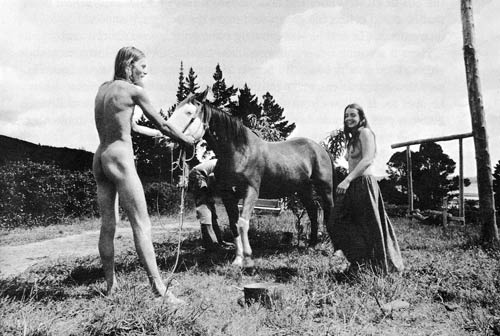
The Virtues Of A Simpler Life: Two members of the 1970s Wilderland commune attempt to persuade their workhorse to regurgitate their clothes. Though it is hard to believe in 2013, in 1974 the Kirk-led Labour Government announced its support for state-subsidised communes ("Ohu") on Crown land.

JUST TRY TO IMAGINE THIS. A New Zealand government which announces a scheme designed to, among other things: “assist people in becoming self-sufficient from the land”; “give people a chance to develop alternative social models”; “promote the virtues of a simpler life”; and “provide a place of healing for participants as well as for society as a whole”.
 
Impossible? No – it happened!
 
Forty years on, the Kirk Labour Government’s “Ohu Scheme” (state-subsidised, self-sufficient communes on Crown land) still possesses the power to shock and surprise. Taking their name from the Maori word for “working together”, and their inspiration from the Israeli kibbutzim, Kirk’s communes represent what is indisputably the high-point of utopian policy formation in New Zealand.
 
The inspirational role played by the kibbutzim (radically egalitarian and self-supporting communities established by Jewish settlers in Palestine from the early twentieth century) reflected the very close links that had grown up between the Israeli and New Zealand Labour Parties since the birth of the State of Israel in 1948. By the 1960s, spending a few weeks or months on a kibbutz had become a rite of passage for many young Kiwi socialists. The kibbutzim’s role in entrenching the ideals of solidarity and cooperation within Israeli society was openly admired by Labour activists.
 
The 60s and 70s were also the decades in which powerful intellectual challenges were mounted against the individualism and materialism of what the American economist, J.K. Galbraith, called the “Affluent Society”. All over the Western World, young people were questioning the values of consumerism and loudly contesting the moral legitimacy of any “Establishment” willing to overlook the horrors of the Vietnam War.
 
The desire to withdraw from this brutally acquisitive society, and experiment with new forms of social organisation, was strong. Culturally, this longing manifested itself in the “hippy” movement, whose followers were invited to: “Turn on, tune in and drop out.”
 
It was the confluence of these two intellectual streams: the powerful political model of the kibbutzim; and the so-called “counter-cultural” impulses of the hippies; that gave the Ohu Scheme’s promoters a fighting chance of success.
 
Even so, it is unlikely that such a utopian project would have been given the go-ahead had New Zealand not, in the early 1970s, been caught up and swept along on a great wave of progressive activity.
 
In 1972, the Royal Commission on Social Security recommended that: “The community [be] responsible for giving dependent people a standard of living consistent with human dignity and approaching that enjoyed by the majority, irrespective of the cause of dependency.” The Kirk Government responded by introducing the Domestic Purposes Benefit.
 
In 1974 – the same year that the Ohu Scheme was officially launched – New Zealand’s ground-breaking and world-beating Accident Compensation Corporation was given legislative life.
 
Kirk’s Attorney-General, the erudite and highly principled Dr Martyn Finlay, shocked conservative New Zealanders by observing that no prison should be made so secure that it destroyed all hope of escape in the minds of its inmates. An “escape-proof” prison, he seemed to be suggesting, was an affront to the indomitability of the human spirit.
 
Like the Ohu Scheme itself, Dr Finlay’s comment simply does not compute in the grim context of the twenty-first century’s second decade. Can anyone imagine John Key’s Attorney General, the coldly acerbic Chris Finlayson, suggesting that Her Majesty’s prisons be deliberately designed to protect the indomitability of the human spirit? And what awful punishment would the Justice Minister, Judith Collins, visit upon him if he did!
 
It would, of course, be very wrong to suggest that the whole of New Zealand suddenly turned into left-wing hippies in the 1970s. Because that simply isn’t true.
 
I vividly recall the day Prime Minister Kirk announced the cancellation of the 1974 Springbok Tour.
 
I was walking down Fergusson Drive in Upper Hutt when an old fellow wearing an RSA badge accosted me – presumably for the offence of being young and having long hair – and berated me for several minutes on the undemocratic character of the PM’s decision. Noticing the plethora of badges attached to my waistcoat (it was 1973!) he scrutinised them carefully for the emblems of New Zealand’s traitorous anti-Apartheid movement. Finding none, he grumpily sent me on my way. (He did not know how close I came that morning to pinning on my Halt All Racist Tours badge!)
 
But, if the progressivism and utopianism of the early 1970s was by no means universal, it was, nevertheless, entirely real. New Zealand warships were dispatched to the waters around the French nuclear testing-site at Mururoa. Racist rugby tours were cancelled. Pristine southern lakes were placed in the hands of environmental “guardians”. And, the government was prepared to set up rural communes.
 
We approach our utopias only by daring to dream. In disavowing their existence, we forget how to do even that.
 
This essay was originally published in The Press of Tuesday, July 23, 2013.

Tuesday, 6 November 2012

Dead-End Streets

Big Norm: Haunted by memories of the material and spiritual poverty which characterised the dead-end streets of the working-class Christchurch suburb of Linwood, where he was raised during the 1930s, Norman Kirk devoted his life to breaking the chains of socio-economic deprivation in New Zealand.
 
DAVID GRANT is one of those dogged miners of the past whose unceasing efforts are occasionally rewarded with an historical gem. Last Saturday, at a Fabian Society seminar entitled “The Kirk Legacy”, he shared one of them with the world.
 
Asked to present a paper on the early life of the Labour Party leader and prime minister, Norman Kirk (whose government was elected forty years ago this month) Mr Grant read aloud a short passage Kirk had written for an unfinished autobiography.
 
The 150-strong Auckland audience was astonished. Not simply because Kirk’s stark prose bears comparison with Hemingway and Steinbeck, but also for the glimpse his words offered into the mind of a working-class New Zealander recalling life in the Christchurch suburb of Linwood during the lean years of the 1930s.
 
In Kirk’s description of the short street where he lived one hears not just compassion but also a barely suppressed anger at its inhabitants’ truncated lives. Obvious, too, is Kirk’s desperation to escape the limiting effects of its material and spiritual poverty.
 
For Kirk was a highly intelligent man with a rare hunger for knowledge of every kind. In later life he would refer to his favourite books as “my patient friends”. That drab Linwood street, which had swallowed the lives of so many of his neighbours, would not claim him. But, equally, Linwood would never relinquish its hold over his imagination. It’s no exaggeration to say his life was dedicated to breaking Labour’s people out of such working-class prisons.
 
Perhaps this is what working-class New Zealanders sensed and loved about the man. That here before them was an emancipator; someone who had seen the size and richness of the world from which they were excluded. A political leader determined to win them entry.
 
So many of the contemporary Left romanticise poverty, imbuing it with mysterious moral power. Kirk despised such nonsense. In the brief passage Mr Grant read out (sorry, but you’ll have to wait for his book) this son of the Great Depression makes it very clear that there is nothing noble or pure about the experience of poverty – quite the opposite, in fact. Poverty deadens. It lowers horizons and empties its victims’ lives of hope. Poverty is the thief of dreams; the robber of dignity; an affront to the conscience. For Kirk, to be poor was to be trapped and shackled: forced to live on a dead-end street.
 
Another important contributor to the “Kirk Legacy” seminar was the political journalist, Colin James. Describing Kirk as “a political pivot between two eras”, he painted him as the harbinger of the big changes that would follow the election of the fourth Labour government in 1984.
 
It is certainly possible to see in Kirk’s dispatch of the frigate HMNZS Otago to observe the French atmospheric nuclear tests at Mururoa, and in his cancellation of the 1973 Springbok Tour, clear anticipations of the tumultuous and nationally defining moments of the 1980s. But it is wrong, I believe, to mould his features into some sort of crude Janus mask: one half smiling benignly on what Mr James calls “the apogee of social democracy” in the early-1970s; the other staring with prophetic intensity towards the brave new world of open minds – and markets – just beyond the decade’s horizon.
 
As Margaret Hayward, Kirk’s private secretary (and another contributor to the day-long seminar) revealed in her invaluable book Diary of the Kirk Years “Mr K” feared laissez-faire capitalism more than any other ideology. In his last speech to the Labour Party conference, writes Hayward, he warned delegates against too much social liberalism.
 
The permissive society, he said, was “just another way of saying ‘I can do what I like’ That would include not just the right to use marijuana but the right to exploit, to speculate, to put monetary gain above social duty.
 
“Some customs and laws might well have become irrelevant through the passage of time, but the permissive society, carried to its logical end, meant there was no law. ‘And if there is no law, the freedom of the permissive society is a trap and a prison for the weak in society.’”
 
Those Linwood memories never left him.
 
The great irony of the past forty years, of course, is that as our personal lives have become increasingly unconfined, our political options have narrowed dramatically.
 
Saturday’s seminar rose as one to welcome Sir Owen Woodhouse – principle architect of New Zealand’s world-beating system of accident compensation. But what chance would such a socially progressive scheme have in 2012? Who, today, would dare promote Kirk’s “Ohu” – communes on Crown Land!
 
Norman Kirk was a pivot, yes, but the turn that followed his tragic death in 1974 was from expansiveness towards constriction; from equality towards inequality; from the light towards the darkness.
 
Down a dead-end street.
 
This essay was originally published in The Press of Tuesday, 6 November 2012.