Friday, 12 August 2016

Hillary Clinton, Progressive.

Neoliberal War Goddess, Or Stalwart American Progressive? Why is this woman, this feminist, this progressive, demonised as some sort of fanatical neoliberal war goddess? Why do even New Zealanders who identify as “left-wing” claim to see no meaningful difference between Clinton and her Republican rival, Donald Trump? How has the woman who campaigned for George McGovern – the most radical presidential candidate in recent American history – been so egregiously defamed?
 
“WHAT WE HAVE TO DO every so often in America is save capitalism from itself.” Hillary Clinton’s take on capitalism is pretty much the same as Franklin Delano Roosevelt’s take on capitalism. If that doesn’t justify placing Clinton among America’s progressives, then the definition of “progressive” must have been changed when the world’s political scientists weren’t looking.
 
Only the most extreme denizens of the Far Right would dispute that Roosevelt’s “New Deal” rescued American capitalism from the looming political consequences of the Great Depression. Certainly, that remains the firm judgement of practically all American socialists. Indeed, the great tragedy of American socialism is that the progressive movement (almost always in the guise of the Democratic Party) has unfailingly stepped up to defuse those economic and social bombs which, left undefused, might so easily have exploded into revolution.
 
Clinton fits very comfortably into that Democratic tradition. Ideologically-speaking she rates as a fairly staunch American “liberal” (New Zealand political scientists would call her a social-democrat). United States experts locate her on the same section of the left political spectrum as President Barack Obama and Senator Elizabeth Warren, and only marginally to the right of Senator Bernie Sanders who, in spite of calling himself a “democratic socialist”, has devoted his life to promoting a social and economic programme indistinguishable from Roosevelt’s New Deal.
 
So why is this woman, this feminist, this progressive, demonised as some sort of fanatical neoliberal war goddess? Why do even New Zealanders who identify as “left-wing” claim to see no meaningful difference between Clinton and her Republican rival, Donald Trump? How has the woman who campaigned for George McGovern – the most radical presidential candidate in recent American history – been so egregiously defamed?
 
The answer is simple. Hillary Clinton has been demonised by the most reactionary elements of the American Right ever since she and her husband looked set to claim the White House in the presidential election of 1992. For nearly quarter-of-a-century she has been the target of an unrelenting campaign of false accusations, scurrilous rumours and outright lies. Recall the disgraceful campaign to undermine the prime-ministership of New Zealand’s own Helen Clark, multiply it by 10, and you will have some idea of the magnitude of what Clinton quite correctly described as “a vast right-wing conspiracy” dedicated to her and her husband’s destruction.
 
Those who were not yet born in 1992 find it difficult to fathom the depths to which the American Right was (and is) willing to sink in order to neutralise any and all threats posed to the legacies of Reagan and Bush by the Democratic Party and its more electable leaders.
 
That Hillary Clinton, as the Junior Senator from New York, voted for the invasion of Iraq has been parlayed by Sanders’ millennial supporters into proof positive of her war-mongering instincts. That dozens of her fellow Democratic senators did the same, is simply ignored. So, too, is the historical fact that ever since the days of the red-baiter, Joseph McCarthy, the Democratic Party has felt obliged to out-perform the Republicans on issues of national security.
 
The Millennial Left’s refusal to put the behaviour of politicians into some semblance of historical context is also evident in the their criticism of Clinton’s actions in regard to Libya. As US Secretary of State, Clinton was acutely aware of how much her country owed to its Nato partners for their unwavering support of the USA’s military commitment to Afghanistan. That was why she was willing to recommend to President Obama that he lend his support to British and French efforts in the UN Security Council to provide air support to Libyan rebels fighting Muamma Gaddafi. Clinton’s critics conveniently forget that it was the Security Council, not the US Secretary of State, who subsequently authorised the “humanitarian” bombing of Libya.
 
Unfortunately, this is not the sort of argument that sways Clinton’s younger critics in the slightest. Anyone who takes money from Goldman Sachs and their Wall Street partners-in-crime is obviously guilty beyond redemption. As is anyone who acknowledges the extraordinary electoral power of the Jewish Vote in US politics by making favourable references to Israel. (Did anyone hear Bernie condemn “Israel’s apartheid regime”?)
 
The “Bernie-or-Bust” die-hards who, unlike their mentor, refuse to recognise the brute realities of American presidential politics, have proved to be fast learners when it comes to orchestrating exactly the same phantasmagorical parade of falsehoods that, hitherto, Clinton only had to fend off from the Right.
 
Hillary has become “Killary”. Bumper-stickers scream “Liar, liar, pants-suit on fire!” Never mind that the US media’s fact-checkers have pronounced Clinton the most truthful of all the major primary contenders. Or that on her watch as Secretary of State the USA markedly improved its global conduct.
 
The only conclusion to be drawn from the above is that, in the minds of politicised Millennials, the meaning of “progressive” has changed. It now means: “Somebody who could not possibly be elected President of the United States.”
 
This essay was originally posted on The Daily Blog of Thursday, 11 August 2016.

Thursday, 11 August 2016

Playing The Game

Citius. Altius. Fortius: The idealised portrait of the ancient Olympic Games, which inspired the modern Olympic movement, depicts a pure, quasi-religious celebration dedicated to the joys of athletic exertion and achievement. The reality was quite the opposite. The ancient Olympic Games were brutally competitive events. Athletes cheated; people were bribed; and the Greek City States erected gaudy tributes to their successful champions. Not to win at Olympia all-too-often ended in civic humiliation and personal disgrace. How little has changed.
 
CRITICISING SPORT in contemporary New Zealand is a bit like criticising God. Actually, it’s worse. Because, when it comes to religious devotion, God ranks a poor second.
 
So much of New Zealanders’ national identity is bound up with their country’s sporting prowess that they recoil from the slightest suggestion that it is not an unquestionable good.
 
Even when the conduct of New Zealand sportsmen (the gender specificity is deliberate) can only be described as profoundly shocking and anti-social, the behaviour is presented publicly as a purely individual betrayal of sporting ideals. Most significantly, they are pilloried for their failure to uphold the values expected of public “role models” for young New Zealanders. That sport itself might be the culprit is never permitted to cross the collective New Zealand mind.
 
Officially, sport is about the pursuit of excellence.
 
At the individual level it embraces the pursuit and attainment of specific physical goals. More generally, it seeks to advance the boundaries of human capacity and achievement. In the words of the Olympic motto: Citius—Altius—Fortius  Faster— Higher—Stronger.
 
Team sport folds this quest for individual excellence into the creation of a competitive whole greater than the sum of its parts. The successful sports team is something organic: a collective expression of human purpose and human will that at once transforms and transcends its individual components.
 
Unofficially – that is to say what everybody acknowledges to be true, but will not publicly confirm – sport is about winning.
 
The idealised portrait of the ancient Olympic Games, which inspired the modern Olympic movement, depicts a pure, quasi-religious celebration dedicated to the joys of athletic exertion and achievement. The reality was quite the opposite. The ancient Olympic Games were brutally competitive events. Athletes cheated; people were bribed; and the Greek City States erected gaudy tributes to their successful champions. Not to win at Olympia all-too-often ended in civic humiliation and personal disgrace.
 
Nothing has changed. Who among our Olympic losers are feted and rewarded? The lucrative sponsorships; the ubiquitous television and newspaper advertisements in which Olympic athletes lend their lustre to every sort of commercial endeavour; these are not offered to the individuals and teams who fail to bring home the gold, silver and bronze medals New Zealanders covet. To the victors – and only the victors – go the spoils.
 
But if sport is about success, then it must also be about failure. Unfortunately, a society that only celebrates winners will find it increasingly difficult to treat its losers with anything but contempt. Even worse, the inculcation of the win-at-all-costs ethos into team sport risks elevating the key elements of collective success: loyalty, obedience and orthodoxy; over the more socially valuable qualities of altruism, tolerance and innovation.
 
The elevation of sporting prowess also risks privileging the physical over the cerebral; the fit over the unfit; the instinctive over the deliberative. It leads, inexorably, towards a society in which “hard” counts for much more than “soft”; the strong for much more than the weak; the wealthy for much more than the poor; the masculine for much more than the feminine; and the straight for much more than the gay.
 
If this sounds like a description of our own neoliberal society it’s because neoliberalism has learned a great deal from the political economy of sport. It is certainly no coincidence that modern management theory borrows heavily from the theory and practice of building and coaching successful sporting teams.
 
Businesspeople, bureaucrats, even academic administrators, display a growing fascination with the techniques employed by sports coaches to foster and develop “leadership” within their teams. In more and more of our large institutions employees find themselves grouped into workplace “teams” presided over by management-appointed “team-leaders”. These latter individuals combine the roles of monitor and exhorter. Inevitably, the team values of loyalty, obedience and orthodoxy become the indicators by which employees are assessed. Ironically, they are also the values which lead directly to organisational stagnation and decline.
 
The incidents arising out of the Chiefs rugby team’s “Mad Monday” celebrations in the Waikato town of Matamata have been presented to the public as the deeply regretted failure of a number of young sportsmen to live up to the ideals of their code.
 
Alternatively, the behaviour in question, far from being aberrant, could be seen as entirely consistent with the values of twenty-first century professional sport. These young men are paid to live in a “hard” culture where the slightest indication of “softness” will be taken as proof of either femininity, or queerness, or both. In such a context, the hiring of a stripper would not be seen as a disaster-in-the-making, but as a perfectly acceptable opportunity for group gratification and solace. They had failed to win the championship: this was how they dealt with being losers.
 
It wasn’t an aberration – it was the norm.
 
 
This essay was originally published in The Press of Tuesday, 9 August 2016.

Wednesday, 10 August 2016

IMPORTANT MESSAGE TO READERS: Moderating Comments On "Bowalley Road".

A Simple Message: All I am asking from those who wish to participate in this blog is a modicum of self-discipline and a generous helping of courtesy.

READERS’ COMMENTS to the postings on Bowalley Road constitute an integral part of the blog. That is why I do not intend to follow the example of Radio New Zealand and The Spinoff by switching-off the comments function.
 
I do, however, understand why those two sites chose to do so. The viciousness and crudity of anonymous commentators is extremely wearying to the spirit. Though the worst examples are swiftly deleted, they must first be read – and that is not a pleasant duty. Also vexatious are the tangential conversations and ideological disputations that ramble on between commentators. Though obviously engaging for their participants, they contribute very little to the overall enjoyment of the blog.
 
With these issues in mind, I have decided to tighten-up the moderation of comments to Bowalley Road.
 
The first and most important change relates to anonymous commentators. From now on all anonymous comments will be deleted without being read. My strong preference is for commentators to use their real names. I do, however, understand why some people feel very uneasy about doing so – especially on such an overtly political blog as Bowalley Road. Accordingly, I will continue to accept pseudonyms, but only with the proviso that commentators, having chosen a name, stick with it. The use of multiple pseudonyms, if detected, will result in the offender being permanently banned from commenting on Bowalley Road.
 
The second change in moderation policy will be to shut down all tangential conversations and/or slanging matches between commentators. Those deemed to be straying from the issues raised in the posting will be warned once to stay on-topic. Persistent off-topic commentary will be deleted.
 
With these changes, I hope to restore Bowalley Road’s commentary threads to their former high standard of tone and content. In essence, all I am asking from those who wish to participate in this blog is a modicum of self-discipline and a generous helping of courtesy.
 
Chris Trotter.

 This posting is exclusive to Bowalley Road.

Tuesday, 9 August 2016

Is Trump Preparing To Substitute Bullets For Ballots?

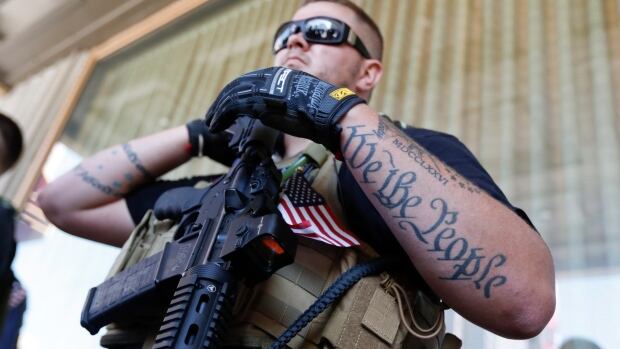
The Constitution In Arms: Alarmed at the steady decline in Trump's poll-ratings, extreme elements of the American Far-Right have begun warning his supporters that the forthcoming Presidential Election will be "rigged" to prevent their candidate from taking office. Already the Republican Party's most notorious political saboteur, Roger Stone, is using words like "bloodbath". Not one to miss his cue, Trump's stump speeches now include repeated references to a "rigged" or "stolen" election.

AS TRUMP’S NUMBERS slump, and Hillary’s surge, the worst elements of the American Right are mobilising in his defence. The Republican Party’s most notorious political saboteur, Roger Stone, is urging Trump to prepare his followers for a “rigged” election. And Trump is listening. To the alarm of election observers and commentators of every political stripe, Trump has taken to dropping the “R” word into his recent stump speeches.
 
“November 8th, we’d better be careful, because that election is going to be rigged,” he told American television viewers on Monday, 1 August, “and I hope the Republicans are watching closely, or it’s going to be taken away from us.”
 
Fears are growing in the Democratic camp that the prospect of losing to Hillary fills Trump with such terror that, rather than concede defeat, he will not shy away from doing irreparable damage to America’s 240-year-old system of representative democracy.
 
Roger Stone, who has a portrait of Richard Nixon tattooed on his back, is nothing if not explicit. In an interview with Alex Jones (a far-right extremist broadcaster and conspiracy theorist) he issued a chilling warning to Trump’s opponents:
 
“Well you have to let them know in advance that you’re not going to stand for it. That if there’s any solid evidence of election irregularities you’re prepared to challenge her swearing in and create a constitutional crisis.”
 
Or something much worse. According to the BBC’s Anthony Zurcher:
 
“In a podcast last week, long-time Trump advisor Roger Stone said that if the election results in November don’t match opinion polls, the Republican nominee should challenge the validity of the election and warned that the unrest could end in a “bloodbath”. “If there’s voter fraud, this election will be illegitimate,” he said. “The election of the winner will be illegitimate, we will have a constitutional crisis, widespread civil disobedience, and the government will no longer be the government.”
 
Roger Stone - Republican Party Fixer.
 
Threats of a similar nature were made in the lead-up to the Republican Convention. Even if, back then, they were directed at the leadership of the Republican Party itself! Historically-speaking, such overt references to political violence are alien to the presidential election process. At the state and local level of American government, however, “election irregularities” are commonplace.
 
Stone’s reference to “voter fraud” is telling. For nearly a decade Republican-controlled state legislatures have been passing legislation specifically designed to make it harder for voters more likely than not to support the Democratic Party to both register to – and cast – their vote. The standard political justification for these so-called “voter suppression” laws is the alleged incidence of fraudulent voting. Expert examination of such claims has pronounced them groundless. Proven examples of voter fraud in the United States are extremely rare.
 
The strongly contested presidential election of 2000 is, however, proof that, even at the presidential level, things can go very badly wrong with the election process. The irregularities surrounding the Florida vote were legion – including strong prima facie evidence of Bush family involvement (in 2000, George W. Bush’s brother, Jeb, was the Florida Governor) in a comprehensive plan to suppress the participation of the state’s African-American voters.
 
A more reckless and less patriotic Democratic Party presidential candidate than Al Gore might have done considerably more to prevent the 2000 election being stolen from him. His party had, after all, won the popular vote by a comfortable margin, and election day exit polls had shown him ahead (albeit narrowly) in Florida. Rather than call his followers into the streets, however, Gore allowed the US Supreme Court to determine the outcome of the election. By the narrowest of margins, the Court voted to declare Bush the winner.
 
Can Donald trump be relied upon to go quietly if the election is won narrowly (or even decisively) by Hillary Clinton? Or will he goad the losing side of the most heavily-armed citizenry on earth into substituting their bullets for their ballots?
 
This essay was originally posted on The Daily Blog of 9 August 2016.

Wednesday, 3 August 2016

Course Correction

Bernie's And Busted: When idealistic young people, most of them utterly unprepared, are pushed into the thrusting, beating and grinding behemoth that is the Democratic Party machine, and told to disrupt it, how shocked the party's critics claim to be, how dismayed, when the machine chews them up and spits them out. As if the Old Left had no idea that, to paraphrase Boromir in Lord of the Rings: “One does not simply walk into the Democratic National Convention.”

JEFFREY ST. CLAIR writes for the American on-line magazine Counterpunch. To read his excoriating critique of the Democratic National Convention is to feel the intense frustration and rage of the progressive American Left.
 
A sample: “Hillary has already out-Thatchered the Iron Lady and she hasn’t been elected yet. She’s made the complete metamorphosis from a Goldwater girl to a McGovern woman to a Reagan granny.”
 
That same frustration and rage was evident in the “Bernie-or-Bust” dead-enders’ attempts to disrupt the Convention. Their petulant bewilderment at being stiff-armed by the event’s organisers and security staff proof of just what a children’s crusade the Bernie Sanders candidacy had become in some US states – California in particular.
 
The Democratic Party is a machine: huge and unforgiving. St. Clair and his fellow critics on the Left know this. It is why they seem to enjoy nothing more than taking their readers into the heart of the mechanism. They point to its massive pistons pumping, its huge gears grinding, the controlled explosions in its vast cylinders, and they profess to be shocked.
 
And when idealistic young people, most of them utterly unprepared, are pushed into this thrusting, beating and grinding behemoth and told to disrupt it, how shocked the critics claim to be, how dismayed, when the machine chews them up and spits them out. As if the Old Left had no idea that, to paraphrase Boromir in Lord of the Rings: “One does not simply walk into the Democratic National Convention.”
 
Unacknowledged amid all this shock and dismay is the simple fact that without the brute force of the Democratic Party’s political machine: without the Wall Street donors, the SuperPACs, the media manipulation and the cheap parliamentary tricks designed to keep nay-sayers off the platform and away from the cameras; progressive politics in the United States would make no headway whatsoever.
 
Sanders grasped this simple fact. That’s why, to the boos of his supporters, he urged them to get in behind Hillary Clinton. Even if his followers failed to grasp it, the most important truth about the Democratic Party machine isn’t how it works, but in which direction it is steered.
 
Listening to Hillary Clinton’s acceptance speech all Jeffrey St. Clair heard was compromise, betrayal and “proto-fascism”. A less jaundiced observer would have heard something much more encouraging. Amid all the patriotic flourishes and the merciless deconstruction of the hollow, clay-footed god that is Donald Trump, a sensitive ear would have detected the crunch and groan of the Democratic Party changing course.
 
Not enough to silence the Bernie-or-Bust dead-enders; and nowhere near enough to mute the criticism of Jeffrey St. Clair; but more than enough to send a shiver down the spine of New Zealand’s Ambassador to the United States, the former Trade Minister, Tim Groser. Barack Obama would like to end his presidency with the congressional ratification of the Trans-Pacific Partnership, but Hillary Clinton is pledged to take the Oath of Office over TPP’s unratified corpse.
 
It was another female US Secretary of State, Madeleine Albright, who described the United States of America as “the indispensable nation”. When all other nations are stepping back, it is the United States that must step forward. In doing so, the United States reveals itself as not only the world’s indispensable nation, but also as its essential leader and guide.
 
This is the geopolitical reality that makes the presidential election of 2016 so critical. If Donald Trump wins, and puts “America First”, then the United States will have signalled its intention to step back and away from its leadership role. But if Hillary wins, as I believe she will, then the United States will begin the long, slow process of leading the world away from the self-destructive shibboleths of neoliberalism.
 
Hillary Clinton and the Democratic National Convention did not swing the wheel of American politics as hard to port as Jeffrey St. Clair and the Bernie-or-Bust dead-enders so obviously desired. But, on a long journey, even a small course correction can alter a vessel’s ultimate destination to a surprising degree.
 
In his glorious anthem, Democracy, Leonard Cohen urges on the USA, that indispensable vessel of the world’s hope:
 
Sail on, sail on
O mighty Ship of State!
To the Shores of Need
Past the Reefs of Greed
Through the Squalls of Hate.
Sail on, sail on, sail on.
 
Such is the political course dictated to Hillary Clinton, not only by what Bernie Sanders calls “the most progressive platform in the history of the Democratic Party”, but by the necessity of repairing an economic system that serves only obscene wealth. Redistributing that wealth isn’t just an ethical imperative, it is a sociological necessity. Inequality is the supreme solvent of human solidarity and social justice.
 
The choice before the American electorate has become existentially clear: sail on, or sink.
 
This essay was originally published in The Press of Tuesday, 2 August 2016.

Monday, 1 August 2016

America's Troubled Waters

All Come To Look For America: Tens-of-thousands accepted the call from this improbably grandfatherly “democratic socialist”, and to their astonishment and delight Bernie’s quest took on the bright aura of plausibility. Was it possible that the white-haired Senator from Vermont might win the Democratic nomination? No. Life is not a song and quests are seldom fulfilled in the way that those who set out upon them imagine. Hillary Clinton drew her political power from a grid several orders of magnitude larger than Bernie’s. Twenty-five years of “Third Way” Democratic Party politics were not about to be overturned by a college graduates’ crusade.
 
BRIDGE OVER TROUBLED WATER – that was the song Paul Simon sang to the Democratic National Convention. No doubt the nearly 2,000 delegates pledged to Bernie Sanders would have preferred their theme-song “America”. Simon gifted Sanders the rights to the song at the very beginning of his extraordinary quest. The campaign advertisement it accompanied was easily the best of the 2015-16 primary season.
 
There is something in the song that touches the hearts of more than the ageing Baby Boomers who recall the song from their long-haired, hitch-hiking days in the 1960s and 70s. Perhaps it is the mixing of what is, after all, a love story, with an account of being caught up in a much larger narrative.
 
“Cathy, I’m lost” whispers the song’s protagonist. “I’m empty and aching – and I don’t know why.” All those college kids who flocked to Bernie’s banner, did they too feel the tug of history’s currents pulling them out into the at once thrilling and terrifying deeps of political commitment?
 
“All come to look for America” runs the refrain. It was both a description and a challenge. Tens-of-thousands accepted the call from this improbably grandfatherly “democratic socialist”, and to their astonishment and delight Bernie’s quest took on the bright aura of plausibility. Was it possible that the white-haired Senator from Vermont might win the Democratic nomination?
 
No. Life is not a song and quests are seldom fulfilled in the way that those who set out upon them imagine. Hillary Clinton drew her political power from a grid several orders of magnitude larger than Bernie’s. Twenty-five years of “Third Way” Democratic Party politics were not about to be overturned by a college graduates’ crusade.
 
Not overturned, that was too much to hope for, but, even in the offices of the Democratic National Committee, Hillary’s people were “feeling the Bern”. Like it or not (and if Wikileaks is to be believed they did not like it at all) the Clinton juggernaut was being influenced by the Sanders insurgency. Obama had beaten Hillary Clinton to the nomination in 2008 on the strength of his famous slogan: “Yes we can”. Now, thanks to Sanders’ “political revolution” from below, Hillary was making sure of the nomination by declaring: “Yes I will”.
 
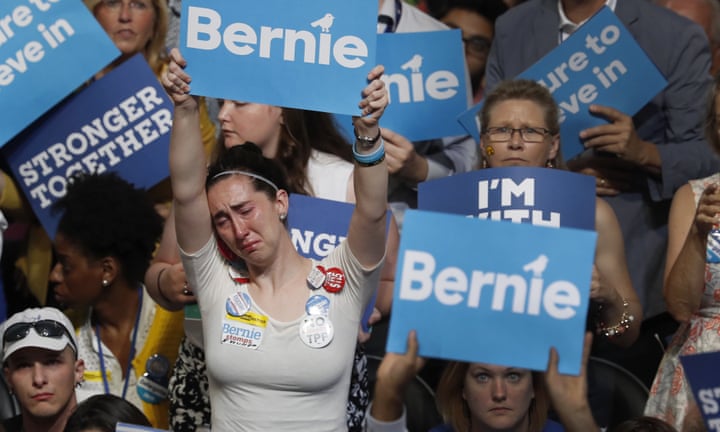
This was the message Sanders had, somehow, to deliver to his followers as, after a poignant reprise of his “America” campaign ad, he stepped on to the stage of Philadelphia’s Wells Fargo Centre. They weren’t about to make it easy for him. The cheers and the chants went on and on as if, by dint of their undiminishing fervour, they could will another, happier outcome.
 
For there was sadness in the faces of Sander’s delegates – even among the cheers. One black woman looked on, her face a carved portrait of despair. Tears rolled unchecked down the cheeks of another young woman as she held aloft a placard promising “A Future To Believe In”.
 
What followed was thirty minutes of uncompromising political education. Sanders acknowledged his followers disappointment, but he refused to let them wallow in it. He may not have won the nomination, but he and his movement had played a crucial role in writing what he called “the most progressive platform in the history of the Democratic Party”. And, like Wendy reattaching Peter Pan’s shadow, Bernie fastened Hillary to the Democratic Party platform with chains of rhetorical steel. The revolution would go on.
 
Pondering Sander’s masterful address, it occurred to me that “Bridge Over Troubled Water” was the right choice after all. It’s a song of two parts. In the first, the singer declares:  “When you’re down and out/When you're on the street/When evening falls so hard/I will comfort you”. In the second part, the focus shifts: “Sail on silver girl/Sail on by/Your time has come to shine/All your dreams are on their way”.
 
Yes, this is Hillary Clinton’s time to shine. She has devoted her entire life to the hugely difficult task of changing the United States of America. That the task has required compromises goes without saying. It may even be true that in her suppers with the Devil she brought too short a spoon. But, it is not only in comparison with the alternative that Hillary shines. She will make a fine President in her own right.
 
And Bernie will be sailing right behind.
 
This essay was originally published in The Waikato Times, The Taranaki Daily News, The Timaru Herald, The Otago Daily Times and The Greymouth Star of Friday, 29 July 2016.

Friday, 22 July 2016

Death In The Arena.

Making America Grate Again: For the past week the world has watched with growing horror the fevered phantasmagoria of far-Right lunacy that the Republican Party is attempting to pass off as a political convention. Does the rise of Trump mark the fall of the American Republic?
 
WATCHING THE OPENING HOURS of the Republican National Convention was like encountering Bob Dylan’s prophetic visions made flesh. There were the ghosts of Belle Starr – resplendent in their blinding white Stetsons – all lustily cheering-on a procession of Trumped-up heroes, while the heads of chambers of commerce from across America looked on in ill-disguised embarrassment.
 
Even so, for sheer implausibility the opening day’s speakers would have taxed even Dylan’s surreal imagination.
 
Scott Baio – all grown up from his stint as “Chachi” on the television sit-com “Happy Days” – warmed-up the crowd. Speaking movingly to the teleprompter, he soaked up the startled audience’s applause like a parched field in the rain.
 
Bizarre enough for you? Well, you just wait, there’s more.
 
David A. Clarke is the Sheriff of Milwaukee County, Wisconsin. Marching up to the podium, the gaudily decorated sheriff snapped out a brittle salute and almost immediately brought the Convention to its feet by declaring that “Blue Lives Matter!”
 
He was black.
 
The opening day’s theme was “Making America Safe Again” – making it just possible to discern the faintest outline of a rationale behind the Trump team’s extraordinary choices. If your slogan features a word as loaded as “again” where better to begin than with the Eisenhower-era certainties of “Happy Days”. And who better than a second-rate actor to sing their praises?
 
The same applies to the Convention’s response to the groundswell of anger and bigotry that has been whipped up by the recent attacks on police officers in Dallas and Baton Rouge. Who better than a sheriff to make the pitch for law and order?
 
Not as good as Sheriff Andy Taylor from Mayberry, North Carolina, would have been, but Uncle Tom Clarke from Wisconsin was a more than adequate substitute. Better, perhaps, since having a white police officer poor scorn on the Black Lives Matter movement could very easily have been misinterpreted by the “liberal media”.
 
Not that was ever any fear of that.
 
The air of surrealism pervading the Convention’s agenda may have been disconcerting, but it was no more unsettling than the mainstream news media’s live coverage of the event. Veteran CNN broadcasters like Wolf Blitzer never batted an eyelid as the procession of freaks and fakes that had been billed as Republican movers-and-shakers made their way across the stage.
 
What’s been unfolding this presidential election year has been called “Post-Truth Politics”, and watching CNN’s coverage it’s easy to see why. The most mendacious misrepresentations of events; glaring sins of omission; outright lies: all are weighed carefully and analysed with the same ponderous gravitas of the seasoned news anchor. So determined are the big networks to escape the dreaded accusation of bias (in favour of what – the truth?) that all of them have steadfastly refused to acknowledge the blow-waved emperor’s nudity.
 
They justify this refusal to speak truth to power by citing their journalistic duty to remain “fair and balanced”. As if their failure to acknowledge the fevered phantasmagoria that the Republican Party is passing off as a political convention is somehow a noble gesture. That they will have to “balance” this week’s moral capitulation by presenting the Democratic Party’s Convention as a collection of equally freakish flakes and fakes only highlights the extraordinary damage “Post-Truth Politics” is inflicting upon the American electorate.
 
The Convention venue, Cleveland’s Quicken Loans Arena, is billed as the home of the “Cavaliers, Monsters and Gladiators”. That these are all the names of Ohio sports teams in no way detracts from the thoroughly Dylanesque symbolism. Cavalier in his treatment of Republican Party tradition, and the fabricator of the most monstrous political expectations, Donald Trump has, predictably, turned his party’s convention into a four-day television mini-series for gladiatorial poseurs.
 
The noted American blogger, Richard Escrow, describes the man who would be crowned America’s king as “a bloated bleached-blond Narcissus transfixed by his own silhouette” – and it is hard to disagree. Who else would subject his party to night after night of saccharine tributes to his own greatness from his own family?
 
No stranger to Post-Truth Politics himself, Britain’s new foreign secretary will have little difficulty in making sense of the Cleveland spectacle. Boris Johnson has made a special study of Rome’s imperial dynasties. His classical historian’s eye will recognise the apotheosis of Donald Trump for what it is: the death of the American Republic.
 
This essay was originally published in The Waikato Times, The Taranaki Daily News, The Timaru Herald, The Otago Daily Times and The Greymouth Star of Friday, 22 July 2016.