Showing posts with label Economics. Show all posts

Friday, 1 May 2020

If The Answer Is "Treasury", Then Ask Another Question!

Ground Zero: It was the Treasury which planned, and in large measure led, the neoliberal revolution in New Zealand. In 1984, its official “briefing paper” to the incoming Labour Government – presented in book form and entitled Economic Management – became the Finance Minister’s, Roger Douglas’s, “Little Beige Book”. Step-by-step it led the new government down the most radical path of deregulation, privatisation and marketisation yet attempted in a western democracy. 

JACINDA ARDERN had the Director-General of Health, Dr Ashley Bloomfield, to stand alongside her in the Beehive Theatrette. Who should Grant Robertson stand alongside? The Finance Minister tells us he is talking with Treasury’s top people. Together, he assures us, they are charting a course out of the unfolding Covid-19 Recession. In effect, Robertson is inviting us to trust Treasury. If economics were a real science, like microbiology, then trusting Treasury would be a reasonable option. But economics isn’t a science. In fact, it’s not even close.

Treasury could send out it’s top person, Chief Executive and Secretary Caralee McLiesh, to stand alongside the Finance Minister, but unless she possesses presentation skills so far undisplayed in her short career at the top of New Zealand’s most powerful government department, it just wouldn’t be the same.

That’s because it was the Treasury which planned, and in large measure led, the neoliberal revolution in New Zealand. In 1984, its official “briefing paper” to the incoming Labour Government – presented in book form and entitled “Economic Management” – became the Finance Minister’s, Roger Douglas’s, “Little Beige Book”. Step-by-step it led the new government down the most radical path of deregulation, privatisation and marketisation yet attempted in a western democracy. Three years later, a second volume, ominously entitled “Government Management”, instructed Labour and National in how to finish the job.

Nothing released by the NZ Treasury in the last 36 years has indicated that it has deviated in any significant way from the ideological position it staked-out so boldly in the early 1980s. That no government elected in the last 36 years has felt confident enough to defy Treasury advice (at least, not in any meaningful way) merely confirms how enduring its ideological and organisational victories have been.

If the Finance Minister invites Ms McLiesh to stand at the other podium on the Beehive Theatrette stage it will tell us at least two things: 1) That the co-ordinates to economic recovery have been set using a neoliberal compass. 2) That the Finance Minister is happy to steer by Treasury’s stars.

New Zealanders are confident that the advice of their Director-General of Health, grounded solidly in medical science, is sound. We can trust Ashley. But, unless there’s been another revolution in the upper echelons of Treasury, its advice will continue to be grounded in the demonstrably unsound neoliberal ideology. That being the case, Caralee can be trusted to prescribe exactly the same medicine New Zealanders have been forced to swallow since 1984. Moreover, if Grant is standing there alongside her in the Beehive theatrette, nodding sombrely as she speaks, then he can be trusted absolutely to administer it.

It is only fair to acknowledge at this point that the Finance Minister isn’t exactly spoiled for choice when it comes to alternative ways out of the economic disaster inflicted upon us by the Covid-19 virus. So crushing were Treasury’s victories of the 1980s and 90s that until very recently the opponents of neoliberalism have lacked the intellectual confidence to advance anything approaching a credible alternative to the economic status quo.

Where, we may ask, is the comprehensive recovery plan submitted to the Finance Minister by the Council of Trade Unions? Where is the progressive equivalent of the plethora of books penned by the disciples of Milton Friedman and Friedrich Hayek in the 1970s and 80s? If the French economist/historian Thomas Piketty is supposed to be the twenty-first century’s answer to that great prophet of managed capitalism, John Maynard Keynes, then the Left has been sold a very soggy croissant.

Once again, being fair to Grant Robertson, it was Labour’s “Future of Work” exercise – over which he presided in the run-up to the 2017 General Election – that equipped the Finance Minister with such heterodox ideas as he has been willing to draw on in responding to the Covid-19 Crisis.

Rather than attempt to replicate the Prime-Minister’s highly effective daily briefings with Dr Bloomfield, perhaps it would be wiser for the Finance Minister to draw upon his Future of Work’s consultative precedent. Would it not constitute an “essential service” to New Zealand’s economic wellbeing to convene (with appropriate social-distancing) a conference embracing all the significant sectors of our society: bosses, workers, farmers, bankers, bureaucrats, professors, students, artists, beneficiaries, priests and non-profiteers; to collectively chart an equitable course to national recovery?

This essay was originally published in The Otago Daily Times and The Greymouth Star of Friday, 1 May 2020.

Wednesday, 2 December 2015

How Economists Are Failing Society: Professor Robert Wade At The Ika Seafood Bar & Grill.

Heterodox And Proud Of It: Professor Robert Wade is an economist who refuses to toe the accepted line. Someone with the courage to point out that the neoliberal economic emperor isn’t wearing any clothes.
 
LAILA HARRE saved the very best for last. The “Salon” lunch with economist, Professor Robert Wade, provided one of those clarifying political moments when, at last, the veil falls away and you are shown the real state of affairs in all its terrifying clarity.
 
Wade is what his orthodox colleagues at the London School of Economics would loftily dismiss as a “heterodox” economist. Someone who refuses to toe the accepted line. Someone with the courage to point out that the economic emperor isn’t wearing any clothes.
 
More than this, however, Wade exposes orthodox neoliberal economics as a failure. Presenting itself as a scientific discipline, fully capable of pronouncing definitively on the true nature of reality – the profession was, nevertheless, unable to produce a single accurate prediction of the Global Financial Crisis (GFC).
 
There was a very good reason for this. As Wade explained to his mostly academic audience, the Dynamic, Stochastic, General Equilibrium (DSGE) model used by orthodox economists all over the world – including the OECD, the IMF, the World Bank and the Bank of England – does not factor-in the influence of the financial sector on the economy, and flatly denies that economies conforming to the DSGE model are susceptible to crises generated endogenously (i.e. from within themselves).
 
Just think about that for a moment. An economic model that makes no allowance for the most powerful force in the modern international economy – finance capital. A model which, for that very reason, simply could not see the Global Financial Crisis coming.
 
Now, you might think that a profession which had exposed its shortcomings so dramatically might be feeling just a little bit chastened; might be looking for a new economic model; might even be ready to admit that it had got just about everything horribly wrong and apologise to the world for all the extraordinary suffering its failure to read reality correctly has produced.
 
You would, however, be wrong.
 
Orthodox economists pride themselves on their positivism. They are not swayed by their emotions, nor do they make value judgements. The language of ethics and social responsibility is foreign to them. Their language is mathematics. Numbers don’t lie – and they certainly don’t apologise!
 
But if Orthodox Economics pays no heed to the real world and cannot predict an event as devastating as the GFC; if it scorns all those who posit a different interpretation of the economic data; if it guards the tenets of its economic faith as jealously as any member of the Roman curia, and punishes heretics with equal severity; then what, exactly, is the orthodox economics profession?
 
The answer lies in the word “faith”. Wade himself said that there is a religious quality to the thinking of the men and women in economic institutions like the NZ Treasury. And this, of course, is exactly what the orthodox economics profession has become – a modern priesthood.
 
In terms of the social and political function it serves, Orthodox Economics is no different from the Medieval Catholic Church. It exists for one reason and one reason only: to justify the ways of the rich to the poor, and to convince them there is no alternative to the inequality and injustice of the existing order. As it was in the beginning, is now, and ever more will be, world without end.
 
This brief review hardly does justice to Wade’s lecture. There is much more that I wish I could recall: astonishing quotations from these naked economic emperors that left his audience shaking their heads in disbelief.
 
The vote of thanks was given by Laila’s dad, who first met Wade when he was a young student of anthropology back in 1960s Auckland. Indeed, he was able to produce a wonderful photograph of the young Robert Wade, taken during an expedition to the islands of the South Pacific.
 
There he was, one of many rowers, hauling manfully on his oar, in the midst of a vast and troubled sea.
 
Somehow, it seemed appropriate.
 
This essay was posted on The Daily Blog and Bowalley Road on Wednesday, 2 December 2015.

Saturday, 21 March 2015

"Damn the Dam" - John Hanlon (1973)


WHILE WE’RE DEBATING the economic competence, or otherwise, of the four candidates vying to become the male co-leader of the Greens, here’s a blast from the past from John Hanlon.
 
Damn the Dam was released in 1973, and tunefully encapsulates just about all of the sentiments that propelled the Values Party into the forefront of progressive New Zealand’s imagination during the General Election campaign of 1972.
 
The Values Party can lay a pretty solid claim to being the world’s first “green” party. (Which is why I found it so odd that only Gareth Hughes was willing to cite one of its earliest members, Jeanette Fitzsimons, as his personal political hero!) But, as Hanlon’s song clearly illustrates, it carried within it, almost from the moment of its birth, the inherent contradiction between the needs of the natural and the human worlds.
 
As my wife puts it (rather brutally I’m afraid): “I’d rather have cheap power than the bloody fantail!”
 
Even within the ranks of the late (and, by some, lamented) NewLabour Party, the comrades rapidly sorted themselves into the “Red-Green” and “Smokestack” factions.
 
In the end, just about all political struggles boil down to a set of arguments based upon giving “power” – however narrowly or widely defined, to “the people” – however narrowly or widely defined. “Tiny animals, little birds as well” don’t get much of a look-in. Which is why Russel Norman was so emphatic in his insistence that the Greens must learn to speak the language of human priorities, aka “Economics”.
 
Still, it’s a lovely song.
 
 
Video courtesy of YouTube.
 
 
This posting is exclusive to the Bowalley Road blogsite.

Thursday, 20 February 2014

This Is What Clever Propaganda Looks Like


TAKE A LOOK at this video from the global charity organisation, Oxfam. Intended to push along moves already underway within the European Union to introduce a Financial Transactions Tax, the video employs the superb comedic talents of the British actor, Bill Nighy, to highlight the bankruptcy of the anti-FTT position. Viewers of the video are also encouraged to get involved in a practical way by signing an accompanying petition.

Enjoy!


This posting is exclusive to the Bowalley Road blogsite.

Saturday, 8 September 2012

The Iron Bed Of Procrustean Economics

Made To Order: Like the mythical monster, Procrustes, neoliberal economists are offended by the real world's inability to fit into the iron bed of their assumptions. No matter. Reality can always be "struturally adjusted" to conform to neoliberalism's Procrustean specifications.
 
PROCRUSTES was an exacting host. Travellers offered a night’s rest on his iron bed never fulfilled his expectations. Inevitably, they were a head too short or a foot too tall. No matter. Procrustes had a simple remedy. If his guests proved too short he stretched their bodies until they measured up. If they were too tall, he just lopped off the bits that stuck out. Unsurprisingly, the Athens to Eleusis Road, which passed by Procrustes’ forge, acquired a grim reputation.
 
The Greek hero, Theseus, put an end to Procrustes’ reign of terror by forcing him to lie on his own beds. That’s beds, plural, because, of course, there had always been two: a long bed for the short guests and a short bed for the tall ones. And since not even the monstrous blacksmith, Procrustes, could be both short and tall at the same time, Theseus was obliged to serve him as he had served others. He did not survive the process.
 
His infamous bed, though, has endured – at least in the English language. Whenever we are obliged to conform to someone else’s undifferentiated and unyielding expectations, we say they are fitting us to a “Procrustean Bed”.
 
Never has the term been more appropriately applied than as a metaphor for contemporary economics. Like the unfortunate travellers along the Athens-Eleusis Road, the nations of the world are invited to measure themselves upon the iron bed of Procrustean Economics and, just like the ogre’s victims, they inevitably find themselves being “structurally adjusted”.
 
It was not always so. As the Norwegian economic historian, Erik Reinert, persuasively argues in a paper presented to the New York-based Social Sciences Research Council, there was a time when not only economists, but ordinary members of the public, could choose between a range of radically different and fiercely competing economic theories.
 
Not any more: “Today we are in the extraordinary situation that these economic theories – covering the whole political spectrum – have virtually disappeared from practical use.”
 
What we are confronted with now, Reinert says, is an “academic monoculture” – with all the risk of catastrophic failure that the term implies.
 
Nor can we rely upon the democratic process to rescue us from the consequences of such failure. Unlike the economic crises of the past, when competing economic prescriptions recruited political champions from within the major political parties, the present crisis has generated an astonishingly uniform political response. Between the parties of the Left and those of the Right minor differences of sequencing and emphasis certainly do exist, but there are no politicians of any stature within the world’s significant economic powers willing to identify themselves with a fundamental challenge to the neoliberal paradigm.
 
Barack Obama may have campaigned in the poetry of “Hope” and “Change”, but as President he has governed according to the very same, prosaic, rules as the Bush Administration, and with the assistance of many of the same personnel.
 
The contrast with Franklin Roosevelt could hardly be more striking. Confronted with a financial system in near collapse, Roosevelt called down the wrath of heaven upon the money-changers of Wall Street and embarked on a “New Deal” that both confronted and confounded the conventional economic wisdom of his day. But President Obama, far from driving the money-changers from the Temple, calmly set about reappointing them to the positions from which they had overseen the gravest financial catastrophe since the Great Depression.
 
The situation in New Zealand is little better. Labour makes a great virtue of the fact that it has signed-up to many of the neoliberal Treasury mandarins’ pivotal recommendations. Where Prime Minister Key refuses to touch National Superannuation, David Shearer promises to lift the age of entitlement and sever its relationship to the average wage. Where Bill English rules out a Capital Gains Tax, David Parker promises to introduce one. Unlike its hard-pressed wage and salary earners, the economically orthodox business leaders of this country have little to fear from a change of government.
 
If Procrustes had two iron beds upon which to stretch or truncate his victims, the current neoliberal establishment possesses two political parties to fend off any genuine ideological challenge. Both parties insist that New Zealand measures-up to the financial markets, and if it’s found wanting, both are ready to lop off a billion or two.
 
Where is Theseus when you need him?
 
This essay was originally published in The Waikato Times, The Taranaki Daily News, The Timaru Herald, The Otago Daily Times and The Greymouth Star of Friday, 7 September 2012.

Friday, 13 July 2012

Business As Usual: Labour Disowns "Uncompromising Dogma"

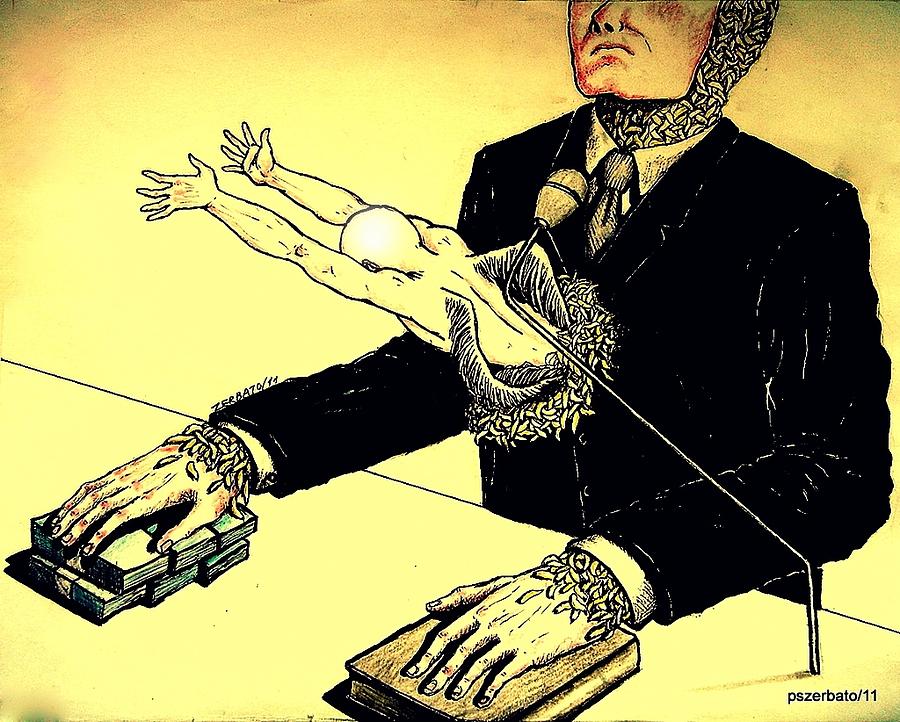
Politics Without Idealism: Paulo Zerbato's grim painting offers an acerbic commentary on the notion that political action can somehow be divorced from the ideals ("uncompromising dogma") which inspired it. In the face of inescapable moral challenges, it is "business as usual" (or as close to "usual" as you can make it) that paves the road to perdition.

“WE CAN’T AFFORD the luxury of uncompromising dogma.” The Green Party should write that down. It’s a direct quote from Labour’s deputy-leader and environment spokesperson, Grant Robertson.

He was speaking alongside (and keeping an eye on, a cynic might suggest) David Cunliffe at a “Labour and the Environment” forum held at the Titirangi Public Library on Saturday, 23 June. I took down Mr Robertson’s words because they were so obviously intended to alert all left-leaning political activists (including Mr Cunliffe) that Labour will be offering no hostages to fortune when it comes to formulating environmental policies for the 2014 election.

It’s worth spending a little time unpicking Mr Robertson’s statement. Obviously, his “uncompromising dogma” barb was directed at the environmental policies of other parties – but which ones?

Was he alluding to the National Party? Certainly, Mr Key’s government has a reputation for dogmatism when it comes to deep-sea drilling, the evils of trade unionism and the virtues of educational standards, but “uncompromising”? Mr Key’s many critics on the Right would strongly disagree. Indeed, it is precisely Mr Key’s willingness to back-track and compromise that so infuriates his detractors.

No, I do not think Mr Robertson’s rhetorical harpoon was intended for the National Party. His target wasn’t a blue whale, it was green.

Labour’s attitude to the Greens gyrates wildly between aggrieved toleration and rank hostility. Fundamentally, they regard the Greens as poachers: impudent trespassers on the Left’s ancestral lands and wilful perpetrators of electoral larceny. It’s what the hapless Clare Curran, Labour MP for Dunedin South, meant when she blogged, in August of 2011, about “attempts by the Greens to encroach on Labour territory”.

Labour looks at the polls: sees its own numbers rising; National’s falling; and the Greens’ tracking up. Clearly, some of National’s soft right-wing vote is drifting back to Labour, but, equally clearly, Labour’s left-wing support is shifting to the Greens. The policy implications of this right-wingers-in-the-front-door, left-wingers-out-the-back, political movement presents the Labour leadership with all kinds of headaches.

Reading the full text of his speech to the Titirangi meeting, it is clear that rather than see Labour go fly-fishing in the rivers of the Right, Mr Cunliffe would prefer the party to lower a net into the ocean of the 800,000 electors who declined to participate in the 2011 General Election.

In his speech, TheDolphin and the Dole Queue, Mr Cunliffe declares:

Getting the best long term outcomes will not always mean maximising short term profits. It can’t. Anyone who tells you it can is either stupid or lying … Do people … understand the costs of not adjusting and not planning for a better future? Do they understand that business as usual simply cannot continue?

The strategic thinking here is bold: align Labour’s policies closely with the Greens’ and let the two parties go fishing together for the disillusioned, the disengaged and, most especially, for the young.

Grant Robertson: Cautious political instincts.

Unfortunately, Mr Robertson’s more cautious political instincts adjudge this sort of thinking to be not bold but reckless. Mr Cunliffe’s recitation of the well-documented global hazards threatening the human species’ long-term survival, and his radical conclusion that “business as usual simply cannot continue”, all of it rings in Mr Robertson’s ears as “uncompromising dogma”. Such policies are all very well for minor parties like the Greens, but they simply will not do for parties that aspire to the status of New Zealand’s “alternative government”.

Such parties “cannot afford the luxury” of a radicalism that just might energise this country’s increasingly inert electorate. An alternative government committed to the notion that “business as usual simply cannot continue” would instantly attract the enmity of every entrenched industrial, commercial and financial interest in the land. It’s leaders would be pilloried, denounced, demonised. And, honestly, Mr Robertson has never struck me as a politician who would, voluntarily, risk any of those experiences.

That’s the message he’s conveying to his rival for the Labour leadership and, more importantly, it’s what he’s saying to the Greens’ co-leaders, Russel Norman and Metiria Turei. It’s a simple, and very brutal warning:

There’s a cabinet seat for you in the next Labour-led government, but only if you’re willing to leave your radical ideals [“uncompromising dogma”] at the door. Only if you accept that it will be ‘business’ as close to ‘usual’ as Labour can make it.

This essay was originally published by The Otago Daily Times, The Waikato Times, The Taranaki Daily News, The Timaru Herald and The Greymouth Star of Friday, 13 July 2012.

Thursday, 29 July 2010

The "Why?" of Superannuation More Important That The "What?"

Offering Solutions? Dr Don Brash has never shied away from posing - or attempting to answer - the difficult questions.

NO ONE can fairly accuse Dr Don Brash of shying away from the difficult and the divisive. In stark contrast to his successor, Dr Brash’s preference has always been to confront contentious issues head-on: to offer solutions – not evasions.

It’s the quality I most admire in him.

Last week Dr Brash did it again. In a speech to the Asset Allocation Summit, meeting in Auckland’s swanky Hilton Hotel, he offered up a solution to the fiscal problems posed by the imminent retirement of the Baby Boomers (the first of whom turn 65 next year).

What Dr Brash is proposing is disarmingly simple. The longer you put off retirement – the bigger your pension. Or, in the good doctor’s own, rather dry, econo-speak:

"In my own view, raising the age of eligibility could be made more politically acceptable if we were to allow a degree of flexibility regarding when the pension is actually taken. If the age of eligibility were 67, for example, under a policy allowing flexibility regarding the age at which it could be drawn somebody might choose to take the pension at, say, 65. At that younger age, the amount received would be actuarially adjusted downwards, and would remain at that lower level (with regular upward adjustments with wages of course) until death. Conversely, if somebody chose to defer drawing the pension until, say 69 or 70, the amount received would be actuarially adjusted upwards."

This is by no means a silly idea – especially if one accepts the demographic and fiscal assumptions it seeks to address.

To hear both the National and Labour Party leaders dismiss Dr Brash’s proposal out-of-hand was, therefore, extremely disappointing. Only a fool would suggest that the vast expansion of our over-65 population will require no adjustments whatsoever to the current delivery mechanisms. But, given the knee-jerk reaction of the two main parties, it’s difficult to conclude that they are led by anything else. Change of some sort to the way we manage and/or pay for New Zealand Superannuation is – as Dr Brash rightly asserts – "inevitable", and political leaders who refuse to face the inevitable are fools indeed.

Dr Brash is similarly right on the money when he urges us to deal with this problem sooner rather than later. Young New Zealanders – the so-called Generations "X" and "Y" – should not be expected to wait until the brute facts of fiscal reality force some future government to implement an equally brutal series of last-minute solutions.

As a trained economist, Dr Brash is, of course, basing his ideas on a number of important assumptions. It’s one of the least understood aspects of economics – this assumption thing – and if more people realised on what a truly heroic scale the profession assumes all manner of things about the world, I suspect it would be taken a lot less seriously.

For example, Dr Brash is assuming that the Treasury’s "projections" about the shape of New Zealand society in 2050 are correct. But, of course, a "projection" assumes that everything that is happening now will go on happening in exactly the same way for (in this case) the next 40 years.

Just think about that for a moment. Cast your mind back (if you’re a Baby-Boomer) to the New Zealand of 40 years ago. Who, in the year 1970, would have accurately predicted where New Zealand would end up? Who could have foreseen "Rogernomics"? The fall of the Berlin Wall? China transforming itself into a capitalist powerhouse? A black American president?

How close would the picture of New Zealand 40 years in the future, projected by Treasury in 1970, have come to the reality of 2010?

Attempting to predict the future is like trying to freeze your own shadow. With every decision we take in the here-and-now, the shape of the future changes. That is why it’s always safer for a government to base its policies on solid and enduring principles. Heroic assumptions are best left to economists.

NZ Superannuation works because it embodies its beneficiaries’ clear expectations about what the state should provide and what the citizen should contribute. It’s universal availability acknowledges the right of every person to be supported in their old age. It is financed out of general tax revenues because every citizen has a duty to be his brother’s – and his sister’s – keeper.

Be guided by those principles, and Treasury’s doom-laden projections can be dismissed for what they nearly always are – "ideological burps".

A society dedicated to the support of its most vulnerable members – be they the very old or the very young – will do what it takes to meet its commitments. That may mean higher taxes. It may mean increased immigration. It may even mean adopting Dr Brash’s suggestion.

Ultimately, what we decide to do matters much less than why we decide to do it.

This essay was originally published in The Press of Tuesday, 27 July 2010.