Showing posts with label Lenin. Show all posts

Tuesday, 21 January 2020

Revolution in New Zealand? Not Even Close!

No Fires Thanks, We're Kiwis: For the moment, in those close-to-home places where revolutions are born, there may be tetchiness and resentment, frustration and complaint, but nowhere is anybody uttering the cry that will bring a New Zealand revolution into being: “We have found the way to make tomorrow better than today!”

WHERE DO REVOLUTIONS begin? The answer, invariably, is “close to home”. Where demonstrable public need meets unresponsive public authority. Where collective outrage invites violent repression. Where injustice spawns indignation and indignation demands action. Where popular action generates governmental reaction. That’s where revolutions are born.

Once begun, what makes a revolution successful? It is tempting to respond with the purely historical observation that revolutions succeed where they are able to muster sufficient armed force to overwhelm those dedicated to their failure. People with guns allow revolutions to succeed. But is mere armed force enough? Surely, before people are willing to wage war on the Revolution’s behalf, they must first believe its objectives to be both desirable and achievable.

The need for guns, and the willingness to use them, almost always arises when the authorities announce their intention to thwart the people’s intentions. When real change, desperately needed, and now within the people’s grasp, is suddenly faced with the prospect of being halted and/or reversed by forces loyal to the status-quo. That is when people start looking for the means to preserve the imminence of change.

Historically, the people’s determination to preserve the imminence of change is soon extended to ensure the preservation of those who have made them believe that change is imminent. Fearing that the authorities are coming for their leaders, people typically resolve to impede their progress: peacefully if possible; by force if necessary. The leaders themselves, realising that the revolution’s failure will more than likely lead to their demise, are left with little choice but to keep pushing it forward as hard and as far as they can. The revolution’s survival, and their own, become welded together.

The French Revolution of 1789, for example, was kicked-off by the fear that the King’s troops were about to visit retribution upon the revolutionary crowds of Paris. The latter rushed to the Bastille, hated symbol of royal power, because they were convinced that within the fortress-prison’s walls they would find the muskets, cannons and gunpowder they needed to resist the King’s soldiers.

The storming of the Bastille, 14 July 1789.

In the Russian capital, Petrograd, in February-March 1917, the soldiers who had refused to fire on the crowds of women demanding bread for their starving families knew that the Czar would immediately dispatch troops to disarm and punish them as mutineers. If their revolt was not extended, then many of them would die. Accordingly, they reached out to radical left-wing politicians and to their working-class supporters in the factories. By joining forces with the political enemies of the hated Czarist regime, and offering them the protection of their rifles and machine-guns, they helped to turn what had started-out as a protest against bread shortages into a full-scale revolution.

But, the events in Petrograd unfolded more than a hundred years ago. Is there a plausible scenario for revolution in New Zealand in 2020? The short answer is “No.” Nothing has occurred for decades in New Zealand that matches in any way the cultural, intellectual, and political preparations that preceded the French and Russian revolutions.

In Eighteenth Century Europe, for example, the cultural supremacy of the Catholic Church and the political doctrine of Absolute Monarchy had been profoundly weakened by what came to be known as “The Enlightenment” or “The Age of Reason”. Breakthroughs in moral and political philosophy, together with the rapid expansion of science, called into question the existence of the Judeo-Christian God and, thus, the “divine right of kings”. Within the ruling classes doubt grew, and from these doubts ordinary people drew confidence that their own ideas and priorities were as worthy of serious consideration as their lords’ and masters’.

Crucially, in the shape of an elected parliamentary assembly, the people had also identified a mechanism capable of supplanting the autocratic rule of the monarch. The self-evidently desirable objectives of “liberty, equality fraternity” were thus made achievable. In the people’s “deputies”, gathered together in the revolutionary “National Constituent Assembly”, the people’s will had finally found its political vector.

In Petrograd, 128 years later, the critical political vector of the “nation” had been replaced by Karl Marx’s “proletariat”. Likewise, the revolutionary mechanism ceased to be a parliament filled with elected representatives, and became, instead, a multitude of workers’ councils (soviets) filled with instantly recallable delegates elected in the factories and regiments. Replacing the Enlightenment and its philosophers was the revolutionary Marxist party – whose ruthless and highly disciplined “cadres” were determined to inspire and guide the soviets of workers and soldiers.

Other determinants of success were also at work in 1789 and 1917.

Bankrupt of both the ideas and the funds required to address the multiple crises afflicting his subjects, the French king, Louis XVI, set in motion a massive, kingdom-wide effort to identify and collate the grievances of the French people. These Cahiers de doléances provided the core agenda of the Estates General – the feudal body charged with advising the Crown, which had not been called together for 175 years! Thus equipped, the people’s representatives possessed a clear idea of what they had to do.

In 1917, also, the Russian people’s priorities were clear. Czar Nicolas II had led them into a disastrous war with the Austro-Hungarian and German empires. Millions of conscripted peasant-soldiers had been killed, the Russian economy was in ruins, and the Russian people were starving. Their lords and masters had failed utterly to protect them and were either unable or unwilling to feed them. When the leader of the revolutionary workers’ party, Vladimir Lenin, arrived at Petrograd’s Finland Station, his speech to the workers’ and soldiers’ delegates was short and to the point: “Peace! Bread! Land! All power to the soviets!” With these simple but highly effective promises, Lenin’s party ruthlessly blew away the political fog engulfing the ineffectual Russian parliament and set in motion the world’s first socialist revolution.

Lenin promises "Peace! Bread! Land!" at the Finland Station, Petrograd 1917.

It should be clear by now that New Zealand’s cultural, economic and political situation bears no comparison with the two great Western revolutions. Neither Maori nor Pakeha culture offers anything to compare with the devastating ideological critiques which the Enlightenment and Marxism brought to bear on the political regimes of France and Russia. Animism with corporate clip-ons is no more a revolutionary doctrine than post-modernism incongruously blended with the politics of identity.

Nor is New Zealand trapped in the sort of intractable economic and military crises that brought down the Bourbon and Romanov dynasties. In fact, it presents itself as a highly successful neoliberal capitalist economy. Which is not to say that poverty has been eliminated, or homelessness overcome, merely that the levels of inequality and social injustice which beset all but a handful of western states is not dramatically worse in New Zealand than it is in other comparable countries. Certainly, the grave challenge of Climate Change looms over New Zealand’s future but, once again, that is a problem to which the entire world has yet to find a workable solution.

Most importantly, the New Zealand ruling-class retains sufficient faith in its ability to manage the nation’s affairs to render any challenge to its dominance ineffective. No mass movement with a practical programme of revolutionary change exists in this country. Nor does it contain a disciplined revolutionary party dedicated to creating one. Those who proclaim themselves champions of change and fighters against injustice are currently more willing to go to war with each other than with neoliberal capitalism. Indeed, it is possible to argue that identity politics, far from being a revolutionary phenomenon, has become the paradoxical vector for neoliberal consolidation. The ever-more-strident calls to recognise every new construction thrown up by the social kaleidoscope have a way of drowning out the truly revolutionary demands for a radical redistribution of the economic pie.

For the moment, in those close-to-home places where revolutions are born, there may be tetchiness and resentment, frustration and complaint, but nowhere is anybody uttering the cry that will bring a New Zealand revolution into being:

“We have found the way to make tomorrow better than today!”

This essay was originally posted on The Daily Blog of Tuesday, 21 January 2020.

Tuesday, 7 November 2017

Bolsheviks Seize Power! 7 November 1917.

Power In The Hands Of The People - For A While: One hundred years on, the revolution which the Bolsheviks not so much made, as destroyed, deserves to be remembered for what it was – a joyous eruption of ‘people power’. It unleashed the creative political and cultural energies of ordinary men and women in ways that by turns astounded, delighted and inspired the whole world. So much so that, even today, a century later, it is the event’s historic assertion: that a better world is possible; which keeps the vivid colours of the Russian people’s revolution so bright in the memory – and hopes – of humankind.

“GO HOME!” Ordered the Bolshevik soldiers surrounding the Tauride Palace in Petrograd. The assembled delegates to the All-Russian Constituent Assembly looked at the rifles and bayonets pointed at them, looked at one another, and dispersed. Thus, was representative democracy ushered-off the Russian political stage in the snows and freezing mists of January 1918. The Assembly, elected by more than 40 million Russians in the first free election of their nation’s history, had deliberated for precisely thirteen hours.

The shutting down of the Constituent Assembly by the Bolshevik government of Vladimir Lenin provoked very little in the way of protest. Lawyers and other professionals objected, of course, rightly foreseeing that a revolutionary regime upheld by rifles and bayonets was unlikely to be the most reliable guarantor of individual liberty and human rights. For the remainder of the politically active population, however, there was simply too much going on.

Their revolution, which had begun nine months earlier on International Women’s Day (8 March) 1917 was still in full-swing, Constituent Assembly, or no Constituent Assembly. So, too, was the debate about the best form of democracy. Perhaps Comrade Lenin was right on this issue. Perhaps the workers’, soldiers’ and peasants’ “soviets” (councils) whose members were directly elected at the factory, barracks and village level, and instantly recallable if they deviated from their mandates, were a better and more accountable form of democratic representation.

What mattered most to Russia’s political activists in the winter of 1917-18 was their conviction that the revolution still belonged to them: that they were still in charge; still directing the flow of events. Many of them, while harbouring serious reservations about the Bolsheviks’ blatantly unconstitutional seizure of power on 7 November 1917, were nevertheless relieved that the Provisional Government of Alexander Kerensky, and its criminal determination to continue the war against Germany, had been removed. They were also heartened by the Bolsheviks’ uncompromising determination to defend the revolution against Tsarist reactionaries like Kornilov. It was possible to fault Lenin’s methods, but not his revolutionary zeal!

With the benefit of a century’s hindsight, it is easy to dismiss these notions as short-sighted and naïve. How could any thinking Russian not understand that a political party guilty of seizing power in a carefully-planned and ruthlessly executed coup d’état had already pronounced the revolution’s death sentence? That the Bolshevik’s aggressively ideological regime, based on the fragile majorities it had constructed in the far-from-stable urban soviets (while the peasantry, 80 percent of Russia’s population, gave their support, overwhelmingly, to the Bolshevik’s rivals, the Socialist Revolutionary Party) could only ever be a regime of rifles and bayonets?

Easy, yes, but wrong. It would take the Bolsheviks many years to fasten a collar around the boisterous puppy that was the Russian Revolution. Many years, during which they would have to overcome innumerable setbacks and dangers.

On 30 August 1918, the young Left Socialist Revolutionary, Fanny Kaplan, very nearly assassinated Lenin. Her party had rebelled against Lenin’s cession of vast tracts of the former Russian Empire to their German foes in the peace treaty of Brest-Litovsk, causing the Bolsheviks to proscribe her party and arrest its leaders. Lenin recovered from Kaplan’s attack, but her bullets left him frail and in deteriorating health.

In the crackdown that followed Kaplan’s attempted assassination, the Bolshevik “Extraordinary Commission”, the Cheka, began its ominous transition: from skilful intelligence gatherer, to the Bolshevik Government’s terroristic secret police.

Meanwhile, the British, French and Americans dispatched troops to Russia, and supplied huge quantities of arms and ammunition to the counter-revolutionary “Whites”, in a concerted effort to strangle the world’s first socialist revolution in its cradle. The resulting civil war which raged from 1918 until well into the 1920s cost millions of Russian lives – including tens-of-thousands of the most decent and democratic Bolsheviks.

As we who live in the Twenty-First Century can well attest, civil wars and the terror-tactics they unleash are tremendously corrosive of civilised values and the democratic institutions they underpin. Mass killing and systematic repression coarsens a culture – raising up sociopaths and psychopaths to dangerously important political and administrative positions. Socialism did not make Joseph Stalin inevitable, but the Bolsheviks’ utter refusal to share power with any of the other participants in the Russian Revolution most certainly did.

One hundred years on, the revolution which the Bolsheviks not so much made, as destroyed, deserves to be remembered for what it was – a joyous eruption of ‘people power’. It unleashed the creative political and cultural energies of ordinary men and women in ways that by turns astounded, delighted and inspired the whole world. So much so that, even today, a century later, it is the event’s historic assertion: that a better world is possible; which keeps the vivid colours of the Russian people’s revolution so bright in the memory – and hopes – of humankind.

This essay was originally published in The Press of Tuesday, 7 November 2017.

Friday, 27 May 2016

Fewer Is Not Better

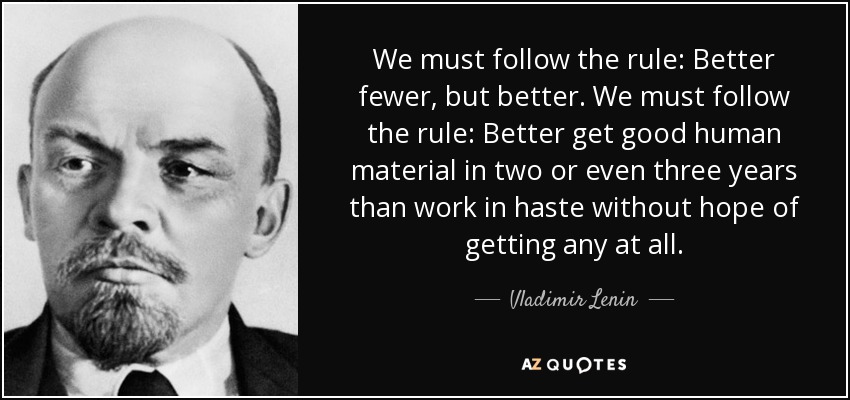
Good Human Material? Viewed from the outside, Labour offers less-and-less to anyone not already comfortable with the injunctions of political correctness. Lacking the “bullshit detectors” of ordinary men and women, progressive parties begin to mistake the technocratic prattle of “experts” for genuine political wisdom. The logical terminus of this trend is when party leaders start nodding approvingly at Lenin’s historic assertion that what the organisation needs are “fewer, but better” members.
 
HOW MANY MEMBERS does the Labour Party have in its centenary year? According to the veteran political journalist, Richard Harman, the answer is – not a lot.
 
Writing in his “Politik” blog on Monday, 23 May, Harman noted:
 
“Politik has learned that the party’s membership is now probably below that of the Greens, which would place it below 5000, possibly less than half that.”
 
If true, that is shocking news – and it’s only fair to point out that within 24 hours the Labour Party’s new General Secretary, Andrew Kirton, was assuring Harman that it was not true. “We are far, far higher than 5,000 and therefore well above the Greens.”
 
In spite of reassuring his readers that the contested information came from “a usually reliable source”, Harman was willing – as of Tuesday morning – to take Kirton at his word.
 
A more cynical person, upon being told by Labour’s General Secretary that the membership figure is “far, far higher than 5,000”, might offer, by way of response, the words of the infamous call-girl, Mandy Rice-Davies, who, when told that an Establishment big-wig had denied all knowledge of her, shot back the immortal line: “Well, he would say that, wouldn’t he?”
 
Certainly, it would be remarkable if a political party with fewer than 5,000 members entertained any serious hopes of becoming the Government. Though its current membership comes nowhere near the quarter-of-a-million figure bruited about in the 1970s, the National Party can still lay claim to being – by a wide margin – New Zealand’s largest political organisation. From its present muster of approximately 25,000, National’s goal is a paid-up membership of 35,000. It’s a measure of the party’s rude health that no one considers that figure to be beyond its reach.
 
Five thousand members, by contrast, is a perilously fragile base from which to launch a bid for state power. Divided by 64 (the number of General Electorates) 5,000 produces an average of just 78 members per electorate! Except that Labour in 2016, to a degree not seen since its formation in 1916, is a party of metropolitan New Zealand – meaning that in National’s provincial heartland its principal electoral opponent has next to no presence at all.
 
But the values of metropolitan New Zealand are not the values of provincial New Zealand – not by a long shot. And even in metropolitan New Zealand there is an important distinction to be made between the values of chic enclaves like Grey Lynn and Wadestown, and the vast suburban tracts that sprawl away from the centres of New Zealand’s largest cities. In the ‘‘burbs’, provincial values have a very familiar ring.
 
If Donald Trump wins the US Presidential Election in November it will be because the Democratic Party long ago lost all contact – and sympathy – with the ordinary voters of the suburbs and the “flyover” states. That “God and Guns” America to which Barack Obama condescended so loftily in 2008.
 
It is difficult to avoid making similar judgements about the New Zealand Labour Party. Too small, and too narrowly recruited, Labour’s membership hasn’t had to do battle with genuine conservatives for the best part of three decades. Progressivism is not improved by being unchallenged. Uncontested, its precepts all-too-easily harden into dogmatic certainties, against which no arguments are permitted to prevail. Lacking the ballast of conservative values, the organisation becomes increasingly vulnerable to erratic helmsmen.
 
Viewed from the outside, Labour offers less-and-less to anyone not already comfortable with the injunctions of political correctness. Lacking the “bullshit detectors” of ordinary men and women, progressive parties begin to mistake the technocratic prattle of “experts” for genuine political wisdom. The logical terminus of this trend is when party leaders start nodding approvingly at Lenin’s historic assertion that what the organisation needs are “fewer, but better” members.
 
Perhaps that is why Richard Harman was so willing to believe General Secretary Kirton’s assertion that Labour’s numbers are “far, far higher than 5,000”. Because to believe that 5,000 (let alone “less than half that”) is the true figure, is to more-or-less concede that New Zealand no longer possesses an Opposition worthy of the name.
 
Harman, like myself, is long enough in the tooth to remember what Labour looked like in the early 1980s, when it had 85,000 paid-up members. Unlike today’s shrunken entity, it looked like a Government-in-waiting.
 
This essay was originally published in The Waikato Times, The Taranaki Daily News, The Timaru Herald, The Otago Daily Times and The Greymouth Star of Friday, 27 May 2016.