
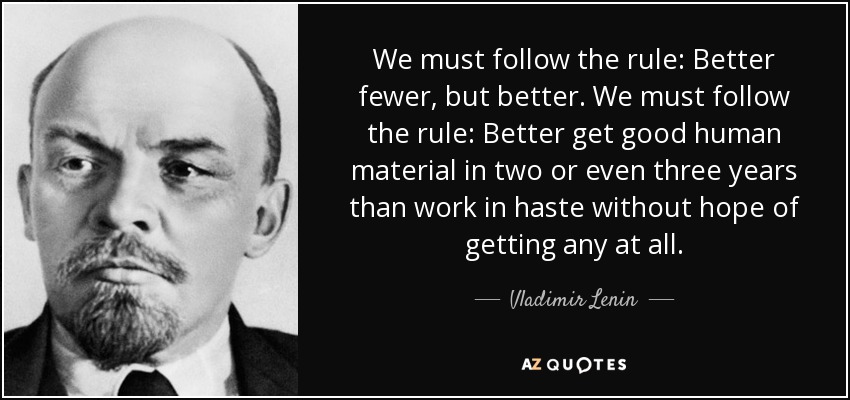
Good Human Material? Viewed from the outside, Labour offers less-and-less to anyone not already comfortable with the injunctions of political correctness. Lacking the “bullshit detectors” of ordinary men and women, progressive parties begin to mistake the technocratic prattle of “experts” for genuine political wisdom. The logical terminus of this trend is when party leaders start nodding approvingly at Lenin’s historic assertion that what the organisation needs are “fewer, but better” members.
HOW MANY MEMBERS does the Labour Party have in its centenary
year? According to the veteran political journalist, Richard Harman, the answer
is – not a lot.
Writing in his “Politik” blog on Monday, 23 May, Harman
noted:
“Politik has learned that the party’s membership is now
probably below that of the Greens, which would place it below 5000, possibly
less than half that.”
If true, that is shocking news – and it’s only fair to point
out that within 24 hours the Labour Party’s new General Secretary, Andrew
Kirton, was assuring Harman that it was not
true. “We are far, far higher than 5,000 and therefore well above the Greens.”
In spite of reassuring his readers that the contested
information came from “a usually reliable source”, Harman was willing – as of
Tuesday morning – to take Kirton at his word.
A more cynical person, upon being told by Labour’s General
Secretary that the membership figure is “far, far higher than 5,000”, might
offer, by way of response, the words of the infamous call-girl, Mandy
Rice-Davies, who, when told that an Establishment big-wig had denied all
knowledge of her, shot back the immortal line: “Well, he would say that,
wouldn’t he?”
Certainly, it would be remarkable if a political party with
fewer than 5,000 members entertained any serious hopes of becoming the
Government. Though its current membership comes nowhere near the
quarter-of-a-million figure bruited about in the 1970s, the National Party can
still lay claim to being – by a wide margin – New Zealand’s largest political
organisation. From its present muster of approximately 25,000, National’s goal
is a paid-up membership of 35,000. It’s a measure of the party’s rude health
that no one considers that figure to be beyond its reach.
Five thousand members, by contrast, is a perilously fragile
base from which to launch a bid for state power. Divided by 64 (the number of
General Electorates) 5,000 produces an average of just 78 members per
electorate! Except that Labour in 2016, to a degree not seen since its
formation in 1916, is a party of metropolitan New Zealand – meaning that in
National’s provincial heartland its principal electoral opponent has next to no
presence at all.
But the values of metropolitan New Zealand are not the
values of provincial New Zealand – not by a long shot. And even in metropolitan
New Zealand there is an important distinction to be made between the values of
chic enclaves like Grey Lynn and Wadestown, and the vast suburban tracts that
sprawl away from the centres of New Zealand’s largest cities. In the ‘‘burbs’,
provincial values have a very familiar ring.
If Donald Trump wins the US Presidential Election in
November it will be because the Democratic Party long ago lost all contact –
and sympathy – with the ordinary voters of the suburbs and the “flyover”
states. That “God and Guns” America to which Barack Obama condescended so
loftily in 2008.
It is difficult to avoid making similar judgements about the
New Zealand Labour Party. Too small, and too narrowly recruited, Labour’s
membership hasn’t had to do battle with genuine conservatives for the best part
of three decades. Progressivism is not improved by being unchallenged.
Uncontested, its precepts all-too-easily harden into dogmatic certainties,
against which no arguments are permitted to prevail. Lacking the ballast of
conservative values, the organisation becomes increasingly vulnerable to
erratic helmsmen.
Viewed from the outside, Labour offers less-and-less to
anyone not already comfortable with the injunctions of political correctness.
Lacking the “bullshit detectors” of ordinary men and women, progressive
parties begin to mistake the technocratic prattle of “experts” for genuine
political wisdom. The logical terminus of this trend is when party leaders start nodding approvingly at Lenin’s historic assertion that what the organisation needs are “fewer, but better” members.
Perhaps that is why Richard Harman was so willing to believe
General Secretary Kirton’s assertion that Labour’s numbers are “far, far higher
than 5,000”. Because to believe that 5,000 (let alone “less than half that”) is
the true figure, is to more-or-less concede that New Zealand no longer
possesses an Opposition worthy of the name.
Harman, like myself, is long enough in the tooth to remember
what Labour looked like in the early 1980s, when it had 85,000 paid-up members.
Unlike today’s shrunken entity, it looked like a Government-in-waiting.
This essay was
originally published in The Waikato Times, The Taranaki Daily News, The
Timaru Herald, The Otago Daily Times and The Greymouth Star of Friday, 27 May 2016.
