
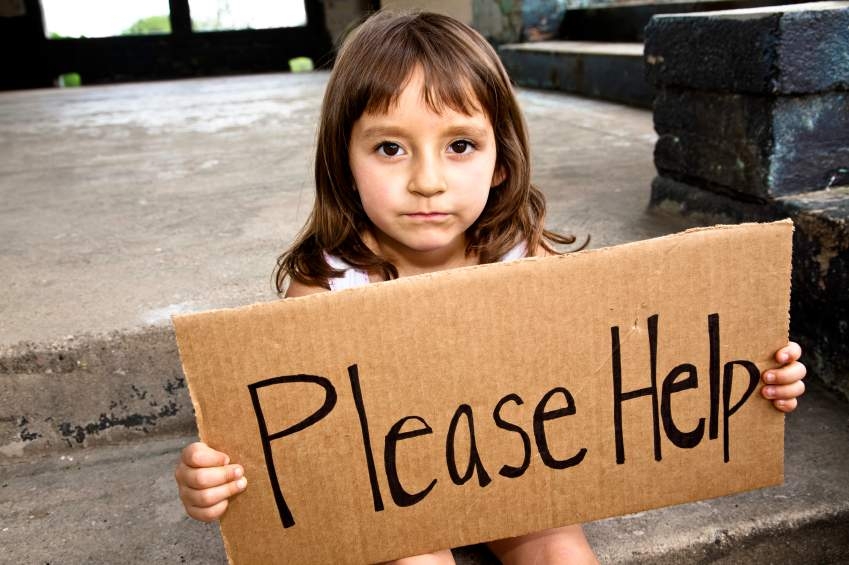
Simple Message - Contradictory Response: In the minds of many conservative New Zealanders a battle rages between their instinctive urge to protect and defend our species’ most vulnerable members, and an equally powerful conviction that their children, as extensions of themselves, constitute a form of personal property – over whom the community and/or the state should exercise only a strictly limited authority.
WHEN IT COMES to children, the attitudes of New Zealanders
are contradictory and hard to fathom. On the one hand, we respond with genuine anguish
to media accounts of infants fallen victim to adult violence. On the other, we
sign monster petitions demanding the right to administer corporal punishment to
our own children. If asked, we will agree emphatically that “the needs of the
child must always come first”. But, when welfare agencies and anti-poverty
campaigners attempt to do just that, we attack them for undermining parental
responsibility.
It’s as if, in the mind of every Kiwi, a battle rages
between the instinctive urge to protect and defend our species’ most vulnerable
members; and an equally powerful conviction that our children, as extensions of
ourselves, constitute a form of personal property – over whom the community
and/or the state should exercise only a strictly limited authority.
Nowhere are these contradictory impulses more clearly on
display than in the current debate over whether or not our schools should
provide their pupils with meals. Wrapped around this narrowly-focused proposal
to “Feed the Kids” is a much wider debate about whether or not a substantial
minority of New Zealand children (estimated at 270,000) are living in poverty.
Conservative New Zealanders take umbrage at the very
suggestion that such a large number of their fellow citizens could be living in
such conditions. They simply deny that child poverty exists. What they believe
New Zealand is witnessing, in the children who arrive at school every morning
hungry, unshod and ill-clothed, is evidence not of inadequate resources, but of
poor parenting.
According to these conservative New Zealanders, thousands of
Kiwi parents are making poor choices about their priorities. What’s more, the
institutions of the welfare state, by failing to impose a more appropriate set
of priorities and enforce more sensible parental choices, have ensured that the
perfectly adequate resources allocated to welfare beneficiaries are both
misapplied and misspent.
Underpinning this conservative view is what can only be
described as an alarmingly eugenicist set of assumptions.
So many poor parental choices, the conservatives argue, is
proof that a certain (and seemingly quite large) percentage of the population
are simply not up to the role of parenting. The straightforward, and brutal,
solution? Do not allow such people to breed – or, if they do, take away their
children and place them with couples whose parental choices pass muster.
It was this sort of thinking that, in Australia, led to the
“Stolen Generation”. Thousands of Aboriginal children were forcibly taken from
their parents and placed with God-fearing, upstanding, middle-class White
Australians. The parental choices of the latter, it was assumed, would be far
superior to those of Aboriginal Australians. The cycle of poverty and abuse
which plagued indigenous communities could thus be broken, and in just a few
generations the Aboriginal “problem” would disappear.
The colossal failure of imagination which the “Stolen
Generation” policy represented; the singular lack of empathy which made its
implementation such a shameful chapter in Australian history; similarly
disfigures the analysis of New Zealand’s conservatives.
It is common to hear talkback callers and conservative
commentators declare that no matter how hard family life has become and no
matter how tough their financial circumstances, no parent should ever be
excused for allowing their child to go to school hungry.
The mental, physical and moral disintegration afflicting
individuals subjected to prolonged periods of social isolation and material
deprivation is well-attested in the academic literature. The collapse of
self-esteem; the recourse to alcohol and drugs as a means of deadening intense
emotional distress; the increased propensity to explosive episodes of violence
and self-harm: all of these symptoms – the entirely predictable consequences of
poverty – are encountered by WINZ staff, police officers, social-workers, GPs,
practice nurses and teachers every day of the week. They are not, however,
encountered with any frequency by those who claim there is no excuse for
sending a child to school hungry.
The conservatives have become intellectually immune to even
the logical inconsistencies of their hard-line attitudes. They refuse to
differentiate the weak and broken-spirited adults of their analysis from the
innocent and suffering children. As mere extensions of the pathetic
human-beings they were foolish enough to choose as their mothers and fathers,
the children of poverty are clearly expected to go down
with the parental ship.
The polarisation of New Zealand society into “comfortable”
and “struggling” has been accompanied by a not unrelated polarisation of
political convictions. Among the comfortably-off we are witnessing a wholesale
rejection of the paternalism which characterised the politics of earlier conservative
leaders like Gordon Coates and Keith Holyoake. In its place we find a new
enthusiasm for the politics of exclusion, punishment and shame.
As if our children’s only role is to embody for posterity
their parents’ blameless success or guilty failure.
This essay was
originally published by The Press of Tuesday,
21 May 2013.

