Showing posts with label State of Emergency. Show all posts

Friday, 8 May 2020

The Safety Of The People Shall Be The Highest Law.

Salus populi suprema lex
The safety of the people shall be the highest law.
- Marcus Tullius Cicero (106-43 BC) Roman Jurist and Statesman

SIMON BRIDGES and his supporters (witting and unwitting) aren’t quite chanting “Lock her up!” Not yet anyway. But they’re headed in that general direction. Faced with a prime ministerial performance that the rest of the world, and most of her own compatriots, have judged to be outstanding, the Right, in desperation, is attempting to criminalise Jacinda Ardern’s “Go Early – Go Hard” strategy against the Covid-19 Pandemic. Shown the way by a couple of liberal professors, Bridges and his media allies are now demanding to know the legal basis for locking down New Zealand. If the Cabinet’s decision, made in haste under extreme conditions, is deemed to be ultra vires (beyond its powers) the way will be opened to endless and politically vexatious litigation.

What these legal purists and panic-stricken politicians do not appear to understand is that if it is the people who are ultimately the fount of all legal authority, then those same people must also possess the power, in extremis, and in the interests of keeping themselves and their loved ones safe, to elevate that existential imperative above all other legal and juridical considerations. With an election looming, any political party foolish enough to attempt to punish Jacinda Ardern and her team for keeping New Zealanders safe will be punished severely at the ballot box. And, if the people are not the ultimate source of all legal authority, well then, who is? Law professors? Lobbyists? The National Party!

The declaration of a State of Emergency is, by its very nature, an exceptional occurrence. Among the most extreme of all the powers wielded by executive authority, it is reserved for those moments when the normal appurtenances of state power are no longer deemed sufficient to maintain public safety. That only those constitutionally sanctioned to do so can declare a State of Emergency is less important than whether or not the persons so empowered believe that such a declaration will be effective. The declaration of a State of Emergency which does not enjoy broad popular support is, in effect, a declaration of war by the state upon its own citizens. Or, to put it another way: the safety of the people can only be maintained by exceptional legal means if the people themselves feel sufficiently threatened to abandon legal norms.

But who, in these situations, falls within the definition of “the people”? Clearly, not everyone can be included if the threat is located within the borders of the state. A nation under foreign attack; responding to a natural disaster; or facing down a global pandemic; will have no difficulty in accepting emergency regulations. Declaring a State of Emergency in the context of a political and/or economic challenge to the smooth functioning of society, however, is a much riskier proposition. Interfering with the free movement of individuals and/or the free disposition of their property in such circumstances can only be made effective by excluding the challenger/s from the usual definition of “the people”. For emergency measures to succeed, such individuals or groups they must first be transformed into “the enemy within”.

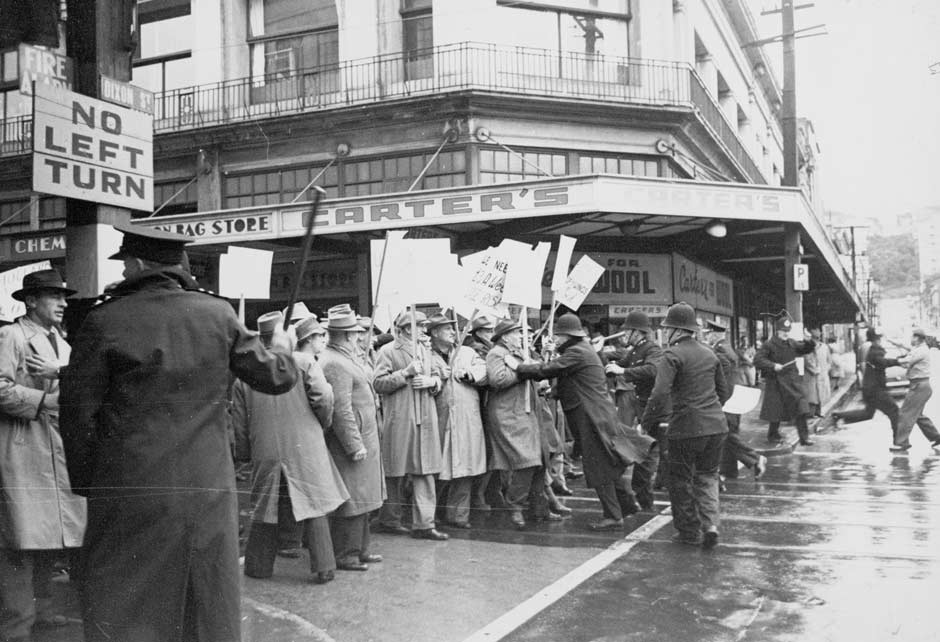
This what happened during the last great extended State of Emergency in New Zealand history: the 1951 Waterfront Dispute. The National Party Prime Minister of the day, Sid Holland and his uncompromising Minister of Labour, William “Big Bill” Sullivan, were able to brand the Waterside Workers Union “wreckers” and curtail their rights because the dispute arose in a context that made the demonization of the watersiders and their allies considerably easier than it would have been at just about any other time.

The Cold War had just turned “hot” in Korea. The militant trade unions had walked out of the Federation of Labour and viciously attacked its leaders: a situation which played into the hands of the FOL’s Machiavellian “boss”, Fintain Patrick Walsh. Between 1946 and 1949, the Labour Party, itself, had quite deliberately isolated, vilified and, in at least one instance, deregistered, militant, communist-led trade unions. This vilification, especially of the Waterside Workers Union, had continued on the pages of the country’s newspapers (most effectively through Gordon Minhinnick’s cartoons in The NZ Herald). Holland and Sullivan could, therefore, rely upon Walsh, the FOL and the daily press to back any attack on the WWU. They could also, crucially, be relatively confident that the Labour Party would remain neutral in the ensuing industrial war.

Because it controlled one of the economy’s crucial choke-points, the wharfies’ union had always been vulnerable to a government determined to destroy its power. Any lengthy period of industrial action could be successfully portrayed as constituting a clear and present danger, not only to the country’s exporters and importers, but to the whole community. This was due to the fact that in the 1950s vast quantities of everyday items were still distributed around the country by ship. Holland was able to argue that shutting down New Zealand’s ports constituted a very real threat to the public safety. As a consequence, his invocation of the draconian Public Safety Conservation Act (1932) was held to be justifiable.

It was enough – just – for the majority of New Zealanders to accept the National Government’s comprehensive restriction of their civil liberties, and the harsh persecution of their fellow citizens, that Holland’s quasi-fascist Emergency Regulations permitted. Had the Korean War not been raging; had the FOL not been split; had Labour been less hostile to the trade union left; and had the public been less vulnerable to a protracted shut-down of New Zealand’s ports; then the National Government probably wouldn’t have risked declaring a State of Emergency. But, with all these factors working in its favour, and with its decisive victory in the Snap Election which Holland called to secure the electorate’s ex post facto endorsement of his treatment of the watersiders, the National Party was given ample proof that, for most Kiwis, the famous maxim of the Roman statesman, Cicero: Salus populi suprema lex; the safety of the people shall be the highest law; was indisputable

In the light of New Zealanders’ conscientious adherence to the “Unite Against Covid-19” rules, Cicero’s maxim continues to meet with their approval. Kiwi acceptance of draconian emergency measures cannot be guaranteed, however, in the absence of two crucial provisos: 1) An overwhelming majority of the people must believe that the threat to their safety is real. 2) They must also be convinced that only the imposition of extreme measures will avert a national catastrophe.

Neither of these provisos applied to the political crisis confronting New Zealand in 1981. Invoking the provisions of the Public Safety Conservation Act was a move the Rob Muldoon-led National Government was unwilling to make in relation to that year’s highly controversial Springbok Tour. It knew that there was insufficient support across the whole country for hard-line emergency measures to be enforced without the use of deadly force. Such was the temper of the country in 1981 that the killing of protesters by police or soldiers would only have made the disorder on the nation’s streets ten times worse.

New Zealand history thus confirms that its people are, indeed, the best judges of their own political security, and will make an exception to the rule of law only when they believe their own and their loved ones’ safety is genuinely imperilled.

The Jacinda Ardern-led Coalition Government is the first since 1951 which, confronted with a clear and present danger to the public’s safety, has felt confident enough of their broad support to promulgate and enforce a stringent emergency regime of indefinite duration. The New Zealand people’s subsequent willingness to “Unite Against Covid-19” constitutes a ringing endorsement of both the Ardern-led Government and Cicero’s militant-democratic slogan.

As their own constitutional guardians, the people are uniquely positioned to recognise those (thankfully rare) moments when the only effective means of keeping themselves safe is by allowing their leaders to operate (temporarily) outside the black letters of the law. And woe betide anyone who tries to stop them!

This essay was originally posted on The Daily Blog of Friday, 8 May 2020.

Monday, 21 May 2012

The Safety Of The People

Salus Populi Suprema Lex: The safety of the people shall be the highest law. The Roman statesman and jurist, Marcus Tullius Cicero (106-43 BC) understood that there are times (in his own case, when Julius Caesar's faction threatened to overthrow the Roman Republic) when, in order to preserve the protection of the laws, it is necessary to set them aside.

A JUST REBUKE merits a considered response. I had answered “Lew’s” (at Kiwipolitico) critique of my, ‘In A Weakened State’ posting (11/5/12) with a single quotation from the Roman jurist and statesman, Cicero: Salus populi suprema lex (The safety of the people shall be the highest law). This clearly riled Otago law professor, Andrew Geddis, who spat back caustically: “I’m pretty sure that’s what Sid Holland and William Sullivan had tattooed on their biceps back in 1951 … . Or is it only an acceptable slogan when deployed by a ‘leftist’?”

I’m sure Professor Geddis is right. I think it highly likely that National’s Sid Holland (a member of the quasi-fascist New Zealand Legion in the 1930s, a rabid anti-communist and a fanatical Cold Warrior) genuinely believed he was safeguarding the New Zealand people when he brought down the notorious Emergency Regulations of 1951. I’m equally sure that the Labour Prime Minister, Norman Kirk, believed he was doing the same when, in July 1974, he asked his acting Attorney-General, Roger Douglas, to prepare for the declaration of a State of Emergency under the 1932 Public Safety Conservation Act. (How Cicero would have loved that name!)

“Big Norm’s” feelings about communist-led unions were almost as strong as Sid’s. In July 1974, incensed by the massive and economically disruptive rank-and-file reaction to the arrest of the Northern Drivers’ Union secretary and avowed communist, Bill Andersen, for defying a court injunction, the Labour prime minister made ready to confront the entire trade union movement. According to Kirk’s private secretary, Margaret Hayward, recalling these events in her Diary of the Kirk Years, the Prime Minister asked her to “sound out” union opinion. “In Auckland, I found, many unions held the attitude, ‘if they want another 1951 we’ll give it to them’”. Fortunately for Big Norm’s progressive political legacy, cooler heads prevailed and the threatened confrontation was avoided.

The declaration of a State of Emergency is, by its very nature, an exceptional occurrence. Among the most extreme of all the powers wielded by executive authority, it is reserved for those moments when the normal appurtenances of state power are no longer deemed sufficient to maintain public safety. That only those constitutionally sanctioned to do so can declare a State of Emergency is less important than whether or not the persons so empowered believe such a declaration will be effective. The declaration of a State of Emergency which cannot be enforced is, in effect, a declaration of war by the State upon its own citizens. Or, to put it another way: the safety of the people can only be maintained by exceptional legal means if the people themselves feel sufficiently threatened to abandon legal norms.

But who, in these situations, falls within the definition of “the people”? Clearly, not everyone can be included in “the public” if the threat to the latter’s safety is located within the borders of the State. A nation under foreign attack, or in the grip of a natural disaster, will have no difficulty in accepting emergency regulations; but a State of Emergency declared in the context of a political and/or economic challenge to the smooth functioning of society – especially one interfering with the free movement of individuals and the free disposition of private property – can only be made effective by excluding the challenger/s from the usual definition of “the people”. For emergency measures to succeed their targets must be transformed into non-citizens. They must become “the enemy within”.

Sid Holland and his Labour Minister, William “Big Bill” Sullivan, were able to do this in 1951 because the dispute on the waterfront occurred in a context that made the demonization of the watersiders and their allies considerably easier than it would have been at just about any other time. The Cold War had just turned “hot” in Korea. The militant trade unions had walked out of the Federation of Labour and viciously attacked its leaders; a situation which played into the hands of the devious “boss” of the FOL, Fintain Patrick Walsh. Between 1946 and 1949, the Labour Party, itself, had quite deliberately isolated, vilified and, in at least one instance, deregistered, militant, communist-led trade unions. This vilification, especially of the Waterside Workers Union, had continued on the pages of the country’s newspapers (most effectively through Gordon Minhinnick’s cartoons in The NZ Herald). Holland and Sullivan could, therefore, rely upon Walsh, the FOL and the daily press to back any attack on the WWU. He could also, crucially, be relatively confident that the Labour Party would remain neutral when he did.

The wharfies were also particularly vulnerable to economic attack. Because they controlled one of the economy’s crucial choke-points, any lengthy period of industrial action could be successfully portrayed as constituting a clear and present danger, not only to the country’s exporters and importers, but also, because vast quantities of everyday items were still distributed by ship in the 1950s, to the whole community. Shutting down New Zealand’s ports, argued Holland, was a very real threat to the public safety, and his invocation of the Public Safety Conservation Act (1932) was, therefore, presented as entirely justified.

Draconian Restrictions: In the name of "public safety" the National Government of Sid Holland suspended the rights to free speech and peaceable assembly.

It was enough – just – for the majority of New Zealanders to accept the draconian restriction of their civil liberties, and the harsh persecution of their fellow citizens, that the Emergency Regulations permitted. Had the Korean War not been raging; had the FOL not been split; had Labour been less hostile to the trade union Left; and had the public been less vulnerable to a protracted shut-down of New Zealand’s ports; then the National Government probably wouldn’t have risked declaring a State of Emergency. But, with these factors working in its favour, and with its decisive victory in the Snap Election called by Holland to secure the electorate’s ex post facto endorsement of his treatment of the watersiders, the National Party was given ample proof that, for most Kiwis, Cicero’s maxim: Salus populi suprema lex; the safety of the people shall be the highest law; was no more than the truth.

It remains, I suspect, “an acceptable slogan” for parties of both the Right and the Left to this very day – with these two crucial provisos: 1) A substantial majority of the people must believe their security to be in jeopardy. 2) They must also be convinced that only the imposition of draconian repressive measures against those threatening their safety will avert social disaster.

Neither of these crucial conditions existed in 1974. Not only was the trade union movement at the peak of its post-war power (here in New Zealand and around the world) but New Zealand society in general was in an expansive mood. Young New Zealanders, in particular, would have been most unlikely to see the declaration of a State of Emergency as either justified or endurable. As Margaret Hayward’s “soundings” made clear to the PM, the prospect of dividing-and-conquering the working-class, on the model of 1951, simply wasn’t there in 1974. The FOL would have been united in its opposition, and would almost certainly have been joined on the streets by tens-of-thousands of university students. The prospect of the Police and the armed forces enforcing draconian emergency regulations in the face of mass strikes and demonstrations, without serious loss of life, was bleak. Hence the very sensible decision by Kirk and his Cabinet to pursue a negotiated settlement.

 Power Surge: The massive rank-and-file response to the arrest, in July 1974, of their communist leader, Bill Andersen, for defying a court injunction, incensed the Labour leader, Norman Kirk. But the temper of the times was too rebellious for him to risk a repeat of 1951.

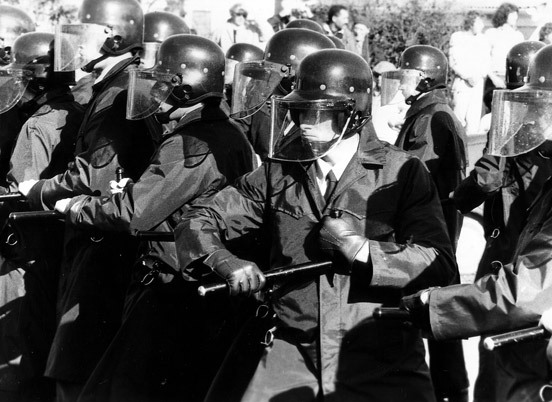
Further evidence of the difficulty in using the provisions of the Public Safety Conservation Act (1932) is provided by the way in which the Muldoon-led National Government chose to police the 1981 Springbok Tour. Unlike his predecessor, Sid Holland, Prime Minister Rob Muldoon did not feel confident enough to invoke emergency powers. Once again, this was because there was insufficient support across the whole country for such measures to be enforced without the use of deadly force. Such was the temper of the country in 1981 that the killing of protesters by police or soldiers would only have increased the numbers of people taking to the streets.

Team Policing: In 1981 not even the pugnacious Rob Muldoon was confident enough to suppress all protest activity by declaring a State of Emergency. Such was the level of public opposition to apartheid that, had he dared, it is likely only deadly force would have allowed the Springbok Tour to proceed.

New Zealand history thus confirms that its people are, indeed, the best judges of their own safety, and will make an exception to the rule of law only when they believe their security is genuinely threatened. That no government, since 1951, has felt certain enough of the public’s broad support to declare such an exception constitutes a ringing endorsement of Cicero’s uncompromising maxim. As their own constitutional guardians, the people are uniquely positioned to recognise those (thankfully rare) moments when the only effective means of preserving the protection of the laws – is to set them, temporarily, aside.

This posting is exclusive to the Bowalley Road blogsite.