Showing posts with label The Rule of Law. Show all posts

Wednesday, 25 August 2021

Labour Must Uphold The Rule Of Law

The Equal Application Of The Laws: There is only so much a judicial system, or any other important part of the state apparatus, will stand before it moves to defend itself. Judges and lawyers cannot be expected to turn a blind eye to egregious breaches of legal norms. As Officers of the Court, it is their sworn duty to uphold the law. They cannot be asked to treat one category of citizen better or worse than another, nor are they permitted to stand back and see injustice done without taking steps to prevent it.

WHEN DAILY BLOG Editor, Martyn Bradbury, says Labour’s lucky the country’s currently distracted by the Covid-19 Delta Variant, he’s right. Were New Zealand safe and out of Lockdown, it would be in the midst of a dangerously divisive row about Oranga Tamariki, the Judiciary, Race, and the Rule of Law.

Given that the matters at the heart of this controversy are sub judice (i.e. under the authority of the court) I shall forbear from discussing the particular case in question. What must be discussed, however, is the direction in which Māori-Pakeha relations are travelling, and exactly what it would take for this government to intervene.

There is only so much a judicial system, or any other important part of the state apparatus, will stand before it moves to defend itself. Judges and lawyers cannot be expected to turn a blind eye to egregious breaches of legal norms. As Officers of the Court, it is their sworn duty to uphold the law. They cannot be asked to treat one category of citizen better or worse than another, nor are they permitted to stand back and see injustice done without taking steps to prevent it.

Attempts to racialise New Zealand’s courts are bound to provoke significant public disquiet. So, too, will any attempt by the Crown to influence the outcome of trials, or civil cases, by exerting unwarranted pressure on judicial officers. Any government made aware of such behaviour has a duty to act decisively to uphold the Rule of Law. Those responsible must be held to account for their actions.

Though the mere mention of the He Puapua Report will elicit the usual protests from the usual suspects, the events highlighted by The Daily Blog’s editor raise vital issues about what inferences the Crown is allowing and/or encouraging Māori to draw from its recommendations.

Any failure to uphold the equal application of the laws, on the grounds that a separate Māori justice system will soon replace the long-established principle of “one law for all”, will be taken as proof that this government intends to change profoundly the constitutional and judicial arrangements of the New Zealand state.

Such a fundamental change to the manner in which justice is administered in New Zealand, especially one predicated on ethnic and cultural considerations, could have no legitimacy without having first secured the endorsement, by way of referendum, of a majority of New Zealand citizens.

To suggest that the articles of the Treaty of Waitangi in some way obviate the Crown’s need to obtain the consent of the New Zealand electorate before changing the way justice is administered, and by whom, is tantamount to suggesting that the Treaty legally entitles the Crown to extinguish democracy in the Realm of New Zealand without reference to its citizens and in defiance of its laws.

Such action would constitute a declaration of war upon the people of this country. Any government participating in such an open attack on the civil and political rights of its citizens would immediately identify itself as their enemy, and forfeit all claims to their continuing loyalty. It would be responsible for unleashing civil war upon New Zealand.

The Labour Government’s silence on these matters is indefensible. A clear statement of its determination to uphold the Rule of Law and protect the democratic rights of all New Zealanders is long overdue.


This essay was originally posted on The Daily Blog of Tuesday, 24 August 2021.

Saturday, 22 August 2020

Laws Do Not Rule – People Do

Trying Our Patience: Quite rightly did the nineteenth century British novelist, Charles Dickens, proclaim: “The law is an ass!” Laws do not rule – people do. This is the incontrovertible fact which Mr Andrew Borrowdale, the man who required the High Court to rule on his challenges to the legality of the Covid-19 Lockdown, singularly failed to grasp.

THE ENABLING ACT was passed by the Reichstag on 23 March 1933. With this single piece of legislation, every act of the Reich Government and its Chancellor, Adolf Hitler, was given the force of law. Any conscientious German lawyer seeking to test the legality of the Nazis’ subsequent, democracy-crushing, edicts in Germany’s highest courts, would have been reassured that the “Rule of Law” remained inviolate.

 Quite rightly did the nineteenth century British novelist, Charles Dickens, proclaim: “The law is an ass!” Laws do not rule – people do. This is the incontrovertible fact which Mr Andrew Borrowdale, the man who required the High Court to rule on his challenges to the legality of the Covid-19 Lockdown, singularly failed to grasp.

 Not that Mr Borrowdale lacked encouragement for his Quixotic endeavour. All manner of pedants and purists were quick to figuratively pat him on the back for his services to the “Rule of Law”. As if the judgement of a few lawyers – albeit lawyers in flowing robes and horsehair wigs – should somehow be permitted to stand above the straightforward, self-protective judgements of ordinary men and women threatened by a global pandemic. As if the decisions made by the people’s elected representatives – for their protection – can be reasonably and responsibly struck down by a gaggle of job-for-life jurists elected by nobody at all.

 Thank God the judges of the High Court turned out to be a great deal more intelligent than the individuals who put so much stock in Mr Borrowdale’s appeal. Andrew Geddes, a law professor at the University of Otago summed it up nicely:

 “So it’s not that the Court got the decision wrong. Rather, it seems clear that the Court’s perception of its job, and the law at issue, was very much coloured by the same collective concerns that drove the government’s response to the virus. Preventing lots of people from dying from a disease is perhaps the government’s highest obligation, and the law has to be seen as enabling the government to carry out that task.”

 Or, as the celebrated Roman statesman, Marcus Tullius Cicero (106-43 BCE) so succinctly put it: Salus populi suprema lex – The safety of the people shall be the highest law.

 Obviously, preserving the people’s safety is, above all else, a political obligation – not least on the part of the people themselves. Consider the passage of the Enabling Act in 1933. Had the German Social Democrats and Communists not been at daggers drawn; had the German army not been so consumed by its desire to wipe out the humiliations of the Treaty of Versailles; then the farcical conditions in which the Enabling Act was passed (the German parliament was ringed with Nazi Stormtroopers, and the Communist Party MPs, having all been taken into “protective custody”, were absent from the Chamber) could not have arisen.

 Thirteen years earlier, in 1920, an attempt by extreme German nationalists, backed by the army and right-wing paramilitaries, to overthrow the Weimar Republic had been foiled by the decisive action of the Social-Democratic Party-led government. Its call for all German workers and civil servants to come out in a nationwide general strike was backed by all the other parties of the German Left. Twelve million workers and civil servants responded. The country ground to a halt. It was the largest and most successful strike in Germany’s history. The so-called “Kapp Putsch” collapsed.

 Three years after Kapp, in 1923, Adolf Hitler’s attempt to stage his own putsch (coup) was foiled by the Munich police. Formed up in a skirmish-line, the armed policemen ordered Hitler’s brownshirts to halt their march through the city. The Nazis (also armed) refused and came on. The Police commander gave the order to open fire. Those Nazis who still could (sixteen of them were killed) fled.

 In both cases, the German judiciary had nothing useful to contribute. It was not the Rule of Law which saved the Weimar Republic in 1920 and 1923, but the German people themselves. Just as, in 1933, it was not the Rule of Law which transferred all effective executive power into the hands of a political psychopath. That was the work of a Depression-ravaged and politically exhausted German population – just enough of whom were ready to trade their liberty and decency for economic security and an end to the Weimar Republic’s intractable political divisions. As clear a case of “be careful what you wish for” as one could hope for.

 In New Zealand, in 2020, the people have also prevailed. A leader they trusted, and who very clearly had their interests at heart, implored New Zealanders to unite against Covid-19 by staying home inside their bubbles. The New Zealand people responded by doing just that. Thus did Jacinda Ardern’s prioritisation of her fellow citizens’ welfare elevate her words to the status of suprema lex – the highest law.

 Jacinda acted hard and early on our behalf, and we should all be exceedingly grateful that she refused to abdicate her responsibility to the courts. That the courts appear to agree is welcome proof that there are at least three judges left in New Zealand who still understand Latin.


This essay was originally posted on The Daily Blog of Friday, 21 August 2020.

Tuesday, 30 October 2012

Because They Can

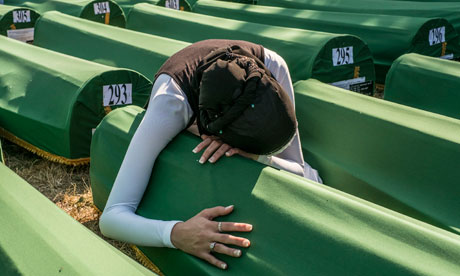
Beyond The Law: A mother embraces all that remains of her son - murdered by the Serbs at Sebrinecia. When the possibility of being held to account disappears, so too do all the "normal" and "decent" restraints of civilised living. If the State breaks the law, then there is no law - and no one is safe.
 
THEY HAD LIVED next door to one another for years. Their children went to the same schools. The men worked in the same fields. Everyone drank the same water, breathed the same air.
 
So what caused one neighbour to fall upon the other so savagely? Shoot to death the father and the sons in their own garden? Rape the mother and daughter in their own kitchen?
 
The world watched, horrified, as the people of what had been Yugoslavia tore their country, and themselves, to pieces in the early 1990s.
 
The bleak lesson of those dreadful times is clear. When there is no possibility of being held to account for their actions, perfectly “normal” and “decent” people become willing participants in the most horrendous crimes.
 
Because they can.
 
Because no one will punish them for doing so.
 
Thinking about such things makes us uncomfortable. It makes us question the meaning of “normal” and “decent”. It makes us wonder if those who speak about “original sin” might have a point. And if the veneer of civilisation might be no more substantial than a bloodstain – and just as easily wiped away.
 
It should make us value all the more the protocols of law and justice. But most of all it should make us acutely sensitive to the words and actions of those in authority over us. Because it is from these figures that the cues invariably come. Stark or subtle, it is their messages that prime us, alert us, incite us and reassure us that from some groups in society the protection of the law has been withdrawn; that they are now fair game; we can do what we like to them. No one will come to punish us. No one will be held to account.
 
And so, to Justice Simon France, we all owe a huge debt of gratitude. This week he placed himself athwart the road that leads to the death of accountability, social safety and personal liberty and said “No further!”
 
The New Zealand Police, or at least the Organised Financial Crime Authority of New Zealand (Ofcanz), had decided that for one particular group of citizens, in this case members of the Red Devils Motorcycle Club, the law could be broken with impunity. To convict men they’d already adjudged guilty and considered enemies of all “normal” and “decent” people, Ofcanz officers believed it right and proper that the Executive and Judicial arms of the state should join forces. That secretly, and in conscious manipulation of the law, they should help a Police undercover agent bring these enemies of the people (organised criminals! drug-dealers!) to “justice”.
 
When I read about Justice France’s decision to stay the prosecution of the Red Devils Motorcycle Club, and was then forced to listen to the outraged response of the Police Association’s Greg O’Connor, I was reminded of the line spoken by the eponymous hero of the hit 1971 counter-culture movie, Billy Jack.
 
Warned that the blatantly illegal actions of a wealthy rancher were sanctioned by the presence of a corrupt local deputy sheriff, Billy Jack says: “When policemen break the law, then there isn’t any law – just a struggle for survival.”
 
Why couldn’t Greg O’Connor have said that? Why couldn’t he have stood up for every honest police officer? Why wasn’t he the first to say that such behaviour was unacceptable and that those responsible must be called to account?
 
More importantly, why wasn’t the Minister of Police, Anne Tolley, willing to say it? Why wasn’t the Prime Minister?
 
Our political leaders are supposed to be the guardians of our rights and liberties. They are supposed to understand and uphold the doctrine of the separation of powers. They are supposed to have sufficient grasp of basic ethical principles to know that “the end justifies the means” is always the first, irrevocable step down the road to perdition.
 
That they appear not to understand these responsibilities to their fellow citizens should make us feel uncomfortable – very uncomfortable. Their public statements – which can hardly be interpreted as anything other than a vote of confidence in the behaviour of the police officers whose actions were so roundly condemned by a senior member of the judiciary – are equally discomforting.
 
Because they are cues; not-so-subtle hints that this is the direction in which we can expect government policy to go. And in no time at all columnists and commentators of like mind were picking-up on their cues; expanding and amplifying their hints.
 
Who are these judges? Why aren’t they lending the Police a hand, instead of protecting these criminals? Who cares about the rights of these “terrorists”? What about the rights of the “good people of Nelson”?
 
No doubt the “good people” of all those Yugoslavian villages heard their leaders asking very similar questions.
 
Right before they butchered their neighbours.
 
This essay was originally published in The Press of Tuesday, 30 October 2012.

Thursday, 25 October 2012

Memo. To: Greg O'Connor From: Billy Jack


"When policemen break the law, then there isn't any law - just a fight for survival."

-  Billy Jack*

*Hero of the 1971 movie Billy Jack, which became a counter-culture hit all over the English-speaking world. Billy was part Native American and all Green Beret (until he quit the special forces in disgust at what was happening in Vietnam and returned stateside to get in touch with his indigenous heritage). Billy's mastery of the martial arts, combined with his radical political views, not only made him "right-on" but also right handy when a wealthy rancher, his redneck bully of a son and the corrupt local deputy-sheriff started making life difficult for the troubled kids up at the "Freedom School" on the nearby reservation. The movie's theme-song, One Tin Soldier, may be listened to here.

This posting is exclusive to the Bowalley Road blogsite

Monday, 21 May 2012

The Safety Of The People

Salus Populi Suprema Lex: The safety of the people shall be the highest law. The Roman statesman and jurist, Marcus Tullius Cicero (106-43 BC) understood that there are times (in his own case, when Julius Caesar's faction threatened to overthrow the Roman Republic) when, in order to preserve the protection of the laws, it is necessary to set them aside.

A JUST REBUKE merits a considered response. I had answered “Lew’s” (at Kiwipolitico) critique of my, ‘In A Weakened State’ posting (11/5/12) with a single quotation from the Roman jurist and statesman, Cicero: Salus populi suprema lex (The safety of the people shall be the highest law). This clearly riled Otago law professor, Andrew Geddis, who spat back caustically: “I’m pretty sure that’s what Sid Holland and William Sullivan had tattooed on their biceps back in 1951 … . Or is it only an acceptable slogan when deployed by a ‘leftist’?”

I’m sure Professor Geddis is right. I think it highly likely that National’s Sid Holland (a member of the quasi-fascist New Zealand Legion in the 1930s, a rabid anti-communist and a fanatical Cold Warrior) genuinely believed he was safeguarding the New Zealand people when he brought down the notorious Emergency Regulations of 1951. I’m equally sure that the Labour Prime Minister, Norman Kirk, believed he was doing the same when, in July 1974, he asked his acting Attorney-General, Roger Douglas, to prepare for the declaration of a State of Emergency under the 1932 Public Safety Conservation Act. (How Cicero would have loved that name!)

“Big Norm’s” feelings about communist-led unions were almost as strong as Sid’s. In July 1974, incensed by the massive and economically disruptive rank-and-file reaction to the arrest of the Northern Drivers’ Union secretary and avowed communist, Bill Andersen, for defying a court injunction, the Labour prime minister made ready to confront the entire trade union movement. According to Kirk’s private secretary, Margaret Hayward, recalling these events in her Diary of the Kirk Years, the Prime Minister asked her to “sound out” union opinion. “In Auckland, I found, many unions held the attitude, ‘if they want another 1951 we’ll give it to them’”. Fortunately for Big Norm’s progressive political legacy, cooler heads prevailed and the threatened confrontation was avoided.

The declaration of a State of Emergency is, by its very nature, an exceptional occurrence. Among the most extreme of all the powers wielded by executive authority, it is reserved for those moments when the normal appurtenances of state power are no longer deemed sufficient to maintain public safety. That only those constitutionally sanctioned to do so can declare a State of Emergency is less important than whether or not the persons so empowered believe such a declaration will be effective. The declaration of a State of Emergency which cannot be enforced is, in effect, a declaration of war by the State upon its own citizens. Or, to put it another way: the safety of the people can only be maintained by exceptional legal means if the people themselves feel sufficiently threatened to abandon legal norms.

But who, in these situations, falls within the definition of “the people”? Clearly, not everyone can be included in “the public” if the threat to the latter’s safety is located within the borders of the State. A nation under foreign attack, or in the grip of a natural disaster, will have no difficulty in accepting emergency regulations; but a State of Emergency declared in the context of a political and/or economic challenge to the smooth functioning of society – especially one interfering with the free movement of individuals and the free disposition of private property – can only be made effective by excluding the challenger/s from the usual definition of “the people”. For emergency measures to succeed their targets must be transformed into non-citizens. They must become “the enemy within”.

Sid Holland and his Labour Minister, William “Big Bill” Sullivan, were able to do this in 1951 because the dispute on the waterfront occurred in a context that made the demonization of the watersiders and their allies considerably easier than it would have been at just about any other time. The Cold War had just turned “hot” in Korea. The militant trade unions had walked out of the Federation of Labour and viciously attacked its leaders; a situation which played into the hands of the devious “boss” of the FOL, Fintain Patrick Walsh. Between 1946 and 1949, the Labour Party, itself, had quite deliberately isolated, vilified and, in at least one instance, deregistered, militant, communist-led trade unions. This vilification, especially of the Waterside Workers Union, had continued on the pages of the country’s newspapers (most effectively through Gordon Minhinnick’s cartoons in The NZ Herald). Holland and Sullivan could, therefore, rely upon Walsh, the FOL and the daily press to back any attack on the WWU. He could also, crucially, be relatively confident that the Labour Party would remain neutral when he did.

The wharfies were also particularly vulnerable to economic attack. Because they controlled one of the economy’s crucial choke-points, any lengthy period of industrial action could be successfully portrayed as constituting a clear and present danger, not only to the country’s exporters and importers, but also, because vast quantities of everyday items were still distributed by ship in the 1950s, to the whole community. Shutting down New Zealand’s ports, argued Holland, was a very real threat to the public safety, and his invocation of the Public Safety Conservation Act (1932) was, therefore, presented as entirely justified.

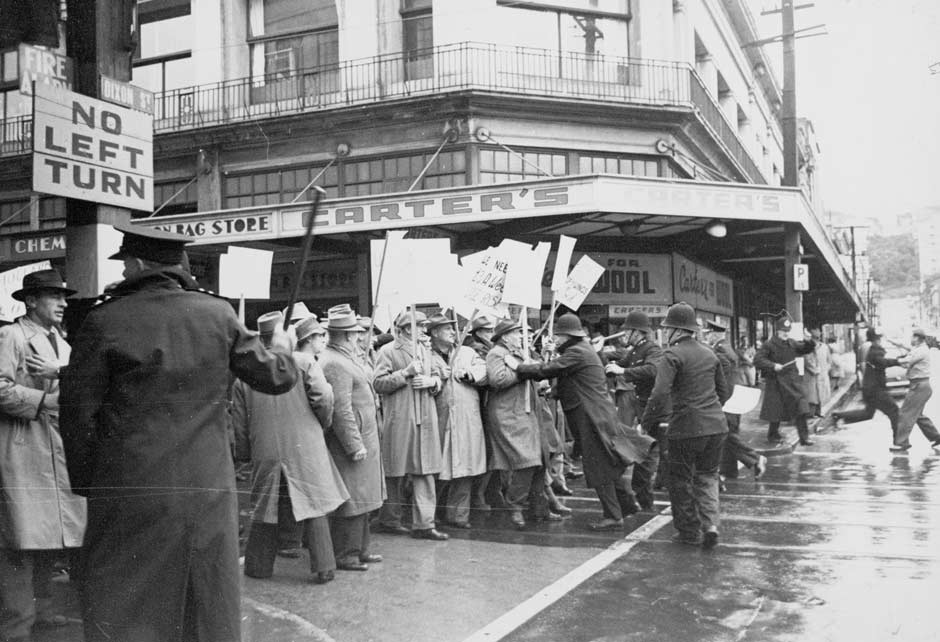
Draconian Restrictions: In the name of "public safety" the National Government of Sid Holland suspended the rights to free speech and peaceable assembly.

It was enough – just – for the majority of New Zealanders to accept the draconian restriction of their civil liberties, and the harsh persecution of their fellow citizens, that the Emergency Regulations permitted. Had the Korean War not been raging; had the FOL not been split; had Labour been less hostile to the trade union Left; and had the public been less vulnerable to a protracted shut-down of New Zealand’s ports; then the National Government probably wouldn’t have risked declaring a State of Emergency. But, with these factors working in its favour, and with its decisive victory in the Snap Election called by Holland to secure the electorate’s ex post facto endorsement of his treatment of the watersiders, the National Party was given ample proof that, for most Kiwis, Cicero’s maxim: Salus populi suprema lex; the safety of the people shall be the highest law; was no more than the truth.

It remains, I suspect, “an acceptable slogan” for parties of both the Right and the Left to this very day – with these two crucial provisos: 1) A substantial majority of the people must believe their security to be in jeopardy. 2) They must also be convinced that only the imposition of draconian repressive measures against those threatening their safety will avert social disaster.

Neither of these crucial conditions existed in 1974. Not only was the trade union movement at the peak of its post-war power (here in New Zealand and around the world) but New Zealand society in general was in an expansive mood. Young New Zealanders, in particular, would have been most unlikely to see the declaration of a State of Emergency as either justified or endurable. As Margaret Hayward’s “soundings” made clear to the PM, the prospect of dividing-and-conquering the working-class, on the model of 1951, simply wasn’t there in 1974. The FOL would have been united in its opposition, and would almost certainly have been joined on the streets by tens-of-thousands of university students. The prospect of the Police and the armed forces enforcing draconian emergency regulations in the face of mass strikes and demonstrations, without serious loss of life, was bleak. Hence the very sensible decision by Kirk and his Cabinet to pursue a negotiated settlement.

 Power Surge: The massive rank-and-file response to the arrest, in July 1974, of their communist leader, Bill Andersen, for defying a court injunction, incensed the Labour leader, Norman Kirk. But the temper of the times was too rebellious for him to risk a repeat of 1951.

Further evidence of the difficulty in using the provisions of the Public Safety Conservation Act (1932) is provided by the way in which the Muldoon-led National Government chose to police the 1981 Springbok Tour. Unlike his predecessor, Sid Holland, Prime Minister Rob Muldoon did not feel confident enough to invoke emergency powers. Once again, this was because there was insufficient support across the whole country for such measures to be enforced without the use of deadly force. Such was the temper of the country in 1981 that the killing of protesters by police or soldiers would only have increased the numbers of people taking to the streets.

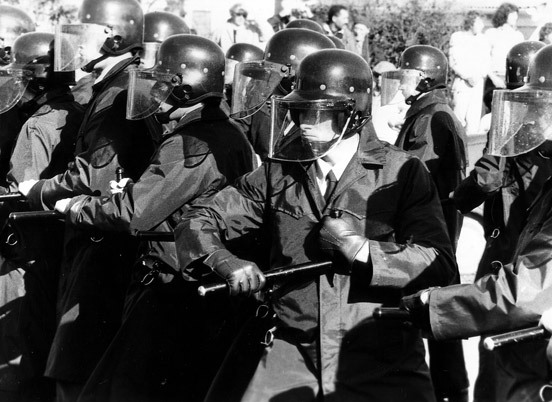
Team Policing: In 1981 not even the pugnacious Rob Muldoon was confident enough to suppress all protest activity by declaring a State of Emergency. Such was the level of public opposition to apartheid that, had he dared, it is likely only deadly force would have allowed the Springbok Tour to proceed.

New Zealand history thus confirms that its people are, indeed, the best judges of their own safety, and will make an exception to the rule of law only when they believe their security is genuinely threatened. That no government, since 1951, has felt certain enough of the public’s broad support to declare such an exception constitutes a ringing endorsement of Cicero’s uncompromising maxim. As their own constitutional guardians, the people are uniquely positioned to recognise those (thankfully rare) moments when the only effective means of preserving the protection of the laws – is to set them, temporarily, aside.

This posting is exclusive to the Bowalley Road blogsite.