Tuesday, 29 March 2011

By Reason of Necessity

"Shhh! It's for the sake of the party!": Sometimes the active choice to endure something bad is preferable to the passive choice of allowing something worse. If the public perception grows (fairly or unfairly) that Labour is morally compromised, then its electoral fortunes are bleak.

DEPOSING A LEADER is probably the most thankless task in politics. At the very least it calls into question the collective wisdom of those who gave the leader his (or her) job in the first place. Also, it just looks bad. A political party that’s forever chopping and changing its leaders very soon attracts comparisons with a bunch of Mafioso chieftains rubbing out their rivals.

These inherent dangers of change explain why there are so many more mediocre leaders than inspiring statesmen. There’s safety in mediocrity. Inspiration equals risk.

If there’s ever a good time to remove a leader, then it's probably immediately following an election. A party looks a lot less shambolic when it's seen to be responding to the electorate’s decision not to make its leader the prime minister. Changing leaders after an election also gives the new broom plenty of time to sweep his party clean and rearrange its ideological furnishing in line with the latest electoral fashions.

The very worst time to organise a leadership spill is when a general election is just months or weeks away. It smacks of desperation and panic – neither of which speak well of a party’s readiness to govern. The only justification for such self-destructive political behaviour is the reason of necessity. Making an active choice to do something bad, rather than allowing a passive choice to permit something much, much worse to happen.

This was the choice the Labour Party made eight weeks out from the 1990 general election when the caucus allowed Helen Clark to persuade it to abandon Geoffrey Palmer in favour of Mike Moore. It wasn’t that Ms Clark believed Mr Moore could win the election, merely that the polling data suggested that Mr Palmer was likely to lose it much more comprehensively. Giving Mr Moore eight weeks to weave his working-class battler magic on Labour’s deeply disillusioned voters simply made more sense than allowing Mr Palmer to drag his party into an electoral abyss from which it might never emerge.

With great reluctance I have come to the conclusion that Labour faces a similar choice in 2011. The scandal surrounding Darren Hughes (which shows every sign of getting a lot worse before it gets any better) has, I believe, fatally infected the leadership of Phil Goff and Annette King. While they remain at the head of Labour’s parliamentary team, controversy of a particularly distasteful nature will continue to, in Helen Clark’s memorable phrase, “swirl around them”. Questions relating to the soundness of their judgement will, fairly or unfairly, give way to questions relating to the quality of their ethics. New Zealanders will forgive a great deal in their politicians, but they will not vote for a party they believe to be morally compromised.

The Labour MP for Dunedin South, Clare Curran, has written on the parliamentary party’s blog “Red Alert” that she and her colleagues are feeling “gutted” by what happened to their friend and colleague.

“Darren was a valued member of caucus, our Whip. A very talented and witty man. Popular. Dedicated to Labour.

Grieving is what we’re doing right now. So give us a bit of latitude. We’ll be back, strong and focused.”

But, with all due respect to Clare and her colleagues, the grieving will have to wait. And if they need to focus on something – focus on this.

Labour’s parliamentary wing as a team of mountaineers in the split second following the fall of one of their lead climbers. Unaccountably, the first three mountaineers have roped themselves together in such a manner that if one falls the other two fall with him. The remaining climbers have only one course of action available to them if they wish to save the expedition: they must slash the rope that binds them to the doomed trio. If they don’t do this – and do it very quickly – they will all be dragged to certain destruction.

But who should replace Phil Goff as leader of the Labour Party? In any other circumstances, I would have nominated Labour’s finance spokesman, David Cunliffe. As I wrote in this column only last year:

“Articulate, good-humoured, open to new ideas and smart enough to turn them into credible policy, Cunliffe [looks] every inch the leader Labour needs to win.”

In this current set of circumstances, however, Labour needs a leader who has already demonstrated his commitment to the high moral standards expected of politicians in the Westminster tradition. David Parker’s instant and unforced decision to step away from his Attorney-General role in the wake of 2006 allegations of commercial impropriety (later judged to be without substance) stands in stark reproof of Mr Goff’s recent prevarications.

David Parker possesses a sharp and innovative political intellect, a fresh face, and most importantly, a clean pair of hands.

The choice, not of sentiment, but of necessity.

This essay was originally published in The Press of Tuesday, 29 March 2011.

Monday, 28 March 2011

No Mandate For Cynicism

A Caucus of Courtiers?: If Labour is not to degenerate into an electoral mechanism dedicated solely to the identification and elevation of alternative political (but not ideological) leaders, then the cynical algebra of personal ambition must not be allowed to replace the party's traditional commitment to New Zealand's poorest and most vulnerable citizens. (The painting, Courtiers, is by Michael Kutsche)

IT'S STAGGERING, the unabashed cynicism of so many of Labour's defenders. As rumour builds on rumour and the indefatigable ferrets of the blogosphere burrow deeper into the political laundry basket, Labour's apologists dismiss the political ramifications of the Hughes Affair with a courtier's shrug.

"Goff's perfectly safe", they say with world-weary certitude, "because who the hell would want to take over the job now? Far better to let Goff lose the election and pick things up from there."

It's only when you begin to decode this statement that the true extent of these apologists' cynical indifference to the fate of Labour's supporters becomes apparent.

All that appears to matter to these Labour courtiers is who gets what in the aftermath of what they clearly assume will be John Key's crushing victory in November.

Such a victory would, however, be a victory by default. Key will win: not because he has the best policies (or, indeed, any coherent policies at all); not because he's got the best team (between them the parties of the Centre-Left could bring together a cabinet of outstanding quality); not because he's in some mystic communion with the zeitgeist (Key and his colleagues represent a view of reality which is fast disappearing everywhere except among the rump rightists of the Anglo-Saxon world); he will win because, bluntly, his principal opponents in the Labour Party are too tired, too timid, too inexperienced or simply too selfish to defeat him.

It is this latter group who deserve the sharpest rebuke. The ones focusing their attention on the most likely intra-party consequences of an election loss for which Goff will inevitably be blamed. Can they realistically hope to have a shot at the top spot themselves? And if they can't - who can? And where should they position themselves - both personally and politically - vis-a-vis the next likely leader? In short, what should they be doing now to give them the best prospects of advancement then?

Nowhere in these calculations does the fate of the people Labour was originally established to defend rate a mention. The fate of solo mums and their kids; the fate of the tens-of-thousands of sickness and invalid beneficiaries; the fate of young Maori and Pasifika school-leavers languishing on the dole; the fate of state house tenants facing eviction: all count for nothing in the cynical algebra of personal ambition. They are a useful source of rhetorical fuel - nothing more.

Those Labour politicians with both the capability and the will to lead should recoil from any suggestion that their best response to the Hughes Affair is to simply bide their time. As social-democrats, as promoters of democratic socialism (which is still Labour's official political mission) they should assess dispassionately the full ramifications of Goff's handling of the Hughes Affair on Labour's election prospects. And if they come to the conclusion that it was inept, and that keeping him on as leader will significantly reduce Labour's chances of success, then they should start counting heads.

Because, even in the most selfish and deeply cynical terms, allowing National to win by default is a disastrous strategy.

A Labour party which begins to be perceived (justifiably or unjustifiably) as morally compromised will attract the votes of fewer and fewer New Zealanders. And a caucus driven by nothing more than personal ambition is bound to become increasingly reckless in its internal jockeying for power.

If all that matters is climbing to the top of the greasy pole, then increasingly the only skill that ambitious Labour politicians will seek to master is how to ascend. New Zealand Labour will become more and more like Australian Labor: a mechanism for the identification and elevation of alternative political (but not ideological) leaders. Its days as the people's first choice for securing social and economic justice will be over.

If David Cunliffe, David Parker, Shane Jones and Maryan Street genuinely believe that by persisting with Phil's leadership they are dooming Labour to an ignominious defeat, and thereby exposing New Zealand's poorest and most vulnerable citizens to social and economic assault, then it is their moral duty to replace him.

Replace him - and make a real contest of this year's general election. The working people of New Zealand will forgive Labour for losing a battle in which every soldier gave his or her all. What they will not forgive is a party whose best captains and bravest warriors, for reasons of personal ambition and private advantage, refused to draw their swords.

This posting is exclusive to Bowalley Road.

Friday, 25 March 2011

Casey Heyne's Justice

Tangible Justice: Casey Heyne's lifts his assailant into the air prior to bringing him down to earth - hard. All over the world people thrilled to this simple demonstration of the biblical injunction: "as ye sow, so shall ye reap". Sometimes (with all due respect to the Carpenter of Nazareth) "turning the other cheek" only makes things worse - just ask the Libyans.

GOOD ON YOU Casey Heynes! The video recording of this young Australian lifting up the school-yard bully who attacked him and body-slamming him hard into the concrete has gone viral. Few would dispute that the global affirmation flowing Casey’s way is well-deserved. To most people, the kid’s a bloody hero.

But not to the principal of Casey’s high school. His response was to suspend not only the perpetrator who started the fight, but the victim who finished it.

Would New Zealand’s school principals have done the same? Well, yes, they probably would.

When confronted with the YouTube clip of Casey’s body-slam the profession emitted a confused murmur of “yes, buts” and “tut-tuts”.

The equivocation of Kelston Boys High School’s assistant principal, Robert Solomone, was, sadly, typical. First he applauded Casey for fighting back: “as a parent as well, I’d want my boy to stand up to any kind of bullying”. Then he back-tracked: “but it’s still unacceptable”. Kelston’s policy is one of zero tolerance for any violence.

“Nine times out of ten”, Mr Solomone told The NZ Herald, “we tend to suspend as well.”

No doubt our principals have good reasons for responding to the emotional and/or physical abuse of their pupils by punishing both perpetrators and victims – but I’m buggered if I can fathom them.

Well before I introduced a policy of zero tolerance for any violence at my school, I’d like to think I would introduce a policy of zero tolerance for injustice; zero tolerance for oppression of the weak by the strong; zero tolerance not just for the act of bullying – but for the bullies themselves.

I’d also like to think that any school I led would also have a policy of affirming and celebrating those who resist injustice; who fight oppression; who stand up for their classmates and take on the bullies.

What would the likes of Mr Solomone say to the students of New Zealand’s secondary schools about what’s going on right now in Libya?

Would he be telling them that what the United States, France and the United Kingdom are currently doing to give effect to the United Nations’ Security Council Resolution on Libya is wrong? Or, worse still, would he saying: “If I was a Libyan democrat right now I’d be urging on those American cruise missiles. I’d be cheering the arrival of those French Mirage jet fighters. I’d be so thrilled that the world was willing to stand up to the tyranny of Muhamar Kadafi. Oh, but don’t forget kids, violence is still unacceptable.”

Personally, I can’t think of any strategy less likely to build trust and confidence in authority among young New Zealanders. How much respect can these kids be expected to show for a system which speaks out of both sides of its mouth at the same time?

And it’s not even as if what they’re telling our children is correct. The law of the land makes it very clear that the use of “reasonable force” in defence of your own person, or to prevent others being harmed, is perfectly acceptable.

What is reasonable force? Well, what a jury considers reasonable is usually determined by the circumstances.

Casey was the victim of an unprovoked physical assault. Believing his prey to be incapable of retaliation the bully came up to Casey and punched him hard in the face. He continued the assault until Casey simply picked him up and threw him down – hard – on the concrete.

I defy any jury in either Australia or New Zealand to find that Casey’s use of force against his assailant was unreasonable. Like the hundreds of thousands of people who’ve watched the incident on YouTube, I’m absolutely sure that the ladies and gentlemen of that jury would be equally thrilled by the sudden reversal of the bully’s fortunes.

If justice is a phenomenon that can be experienced as a physical sensation, then it’s justice that we feel as Casey puts his assailant down.

Neither the students they teach, nor the society in which they live, are well-served by principals and teachers who deny the raw experience of natural justice to the young people in their care.

Justice isn’t something you can accomplish with words – bullies don’t heed words.

Justice cries out for deeds.

If you doubt that – then go ask the Libyans.

Go ask Casey.

This essay was originally published in The Timaru Herald, The Taranaki Daily News, The Otago Daily Times and The Greymouth Star of Friday, 25 March 2011.

Thursday, 24 March 2011

Reforming The Abortion Laws: A Simple Guide


I don't know how she feels
And I can't know how she feels.
But I want her to know
That I feel for her, oh
I want her to know that I feel.


And I feel so ashamed,
That her life should have been so maimed
By the blindness
That drove her to this, oh
I feel so ashamed.

But his face just curled in contempt.
"Don't sing me your sad lament!"
When she said "I can't cope",
The old man with the stethoscope
Just curled his face in contempt.

And the cold rain fell
On that back street hell.
On the hard table-top
Would the pain never stop
As the cold rain fell.


On a grey afternoon,
In an old waiting-room
He said: "In this circumstance
She's a fifty-fifty chance."
On a grey afternoon.

And I don't know how she feels.
And I can't know how she feels.
But I want her to know
That I feel for her, oh
I want her to know that I feel.


Chris Trotter
1974

(Lyrics to the song performed by Chris Trotter at a pro-choice rally addressed by US feminist, Jessica Starr, Victoria University Student Union, 1974.)

REFORMING CONTROVERSIAL LEGISLATION is a daunting political project. Just how daunting is signalled by the adjective we place before the noun. The presence of the word controversy – literally, “to turn against” – should warn us that what we are dealing with is conflict. And therein lies the reformer’s greatest challenge. Legislating from the starting point of ideological consensus is easy. Passing laws in circumstances of ideological conflict is not only difficult, it's hazardous.

Thirty-five years ago the abortion issue lay at the heart of an ideological conflict that encompassed much more than a woman’s right to determine when and with whom she would bear children. It was the touchstone of second wave feminism. For many active feminists, how far New Zealand was prepared to go in recognising a woman’s right to choose, would be the measure of how far it was prepared to go in recognising women’s rights – full stop.

The legislation which eventually emerged from this conflict, the Contraception, Sterilisation and Abortion Act (1977), fell well short of feminist demands. New Zealand’s legislators were unwilling to concede that the termination of a pregnancy was a choice to be made by the woman involved – and by her alone. The CS&A Act did, however, legalise abortion – but only in circumstances where, in the opinion of medical professionals, the continuation of a woman’s pregnancy would endanger her physical and/or mental health.

Even this very limited concession would not have occurred without the mass organisation of pro-choice opinion undertaken by the Abortion Law Reform Association of New Zealand (ALRANZ) and the Women’s National Abortion Action Coalition (WONAAC). These pressure groups, combined with the accumulating moral force of the Working Women’s Charter – then making its torturous way through the trade union movement and the Labour Party – forced the issue of abortion onto the political agenda in a way that made some form of legislative response unavoidable.

The reformers’ successful mass mobilisation of pro-choice sentiment had followed, with Newtonian precision, the emergence in New Zealand of a well organised anti-abortion lobby. The catalyst for this so-called "pro-life" movement had been the successful liberalisation of abortion laws in the UK (1967) and Australia (1969).

Arrayed against the forces of change were a formidable combination of religious and secular opponents. The Catholic Church, in particular, waged an uncompromising struggle against any form of legislative reform. The anti-abortion lobby’s secular wing was the Society for the Protection of the Unborn Child (SPUC) established in 1970. Significantly, it drew a large measure of its support from those socially conservative New Zealand women who rejected the feminist project as a direct challenge to their more traditional definitions of womanhood.

In purely electoral terms, it was this latter group which exercised the decisive political influence. The findings of the Royal Commission on Contraception, Sterilisation and Abortion, whose conservative report provided the blueprint for the CS&A Act, reflected the fact that in the 1970s, outside the socially liberal milieus of the universities and the leafier suburbs of the larger cities, New Zealand remained a very conservative country.

The liberal/conservative balance on abortion did gradually begin to shift, however, as fresh cohorts of younger New Zealanders joined the electorate. But even in the mid-1980s the forces of conservatism remained a formidable obstacle.

Those who wonder why Labour feminists like Anne Hercus, Fran Wilde and Helen Clark failed to introduce a more liberal abortion regime between 1984 and 1990 need look no further than the series of “Women’s Forums” that the new Women’s Affairs Minister, Anne Hercus, organised in the first few months of the Fourth Labour Government. These were open to all women and were (at least in part) intended to demonstrate to the wider electorate how much support already existed for a substantial advance in the rights of New Zealand women.

What the forums actually showed was how effortlessly conservative women were able to out-organise their liberal sisters. Within weeks of their initiation the forums had degenerated into angry battlegrounds, where reformers and traditionalists traded verbal, and on at least one occasion, physical, blows. When it became clear that the conservative women’s groups had mastered the art of “stacking” the forums with their own supporters, Hercus’s brave experiment in participatory democracy was brought to an ignominious, and for Labour’s feminist MPs, salutary, end.

On the matter of access to abortion services, however, the reformers had the last laugh. While the black letter of the CS&A Act continued to criminalise abortion except in extremis, in practice New Zealand women found obtaining a termination to be a relatively straight-forward exercise. Judged solely by the number of terminations per capita, it has become increasingly difficult to distinguish New Zealand from those jurisdictions in which abortion-on-demand is already legislatively entrenched.

Both sides of the argument now face a dilemma. If the pro-choice advocates attempt to completely decriminalise abortion and make it entirely a matter of maternal choice they risk a full-scale mobilisation of the religious and political Right. But, if the pro-life advocates persist in seeking a judicial reversal of the de facto abortion-on-request status-quo, they risk igniting the furious indignation of hundreds-of-thousands of New Zealand women.

Breaking this impasse will be extremely difficult.

As a first step, pro-choice reformers should make a serious effort to ascertain the current balance of pro- and anti-abortion opinion in New Zealand. By serious, I mean offering respondents a plausible set of choices ranging all the way from outright prohibition to abortion-on-demand. They should also be asked how far they’re prepared to go to see their choice enacted. Additional focus-group study of the issue would be helpful in terms of identifying those philosophical arguments and rhetorical tropes which attract, and those which repel, popular support for abortion rights.

Armed with this basic data, the reformers could begin designing an effective pro-choice campaign. (If the polling data reveals overwhelming support for changing the existing legislation in a more liberal direction, then an important component of the organising effort might be a nationwide petition.)

Running parallel to the market research exercise, the reformers should embark on an effort to accurately identify where every Member (and potential Member) of Parliament stands on the abortion issue. Careful note should be taken of the arguments they use to justify their For/Against/Undecided/Won’t Say positions. This sort of research formed an important part of earlier pro-choice campaigns (Ref: Erich Geiringer's SPUC 'Em All! Abortion Politics 1978, Alister Taylor Publishers, 1978).

The best possible time to begin such a campaign would be about two years out from the next scheduled general election. If the reform campaign was designed to reach its crescendo about a year from polling-day the political parties would have both the incentive and the time to develop clear policy on the issue. The reformers could then endorse the party (or parties) whose policies most closely resemble their preferred outcome.

If the reformers’ endorsed party (or parties) won sufficient seats to take office after the election, then the passage of more liberal legislation could proceed smoothly and swiftly within the first six months of the new Government’s three year term.

Just in time for the conservatives to start planning the launch of their own “REPEAL” campaign about six months later.

Tuesday, 22 March 2011

Reflections On The Christchurch Earthquake: Not A Tame Lion

The Jehovan Deity: For the benefit of his younger readers the Christian novelist, C.S. Lewis, re-cast Jehovah as Aslan, the Lion Lord of Narnia. He was careful, however, to retain the Judeo-Christian deity's dangerously unpredictable omnipotence. As he has one of his Narnian characters say of Aslan: "He's not a tame lion!"

WAS GOD PRESENT in Christchurch on 22 February 2011? It’s a question many New Zealanders have wrestled with over the past month, and the tragedy which engulfed Japan on 11 March has given it added urgency.

Officially, we’re a secular nation, yet Census data confirms that more than half of New Zealanders retain a belief in God. That belief is sorely tested by natural disasters. If God was present in Christchurch on 22 February, why didn’t He prevent the earthquake?

But, in posing this question aren’t we separating God from the natural world? Seating Him on a divine throne beyond this earthly realm? Requiring Him to demonstrate his mastery over his own creation by, in this case, countermanding the movement of the earth’s tectonic plates?

Yes, we are. But we can hardly be blamed for doing so. Because, when all is said and done, this is the view of God we have inherited from the Bible. He is the maker of heaven and earth and if it pleases him to command the sun to stand still, or the oceans to o’ertop the world, then it will be so. He is Jehovah, “I am that I am”, the God Charlton Heston (in the role of Moses) invokes when Pharaoh’s army traps the Israelites against the margins of the Red Sea.

“Behold His mighty hand!”, Charlton cries, and low, the waters of the sea are parted.

There are, of course, plusses and minuses to the Jehovan conception of divinity, as the celebrated author, C.S. Lewis, well understood.

In The Horse and His Boy, one of his Chronicles of Narnia, he makes it clear that his own rendering of the Jehovan God – the golden lion Aslan – is not a pet to be called for and dismissed at our convenience. On the contrary, he is an altogether dangerous being. As one of Lewis’s characters indignantly observes: “He’s not a tame lion!”

And, yet, it was to a rather tame deity that the Dean of Christchurch Cathedral, Peter Beck, appeared to be appealing in the aftermath of the earthquake. In answer to the question: “Where was God on 22 February?” he responded:

“God is in all these people. God is in the midst of all this. God is weeping with those who weep. God is alongside those who are finding the energy to just keep going. God is in the people who are reaching out and seeking to sustain one another. God is about building community, about empowering people.”

And, when a journalist demanded: ‘Yes, but where was God was when offices pancaked and burned and hundreds died?’

He replied:

“Well, we live on a dynamic, creating planet that’s doing its thing. For whatever reason, our forebears chose to build this city on this place. They didn’t know we were on this fault line. God doesn’t make bad things happen to good people. We make our own choices about what we do.”

Doing its thing?! What exactly is the Dean trying to say? That the natural world is a conscious entity? That it has its own volition and (God save us!) its own agenda? And did Cantabrians, thanks to the poor choices of their “forebears” simply find themselves in this “dynamic, creating planet’s” way? And was Jehovah, in fulfilment of some hitherto undisclosed self-denying ordinance, required to turn his face from the imminent suffering of Cantabrians and keep his mighty hands in his pockets?

If so, then God has a rival – a divine competitor in the omnipotence business. And the Dean is in flagrant breach of the Nicene Creed, the first article of which states, unequivocally: “We believe in one God, the Father Almighty, Maker of heaven and earth”.

Perhaps the Dean should return to his Bible and ponder the God that spoke to Moses from the burning bush. The God that gave man counsel from the whirlwind, and moved before the Children of Israel in a pillar of fire. Perhaps he should consider the God that laid Jericho low and sent fire from heaven to consume Sodom and Gomorrah. A red God, a wrathful God, a jealous God. The God that was ready to drown the whole world. The God who, when his son, nailed to a cross, cried out “Father, why have you forsaken me?”, remained silent.

Shock and awe. These words have been sullied by the Pentagon’s bloody hands. Yet it is only in those moments when all our human conceits are battered down and laid to waste that we, shocked and awestruck, come close to understanding Jehovah as the authors of both the Old and New Testaments understood Him.

Was God present in Christchurch on 22 February? Oh yes, He was there. And He is with us always. Beyond our questions; beyond our understanding; beyond our judgement.

Not a tame lion.

This essay was originally published in The Press of Tuesday, 22 March 2011

Monday, 21 March 2011

Harping On About The Abortion Issue

No Compromise!: But radical Pro-Choice feminist blogger The Queen of Thorns should remember that political activists who demand "All or Nothing!" almost always end up with nothing at all.

THE “QUEEN OF THORNS” described it as “Chris Trotter’s worst nightmare”. A gathering of approximately 70 “liberal lefties” who, by daring to raise the divisive issue of abortion were, to use QoT’s provocative language: “going to just ruin Labour’s chances of winning the 2011 election”.

It was a curious way of describing the participant’s objectives. A reference, I suppose, to this posting from July 2010 in which I questioned the political wisdom of Labour List MP Steve Chadwick promoting a private member’s bill legalizing abortion at the woman’s request up until the 24th week of her pregnancy.

What QoT and a host of other feminist bloggers objected to so strongly back then, and are even more vociferously opposed to now, is the notion that reforming the abortion laws might take second (or even third) place to other political considerations. I don’t believe I’m in any way misrepresenting their position when I say they consider anyone who counsels letting sleeping dogs lie on this issue as “objectively” (if I may resurrect that fine example of Leninist jargon) locating themselves in the anti-abortionist camp.

There’s a bullying aspect to this style of politics which takes me all the way back to the late 1970s – when the only acceptable position for a man to adopt in relation to feminist political priorities was one of enthusiastic and unquestioning support. (As I scrolled down the hundreds of passionate comments elicited by QoT’s posting, I must confess to experiencing a wave of nostalgia for those ideologically invigorating times.) But nostalgia is no substitute for hard-headed political analysis. Abject surrender to ideological extremism and political solipsism is no more intelligent now than it was 40 years ago.

It is worth re-stating, therefore, that the heedless pursuit of abortion on demand could very easily prove counter-productive. There was – and is – absolutely no guarantee that kicking these sleeping dogs into angry wakefulness will result in them sinking their teeth into the forces of conservatism. As the recent, extraordinary, Section 59 acquittal made depressingly clear, social liberalism is on the retreat in New Zealand. If QoT and her comrades put their boots into the Rottweilers of Reaction they may very soon find these no-longer-sleeping canines at their throats.

As usual, the United States points the way when it comes to reactionary political trends. Before embarking on their crusade for abortion law reform in New Zealand, QoT and her friends should first consider the implications of the sudden and dramatic collapse of support for the “Pro-Choice” position in the USA.

As recently as May 2006 the Gallup Poll showed that 51 percent of Americans considered themselves to be Pro-Choice, with only 41 percent declaring themselves to be “Pro-Life”. By May 2009 the position had been almost exactly reversed with the Pro-Lifers on 51 percent and the Pro-Choicers on 42 percent. The Gallup pollsters also asked respondents to tell them whether they personally believed abortion to be morally acceptable or morally wrong. In 2006 43 percent believed abortion to be morally acceptable and 44 percent said it was morally wrong. By 2009, abortion’s moral acceptability had fallen to 36 percent, with those believing it to be morally wrong rising to 56 percent of the Gallup sample.

More recent polling (January 2011) by the Pew Research Centre shows the overwhelming majority of Americans positioning themselves in the middle of this issue. Only 18 percent of respondents believed abortion should be “legal in all cases”, with just 16 percent willing to declare it “illegal in all cases”.

New Zealand is not the USA and I must be cautious about extrapolating too freely from the opinions of Americans. What I can say, however, is that the political strategists of the Right, both in the United States and New Zealand, have demonstrated a far greater talent for the prosecution of “wedge politics” than the Left. The latter could once rely upon the so-called “liberal media” to carry its arguments to the public. But is that still the case today? Whose arguments do we hear most clearly in the 21st Century? Something tells me that in the age of Fox News – it ain’t the Left’s.

It’s all too easy for QoT to come out swinging at the liberal and left-wing contributors to The Standard (and Bowalley Road). Let’s see how far her expletives-included, take-no-prisoners tactics get her in the mainstream media.

The brute political fact remains that if New Zealand is not to experience another blitzkrieg of neoliberal “reform” in 2012, a combination of centrist and left-wing parties will have to secure more seats in the House of Representatives than the parties of the Right in 2011. Perhaps, if Labour and the Greens between them were in a position to form a government, abortion law reform could form part of either, or both, parties’ manifestoes. Unfortunately, a Centre-Left victory is almost certain to depend on NZ First crossing the 5 percent threshold. The socially conservative supporters of Winston Peters seem unlikely partners in any abortion law reform initiative.

Is QoT really so willing to abandon solo mums and their kids to the tender mercies of the two Paulas? Is she really so impervious to the argument that the consequences of unemployment and poverty will fall most heavily on women and children? If politics is about priorities, is she really so sure that abortion law reform comes ahead of protecting what’s left of the New Zealand welfare state?

Even some of her own supporters don’t think so. I’m thinking of a prominent feminist blogger who was recently elected to public office. In her election propaganda she described herself as a “mother” and declared her commitment to building “strong communities”. Nowhere in any of the material distributed to the electors did she inform them that she was an active left-wing trade unionist and a vehement supporter of abortion on demand.

In the deeply conservative part of New Zealand in which she was standing, keeping these facts from the voting public made perfect political sense. Had she been completely honest with the electors they almost certainly would have rejected her.

But that’s politics QoT. To get some things you have to give others away. Political activists who demand “All or Nothing!” almost always end up with nothing at all.

Your sister-in-arms understood that, QoT.

It’s time you learned.

Friday, 18 March 2011

The Rise & Fall of Anglophonia

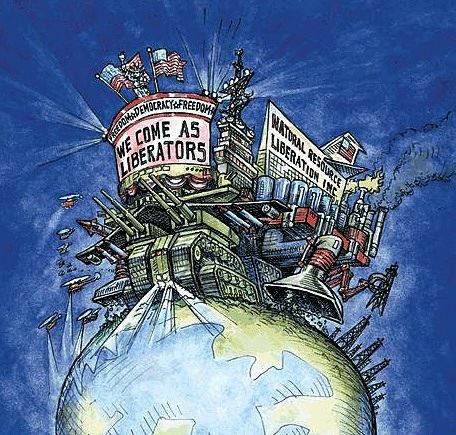
The Good Old Firm: Anglophonia, led by the USA, dominates the planet. But the reckless greed of its elites and the moral bankruptcy of its neoliberal creed offer little hope of its longevity as a global hegemon.

THERE WAS A TIME when membership of the Anglo-Saxon Club was a good thing. The powerful ties binding the United States of America to the United Kingdom, Canada, Australia and New Zealand were the envy of other states. No matter how strategically important these nations might be to the security of Anglophonia, they could never hope to enjoy the familial intimacy of its member states.

The linguistic, cultural, historical and economic affinities animating the Anglo-Saxon powers ultimately cohered into a global hegemony of unprecedented reach and power. With the eventual collapse of the Soviet Bloc in 1989-91, Anglophonia found itself bereft of serious ideological rivals. The New World Order spoke English – with an American accent.

But Anglophonia’s triumph – codified in the neoliberal economic prescriptions of the so-called “Washington Consensus” – turned out to be rather hollow.

The Cold War had disciplined Anglophonia’s ruling-class in much the same way as the long struggle against the rival city-state of Carthage had disciplined the wealthy Patricians of Ancient Rome. Without a common foe to enforce a high level of social cohesion and equity, the elites of both world empires felt free to loot their national treasuries and vitiate the political and economic rights of their – now burdensome – lower orders.

In the case of Anglophonia, this “revolt of the elites” (to borrow Christopher Lasch’s striking terminology) is readily tracked by calculating the share of pre-tax household income received by the top 1 percent of Americans between 1917 and 2011.

Immediately prior to America’s entry to World War I, the top 1 percent commanded just under 18 percent of pre-tax household income. Their share fell about 3 percentage points during the war, but by 1929 it had soared to an astonishing 20 percent.

From the 1930s to the 1970s, however, the fortunes of the top 1 percent changed dramatically as the Great Depression, Roosevelt’s “New Deal”, World War II and the fiscal exigencies of the Cold War relentlessly reduced their share of America’s wealth. The nadir was reached in 1972 when the top 1 percent’s share fell to just 7 percent of pre-tax household income.

With the election of Ronald Reagan in 1980 the revolt of the elites began in earnest. Between 1985 and 1989 (the year the Cold War ended) the wealthiest American’s share of pre-tax household income leapt from 9 percent to just under 13 percent. By 1999 it stood at 16 percent and by 2005 it had reached 18 percent. Today, the top 1 percent of American households commands the same 20 percent share of pre-tax income as 1929.

These bare and brutal statistics chronicle the steady growth and sudden collapse of social equity in the United States. But the whole sorry saga of union-busting, deregulation and privatisation has, from the late-1970s to the present, facilitated the elites’ reclamation of economic and social pre-eminence throughout Anglophonia.

To preserve at least the façade of democracy while they re-construct the plutocratic order of the 1920s the elites have been forced to hollow out the core institutions of the social-democratic culture that did them so much damage. The trade unions were the first to go, closely followed by the universities (at least in their guise as critic and conscience of society). Their most important conquest, however, has been the news media. Like the circuses of Ancient Rome, the Anglophonian news media is designed to inflame rather than inform.

If you would like to see the future – watch Fox News.

Not even science is exempt from the relentless partisanship of Anglophonia’s plutocrats.

As recently as 2007 just over 70 percent of Americans told pollsters that they accepted anthropogenic global warming as a scientific fact. Canadian social critic, Naomi Klein, found that by 2009 only half America held that view.

The same phenomenon is visible in Australia, where the most recent surveys show less than half the population believing in global warming. Ask these climate-change sceptics why, and they reply: “Because global warming is a socialist plot to redistribute wealth”.

This is the price plutocracy is forced to extract from the societies it feeds on. Neoliberal dogma is to Anglophonia what Christian dogma was to Rome: the ideological vector of its intellectual and cultural disintegration.

English will probably remain the lingua franca of the Twenty-First Century, but increasingly it will be spoken with a Chinese or Brazilian accent.

This essay was originally published in The Dominion Post, The Timaru Herald, The Taranaki Daily News, The Otago Daily Times and The Greymouth Star of Friday, 18 February 2011.