Friday, 31 August 2012

A Proprietary Interest

To Name Is To Own: Now known as Trotter's Creek this little river in North Otago was originally called Te Awakakokomuka. What became of the customary rights attached to the Maori users of this waterway after its name was changed? 
 
TROTTER’S CREEK tumbles out of the Horse Range, chuckles through Trotter’s Gorge, and empties itself into the Pacific Ocean under the looming cliffs of the Moeraki peninsula at Katiki Beach. Along the way the little river runs (in the remarkably poetic language of an Otago Regional Council pamphlet) “with large slow, deep pools combined with shallow riffles.”
 
I would be lying if I said that on the rare occasions I drive over and alongside Trotter’s Creek I do not feel a proprietary tug. The coast of North Otago is and will always be my turangawaewae – my place to stand – and the geographical features that bear my family’s name only reinforce this sense of belonging. It’s where I was born. It’s where I hope to be buried.
 
But is Trotter’s Creek really Trotter’s creek? Can a family – or an individual – really lay claim to the water that falls from the sky, or the riverbeds over which it flows back to the sea? My family took possession of the land through which Trotter’s Creek flows in 1851. As the years passed, the name it bore before their arrival, Te Awakakokomuka, gradually fell into disuse. What cannot be disputed, however, is that the people who lived along the North Otago coast before the Magnet dropped anchor at Waikouaiti in 1840, also knew those “slow, deep pools” and “shallow riffles”. Wading between the Koromiko bushes, bearing home the river’s bounty, they, too, would have felt a proprietary tug.
 
A thousand miles to the north and thirty-eight days before my great-great-great-grandfather, William Sinclair Trotter, was rowed ashore from the Magnet, Captain William Hobson of the Royal Navy, acting on behalf of England’s Queen, Victoria, had promised the Maori tribes of New Zealand: “the full, exclusive and undisturbed possession of the Lands and Estates, Forests, Fisheries, and other properties which they may collectively or individually possess, so long as it is their wish and desire to retain the same in their possession”.
 
William Sinclair Trotter: Lands and estates, forests and fisheries of his own.
 
I doubt if William cared very much what promises Captain Hobson had made in the Bay of Islands. Waitangi was a long way from Waikouaiti, where the population of the local tribes had been thinned by war and disease, death and dispossession. In Caithness, in Scotland’s far north, he had helped the local squire, Sir John Sinclair, instruct his tenants in the husbandry of the hardy Cheviot sheep that William's father, Alexander, had driven up from the Scottish borders. He planned to turn these shepherding skills to his own advantage in this new country. Here he would carve out lands and estates, forests and fisheries of his own.
 
We call it “property” and fence it ‘round, not only with No.8 wire, but also with laws, covenants, easements and abstraction rights. This is “ours” we say, and all those things that we cannot fence-in or pin-down – like the sunlight and the wind, the rivers and the waves – we declare common property. But the products we make from the commons: grass, milk, electrical energy; they remain ours to buy and sell.
 
We have forgotten that Trotter’s Creek was once Te Awakakokomuka. Our laws, covenants, easements and abstractions have little to say about the customary rights attached to its waters in the years before it ran through the “property” of my hardy forebears. Before the Magnet’s anchor dropped, Te Awakakokomuka was something else, not “property” exactly, but something very close. The tangata whenua who paddled canoes along its banks; who had names for each of its “slow, deep pools” and “shallow riffles”; who snared the birds that flitted among the koromiko bushes lining its banks and trapped the eels which lurked beneath them; they had a stake in Te Awakakokomuka.
 
The difference between a little creek in North Otago and Waikato’s mighty river is really only a matter of scale. The Waitangi Tribunal recommends these long-neglected questions concerning water be answered – definitively. Proprietary “tugs” are transitory. Proprietary “interests” may prove more enduring.
 
This essay was originally published in The Dominion Post, The Waikato Times, The Taranaki Daily News, The Timaru Herald, The Otago Daily Times and The Greymouth Star of Friday, 31 August 2012.

Thursday, 30 August 2012

More "West Wing" Than Left-Wing

Magical Thinking: So compelling was Aaron Sorkin's script for the hit TV series The West Wing that it was easy to forget that "President" Jed Bartlett was a right-wing "New Democrat" in the mould of Bill Clinton. Many Labour and Alliance staffers (some of them now MPs) were won over by Sorkin's hard-headed 1999 definitions of feasible politics. Thirteen years after the series first aired, and in spite of the Global Financial Crisis comprehensively discrediting "Clintonomics", they remain more West Wing than left-wing.
 
THE SAME YEAR New Zealanders elected the Labour-Alliance Government, 1999, NBC launched Aaron Sorkin’s The West Wing. The fast-moving, fast-talking television drama series soon became compulsory viewing for Labour and Alliance staffers. Sorkin’s intelligent, razor-sharp dialogue revealed a world of politics very different from that portrayed by the cynical members of the Press Gallery. “President” Jed Bartlett’s staffers offered much, much more than the usual smarts and wisecracks. What transformed the day-to-day activities of characters like Josh Lyman, “Ceejay” Cregg, Sam Seaborn and Toby Ziegler into such compelling television was that they were motivated by real and passionately articulated principles. Sorkin had done the seemingly impossible, he had made back-room politics sexy.
 
The model for The West Wing was, of course, the Clinton White House. As the first “Baby Boomer” President, Clinton brought a looser (as it turned out a much looser) and more informal style to the administrative warren which gave Sorkin’s series its name. The fictional Bartlett (played superbly by Martin Sheen) may have hailed from straight-laced New Hampshire (a far cry from Clinton’s sleazy Arkansas) but viewers warmed to the younger characters who were as “cool” as they were competent. Characters who commented on blogs and confronted protesters – not with billy-clubs and tear gas, but with weapons fashioned out of (shock, horror) facts and figures. These were people who could command arguments.
 
But among all the “walk and talk” tracking shots and fast-talking riffs on everything from Middle Eastern politics to stem cell research, it was easy to miss the underlying political identity of the “Bartlett Administration”. This was not a collection of New Deal Democrats (except, maybe, for Toby Ziegler). President Josiah ‘Jed’ Bartlett was a Nobel Laureate in Economics – neoliberal economics. Sorkin’s politics were and are the “liberal” politics of the so-called “New Democrats” and their “moderate” Democratic Leadership Council. In short, Sorkin was channelling the Clintons’ politics: Bill’s and Hillary’s.
 
It’s the politics that gave the world NAFTA (the North American Free Trade Agreement) and declared “the era of big government” to be “over”. The politics that put an end to “welfare as we have known it”. Sorkin's Bartlett Administration is a paean to the virtues of Anthony Gidden’s “Third Way” – presented to the world by a master screenwriter whose persuasive powers not even Tony Blair’s master manipulator, Alastair Campbell, could equal. There was a darker side too. On matters of “National Security”, Bartlett’s chief-of-staff, Leo McGarry, was as hard-line as Sorkin could imagine: an avenging American Eagle in a White House briefing-room already bristling with hawks.
 
Such were the role models that Labour’s and Alliance’s young staffers attempted to emulate. And Sorkin’s pithy justifications for everything from fiscal responsibility to free-trade were to leave a deep impression. When the young men and women who filled the offices around Helen Clark and Jim Anderton (Grant Robertson, Jacinda Ardern, Chris Hipkins, John and Josie Pagani) recall the exemplars of “modern social democracy” do they think only of Bill Clinton, Tony Blair and Gerhard Schroeder, or are Jed Bartlett, Josh Lyman and “Ceejay” Gregg also in their minds?
 
That The West Wing was able to present itself as a progressive drama was only because the Right (especially in the USA) had become so utterly bereft of anything even remotely resembling principle. That, and a long economic boom which appeared to confirm everything its neoliberal architects preached and predicted. Helen Clark and her Finance Minister, Dr Michael Cullen, floated on these economic updrafts for nearly nine years: long enough for those who worked on their staffs to become convinced that while the “reforms” of the fourth Labour government may have been poorly sequenced, and much too brutally imposed, they were, in the context of their time, the right thing to do.
 
Today, the grim legacy of the magical political and economic thinking that Aaron Sorkin so brilliantly gave voice to in The West Wing lies all around us. The Third Way we bought from Clinton and Blair, Clark and Cullen turned out to be a pup. The Fed’s credit-fuelled boom turned to bust. The middle class maxed-out its credit cards. The working-class fell off a cliff. Social inequality spreads through the body-politic like a deadly, metastasizing cancer. Only the rich are smiling.
 
Sorkin, himself, has recognised the shift. His new television series, The Newsroom, lays bare the moral and material legacies bequeathed to America by the political-economy of his West Wing characters. Tellingly, the smart, sassy and principled heroes of this, Sorkin’s latest paean to the faltering American dream, are no longer politicians – they’re journalists.
 
Here in New Zealand, however, the young staffers of 1999 have become the middle-aged politicians and senior advisers of 2012. And although their waistlines have widened, the ideological path followed by these ageing West Wing fans remains as straight and narrow as a Jed Bartlett budget. Their understanding of the electorate is still rooted in the expert analyses of poll data and focus groups. (Sorkin’s satire was never sharper than when he made Joey Lucas, Jed Bartlett’s hot-shot pollster, deaf). Worst of all, the economic and social arguments these unreconstructed "utopian realists" continue to hurl against their critics (both Right and Left) all come from the era of dot-com bubbles and sub-prime mortgages.
 
Arguments that sound more West Wing than left-wing.
 
This posting is exclusive to the Bowalley Road blogsite.

Tuesday, 28 August 2012

Our Diminishing Capacity For Empathy

 A Failure Of Empathy: The casual cruelty of Barbara Sumner-Burstyn's Facebook posting about the death of Lance Corporal Jacinda Baker offered swift corroboration of Dr Bruce Perry's claim that social media are diminishing our capacity for empathy.
 
ARE SOCIAL MEDIA making us crueller? Dr Bruce Perry, an American neuroscientist currently touring New Zealand, argues that the explosive growth of communications technology is diminishing our capacity for empathy. By undermining face-to-face relationships and weakening the intimate and ethical bonds that hold communities together, claims Dr Perry, social media are changing the way our brains work.
 
A challenging thesis, but Dr Perry’s disturbing ideas received almost instant corroboration. In an extraordinary outburst on Facebook, the New Zealand film-maker, Barbara Sumner-Burstyn, delivered the following, scathing, ‘testimonial’ to Lance Corporal Jacinda Baker, the young New Zealand soldier killed in action in Afghanistan on 19 August:
 
“Oh, so fallen soldier Jacinda Baker liked boxing and baking – did they forget she also liked invading countries we are not at war with, killing innocent people and had no moral compass. She 100 per cent does not deserve our respect for her flawed choices. We are not at war. We are helping America invade another country for their oil. No more than that.”
 
It is difficult to know where to begin with this thoroughly obnoxious piece of writing. Perhaps with Ms Sumner-Burstyn’s simple errors of fact.
 
Lance Corporal Baker did not invade Afghanistan, she was posted there as a serving member of the New Zealand Defence Force (NZDF) which was in Afghanistan at the behest of the New Zealand Government, which had agreed to supply the International Security Assistance Force (ISAF) with a Provincial Reconstruction Team in Bamiyan province. The ISAF is in Afghanistan by virtue of a UN Security Council resolution authorising UN member states to aid the creation of an effective and democratic Afghan government.
 
Lance Corporal Baker, far from “killing innocent people” was a medic – duty bound to assist all those wounded in combat or injured by enemy munitions – regardless of status or nationality. When she was killed, Lance Corporal Baker was escorting an injured comrade to medical assistance. It is extremely difficult to reconcile these facts with Ms Sumner-Burstyn’s charge that Lance Corporal Baker “had no moral compass”.
 
Ms Sumner-Burstyn’s final claim: “We are helping America invade another country for their oil” is similarly false. Afghanistan possesses no oil fields worth expending US blood and treasure to secure. The Americans are there for only one reason. Because the Taliban Government of Afghanistan had offered safe haven to Osama Bin Laden and Al Qaida: the terrorists ultimately responsible for the murderous attacks of 11 September 2001.

Lance Corporal Jacinda Baker
 
Natural reticence, not to mention fear of instant retaliation, would almost certainly have prevented Ms Sumner-Burstyn from uttering such false and hurtful accusations in front of people who did not share completely her opinions on the Afghanistan conflict. The classical injunction De mortuis nil nisi bonum – Of the dead speak only good – invokes a simpler world in which people confronted one another face-to-face. By placing a computer screen between herself and the family, friends and comrades of Lance Corporal Baker, Ms Sumner-Burstyn lost the inhibitive effect of close human proximity. Without its protection she had nothing to shield her from the full emotional and practical consequences of her actions.
 
These followed with terrifying speed and intensity. Ms Sumner-Burstyn’s comments appeared on her Facebook Page on Friday, by Saturday a new Facebook Page – Sumner Burstyn Give Back Your NZ Passport! – had attracted more than 15,000 followers. By Sunday that number had grown to 20,000.
 
Reading the comments posted on this new page, Dr Perry would no doubt suffer an embarrassment of evidential riches for his diminishing-empathy thesis. If Ms Sumner-Burstyn’s comments were ignorant and insensitive, the response was nothing short of homicidal. The reactive firestorm’s flames leaped across the Pacific Ocean to Canada – where Ms Sumner-Burstyn is working – and she hurriedly took down her Facebook Page and changed her e-mail address.
 
Too late. On the Internet everything is recoverable – including screen-shots of Ms Sumner-Burstyn’s original comments. By Sunday, family members had been driven from their homes by the public fury. Threatened with rape and murder, Ms Sumner-Burstyn fears to return to New Zealand.
 
A recent photograph of Ms Sumner-Burstyn shows a middle-aged woman posed in front of a large book-case filled with academic literature. Studying her face, and reading about her many awards for documentary film-making – many of them on “progressive” themes – it is difficult to fathom how Ms Sumner-Burstyn could be capable of such casual cruelty. As a clearly gifted artist and feminist, it is extraordinary that she was so utterly unable to empathise with Lance Corporal Baker – the first female member of the NZDF to lose her life on active service.
 
By the same token, it is profoundly depressing to read the spittle-flecked responses of her detractors.
 
Lance Corporal Baker lost her life on a mission to re-build and heal a damaged province in a ravaged land. Her empathy merited a much more generous memorial.
 
This essay was originally published in The Press of Tuesday, 28 August 2012.

Friday, 24 August 2012

Ghosts That Walk In The Dark

Turbans and Kalashnikovs: The mental image most New Zealanders hold of the Taliban is of Taliban 1.0 - the religious student army that won the Afghan civil war back in 1996. But the new Taliban - Taliban 2.0 - is as likely to be kitted-out in business suits and carry lap-tops. According to Kiwi war correspondent, Jon Stephenson, Taliban 2.0 are "ghosts that walk in the dark" - guerrilla fighters against an army of occupation. And because the soil they walk on is their own, they will not be beaten.
 
WHEN WE HEAR the word “Taliban” most of us think of turbans and Kalashnikovs. In our mind’s eye we see an embittered Pashtun tribesman, his lungee as black as his bristling beard, squatting in the mouth of a mountain cave. Such fighters still exist, of course, but this mental picture much more closely resembles the Mujahedeen who drove out the occupying Soviet forces back in the 1980s. The word talib means, simply, a student of the Koran, and it was an army of such holy scholars – taliban – that ended the Afghan civil war in 1996. Think, Salvation Army – with machine-guns.
 
The first Taliban administration – let’s call it Taliban 1.0 – entered into the complexities of government with very little experience. Raised and educated in the deeply conservative religious schools (madrassas) of Pakistan’s tribal territories, many of its fighters were the sons of refugees who had fled the Soviets’ murderous attack helicopters. Hardly more than teenagers, the Taliban relied almost exclusively upon their religious teachers (mullahs) for political and legal guidance. Under the Taliban, Afghanistan became an Islamic Emirate, governed according to Sharia law.
 
That was the Taliban the West defeated in the aftermath of 9/11.

The insurgent force which has grown up in Afghanistan during the occupation of the International Security Assistance Force (ISAF) is, however, very different from the first Taliban army. Let’s call it Taliban 2.0.
 
The guerrillas of Taliban 2.0 are as likely to be dressed in a Western suit and carry a lap-top as they are to wear a turban or tote a Kalashnikov. They are highly skilled, highly motivated and highly dangerous. Like the French Resistance and the Viet-Cong, the new Taliban’s strategic and tactical objectives are brutally simple: wear down the occupiers’ will; sap his morale; undermine his faith in the “mission”; cause him to fear and mistrust the local population. In short, make him want to leave.
 
The New Zealand war correspondent, Jon Stephenson, based in Kabul, warns that this “fighting-season” the insurgency and its insurgents “are everywhere”. With typical bluntness, he says that were he to set out alone from the Afghan capital and drive for twenty-five minutes in any direction: “I’d be dead.” His description of Taliban 2.0 is chilling. They are, says Jon: “Ghosts that walk in the dark”.
 
And they’ve been walking our way.
 
Because the Hungarian Government’s rules of engagement do not permit its ISAF contingent to do any more than escort and protect its aid workers, a tactical window has opened in the south of Baghlan province. Unharried by regular forward patrols, the Taliban appears to have established a base of operations from which its fighters sally forth into neighbouring Bamiyan Province to attack the Afghan National Police and install deadly Improvised Explosive Devices (IEDs) along roadsides patrolled by ISAF troops from New Zealand. In less than a month, the Taliban have killed five Kiwi soldiers – three of them by means of a massive IED.
 
Their tactics have already borne fruit. According to a report in The New York Times: “New Zealand announced Monday that it would probably withdraw its small troop contingent from Afghanistan months ahead of schedule, aiming for early 2013 rather than October of that year.”
 
This is, of course, exactly what the Taliban wanted to hear. The more ISAF members who bring forward the date of their withdrawal, the less tenable the whole occupation becomes.
 
The Graveyard Of Empires: An American GI whistles nervously past the cemetery of previous occupiers' hopes.
 
As the Times report points out: “New Zealand now follows France, a much bigger coalition partner, which in January announced it was accelerating its troop withdrawal.”
 
Prime Minister John Key’s decision to move up New Zealand’s withdrawal date is a wise one. Had he attempted to “tough it out”, it’s highly probable the Taliban would have continued to seek out and kill New Zealand soldiers. The public announcement of this country’s early departure from Afghanistan is, however, almost certain to satisfy the Taliban’s strategic ambitions vis-a-vis New Zealand. Their tactical priority now will be to melt back into the population before ISAF Special Forces (including, most likely, members of the New Zealand SAS) locate and destroy the unit responsible for the latest deadly attacks.
 
This is the enemy against whom we have deployed our soldiers. He will not be beaten. Because, no matter how many Taliban are slain, the ‘ghosts that walk in the dark” walk upon their own soil. 

This essay was originally published in The Waikato Times, The Taranaki Daily News, The Timaru Herald, The Otago Daily Times and The Greymouth Star of Friday, 24 August 2012.

Tuesday, 21 August 2012

All Equal Under The African Sun

Sharpeville, South Africa, 21 March 1960: Sixty-nine black South Africans, protesting against Apartheid, were shot down by the white South African police. White rule could only be maintained and enforced by systematic and deadly state violence.

YOU CAN TELL it’s a hot day. The sky has that washed out quality and all the shadows are tucked in tight. The ground is dusty. Sunlight shimmers on the leaves of the trees. Judging by the distinctive styling of the parked cars, it’s more than sixty years ago. In the foreground of the photograph, sprawled awkwardly in the mid-day heat, you can count more than twenty bodies. All shot in the back while running away. Discarded shoes and hats and handbags fill the spaces between the men and women who fell. Blood is mixed with the dust in Sharpeville, South Africa, 21 March 1960.

It’s a famous photo – what the propagandists call a “recruiter”. I can’t have been more than twelve or thirteen when my eyes first consciously registered all those motionless bodies baking in the Transvaal heat, but even then I knew that such photographs are included in history books for a reason. Such images affront us; challenge us; dare us to do something about it.

And we did do something about it. In the years after 1960 more and more New Zealanders voiced their opposition to the Apartheid system of racial segregation and exploitation responsible for the Sharpeville Massacre. In 1981 we astonished the world with the vehemence of our protests against the touring South African rugby team. And when, at last, the saintly Nelson Mandela, leader of the African National Congress (ANC) was released from his Robben Island prison, and black South Africans won their freedom, we New Zealanders felt a special pride. The new, non-racial, Republic of South Africa seemed to us the very epitome of Good triumphing over Evil. Sharpeville was avenged.

But, we were deceived.

White South Africa’s racism – like racism everywhere – served a larger economic purpose. More than an exercise in racial segregation, Apartheid was an exercise in the management and exploitation of black South African labour. The ANC understood this. The Communist Party of South Africa (CPSA) understood this. The Confederation of South African Trade Unions (COSATU) understood this. The young Soweto activists who risked Apartheid’s billy-clubs, bullets and bombs understood this. And, most importantly, South Africa’s capitalists understood this.

Much as we would like to believe that it was the street protests of 1981 that tipped the balance against the Apartheid regime, it was, in fact, the international boycott of South African exports that prompted the leading White politicians and businessmen to contemplate abandoning the increasingly unsustainable moral and material infrastructure of Apartheid.

But, before they could act, they needed some iron-clad reassurances. The transfer of power from the old system to the new must be peaceful. The farms and businesses of the Afrikaner minority must not be seized. And, most importantly, there must be no wholesale nationalisation of South Africa’s key, export-earning, multinational mining operations. That these demands would require the ANC to repudiate most of its core economic and social objectives was well understood by the negotiators on both sides, and yet the ANC agreed. Why?

Here we have to step back a little and ask ourselves what else was going on in the late 1980s and early 1990s.

That the release of Mr Mandela coincided with the end of the Cold War was not accidental. While the world remained divided into two competing ideological blocs, both baring nuclear teeth, the radical socialisation of South Africa’s economy was a viable proposition. By the late 1980s, however, “actually existing socialism” was everywhere in retreat, and with the collapse of the Soviet Union in 1991 the ANC’s economic and social programme became an instant anachronism. The global triumph of free-market economics left Mr Mandela with no option but to limit the ANC’s “revolution” to purely political objectives. South Africa’s 1996 Constitution guarantees all South Africans formal equality under the law, but the economic realities – which drove the White minority to erect the institutions of Apartheid in the first instance – remain in place.

The millions of black South Africans who queued for hours to cast their first democratic ballots in 1994 undoubtedly regarded the ANC as their liberator and guarantor of a free and more prosperous future. In reality, however, the ANC Government could only be the protector of the economic status-quo. The redistribution of wealth, which most black South Africans had assumed would follow the ending of Apartheid, did not materialise.

Rustenburg, South Africa, Thursday, 16 August 2012. In the dust and scrub outside the British-owned Lonmin platinum mine a terrible silence has fallen. Clouds of tear gas swirl and mingle with the acrid smoke from discharged pistols and automatic rifles. Between the lines of armed police and striking miners lie more than a hundred dead and wounded South African citizens.

Rustenburg, South Africa, 16 August 2012: Thirty-four striking black South African miners are shot and killed by black South African police outside the British-owned Lonmin Platinum Mine. 

All are equal under the African sun, but some, in George Orwell’s bitter formulation, remain “more equal than others”.

This essay was originally published in The Press of Tuesday, 21 August 2012.

Friday, 17 August 2012

Unimpeachable Credentials

And So It Begins: Co-Leader of the Maori Party, Tariana Turia, is "red-eyed" by John Ansell as part of his "Colourblind New Zealand" campaign. Mr Ansell has pledged to affix his red eye-patches to all those who adhere to and/or promote the bi-cultural revisioning of New Zealand history. Mr Ansell insists that he is operating independently, but who stands to make best use of the formidable political weapon he is fashioning?

EVERY STUDENT EDITOR dreams of a scoop: a major story that nobody else (especially the “mainstream media”) knows anything about. And that’s exactly what “Treatygate” is – a scoop. Joe Stockman, Editor of the Otago University student magazine, Critic, and his News Editor, Callum Fredric, were first off the mark with a story that has potentially huge ramifications.

In Mr Fredric’s own words: “Critic has obtained documents from controversial race campaigner Louis Crimp, setting out a plan for a $2 million campaign aiming to make New Zealand a ‘colourblind’ (racially neutral) state.”

According to Critic, the man with the plan is John Ansell – mastermind of the National Party’s very-nearly-successful “Iwi/Kiwi” billboard campaign of 2005. If he manages to lay his hands on anything like $2 million, Mr Ansell’s proposed campaign to “expose the 40 year state brainwashing campaign that has distorted the history of Crown-Maori relations” could gain considerable political traction. Whatever you may think of him, Mr Ansell’s credentials as a propagandist are difficult to dispute.

The involvement of Mr Crimp is another matter. The elderly Invercargill millionaire’s only foray into national politics could hardly be described as an unqualified success. The media outlets through which Mr Ansell’s propaganda would, presumably, be communicated to the public might balk at associating themselves with such a controversial duo. There’s also the very real possibility that one, or all, of the Press Council, the Advertising Standards Authority, the Broadcasting Standards Authority and the Human Rights Commission might intervene to ban or modify messages intended to: “expose the bias [in favour of Maori] and enrage the public”.

Herein lies the difficulty confronting those who remain unconvinced by the bicultural orthodoxy of New Zealand’s political establishment. It has spent the best part of forty years surrounding itself with laws and conventions, tribunals and authorities, to the point where it is virtually unassailable from without. Messrs Ansell and Crimp are, therefore, very likely to discover that any full-scale frontal assault on its institutional walls is easily repelled.

The bicultural consensus is, however, acutely vulnerable to subversion from within. Thinking back over the past eight years, Mr Ansell should ask himself: “Why was my 2005 campaign so effective?” The simple answer is: Dr Don Brash. The mass racial animus that Mr Ansell is so skilful at arousing remains politically accessible – but only to a person bearing unimpeachable establishment credentials. Someone like the former Governor of the Reserve Bank. Someone like the Leader of the Opposition. Someone the opponents of biculturalism can credibly envisage moving into a position of power strong enough to bring the forty-year bicultural consensus crashing down.

Neither Mr Ansell, nor Mr Crimp, is that someone.

There is, however, something already in the political pipeline that just might provide the impetus for a politician bearing unimpeachable establishment credentials to avail himself, or herself, of Mr Ansell’s skills and Mr Crimp’s dollars. Something that could very easily be dubbed “Treatygate”. The report of the Constitutional Advisory Panel, due no later than September 2013, may prove to be a bicultural bridge too far for the Pakeha majority.

Set up at the insistence of the Maori Party following the 2011 General Election, the Constitutional Advisory Panel is dominated by individuals sympathetic to the bicultural cause. Their recommendations are, therefore, likely to be … challenging. Messrs Ansell and Crimp would probably describe them as a ticking time-bomb. But, if so, their casualties will not be found in the National Party.

Indeed, a cynic might say that the National Party could hardly have constructed a situation more certain to rebound to its advantage. Just think about it. A report no National, NZ First or Conservative Party voter will accept, but which no Labour, Green, Mana or Maori Party MP can reject. And who bears a more unimpeachable set of establishment credentials than the Prime Minister of New Zealand?

Get ready for another scoop, Critic. The story exposing National’s 2014 contract with “Treatygate Productions” and anonymous donations totalling two million dollars.

This essay was originally published in The Dominion Post, The Waikato Times, The Taranaki Daily News, The Timaru Herald, The Otago Daily Times and The Greymouth Star of Friday 17 August 2012.

Tuesday, 14 August 2012

Running On Different Lines

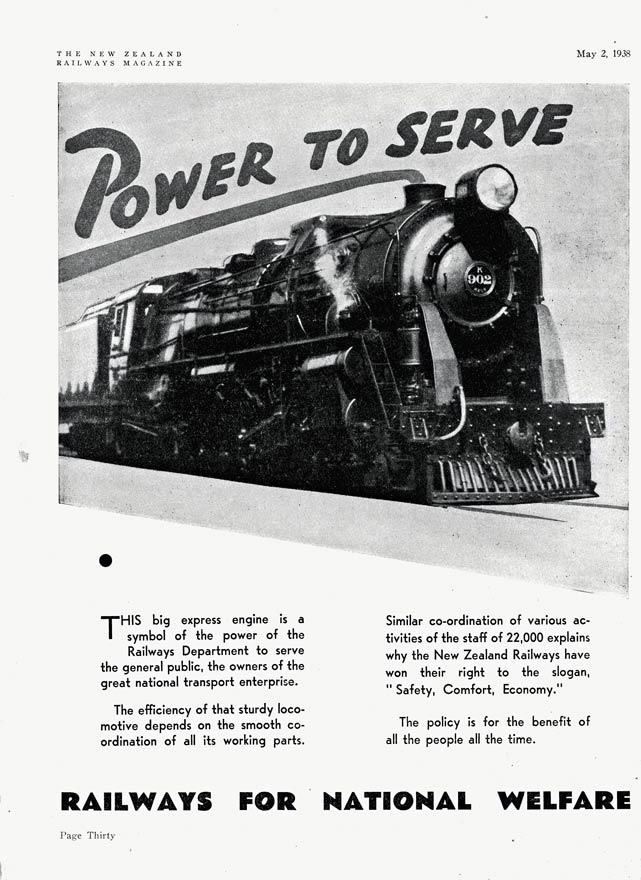
A Different Ethos: A page from the May 1938 issue of the New Zealand Railways Magazine. There are more ways to measure the value of an enterprise than simple profit and loss.

THE FLINTY-FACED MEN who run everything these days will call me a hopeless romantic, but I won’t care. They’ll point to the bottom line of the company’s accounts and shake their heads. “This is a business,” they’ll say, using that patient tone reserved for fools and children. “It must be run as a business.” But I won’t be convinced.

“Business”, no matter how hard its backers try to convince us otherwise, does not belong in the same ontological category as “Weather”. It’s not something we simply have to live with because, no matter how much we talk about it, or complain about it, we cannot change it. Businesses are the work of men and they are whatever men tell them to be. Bottom lines can be made to measure more than profit and loss.

The New Zealand Railways used to have 20,000 workers on its payroll. On the trains and railcars and electric units there were engineers, conductors and guards. In the stations and marshalling yards there were station-masters, schedulers, pointsmen, shunters and ticket-sellers seated in narrow booths. In the railway workshops hundreds of highly skilled tradesmen designed and built locomotives and rolling stock, refurbished carriages and undertook running repairs and maintenance. Up and down the thousands of miles of track gangs of railway workers checked the signalling gear, maintained the rails and ties and sleepers, noted signs of wear and tear and assessed the risk of washouts and slips. In between keeping the network safe, at ten and twelve and three o’clock, you’d see them hunched around a primus stove, boiling a billy, smoking a fag, chewing the fat. Working men, gainfully employed, bringing home a living wage to their wives and children.

How do you fit that picture into your bottom line, Mr Businessman?

How do you measure the value of kids growing up in working families where Dad and Mum pointed with pride to the great machines that the brains and hands of working people had made? What price do you put on the mastery of the complex tools, the lathes and presses, that produced the components that kept the machines running? Or the lifetime of productive work that their makers could look back on, and their sons and daughters aspire to? Where, on your bottom line, Mr Businessman, do you account for the vibrant neighbourhoods radiating out from the marshalling-yards and workshops at their heart? The shops and the supermarkets where people gathered and swapped gossip; the pubs and clubs where they argued about sport and politics? Are they not worth as much as the working-class neighbourhoods of China?

If you were honest, Mr Businessman, you’d tell me (sotto voce) that, really, it’s not THE bottom line that matters, but WHOSE.

The railways belonged to the people, but the road haulage companies belonged to their shareholders. Hardly surprising, then, that under the shareholders’ political party roads and lorries began to take precedence over rails and locomotives. When budgets were being drawn up it was to concrete and bitumen that the funds were allocated – not diesel oil, steel and hardwood sleepers. In other parts of the world the symbols of modernity were high-speed trains and light-rail public transportation networks, but here in New Zealand the future belonged to six-lane highways and 18-wheeler trucks.

Symbols Of Modernity: High-speed trains became emblems of progress and technological prowess in Japan, Western Europe and China - but not in New Zealand.

In 1986 the party that had pledged to “Save Rail” corporatized it. NZR became an SOE and from that moment on it was to be run as a business, with a business’s bottom line, and a business’s ruthlessly “downsized” workforce.

At the stroke of a pen, all the benefits that could not be accommodated in the accountant’s ledger ceased to matter. The benefit of having people gainfully employed and paying taxes instead of rotting on the dole. The benefit of working-class kids aspiring to be skilled tradespeople rather than patty-flippers at Macdonalds. The benefit of having socially coherent and flourishing neighbourhoods rather than decaying factories and weed-infested marshalling yards full of young people without jobs getting high on drugs where their fathers and mothers once earned a decent wage.

But that’s the way it was. New Zealand had joined the “Real World” of global markets and bloodless calculators. Railways were so … well … Nineteenth Century. Horny-handed sons of toil poring coal into puffing-billies. Away with them! Sell it to the highest bidder (and the friends of the highest bidder). Strip out the assets. Let the rest run down. Then (and this is the point where it’s really important to keep a straight face) sell it back to the people at a price that has nothing to do with the bottom line.

Still, we romantics are patient folk. As the Earth’s atmosphere heats up, and Peak Oil plays havoc with the truckers’ profits, those much-despised and long-neglected rails are beginning to hum.

This essay was originally published in The Press of Tuesday, 14 August 2012.