Friday, 10 December 2021

Keeping Out The Virus Of Racism.

Your Pathologies Are Not Wanted Here: In the face of Covid’s dangers, Pakeha New Zealanders have readily conceded the need to surrender many of the civil rights they would otherwise defend with vigour. They have done this to keep themselves and others safe. For iwi organisations to ask that their people be equally protected is, surely, not unreasonable?

FREEDOM OF MOVEMENT within the borders of one’s own country is an important human right – and not one to be revoked lightly. Erecting road-blocks on public highways, and subjecting travellers to close official scrutiny, is deemed tolerable by most citizens, but only for the purposes of preserving public safety.

Few people would object to the Police checkpoints set up to catch drunk drivers. Aware of the carnage caused by people driving while intoxicated, most of us are willing to endure a few minutes of inconvenience for the greater good. Likewise with those road-blocks set up in civil emergencies to protect travellers from fire, flood and earthquake. In such circumstances, with rescue services stretched to the limit, it is simply not rational to allow travellers to put themselves, and others, at unnecessary risk.

Why then are we hearing so many loud objections to the idea of road-blocks being erected jointly by the Police and iwi organisations to protect vulnerable Māori communities in Northland, Taranaki and Tai Rawhiti (the East Coast of the North Island)? What is it about this particular limitation of New Zealanders’ freedom to travel that generates such vociferous responses?

Apart from the depressingly obvious.

Perhaps the first point to make is that these Police/iwi roadblocks are legally mandated. Legislating under urgency in November, the Government changed Covid laws to grant iwi organisations the power to close roads and public places and stop vehicles. But only, it is important to note, with the co-operation and under the supervision of a Police officer or officers.

Clearly, the arguments put forward by Māori communities found attentive ears among New Zealand’s parliamentarians. With the awful precedent of the 1918-19 Influenza Epidemic before them, how could it be otherwise? The two thousand Māori fatalities attributed to the deadly “Spanish Flu” were out of all proportion to the indigenous population. Is it so surprising that, in the midst of another global pandemic, Māori are determined to avoid a similar catastrophe?

Why, then, are so many Pakeha so angry? Why, in particular, has the Act Party felt entitled to inflame matters? As someone who was in Parliament when the legislation was being passed, what has prompted the Act Party leader, David Seymour, to declare:

“Labour has snuck a law through Parliament letting iwi run checkpoints. Our weak PM has surrendered basic rights. The Police Commissioner, rather than upholding the law, has given into demands of iwi. Kiwis have a right to move around the country without being stopped by thugs.”

Let’s pick apart this extraordinary statement. Because, astonishingly, just about everything Seymour alleges is false. No basic rights have been surrendered by the Prime Minister. On the contrary, the right of Māori New Zealanders to be protected from possible infection by visitors to their isolated communities has been upheld. Nor is it the case that the Police Commissioner, Andrew Coster, has failed in his duty to uphold the law. As we have already established, these Police/iwi roadblocks, erected for the preservation of public safety, are entirely legal. And while it is perfectly true that “Kiwis have a right to move around the country without being stopped by thugs”, set in the context of the Act leader’s entire statement, that sentence can only be described as racially inflammatory.

Is it really the case that Parliament and the Police have “given in to iwi demands”? Doesn’t the Third Article of the Treaty of Waitangi confer upon Māori the same rights and privileges as all other “British subjects”. In the face of Covid’s dangers, Pakeha New Zealanders have readily conceded the need to surrender many of the civil rights they would otherwise defend with vigour. They have done this to keep themselves and others safe. For iwi organisations to ask that their people be equally protected is, surely, not an unreasonable “demand”?

To describe those operating these roadblocks as “thugs” is the final insult. As if any group of Māori daring to stop the driver of a monstrous SUV and question him concerning his intentions in their traditional tribal territories – their “rohe” – must ipso facto be common criminals – “thugs”.

Just pause for a moment and contemplate the extraordinary sense of racial entitlement behind such indignation: the brutal assumption of superiority; the shameless assertion of privilege.

Erecting roadblocks against all such intrusions of unabashed Pakeha racism is, surely, long overdue?


This essay was originally published in The Otago Daily Times and The Greymouth Star of Friday, 10 December 2021.

Thursday, 9 December 2021

Sitting Next To Cousin Simon.

The Climate Inactivist’s Tale: “Keeping our eyes on the ‘Big Picture’ is important. The problem, of course, is trying to locate New Zealand in the overall composition. Because, if the ‘Big Picture’ of Greenhouse Gas Emissions covers 1,000 square centimetres of canvass, New Zealand’s share of the surface amounts to just 1.7 square centimetres. You’ve got to get up real close to even see our contribution to the problem.”

EVERY FAMILY HAS ONE. You must know the sort. One of the Baby Boom generation, who desperately wishes he wasn’t. He looks in the mirror and sees more and more grey hairs. His face, too, is changing. Sagging, folding, failing: his increasingly unfamiliar features all appear to have given up resisting the relentless tug of gravity – and old age. But, even as his body surrenders, this guy’s spirit goads him into ever greater feats of ideological derring-do. The man may be getting older, but the ideas he espouses grow younger with every passing year.

If you’re especially unlucky you’ll end up being seated next to this guy – let’s call him Cousin Simon – at Christmas Dinner. Some small inkling of what you’re in for comes from the weird language he speaks. He talks about all sorts of important things happening “in this space” and promises to send the “deets” to your “device”. Far from being reproached by your furrowed brow, he delights in your obvious incomprehension. The two of you may be roughly the same age, but he, at least, remains tuned to the frequency of youth.

Watching him watching the rest of the family, you just know he’s waiting for some poor sod to say something requiring his beneficent intervention. You don’t have to be a rocket scientist to work out who it’s likely to be. Your other cousin, Murray, has been a dairy farmer all his life and has a powerful set of politically incorrect views to prove it. To make matters worse, Murray derives obvious pleasure from winding Simon up.

“You’d be disappointed with the COP26 fiasco, Simon. With the atmosphere warming up, all that hot air was probably the last thing the planet needed! But, for my money, the best story to come out of the whole conference was the news item that Royal Air Force cargo planes had to make dozens and dozens of flights between London and Glasgow to ensure that all the big-wigs had suitably flash limousines in which to travel back and forth to the conference venue. That’s quite a carbon footprint!”

Simon’s brow furrows and he lets out a long sigh.

“Those are the sort of stories climate inactivists seize upon to discredit what is actually the incredibly important work of international gatherings like COP26. It is vital, when discussing Climate Change, Murray, to keep your eyes on the Big Picture.”

Murray’s grin should have warned Simon that he was walking into an ambush.

“Ah, yes, the ‘Big Picture’, you’re so right, Simon. Keeping our eyes on the ‘Big Picture’ is important. The problem, of course, is trying to locate New Zealand in the overall composition. Because, if the ‘Big Picture’ of Greenhouse Gas Emissions covers 1,000 square centimetres of canvass, New Zealand’s share of the surface amounts to just 1.7 square centimetres. You’ve got to get up real close to even see our contribution to the problem. So, if we were to paint over all our GGE sins, it would take a pretty sharp-eyed observer to notice they’d gone.”

Simon shook his head in that infuriating ‘more in sorrow than in anger’ way he has perfected.

“But, Murray, that’s a bit like saying there was no need for New Zealand to have participated in World War II, because our contribution to the final victory over fascism was almost too small to measure. Regardless of our size, we did the best we could – we played our part. Doing our bit in the fight against Climate Change is equally important. Even the smallest of contributions counts for something.”

Murray put down his knife and fork and snorted derisively.

“No, it doesn’t, Simon. And your comparison with World War II just doesn’t hold water. How long do you think New Zealand would have persisted – voluntarily – if its participation in the war effort was rapidly destroying its economy, throwing tens-of-thousands of people out of work, and causing its social fabric to disintegrate? This country did bloody well out of the War. The Brits took everything we could load into a freighter’s hold. But, when fighting achieves nothing but the destruction of everything people hold dear, well, then they stop fighting. How long did the Norwegians hold out? The Belgians? The Dutch? The bloody French? The damage we would have to inflict upon ourselves to make the slightest impact on our emissions is just too great. New Zealanders won’t stand for it.”

Simon stared hard at Murray. The table fell silent.

“So, what are you saying, Murray? That we should just give up?”

Murray sighed.

“What I’m saying, Simon, is that the idea we can ‘do something’ is just nonsense. Our entire civilisation was built by the energy derived from the burning of fossil fuels. Take away its fossil fuel and our civilisation collapses. It’s just that simple, Simon. We simply have no choice but to go on doing what we’ve always done. You shake your head? Well, think about this. Europe is suffering from an acute fuel shortage – and winter is fast approaching. Without heating oil, without natural gas, and, yes, without that terrible stuff called ‘coal’, Europeans will freeze. Do you really think their governments are going to tell them: ‘Rug-up folks! We’re fighting global warming!’ Not a chance. They’re going to keep the lights on and the central heating working – no matter what.”

Simon, was having none of it.

“That’s just bullshit, Murray! Europe has made huge strides in bringing alternative energy sources into the mix. The technology is there – it’s being used right now!”

Murray let loose another guffaw.

“Europe? North America? Australasia? Oh sure. They can play at fighting climate change because all the industrial grunt work is being done in other parts of the planet. Take a look at what powers the machines of China, India, Brazil, Nigeria, South Africa – it ain’t windmills and solar panels, Simon – that’s for sure! Don’t you get it? If these ‘workshops of the world’ stop using fossil fuels, then nothing gets made. You think we’ve got ‘supply-chain’ problems now, with Covid? Just wait until another thousand Chinese factories shut down for want of the electricity generated by coal-fired power plants! So, you tell me, Simon: when those factories are no long creating profits, how are the Chinese supposed to pay for New Zealand’s Milk Powder?”

Oh boy! This was about to get just a little too hot for Christmas Day. Thank God Murray’s wife was thinking the same thing.

“Come on everybody, that’s enough politics. Your Christmas Dinner’s getting cold. Murray, why don’t you go and get Simon another glass of chilled Chardonnay. He looks like he could use one!”


This essay was originally posted on The Daily Blog of Thursday, 9 December 2021.

Monday, 6 December 2021

A Smooth Performance.

In A Word: The new Leader of the Opposition, Christopher Luxon, has very clearly chosen to reject the option of presenting a “flinty-faced” National Party to an electorate grown accustomed to the rhetoric of “kindness”. If the message of National’s new leader could be compressed into a single word, then that word would be: Moderation.

COVID HAS A LOT to answer for. Todd Muller, in particular, has good cause to feel aggrieved. How much more smoothly his induction to “the hardest job in politics” might have gone if he had been able to sit down, in familiar surroundings, and answer his inquisitors calmly and with due consideration.

What New Zealanders saw, instead, was Muller standing all alone in the echoing darkness of the Old Legislative Chamber. Starkly lit, and filmed from a low angle, he was forced to respond to questions directed at him from hundreds of kilometres away. Fixed to his position in front of the camera, he attempted to enliven the strained encounter by raising his voice and gesticulating energetically. The effect was unsettling: a big, shouty man, waving his arms about randomly it the dark. In short, a performance most unlikely to inspire either confidence in, or affection for, the National Party and its new leader.

The contrast with Christopher Luxon could hardly be sharper. Interviewed by Jack Tame for TVNZ’s Q+A current affairs show on Sunday, 5 December, the new National leader was seated comfortably in what one must assume was his own (very stylish) Auckland residence. The interview set-up was so much more conducive to useful communication than the desperately uncomfortable environment inflicted upon Muller. The lighting was flattering, the camera-angles professionally determined. With both men seated comfortably, eye-to-eye, Tame’s questions, and Luxon’s answers, resulted in the sort of unforced, self-revelatory dialogue that permits the voters to get a good measure of the Opposition’s new leader.

One can only speculate about the to-ing and fro-ing between TVNZ, the Q+A team, and Luxon’s people, that presumably preceded the interview. What seems clear, however, is that the advice being tendered to the new National leader is several orders of magnitude superior to that supplied to his hapless predecessors. This is important.

For most of her term as Prime Minister, Jacinda Ardern has had at her disposal the formidable expertise of, initially, Mike Munro (Helen Clark’s superb media manager) and then the equally competent Andrew Campbell. Combined with her own not inconsiderable talents as a communicator, the highly professional media management of Ardern’s Government has contributed significantly to its political success.

There is a story (possibly apocryphal) which illustrates the vital importance of what would now be called the “situational awareness” of a good media manager. It harks back to a post-election period when Winston Peters was, not untypically, denying all interest in the “baubles of office”. When, however, it became clear that his support would be needed to keep Helen Clark’s Labour-led Government in power, Peters’ disinterest began to slacken.

Waylaid at one of the country’s larger airports by a scrum of journalists, Peters was repeatedly challenged to explain his sudden change of heart vis-à-vis said baubles. It was then that Mike Munro, who fortuitously happened to be present, noticed that Peters was standing in front of a Christmas display featuring a plethora of – you guessed it – baubles. Understanding immediately how damaging this “Winston with Baubles” image would be: Munro gently nudged the NZ First leader in front of a less compromising backdrop.

Silly? Petty? Well, yes, of course. But one has only to recall the images of Don Brash attempting (unsuccessfully) to climb in and out of a racing car, or “walking the plank” from a speed-boat to the jetty, to grasp just how much careful thinking and planning needs to go into how a political leader is presented. Even in 2021, one picture is still worth a thousand words.

It should, therefore, be a source of real satisfaction to National’s backers and strategists that Luxon has around him a team capable of setting up something as politically constructive as the Q+A dialogue with Tame. Quite apart from all the non-verbal communications: the sophisticated and stylish surroundings; the subject’s relaxed demeanour; Luxon was able to deliver his pitch without any of the weird distractions that prevented Muller from communicating effectively with his audience.

What, then, was the substance of Luxon’s pitch and how effectively did he present it? If the message of National’s new leader could be compressed into a single word, then that word would be: Moderation.

Luxon made it clear that he will be making full strategic use of Bill English’s “Social Investment” policy – “surging” resources to where they can do the most good for those deemed likely to make a prolonged call upon the state’s resources. While declining to offer a full endorsement of former National Prime Minister Jim Bolger’s call for a “reimagining of capitalism”, Luxon made it clear he was no hard-line adherent of the laissez-faire policies of Roger Douglas and Ruth Richardson. (Not to mention Act’s David Seymour.) Nor was he prepared to put a cap on state indebtedness as a percentage of GDP. (As both Labour and the Greens did in 2017.) Lower taxes: while something he would “love” to do, is not something he’s committing National to – just yet.

All this will be music to the ears of the 400,000 National “deserters” of 2020. Luxon has, very clearly, chosen to reject the option of presenting a “flinty-faced” National Party to an electorate grown accustomed to the rhetoric of “kindness”. There are simply too many women voters the party needs to win back from Labour.

Conservative males will likely interpret Luxon’s pitch in slightly different terms. The priority for these voters is a National leader capable of restoring the New Zealand ship of state to an even keel. Radicalism of all kinds: be it of the Right or the Left; is unsettling. Moderation is exactly what they are seeking: a return to business as usual.

Perhaps the most important of Luxon’s answers to Tame’s questions were the ones he gave on Māori-Pakeha relations. After displaying an impressively succinct understanding of the Treaty of Waitangi’s three articles – an understanding conspicuously lacking in the Prime Minister when similarly questioned in 2018 – Luxon drew a very clear line in the sand on the issue of Māori co-governance.

Foreshadowed here, is what, for many New Zealanders, will be a welcome rejection by National of what is fast becoming the “official” version of the Crown’s Treaty obligations. Members of the political class have been given a thoroughly polite, but timely, warning that a change of government will bring with it a considerably less radical interpretation of the Treaty’s meaning. Those senior public servants anticipating an inexorable, bi-partisan advance towards the full realisation of Māori co-governance, in time for the Treaty’s bicentennial in 2040, should think again.

Naturally, not every one of Luxon’s replies were as polished, or filled with political heft, as his response to Tame’s questioning on the Treaty. Indeed, it would be astonishing if they were. National’s new leader has been in Parliament for barely a year, and there is still a lot of polishing to do. Labour’s problem, however, is that Luxon is not a rough-hewn work-in-progress, still bearing the marks of the chisel. On the contrary, the man already offers a remarkably smooth surface to the camera’s gaze.

Two more years of polishing. Two more years of coming to grips with the insatiable hunger of the 24-hour news cycle. Two more years of drawing the best from a caucus team already buoyed by the palpable change of mood across both party and country. Two more years of favourable poll numbers. Two more years of rising donations from the fabled “big end of town”. Two more years of refining National’s message and upgrading the means of delivering it – and Labour will be in a world of pain.

How eagerly the Prime Minister must be awaiting medical science’s final judgement on the Omicron Variant. The worse, the better.


This essay was originally posted on the Interest.co.nz website on Monday, 6 December 2021.

Friday, 3 December 2021

Onward Luxon’s Soldiers (Sung to the tune of Onward Christian Soldiers)

Marching As To War?

Onward Luxon’s soldiers,
Marching to class war,
With the lust for profit,
Going on before.
Chris the new ringmaster,
Leads against the foe;
Forward into battle
Goes this C.E.O!

Onward Luxon’s soldiers,
Marching to class war,
With the lust for profit,
Going on before.


From Luxon’s religion
Voters may yet flee;
Surely someone’s focused-grouped
His Christianity?
Bottom lips may quiver,
When the news is shared;
From Bible-bashing, Pro-Life Nats
This country would be spared.

Onward Luxon’s soldiers,
Marching to class war,
With the lust for profit,
Going on before.


The Nats were once a party
Inspiring fear and dread;
In every street, in every town,
They left the Reds for dead.
Now a fractious rabble,
Of vicious smears and leaks;
An off-putting selection
Of circus clowns and freaks.

Onward Luxon’s soldiers,
Marching to class war,
With the lust for profit,
Going on before.


Leader follows leader,
Factions rise and fall,
But the pollsters’ numbers
Hardly change at all.
Weary of the slaughter,
Caucus takes a punt;
Pin their hopes, just one more time,
On one more rich, white … man.

Onward Luxon’s soldiers,
Marching to class war,
With the lust for profit,
Going on before.


Gleeful sits Jacinda,
Among her happy throng;
Struggling to believe that
Her luck could last so long.
Covid won the last fight,
Unleashing the Red Tide;
Does Luxon prove that Labour
Has God upon its side?

Onward Luxon’s soldiers,
Marching to class war,
With the lust for profit,
Going on before.


Chris Trotter 
2 December 2021


This parody was originally posted on The Daily Blog of Friday, 3 December 2021.

Can Luxon “Reimagine Capitalism” – Like Muldoon?

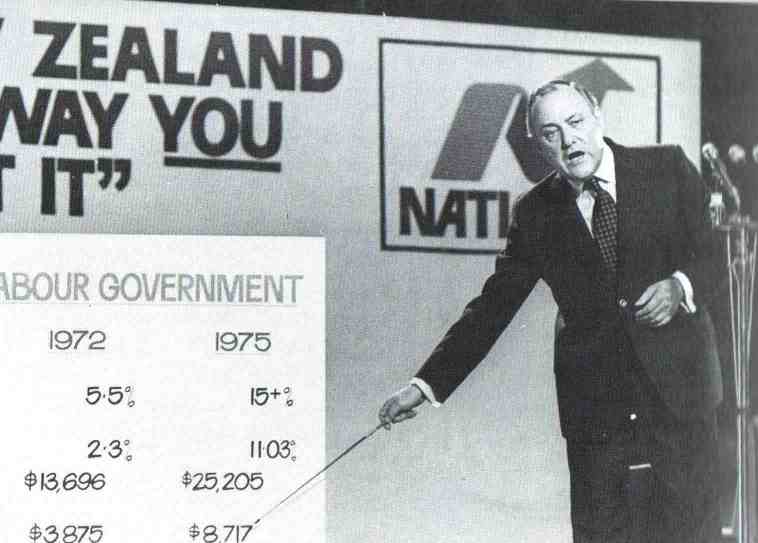
Outflanking The Socialists: Because there really isn’t any other way that National can win. Christopher Luxon, like Rob Muldoon (above) needs to go fishing where there are fish to catch. Using what for bait? Simple. A solemn promise to halt the upward redistribution of wealth among the sort of highly-educated, middle-class bureaucrats who get paid for telling working people what to do.

THE PROBLEM with Jim Bolger’s sagacious intervention of last Sunday was that it diagnosed National’s disease, but supplied no remedy. It is all very well to tell National’s new leader, Christopher Luxon, that he must articulate a clear “vision” to the electorate. Who would disagree? Much more helpful, however, would’ve been some indication as to what that vision might be.

The nearest Bolger got was a suggestion that the new Leader of the Opposition might like to “reimagine capitalism”. Now, as a man of the Left, I have to say this was a pretty startling piece of advice. Most of those on the centre-right of politics struggle with the idea that there is anything about capitalism that requires “re-imagining”. What Bolger’s radical diagnosis appeared to be saying, however, was that National’s longstanding mistrust of political imagination might just lie at the heart of the party’s electoral difficulties.

Fair enough. But asking Luxon to re-imagine capitalism strikes me as a rather tall order for someone who’s only just celebrated his first year as an MP. Tall, but not impossible. Because, as Newsroom journalist Nikki Mandow reminded us on Monday morning (29/11/21):

“[I]t was Luxon who first introduced former KiwiRail chief executive Peter Reidy to the high engagement, high performance management model.

‘He’d been using it for a couple of years at Air New Zealand and was getting great results in terms of engaging frontline workers and their union to improve productivity’.”


Does this “high engagement, high performance management model” count as an example of reimagining capitalism? Maybe it does. It certainly counts as persuasive evidence that Luxon isn’t afraid of new ideas, new ways of working, and – wonder of wonders for a National Party politician – that he isn’t afraid of interacting productively with workers and their unions.

And that lack of fear is likely to prove crucial to Luxon successfully hauling National out of the rural and provincial swamp in which his predecessor, Judith Collins, had allowed her party to become mired.

Because, if there is one fact that National’s new leader must make his colleagues understand, it is that there simply aren’t enough farmers, small businesspeople and conservative Christians living in New Zealand to carry their party to victory. Nor is it any longer the case that a middle-aged White male, with a background in business, can expect to be automatically deferred to by centre-right voters – let alone centre-left converts.

Not that I’m suggesting a business background is a handicap, merely that it’s not enough. Not with half the workforce made up of women. Not when the blue collars of New Zealand’s proletariat are, increasingly, fastened around brown necks. Not when a growing proportion of New Zealand’s population grew up in powerful and active states, for whom the planning and implementation of economic development remain core government functions. (As was once the case right here in New Zealand!)

If Luxon’s caucus is unwilling to exercise their collective political imagination upon these electoral and cultural fundamentals, then National’s future is bleak. Eventually, Labour – which understands, at least theoretically, that these key transformations must be acknowledged and responded to – will work out how to make change happen.

Luxon’s tenuous – and presumably temporary – advantage is that Labour has yet to master the art of turning theory into practice. If, while his political opponents continue to faff about, Luxon reaches out, like Boris Johnson, to that part of Labour’s traditional working-class base that is no longer quite sure whose side Jacinda Ardern and her government is on, then National can begin to amass the additional numbers it needs to reclaim the Treasury Benches.

Outlandish? You reckon. Impossible? Well, it certainly won’t be easy, but it should not be forgotten that National has done it before. Luxon could do a lot worse than to set about rehabilitating the reputation (and some of the policies) of Rob Muldoon. Not the whole shebang, mind, but, at the very least, Muldoon’s willingness to reimagine, and reconfigure, capitalism in the way ordinary New Zealanders wanted it.

Because there really isn’t any other way that National can win. Luxon, like Muldoon, needs to go fishing where there are fish to catch. Using what for bait? Simple. A solemn promise to halt the upward redistribution of wealth among the sort of highly-educated, middle-class bureaucrats who get paid for telling working people what to do.


This essay was originally published in The Otago Daily Times and The Greymouth Star of Friday, 3 December 2021.

Thursday, 2 December 2021

The Fellowship Of The Upper Room.

Render Unto Caesar: What kind of Christian would attempt to persuade his brothers and sisters that the moral imperatives of their faith must not, under any circumstances, be given practical expression in the flesh-and-blood world they inhabit? To suggest, as Luxon does, that faith and politics can – and should – be separated, admits but one of two possible conclusions. Either he does not understand the obligations of a Christian. Or, he isn’t one.

THE FIRST QUESTION: “Is the ‘Upper Room’ a church? Strictly speaking, the answer is ‘No’. It is certainly a place of evangelical Christian fellowship, but if by ‘church’ you mean a dedicated house of worship, with a steeple, stained-glass windows, wooden pews and an ornately carved pulpit, then, no, the Upper Room is not a church. So, Christopher Luxon didn’t lie to RNZ’s Suzie Fergusson on Wednesday morning (1/12/21) when he said he hadn’t been in a church for five years.

Where I come from, however, we would call Luxon’s answer “Jesuitical” – meaning “practicing casuistry or equivocation; using subtle or oversubtle reasoning; crafty; sly; intriguing”. Why? Well just think about Luxon’s answer for a moment or two. Five years ago, Luxon’s political career was just a gleam in Prime Minister John Key’s eye. He was still at the helm of Air NZ, still earning more than $4 million per annum, and, almost certainly, still a key participant in the Fellowship of the Upper Room.

Why not admit frankly to his membership of the Upper Room? What is it about this Fellowship that prompts Luxon and his advisers to make as little of it as possible? The answer lies in the information unearthed by the sort of journalists who know where to go looking on the Internet for linkages between evangelical Christian fellowships and ambitious right-wing politicians. What those searches revealed was an Upper Room pastor of decidedly Trumpian sympathies, whose political views appeared to match those of the American Christian Right. Unsurprisingly, Luxon has done his utmost to put these “interesting” associations as far behind him as possible.

Indeed, his embarrassment is evident in the way he attempts to dissuade journalists from examining his Christian beliefs too closely. He told his first media conference as Leader of the Opposition that his faith had been “misrepresented and portrayed very negatively”. That personal faith, he declared was something that “has grounded me and put me into [a] context that is bigger than myself.” Anticipating the assembled journalists’ next question, he went on to clearly affirm his belief in the “separation of politics and faith”.

Now this is a rather peculiar formulation. Most people who had given the question serious thought would have used the more familiar formulation: the separation of Church and State. There are many sound historical and philosophical reasons for keeping the spiritual and temporal powers in their proper spheres. Theocracies are not comfortable places in which to live.

Jesus himself famously responded to the daunting challenges of power and piety with his wonderfully (and typically) enigmatic: “Render therefore unto Caesar the things which are Caesar’s; and unto God the things that are God’s.”

But keeping “faith” and “politics” separate? Well, that’s a very different matter. Many would argue that no Christian worthy of the name would ever attempt to do such a thing. Was Jesus keeping faith and politics separate when he scourged the money-changers and overturned their tables? When he cried out: “The Scriptures declare, ‘My Temple will be called a house of prayer,’ but you have turned it into a den of thieves!” Was the Galilean carpenter keeping politics on the down-low when he told his followers: “[I]t is easier for a camel to go through the eye of a needle than for a rich person to enter the Kingdom of God!” (One can only speculate about how easy entering Heaven might be for the owner of seven houses!)

What kind of Christian would attempt to persuade his brothers and sisters that the moral imperatives of their faith must not, under any circumstances, be given practical expression in the flesh-and-blood world they inhabit? If the Almighty commands: “Thou shalt not kill.” Then, is it not incumbent upon a Christian legislator to make laws forbidding murder and manslaughter? (And Abortion?) To suggest, as Luxon does, that faith and politics can – and should – be separated, admits but one of two possible conclusions. Either he does not understand the obligations of a Christian. Or, he isn’t one.

Then again, it is possible that he is the sort of Christian that gave us the word I used earlier, “Jesuitical”.

The “Society of Jesus” – The Jesuits – were formed in 1540 to combat the “error” of Protestantism at a time when the Catholic Church and the followers of Martin Luther and his theological reformers were locked in mortal combat for the soul of Christendom. In the bitter religious and military conflicts arising out of the Catholic “Counter-Reformation”, the Jesuit Order became the equivalent of the Pope’s Navy SEALs – an elite ideological force in the defence of the one true faith. As is the case with so many elite units, the ends of the Jesuits’ spiritual combat missions were deemed sufficiently important to justify all manner of means.

Fast-forward to the Twentieth and Twenty-First Centuries, and Christianity is still a religion bitterly divided between those caught up in the struggle to determine what belongs to Caesar and what belongs to God; and those who, heretically, have come to regard the purposes of God and the purposes of Caesar as one and the same.

The former see God’s marching-orders in Jesus’s Sermon on the Mount: and in God’s preferential option for the poor. The latter believe that God exercises his authority through those he chooses to lead a lost and sinful world. Crucially, these need not be good men. Was the murderer and adulterer, King David, a good man? God loved him, nonetheless. All that matters is that such men rise to positions from which the will of God can be made manifest. The American Christian Right understood immediately that Donald Trump wasn’t a good man. But, they believed with all their heart that he was God’s man.

Which of these two groups does Christopher Luxon belong to?

As the Taxpayers Union was quick to point out, a man who took a $4 million pay-cut to enter Parliament was clearly not doing it for the money! Interviewed on camera by Stuff, just hours after becoming the National Party’s new leader, Luxon traces his interest in politics to reading a biography of Winston Churchill – a man who, from an early age, was convinced that God/Destiny had a special purpose for him. The biographies of “great men” have shaped Luxon’s understanding of both business and politics. If the Taxpayers Union is right, and he’s not in Parliament for the money, then why is he there? For the power?

Luxon insists that his goal is to restore National to the paths of moderation. If true, then we must wish him well. But I can’t help recalling his difficulty in responding to Suzie Fergusson’s questions about his faith. To be an evangelical Christian is to be a proud proclaimer of Christ’s “good news” to “all the nations”. No Christian politician should ever be tongue-tied when challenged to declare his mission. Jesus’s “Order of the Day” has not changed in 2,000 years:

“Love the Lord your God with all your heart and with all your soul and with all your strength and with all your mind’ and, love your neighbour as yourself.”

The only world worth fighting for politically, and the only world worth living in, is the world in which Caesar marches to the same order.


This essay was originally posted on The Daily Blog of Thursday, 2 December 2021.

Tuesday, 30 November 2021

The Simple Thing That’s Hard To Do.

What's Not To Like? There’s a reason why the self-evident benefits of a “one world government” arouse such visceral opposition from those with a vested interest in both the local and the global status quo. A world run for the benefit of all human-beings strikes at the very heart of the idea that there is something both admirable and efficient about an economic and social system which allows individuals and their families to accumulate and pass on great wealth – at the expense of others.

WHAT IS THE REASON people fear a united world in which solidarity, rather than greed, is the driving force? In such a world the Covid-19 Pandemic would have been handled collectively, without regard to either the narrow interests of nation states, or the hunger for corporate profit. In such a world the response to global warming would have been instantaneous, decisive, successful, and set in motion 50 years ago. In such a world no one would be permitted to remain in need, and obscene wealth would be unthinkable. That such a world would be the preference of just about every human-being seems indisputable – and yet it exists only in the imagination of utopian dreamers.

Why is that?

My question is prompted by some of the placards I saw being carried by participants in the recent anti-vaccination protests. Some of these referenced Agenda 21, others Agenda 30. According to Wikipedia, Agenda 21 is “a non-binding action plan of the United Nations with regard to sustainable development. It is a product of the Earth Summit held in Rio de Janeiro, Brazil, in 1992.” Agenda 30 is another UN initiative which, similarly, offers a “blueprint to achieve a better and more sustainable future for all people and the world by 2030.” What could possibly prompt people to object to these self-evidently beneficial goals?

The answer, of course, is Fear. Fear of in some way being made subordinate to foreigners. No, let’s be honest here. Fear of people with dark skins requiring people with white skins to share the world’s resources more equitably. Fear of losing the last remaining privilege still available to the poorest and most despised of white people: their supposed racial superiority. Fear of no longer belonging to the collectivity of masters. Fear of joining the collectivity of servants and slaves.

How else to explain the extraordinary reaction of the White World to the identification of the Omicron Variant of Covid-19 by South African scientists? Rather than thank the South Africans for alerting the world to this new potential threat to global health, the nations of Europe, North America and Australasia immediately banned all flights from the southern third of the African continent. Never mind that the Omicron Variant had already arrived in locations all over the planet, including Europe, the nations of the West reflexively, almost casually, delivered yet another devastating blow to the fragile economies of South Africa and her neighbours.

Not fair! Cry the governments of the West. We are only doing what is necessary to protect our people from this new Covid threat. Which is true, but which also brings us back to where we began.

In a solidaristic world: one without borders and self-protective nation states; the extraordinary, publicly resourced, scientific effort that created a plethora of Covid-19 vaccines in record time, could not have been privatised by vast pharmaceutical corporations and transformed into super-profits. On the contrary, the resources of the entire planet would have been mobilised to produce sufficient vaccine to inoculate the entire human population in the shortest possible time. The idea of leaving hundreds-of-millions of people unvaccinated – and, by doing so, allowing the virus to mutate at will – would have been dismissed as not only scientifically imbecilic, but also morally indefensible.

A similar regard for global well-being and justice, backed up by a global police force recruited from ethnic and linguistic communities from across the planet, would have brought a swift halt to the indefensible destruction of the Amazonian rain forest by Brazilian farming and mining interests.

That same international police force would long ago have indicted the major oil corporations for conspiring to keep hidden from the global public the deadly threat posed to the planet by rising fossil-fuel pollution. (Always assuming that such dangerous concentrations of private power would even be allowed to exist in a world committed to and driven by the obligations of global solidarity.)

It is here, of course, that we run headlong into the other reason why the self-evident benefits of a “one world government” arouse such visceral opposition from those with a vested interest in both the local and the global status quo. A world run for the benefit of all human-beings strikes at the very heart of the idea that there is something both admirable and efficient about an economic and social system which allows individuals and their families to accumulate and pass on great wealth – at the expense of others.

The very thought that this system might be superseded terrifies even those who do not possess great wealth. For these benighted souls, an indestructible aspiration to somehow join the ranks of the rich and powerful has lighted their way through all the dark vicissitudes of life. Selfish dreamers, their stunted existence at the bottom is made bearable by the (mistaken) assumption that there is always room at the top. Threaten this, their most precious dream, and their reaction will be as vigorous as it is vicious.

Paradoxically, the only effective evolutionary responses to a global pandemic – collectivism and solidarity – are also the most effective means of inspiring ferocious resistance to all the measures required to give them practical effect. The same is true of the economic, social and political policies required to eliminate poverty, racism and sexism. Indeed, all the evils which beset human societies may ultimately be traced to a common hatred of anything and everything that draws people together in freely-given love and trust.

Nowhere is the natural inclination of human-beings to come together in friendship and confidence illustrated more vividly than in the story about the first Christmas of World War I. How the German and English soldiers, hearing the carol-singing of their enemies drifting across no-man’s land, climbed cautiously out of their trenches and met them halfway. Alcohol, cigarettes and Christmas rations were exchanged, along with the soldiers’ low opinion of the war. Shocked and alarmed, their officers soon put an end to this unauthorised fraternisation. Within hours, these ordinary Germans and Englishmen were back in their trenches and doing their best to kill one another. It was the one and only “Christmas Truce” of the war.

How close those soldiers came to the essential truth of the tragedy in which they were all submerged: that it simply didn’t have to be that way. Abandon the mythologies of race and nationality, and embrace the reality of our common humanity, and war is only one of the evils that will disappear.

As the German poet, playwright, and communist, Bertolt Brecht, put it:

It is reasonable. You can grasp it. It’s simple.
You’re no exploiter, so you’ll understand.
It is good for you. Look into it.
Stupid men call it stupid, and the dirty call it dirty.
It is against dirt and against stupidity.
The exploiters call it a crime.
But we know:
It is the end of all crime.
It is not madness but
The end of madness.
It is not chaos,
But order.
It is the simple thing
That’s hard to do.


This essay was originally posted on The Daily Blog of Tuesday, 30 November 2021.