Wednesday, 13 January 2016

The Club That Rules The World.

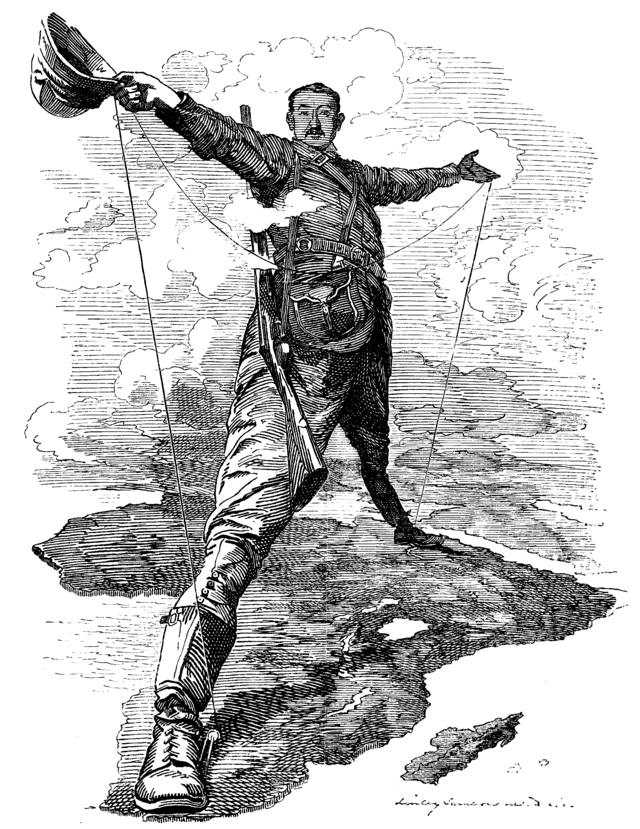
The Colossus That Was Rhodes: Britain's ur-imperialist not only dreamt of constructing a railway from "Cairo to the Cape", but also of expanding the dominion of the Anglo-Saxon powers to encompass the entire planet. A century on, the United States, aided by the United Kingdom, Canada, Australia and New Zealand, has indeed become the global hegemon. The GCSB spy-base at Waihopai is part of that hegemony.

WHAT DO CECIL JOHN RHODES and the Waihopai Spy Base have in common? The answer is: the maintenance of a world in which the Anglo-Saxon powers continue to play a dominant role. Rhodes, the great nineteenth century British imperialist, could not have imagined the raw technological power which installations like the GCSB’s Waihopai Station have added to the imperial mission, but he would have approved – wholeheartedly.
 
He would also have felt entirely vindicated by the current disposition of global economic, military and political power. His vision of the future was one in which the might of the British Empire and the United States had become fused in an Anglo-Saxon imperium to which the rest of the world paid homage.
 
Naturally, Rhodes foresaw the British Empire taking the lead role in this geopolitical drama. In the late nineteenth century, when he was at the summit of his remarkable career, the power of the USA remained veiled. (Although, the exertions of the Civil War, 1861-65, should have alerted Rhodes to America’s prodigious potential.) Even so, his most enduring legacy, the Rhodes Scholarship, was intended to create a special brotherhood of Anglo-Saxon leaders, drawn overwhelmingly from the British Empire and the USA, into whose hands the grand mission of bringing as much of the world as possible under Anglo-Saxon control could be safely reposed.
 
At the heart of Rhodes’ plan to create a global elite lay Oxford University – among whose dreaming spires the Rhodes Trust’s carefully selected scholars were expected to imbibe that noxious mixture of classical idealism, medieval obscurantism and contemporary chauvinism from which the British Empire had been fashioned.
 
Just how toxic this amalgam could be may be judged by Rhodes’ own justification for the creation of Anglo-Saxon hegemony:
 
“I contend that we are the finest race in the world and that the more of the world we inhabit the better it is for the human race. Just fancy those parts that are at present inhabited by the most despicable specimens of human beings what an alteration there would be if they were brought under Anglo-Saxon influence, look again at the extra employment a new country added to our dominions gives.”
 
Rhodes was by no means the only statesman in the British Empire to evince such crude and unabashed racism, and he certainly wasn’t the most peculiar. Not only was New Zealand’s Prime Minister from 1912 to 1925, William Ferguson Massey, a bigoted Orangeman and fervent British imperialist, but he was also a “British Israelite” – a believer in the absurd notion that the inhabitants of the British Isles are descended from one of the lost tribes of Israel and, therefrore, as God’s chosen people, destined to rule the world!
 
It is one of history’s ironies that when men felt free to believe in and give voice to such ideas, full Anglo-Saxon hegemony remained an imperial dream. A century later, with Anglo-Saxon hegemony an accomplished fact, only the most foolhardy British or American statesman would consider drawing the world’s attention to it.
 
Just occasionally however, the world’s reminded of the hegemon’s existence – as when our Prime Minister, John Key, spoke openly of the price of membership of “the club”. He was, of course, referring to New Zealand’s participation in the UK-USA (“Five Eyes”) Agreement alongside Canada and Australia. Although, helping the British and Americans to spy on the rest of the world is very far from being the only “service” members of the Anglo-Saxon “club” are required to provide.
 
Regardless of whether the power contributed is “hard” (military) or “soft” (financial and cultural) members of the Club are expected to keep their subscriptions current. Indeed, it is highly questionable as to whether resignation is even possible. Like the Hotel California, the Anglo-Saxon Club can be a hard place to leave.
 
Contributing To Anglo-Saxon Hegemony: The Waihopai Spy Base.
 
And yet, every January an apparently indefatigable group of protesters gather outside the Waihopai Spy Base to demand its closure and New Zealand’s withdrawal from the Five Eyes Agreement. The sub-text of their annual protest, however, is this country’s long association with the sins of Anglo-Saxon imperialism.
 
The protesters mission is to persuade New Zealanders to disentangle themselves once and for all from Rhodes’ vision: to cease and desist playing even the tiniest role in exerting Anglo-Saxon hegemony.
 
It’s a big ask. Who resigns voluntarily from the club that rules the world?
 
This essay was originally published in The Waikato Times, The Taranaki Daily News, The Timaru Herald, The Otago Daily Times and The Greymouth Star of Friday, 8 January 2016.

Saturday, 2 January 2016

Orbiting A Dying Sun?

A Dying Sun?  Perhaps one hundred years of Labour is enough.
 
AS THE OLD YEAR shuffles towards the wings of the political stage, the Infant Year arrives garlanded with many questions. For those who position themselves on the left of the political spectrum, the biggest of these questions concerns the future of the Labour Party.
 
Love it, or hate it, Labour is the sun around which all the other progressive parties and institutions of New Zealand’s political life must orbit. It’s gravitational pull being inescapable, Labour’s fate, and the fate of the Left in general, are inseparable.
 
Significantly, 2016 marks the centenary of Labour’s birth.
 
In July 1916, in the midst of a monstrous war whose gargantuan appetite had already consumed thousands of young New Zealand lives, representatives of the “democratic public” arrived in Wellington determined that Government plans to conscript men must be accompanied by plans to conscript wealth. The delegates were also seized by the effects of the hitherto all-conquering Liberal Party’s inability to any longer honour its mandate as the democratic public’s principal standard-bearer. Progressive New Zealand was in the mood for something new.
 
The temptation to compare and contrast the Labour Party of 1916 with the Labour Party of 2016 is irresistible. And, no matter how hard the party’s supporters try to convince progressive voters that the opposite is true, it is not an exercise from which Labour emerges with any credit. In 1916, Labour was led by heroes. One hundred years on, perhaps predictably, it is led by colourless political careerists: men and women lacking the character, courage and creative intelligence to be genuine revolutionaries – or even effective reformers.
 
Labour in 2016 is a party dominated by Members of Parliament who seem to be simply waiting their turn to form a government. Labour’s view of politics is, at best, instrumental. Her advisers argue that if the voting public can no longer be inspired (a proposition with which they heartily concur) then it must be manipulated. Cynicism on this scale, however, is only ever successful when backed-up by copious quantities of cash – and the Labour Party of 2016 is broke.
 
Accordingly, about the only thing 2016 has in common with 1916 is the growing sense among progressive voters – the democratic public – that the hitherto all-conquering Labour Party has lost its way.
 
International trends in progressive politics provide considerable encouragement for this point of view. In Europe and the United States there is growing evidence of the emergence of a new progressive paradigm: one which takes as its starting point the necessity of challenging and defeating the dominant neoliberal worldview.
 
2015 began with the stunning electoral victory of the radically left-wing Syriza in Greece, and ended with the much-better-than-expected showing of the equally radical Podemos in Spain’s general election. In September, to the consternation of just about everyone, the radical leftist, Jeremy Corbyn, was elected Leader of the British Labour Party. One month later, the first Democratic Party presidential candidates’ debate in Las Vegas was dominated by the self-proclaimed “Democratic Socialist”, Senator Bernie Sanders, and an at least rhetorically radicalised Hilary Clinton – who promised, incongruously, to “save Capitalism from itself”.
 
Not that the news has been all good for the Left. Syriza’s, and by democratic extension, the Greek people’s, brutally enforced submission to the European Union’s financial diktats offers a terrifying object lesson about the very real dangers inherent in challenging the neoliberal world order. As does the vitriol directed against Jeremy Corbyn, not only by his Tory opponents and the right-wing press, but also by members of his own Labour caucus!
 
Mention Jeremy Corbyn, Bernie Sanders, Syriza or Podemos to the New Zealand Labour Party, however, and you will be met with a mixture of impatience and hostility. As if New Zealand is in any way comparable with the UK, the USA, or Europe! As if this country has ever before fallen victim to political trends originating in these utterly alien cultures!
 
The year following the Labour Party’s foundation, revolution erupted across the Russian Empire. Labour’s leaders in New Zealand were excited, enthralled and inspired. That dour Scot, Peter Fraser, who was later to become New Zealand’s 24th Prime Minister, proudly proclaimed that: “If I was in Russia, I’d be a Bolshevik!”
 
Can anyone imagine Andrew Little proclaiming: “If I was in Greece, I’d be a member of Syriza!”
 
Perhaps one hundred years of Labour is enough?
 
This essay was originally published in The Waikato Times, The Taranaki Daily News, The Timaru Herald, The Otago Daily Times and The Greymouth Star of Saturday, 2 January 2016.

Happy New Year Bowalley Road Readers!

 
May 2016 bring happiness and fulfilment to all the readers of Bowalley Road.
 
This posting is exclusive to Bowalley Road.


Friday, 25 December 2015

Merry Christmas To All Bowalley Road Readers


"Behold, a virgin shall be with child, and shall bring forth a son, and they shall call his name Emmanuel, which being interpreted is, God with us." - Matthew 1:23
 
This posting is exclusive to Bowalley Road.

Thursday, 24 December 2015

The Carpenter And The Merchant - A Tale For Christmas 2015.

“A trader? No. Carpentry was my trade – although, some said I did better as a fisherman. As to what brings me south: that is easy. I came looking for a merchant: a merchant with a message. I have a great interest in messages.”
 
THEY ARRIVED amidst the snorting of camels and the loud shouting of orders. The Carpenter watched the caravan unload. The sun-shimmer on the dust-clouds kicked up by the dark-robed men made him squint. Where was he – this merchant, this messenger, about whom the Carpenter had heard so much? He took another sip of the strong red Arabian wine in his cup, and waited.
 
The Merchant took in the dimensions of the inn and calculated roughly how much of his animals’ burdens he was likely to leave behind. But, first things first. He needed to wash the desert from his face and feet and hands. The prospect of a cool jug of water was almost as refreshing as the water itself. Yes, he would introduce himself to the inn-keeper, perform his ablutions, and then join that fellow he’d spotted as he crossed the threshold – the one sipping wine in the shade. The one whose glance had stopped him in his tracks.
 
“Peace be with you, my friend”, said the Merchant, placing his hand lightly upon his chest by way of greeting.
 
“And with you also”, replied the Carpenter, gesturing towards the stool opposite. “You have travelled far and your beasts are heavy laden, it is good to give them rest and take shelter from the relentless sun.”
 
“True words, my friend,” the Merchant replied, “even if they are garnished with the accents of the distant north. You are a Galilean?”
 
The Carpenter smiled and nodded slowly. “Yes. A long time ago. I was a Galilean.”
 
“What brings you so far south? Are you a trader?”
 
“A trader? No. Carpentry was my trade – although, some said I did better as a fisherman. As to what brings me south: that is easy. I came looking for a merchant: a merchant with a message. I have a great interest in messages.”
 
Though the sun was at its zenith, and the landscape all around buckled and wavered in its heat, the Merchant felt a chill run through him – as though a sword, sheathed in ice, had suddenly been driven into his heart.
 
“Who are you, Carpenter?” The Merchant’s voice withered to a whisper. “There is something in your eyes that I have seen before. Are you one of His messengers?”
 
The Carpenter laughed, broke an unleavened loaf and refilled his cup. “Won’t you join me? Whoever makes this wine surely knows his business!”
 
“Thank you, no”, said the Merchant, struggling to regain his composure, “I do not drink wine.”
 
“No? A pity. But then I hear your message is an austere one. Can you reduce it to a single word?”
 
“Indeed, I can, Carpenter, and that word would be “Submit!”.
 
“Submit? Submission? Surrender? This is your message? This is what you believe the One True God demands of his children?”
 
“No, of course not. The One True God is all Love and Mercy. Submission is what I, the One True God’s chosen messenger, demand of men. The human race is not fit to choose, it is too proud, too lustful and too greedy to be left to make its own way to the One True God. If men are not shown a clear path, then they will stray. If I ask them to obey, it is only fair that I leave them the clearest set of instructions.”
 
“Instructions?” The Carpenter took a thoughtful sip of wine and smiled, as if remembering an old joke. “Yes, I tried that once, standing on a hill in Galilee. They were simple instructions – or so I thought at the time. They didn’t take.”
 
“But, that’s just it! What use is there in a rule that is not enforced? If men prove unwilling to follow the path, then we must shepherd them with the sword!”
 
“The sword you say? I had a friend who tried to defend the work of the One True God with a sword. I will say to you, Merchant, what I said to him: ‘Put your sword back into its place. For all who take the sword will perish by the sword’.
 
Wonder and terror vied for control of the Merchant’s features. With a wild cry, he fell to his knees.
 
When he looked up the Carpenter was gone. On the table, scrawled in wine as red as blood, the Merchant found a single word.
 
“Love.”
 
This short story was originally published in The Waikato Times, The Taranaki Daily News, The Timaru Herald, The Otago Daily Times and The Greymouth Star of Thursday, 24 December 2015.

Wednesday, 23 December 2015

Politician of the Year 2015

Thoughtful Workhorse: For doing most of this government's heavy lifting and for thinking about the half of the electorate who doesn’t vote for the National Party, my Politician of the Year for 2015 is – Bill English.
 
CHRISTMAS LOOMS, and political columnists – like everyone else – are looking forward to enjoying another festive season in the sun. Before we head off to the beaches and the barbecues, however, one last chore remains. As the Old Year hobbles towards the wings of the political stage, our own grandiloquently judgemental subset of the journalistic profession feels obliged to nominate a Politician of the Year.
 
It’s tempting to award the prize – again – to John Key. Because, pony-tails and off-colour stunts aside, our Prime Minister remains a phenomenon. Eight years into his prime-ministership, Key’s extraordinary popularity with the voters remains undiminished. This, alone, would be sufficient to conjure-up words like unusual, uncanny and unprecedented. But, when you add to the PM’s bullet-proof popularity, the enduring popularity of his government, then words begin to fail even those of us who use them for a living.
 
Quite simply, this National Party-led Government has no peer in post-war history. Not even the long, languid summer of the Holyoake Years (1960-1972) can offer New Zealanders a valid comparison. In those First-Past-The-Post days there was a fair bit of give in our electoral system. In 1966, for example, National’s vote dropped 3.5 percentage points to an historically low 43.6 percent, and yet “Kiwi Keith” retained power with a majority of 8 seats.
 
A decline of that magnitude under MMP would, almost certainly, be fatal. And yet, in spite of the Opposition parties’ fondest hopes, ‘decline’ is not something that John Key’s numbers have, so far, been willing to do.
 
He won office in 2008 with a very creditable 45 percent of the Party Vote (the highest ever secured under MMP up until that time). In 2011, when all the pundits were expecting a falling away of popular support, National’s Party Vote improbably rose to 47 percent.
 
Now, 47 percent would have been highly respectable result even under FPP. In the context of New Zealand’s proportional electoral system, however, it was utterly astounding. So when, on Election Night 2014, it looked as though National may have lifted its Party Vote, again – this time to 48 percent! – people began muttering about political witchcraft.
 
But it is not the Devil that John Key has made a pact with, it is that part of the New Zealand electorate that enjoys secure and relatively well-remunerated employment; a stable family environment (including a home whose value continues to scale new heights of implausibility) and which, if pressed, will admit to living a life of considerable material comfort.
 
“Winners” is such an ugly word, but that is how these folk would, by and large, define themselves. And while they’d be reluctant to admit that their success is attributable to anything but their own hard work and talent, they’re more than willing to acknowledge that John Key and National have done nothing to hinder their advancement.
 
To celebrate the absence of a negative is hardly the most positive of political expressions. But, for as long as it delivers National around 50 percent of the Party Vote – they’ll take it.
 
What makes me reluctant to award the accolade of Politician of the Year to John Key, however, is his apparent lack of interest in the lives of the 50 percent of New Zealanders who don’t vote for the National Party, and for whom John Key is not the Preferred Prime Minister. Call me old-fashioned, but I believe that true political greatness is to be measured by what a politician (and government) does: not only for the lucky and the strong, but also for the weak and unfortunate.
 
Now, at this point you may be thinking that I’m about to bestow the accolade upon someone from the Opposition’s ranks. You would, however, be wrong. Because 2015 has not been a year in which anyone from the Opposition parties has offered the weak and the unfortunate very much at all – not even that most subversive of emotions: Hope.
 
No, the politician I have in mind is the one who labours away in the engine-room of Key’s Government. The one who keeps the wheels of the economy turning, and international investors smiling.
 
Solid achievements, both, but I am more disposed towards him because, unlike his boss, he has been giving long and arduous thought to the plight of the weak and unfortunate among us. More than this, he has been thinking about them in a new and intellectually challenging fashion.
 
His approach has been called actuarial, because his calculations are all about the risk and the cost – both individually and collectively – of not making the weak stronger and their misfortunes less determinative; of not organising the right sort of state intervention at the right time.
 
For thinking about the half of the electorate who doesn’t vote for his party, my Politician of the Year for 2015 is – Bill English.
 
This essay was originally published in The Press of Tuesday, 22 December 2015.

Tuesday, 15 December 2015

Changing Sides.

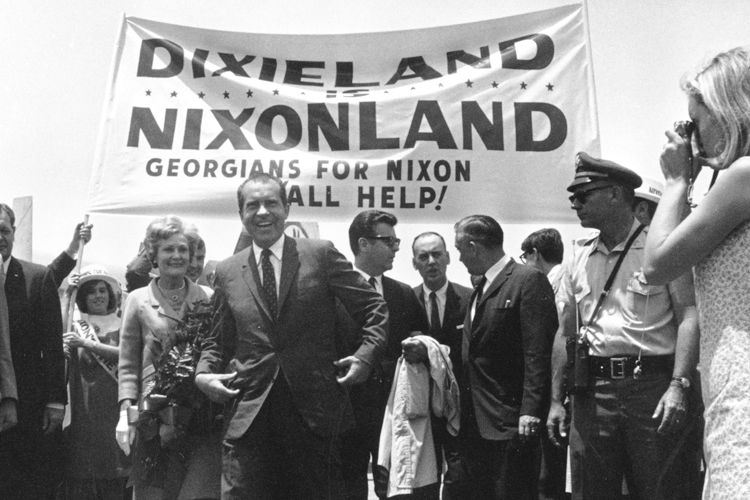
Nixon's Southern Strategy: Persuading White, former Democratic Party voters to change sides and vote Republican in 1972 proved a relatively easy sell for President Richard Nixon in Southern US states forced to grant Black Americans their civil rights in the 1960s. In the mid-1970s, New Zealand's Rob Muldoon made an equally successful pitch for Labour voters alienated by what they saw as their party's capitulation to social liberalism. Wooing, winning and keeping this chunk of the electorate has also played a critical part in John Key's long-term political success.
 
IT WAS FORTY YEARS AGO on Saturday, 12 December, that Robert Muldoon was sworn in as New Zealand’s thirty-first prime minister. His extraordinary success in the 1975 General Election – where he turned a 23-seat deficit into a 23-seat majority for the National Party – signalled the arrival of something new and highly disruptive in New Zealand politics. Since 1975, cultivating the support of a particular (but not especially progressive) type of Labour voter has proved crucial to the electoral success of both major parties.
 
Like so many of the other influences that have shaped New Zealand society over the past 40 years, Muldoon’s political strategy and tactics were borrowed from the United States.
 
The US Democratic Party’s support for black civil rights in the 1960s dislodged millions of hitherto rock-solid white voters in the southern states of the USA. The Republican Party (the party of Abraham Lincoln!) lost little time refashioning itself as the new political home for Dixie’s aggrieved white supremacists. By 1972, these blue-collared “good ole boys” had been drawn alongside the Republican Party’s traditional conservative base in what President Richard Nixon called “the great silent majority” – which noisily swept him back into the White House on a landslide.
 
The not unnatural assumption of the right-wing political strategists who had engineered this stunning desertion of formerly “left-wing” voters to the conservative cause, was that, on economic matters, conservative leaders would need to tread very carefully.
 
Nowhere was this determination to preserve the economic under-pinnings of the welfare state more in evidence than under the National Government of Rob Muldoon. If Labour’s social liberalism – as evidenced by its deeply unpopular cancellation of the 1973 Springbok Tour – had caused an electorally crucial number of socially conservative blue-collar workers to throw in their lot with “Rob’s Mob”, then, surely, it would be the purest folly to give in to the “New Right’s” demands to curb the unions, free-up the markets and dismantle the welfare state?
 
But Muldoon’s combination of highly divisive social conservatism and aggressive state interventionism (Springbok Tours and Wage & Price Controls!) was much too volatile a political mixture to be more than a stop-gap solution to the deep structural problems confronting post-war capitalism.
 
The New Right’s strategists were, accordingly, willing to gamble that a full-scale assault on the key elements of the social-democratic post-war economy (unions, nationalised industries and welfare) would so shatter the political coherence of the Left that the victims of their assault – especially poorly-educated white males – would remain susceptible to an aggressively pitched, socially conservative, agenda.
 
This was certainly the political wager of Margaret Thatcher and Ronald Reagan, whose domestic assaults on the post-war social-democratic consensus, coupled with a ruinously expensive upping of the Cold War ante, broke the Left comprehensively, both at home and in its nominal heartland – the Soviet Empire. They were blows from which the Left has yet to recover. The destruction was made even more complete in New Zealand by the Right’s successful subversion of the parliamentary wing of the NZ Labour Party.
 
The introduction of Neoliberalism to New Zealand by Labour, while enormously dislocating in economic and social terms, did mean that it was social-liberalism, rather than social-conservatism, that set the political tone throughout the 1990s and into the Twenty-First Century. This is especially true of Maori-Pakeha relations and immigration policies across that period. In both contexts, liberal policy settings have facilitated a number of profound societal shifts and apparently irrevocable changes.
 
Certainly, when Dr Don Brash attempted to harness a mass political following to an indisputably radical revision of race relations in New Zealand, he was unable to duplicate the success of Rob Muldoon in 1975. His in/famous “Orewa Speech” on nationhood was, however, to prove astonishingly successful in uniting virtually the entire right-wing vote behind the National Party. To the point where only a very small shift in the allegiances of Labour voters would be sufficient to usher a National-led Government into office.
 
In the eighth year of John Key’s National-led Government, his success in wooing back those National Party voters who had defected to Labour under the “competent” governance of Helen Clark, as well as holding on to those Labour defectors, for whom Clark’s progressive policy agenda – especially during her third term – had become insupportable, is without historical precedent.
 
Key may not remember which side he was on during the Springbok Tour, but he knows better than to engage in such divisive political behaviour. Nor is his political survival predicated (as Muldoon’s was) on making such ideologically aggressive gestures. Labour’s defectors are nothing like the angry white males to whom Donald Trump is currently appealing in the United States. Key’s winning strategy has been to convince the a-little-bit racist, a-little-bit sexist, a-little-bit homophobic “Waitakere Man” that, on his watch, nothing will be done to make him change sides.
 
This essay was originally published in The Press of Tuesday, 15 December 2015.